Table 1.
Clinical and demographic findings of the study subjects
| Age, years | |
| Median (Interquartile range) | 45 (38-54) |
| Gender, n (%) | |
| Female | 190 (95.0) |
| Male | 10 (5.0) |
| ECOG-PS, n (%) | |
| 0 | 162 (81.0) |
| 1 | 38 (19.0) |
| Primary tumor, n (%) | |
| Breast | 128 (64.0) |
| Genital | 63 (31.5) |
| Prostate | 7 (3.5) |
| Pancreas | 2 (1.0) |
| Family history, n (%) | 91 (45.5) |
| Degree of relatives, n (%) | |
| First-degree | 67 (33.5) |
| Second degree | 22 (11.0) |
| Third degree | 2 (1.0) |
| Diagnosis age of relatives, median (IQR) | |
| Parent diagnosis | 57 (50-66) |
| Sibling diagnosis | 44.5 (35-49) |
| Second relatives | 40 (35.5-48.5) |
| Multiple primary tumor, n (%) | 12 (6.0) |
| Synchronous | 1 (0.5) |
| Metachronous | 11 (5.5) |
| Multiple primary tumor site, n (%) | |
| Breast-ovary | 11 (5.5) |
| BRCA, n (%) | |
| BRCA-1 | 130 (65.0) |
| BRCA-2 | 70 (35.0) |
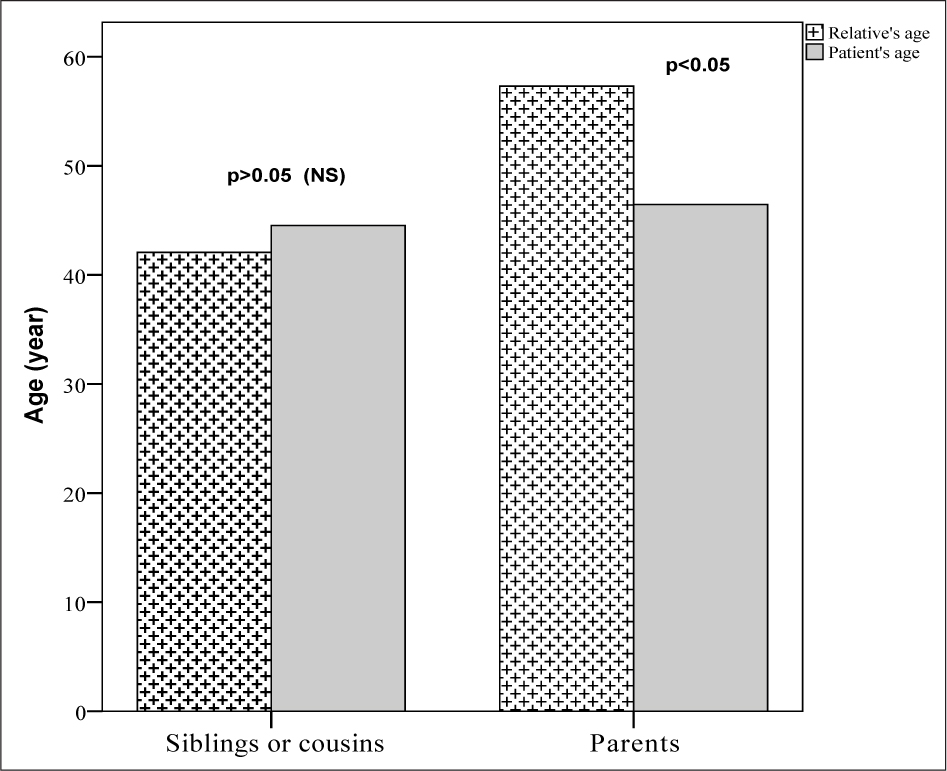
Figure 1.
Diagnosis age of all patients and their relatives
Table 2.
Clinical and demographic data of breast cancer patients
| Age, years | |
| Median (Interquartile range) | 41.5 (34-50) |
| Gender, n (%) | |
| Female | 126 (98.4) |
| Male | 2 (1.6) |
| ECOG-PS, n (%) | |
| 0 | 114 (89.1) |
| 1 | 14 (10.9) |
| BRCA, n (%) | |
| BRCA1 | 79 (61.7) |
| BRCA2 | 49 (38.3) |
| Primary tumor size (T), n (%) | |
| 0-2 cm –T1 | 79 (79.0) |
| 2-5 cm- T2 | 15 (15.0) |
| 5 cm and above-T3 | 4 (4.0) |
| Lymph node metastasis, n (%) | 61 (47.7) |
| Stage, n (%) | |
| Stage I | 30 (23.4) |
| Stage II | 53 (41.4) |
| Stage III | 29 (22.7) |
| Stage IV | 14 (10.9) |
| Histopathology | |
| ER, %, median (IQR) | 45 (0-90) |
| PgR, %, median (IQR) | 0 (0-65) |
| CerbB2, IHC, n (%) | |
| 1+ | 17 (13.3) |
| 2+ | 22 (17.2) |
| 3+ | 8 (6.3) |
| cerbB2, FISH | 12 (9.4) |
| Ki-67, %, median (IQR) | 30 (15-50) |
| Subtypes, n(%) | |
| Triple negative | 56 (43.8) |
| Luminal Her2- | 57 (44.5) |
| Luminal Her2+ | 9 (7.0) |
| cerbB2+ | 3 (2.3) |
| Tumor location, n (%) | |
| Right | 65 (50.8) |
| Left | 58 (45.3) |
| Bilateral | 5 (3.9) |
| De novo metastasis, n (%) | 14 (10.9) |
| Metastasis site, n (%) | |
| Lung | 10 (7.8) |
| Bone | 18 (14.1) |
| Liver | 8 (6.3) |
| Lymph node | 4 (3.1) |
| Family history, n (%) | 64 (50.0) |
| Diagnosis age of relatives, median (IQR) | |
| Parent diagnosis (n=15) | 51 (46-57.5) |
| Sibling diagnosis (n=7) | 44 (35-49) |
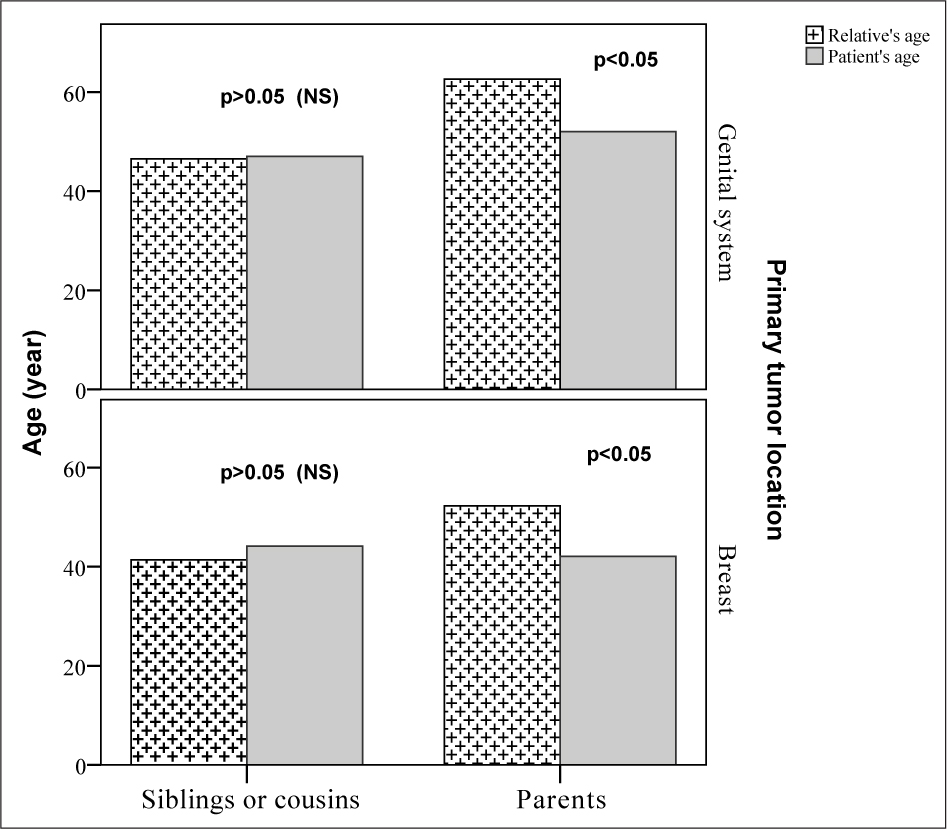
Figure 2.
Diagnosis age of breast and genital cancer pat
Table 3.
Clinical charactersitics of the genital site tumors
| Age, years | |
| Median (Interquartile range) | 50 (44-59) |
| ECOG-PS, n (%) | |
| 0 | 43 (68.3) |
| 1 | 20 (31.7) |
| Tumor Location, n (%) | |
| Ovary | 58 (92.1) |
| Endometrium | 2 (3.2) |
| Peritoneum | 1 (1.6) |
| FIGO stage, n (%) | |
| Stage I | 12 (19.0) |
| Stage II | 9 (14.3) |
| Stage III | 26 (41.3) |
| Stage IV | 12 (19.0) |
| De novo metastasis, n (%) | 20 (31.7) |
| Histopathology, n (%) | |
| Serous | 48 (76.2) |
| Endometrioid | 9 (14.3) |
| Serous+Endometrioid | 4 (6.3) |
| Postop residual disease, n (%) | 13 (20.6) |
| Ca125 at diagnosis | |
| Median (Interquartile range) | 155 (41-560) |
| BRCA, n (%) | |
| BRCA1 | 49 (77.8) |
| BRCA2 | 14 (22.2) |
| Platinum-based therapy cycles | |
| Median (Interquartile range) | 6 (6-6) |
| Platinum-therapy response, n (%) | |
| CR | 43 (68.3) |
| PR | 12 (19.2) |
| PFS of platinum based regimen (first-line) | |
| <6 months | 0 |
| 6-12 months | 14 (22.2) |
| >12 months | 28 (44.4) |
| Platinum based line number | |
| Median (minimum-maximum) | 1 (1-6) |
| Family history, n (%) | 24 (38.1) |
| Diagnosis age of relatives, median (IQR) | |
| Parent diagnosis | 63 (58-68) |
Table 4.
Clinical and demographic findings of patients with prostate cancer
| Age, years | |
| Median (Interquartile range) | 57 (57-60) |
| De novo metastasis, n (%) | 3 (42.9) |
| PSA | 47 (14-74) |
| mCRPC, n (%) | 7 (100) |
| Time from metastasis to CRPC status (months) | 28 (14-58) |
| Treatment line settings | |
| Docetaxel at 1 line | 7 (100) |
| Enzalutamid at 2 line | 5 (71.4) |
| Abiraterone at 2 line | 1 (14.2) |
| Lutesyum at 3 line | 3 (42.9) |
| Olaparib at 3 line | 5 (71.4) |
| Docetaxel PFS (months) | 13 (12-14) |
| Postdocetaxel treatment options | |
| Enzalutamide | 5 (71.4) |
| Abiraterone | 1 (14.2) |
| Cabazitaxel | 1 (14.2) |