Table 1.
Summary of clinico-pathological characteristics of breast cancer patients
| Characteristics | Data (mean ± SD or n (frequency in %)) |
|---|---|
| Gender | |
| Male | 2 (2.5) |
| Female | 78 (97.5) |
| Age | |
| >50 years | 45 (56.25) |
| ≤50 years | 35 (43.75) |
| Body mass index (kg/m2) | 25.4±3.3 |
| Histological grade | |
| I | 15 (18.75) |
| II | 28 (35) |
| III | 37 (46.25) |
| TNM stage | |
| I | 10 (12.5) |
| II | 13 (16.25) |
| III | 19 (23.75) |
| IV | 38 (47.5) |
| Cancer metastasis | |
| Positive | 38 (47.5) |
| Negative | 42 (52.5) |
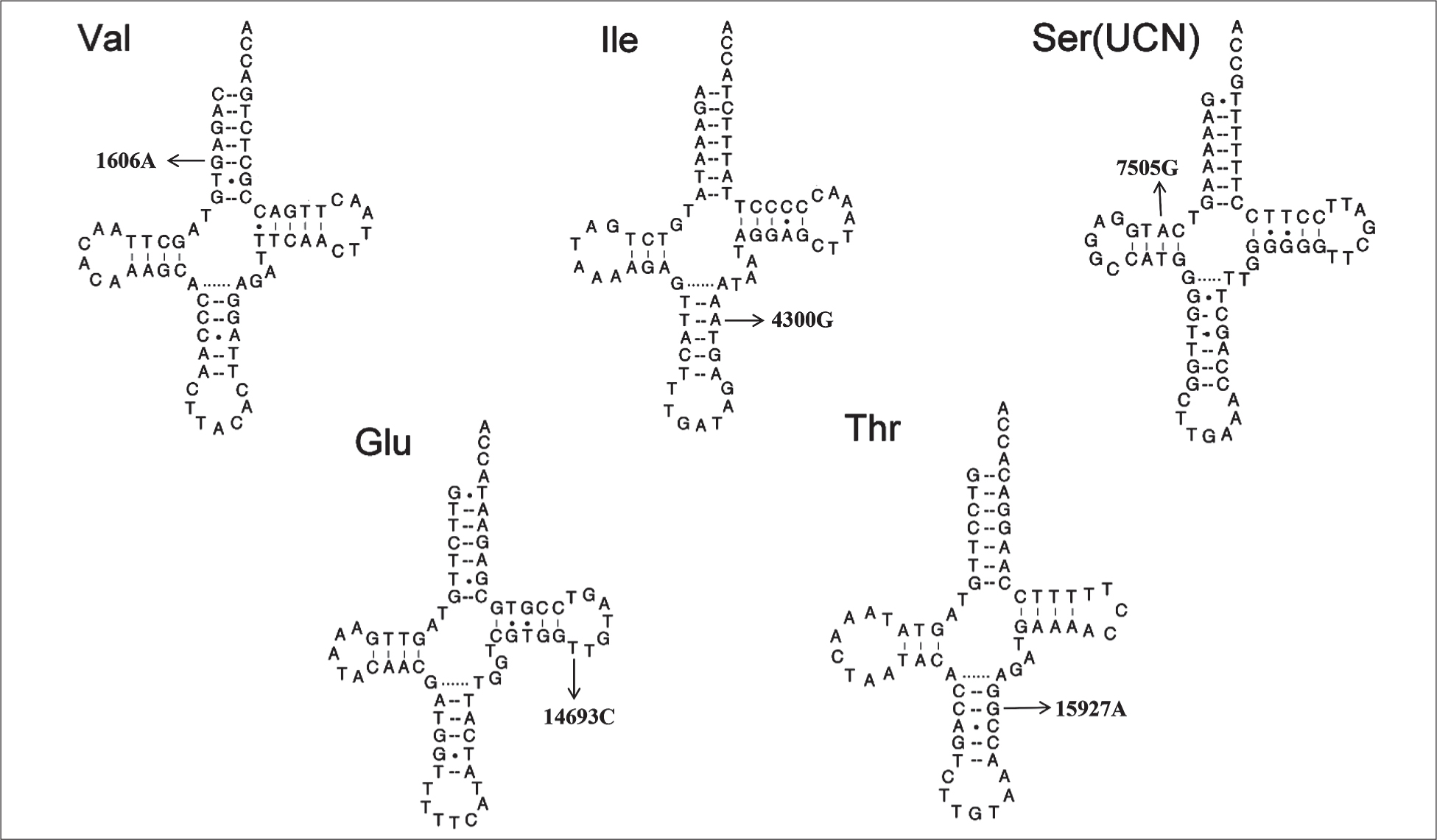
Figure 1.
Cloverleaf structures of five mt-tRNAs. Arrows indicate the locations of breast cancer-associated mt-tRNA mutations.
Table 2.
mt-tRNA mutations identified in this case-control study
| Gene | Sequence alternation | CI (%)a | Homoplasmy /Heteroplasmy | Watson-Crick base pairingb | Nucleotide at tRNA | Location | Number of 80 breast cancer tissues (%) | Number of 80 matched normal adjacent tissues (%) | mtDNA haplogroup | Disease association |
|---|---|---|---|---|---|---|---|---|---|---|
| tRNAVal | G1606A | 100 | Heteroplasmy | G-C↓ | 5 | Acceptor arm | 1 (1.25) | 0 | N9a | Progressive ataxia, seizures, mental deterioration, mild myopathy, and hearing loss |
| tRNAIle | A4300G | 100 | Heteroplasmy | C-G↓ | 42 | Anticodon stem | 1 (1.25) | 0 | C4c | Cardiomyopathy |
| tRNASer(UCN) | T7505C | 100 | Homoplasmy | A-T↓ | 10 | D-arm | 2 (2.5) | 0 | F1 | Deafness |
| tRNAGlu | A14693G | 100 | Homoplasmy | 54 | TΨC-loop | 2 (2.5) | 0 | Y2 | MELAS, deafness, LHON | |
| tRNAThr | G15927A | 100 | Homoplasmy | C-G↓ | 42 | Anticodon stem | 1 (1.25) | 0 | B5b | Parkinson’s disease, LHON, deafness, CHD, |
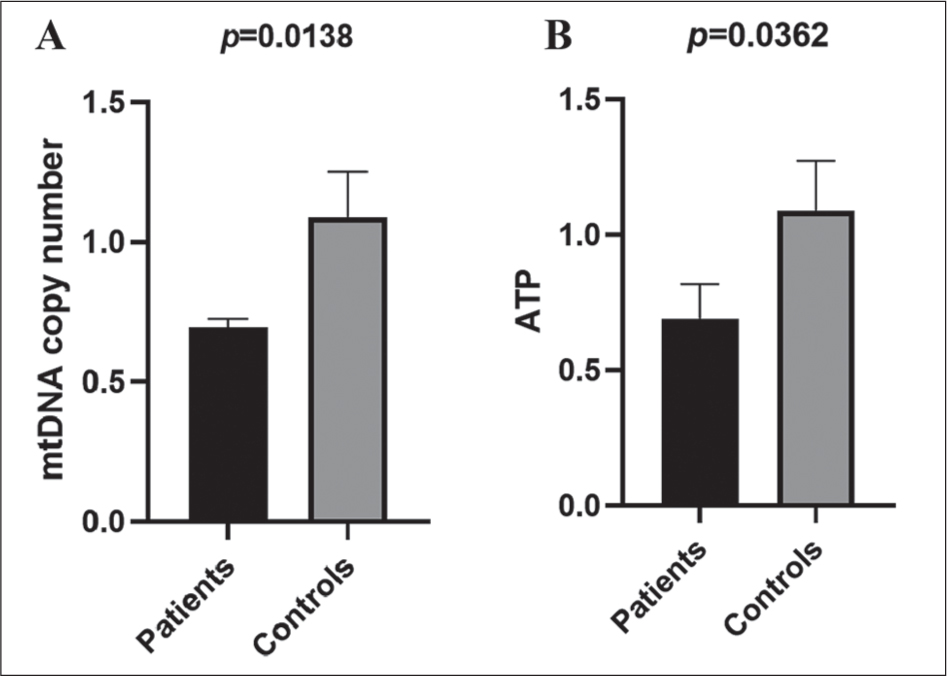
Figure 2.
Analysis of mitochondrial functions. A. mtDNA copy number analysis in patients with and without mt-tRNA mutations. B. ATP qualification in patients with and without mt-tRNA mutations.
Table 3.
The predicted pathogenicity of breast cancer-associated mt-tRNA mutations
| Scoring criteria | G1606A mutation | Score | A4300G mutation | Score | T7505C mutation | Score | A14693G mutation | Score | G15927A mutation | Score | Classification |
|---|---|---|---|---|---|---|---|---|---|---|---|
| More than one independent report | Yes | 2 | Yes | 2 | Yes | 2 | Yes | 2 | Yes | 2 | ≤6 points: neutral polymorphisms; |
| Evolutionary conservation of the base pair | No change | 2 | No change | 2 | No change | 2 | No change | 2 | No change | 2 | 7~10 points: possibly pathogenic; |
| Variant heteroplasmy | No | 0 | No | 0 | No | 0 | No | 0 | No | 0 | |
| Segregation of the mutation with disease | Yes | 2 | No | 0 | Yes | 2 | Yes | 2 | Yes | 2 | 11-13 points (not including evidence from single fiber, steady-state level or trans-mitochondrial cybrid studies): probably pathogenic |
| Histochemical evidence of mitochondrial disease | No evidence | 0 | No evidence | 0 | No evidence | 0 | No evidence | 0 | No evidence | 0 | |
| Biochemical defect in complex I, III or IV | Yes | 2 | Yes | 2 | Yes | 2 | No | 0 | Yes | 2 | |
| Evidence of mutation segregation with biochemical defect from single-fiber studies | No | 0 | No | 0 | No | 0 | No | 0 | No | 0 | |
| Mutant mt-tRNA steady-state level or evidence of pathogenicity in trans-mitochondrial cybrid studies | Strong evidence | 5 | Strong evidence | 5 | Strong evidence | 5 | Weak evidence | 3 | Strong evidence | 5 | ≥11 points (including evidence from single fiber, steady-state level or trans-mitochondrial cybrid studies): definitely pathogenic |
| Maximum score | Definitely pathogenic | 13 | Definitely pathogenic | 11 | Definitely pathogenic | 13 | Possibly pathogenic | 9 | Definitely pathogenic | 13 |