INTRODUCTION
Diastrophic dysplasia (DTD), or diastrophic dwarfism, is an uncommon genetic pathology falling under the group of skeletal dysplasias [1]. It is a progressive condition conducting to physical disability [2]. The first signs of DTD are observed at birth and develop following the defects in cartilage buildup process, affecting skeletal formation. Additionally, respiratory complications may lead to increased mortality in children with DTD in the neonatal period [3]. The associated symptomatic findings include their severity and range, showing a wide diversity in separate cases. Concurrently, the clinical features often include limb shortening (short-limbed dwarfism) and short stature; defective development of joints (joint dysplasia) and bone structure (skeletal dysplasia) in many body regions; progressive pathological spine curvature (predominantly scoliosis and/or kyphosis); pathological changes in the pinnae tissue (external ear parts); they may also include craniofacial area malformations [4, 9, 11, 21]. IQ is usually normal.
The diagnosis is based on the presence of pathogenic variants in SLC26A2, which is associated with autosomal recessive forms of skeletal dysplasia, in pair with phenotypic symptoms and radiographic findings [5]. Confirmation of diagnosis during the prenatal period can be executed by ultrasound and an invasive prenatal diagnostic with a molecular genetic testing [6].
More than 300 genes were reported to be involved in skeletal dysplasia with autosomal recessive (AR), autosomal dominant and X-linked manner (Table 1). Clinical signs of all these diseases have similar manifestations and a comparable phenotype, thus only genetic testing results can state the appropriate diagnosis and determine the disorder risk for relatives. The type of inheritance and genes associated with different forms of skeletal dysplasia are presented in the Table 1. The prevalent skeletal dysplasia type is FGFR3-related disorders, inherited in an autosomal-dominant manner [6].
Table 1.
The type of inheritance and genes associated with different forms of skeletal dysplasia
| Group or name of the disorder FGFR3 disorders | Mode of Inheritance | Gene Symbol |
|---|---|---|
| Thanatophoric dysplasia | AD | FGFR3 |
| Achonodroplasia | AD | FGFR3 |
| Hypochondroplasia | AD | FGFR3 |
| SADDNA | AD | FGFR3 |
| Type II collagen disorders | ||
| Achondrogenesis II | AD | COL2A1 |
| Hypochondrogenesis | AD | COL2A1 |
| Spondyloepiphyseal dysplasia congenita (SEDC) | AD | COL2A1 |
| Kniest dysplasia | AD | COL2A1 |
| Type X1 collagen disorders | ||
| Fibrochondrogenesis | AR | COL11A1 |
| Fibrochondrogenesis | AD | COL11A1, COL11A2 |
| Otospondylomegaepiphyseal dysplasia (OSMED) | AR | COL11A2 |
| Sulfation disorders | ||
| Achondrogenesis IB | AR | SLC26A2 |
| Atelosteogenesis II | AR | SLC26A2 |
| Diastrophic dysplasia | AR | SLC26A2 |
| Chondrodysplasia with congenital joint dslocations | AR | CHST3 |
| Perlecan disorders | ||
| Dyssegmental dysplasia | AR | PLC |
| Dyssegmental dysplasia, Silverman-Handmaker type | AR | PLC |
| Dyssegmental dysplasia, Rolland Desbuquois type | AR | PLC |
| Filamin Disorders and similar disorders | ||
| Otopalatodigital syndrome I and II | XLD | FLNA |
| Osteodysplasty, Melnick-Needles | XLD | FLNA |
| Atelosteogenesis types I and III | AD | FLNB |
| Larsen syndrome | AD | FLNB |
| Spondylo-carpal-tarsal dysplasia | AR | FLNB |
| Serpentine fibula-polycystic kidney syndrome | AD | NOTCH2 |
| TRPV4 disorders | ||
| Metatopic dysplasia | AD | TRPV4 |
| Short-rib dysplasias (with and without polydactyly) | ||
| Chondroectodermal dysplasia (Ellis-van Creveld (EVC) | AR | EVC1, EVC2 |
| Short-rib polydactyly syndrome I, II, III and IV including Asphxiating Thoracic Dystrophy | AR | DYNC2H1, IFT80NEKWDR35WDR19WDR34 |
| Thoracolaryngeal dysplasia | AD | unknown |
| Metaphyseal dysplasias | ||
| Cartilage-hair hypoplasia | AR | RMRP |
| Metaphyseal dysplasia, Jansen type | AD | PTHR1 |
| Spondylo-epi-(meta)-physeal dysplasia | ||
| SEMD, short limb abnormal calcification type | AR | DDR2 |
| Severe spondylodysplastic dysplasias | ||
| Achondrogenesis 1A | AR | GMAP210 |
| Schneckenbecken dysplasia | AR | SLC35D1 |
| Opsismodysplasia | AR | INPPL1 |
| Acromesomelic disorders | ||
| Acromesomelic dysplasia, type Maroteaux | AR | NPR2 |
| Mesomelic and rhizo-mesomelic dysplasias | ||
| Langer type (homozygoud dyschondrosteosis | pseudo-AR/XLD | SHOX |
| Omodysplasia | AR | GPC6 |
| Robinow syndrome, recessive | AR | ROR2 |
| Robinow syndrome, dominant | AD | WNT5 |
| Bent bone dysplasias | ||
| Campomelic dysplasia | AD | SOX9 |
| Stuve-Wiedemann dysplasia | AR | LIFR |
| Bent bone dysplasia FGFR2 type | AD | FGFR2 |
| Slender bone dysplasias | ||
| Microcephalic osteodysplastic primordial dwarfism (MOPD1) | AR | RNU4ATAC |
| Microcephalic osteodysplastic primordial dwarfism (MOPD2) | AR | PCNT |
| Osteocraniostenosis | FAM111A | |
| Dysplasias with multiple joint dislocations | ||
| Desbuquois dysplasia | AR | CANT1, XYLT1 |
| Pseudodiatrophic dysplasia | AR | unknown |
| Chondrodysplasia punctata group (CDP) | ||
| CDP, X-linked dominant | XLD | EBP |
| Conradi-Hunermann type (CDPX2) | XLR | ARSE |
| brachytelephalangic type (CDPX1) | XLD | NSDHL |
| CHILD syndrome | XLD | EBP |
| Greenberg dysplasia | AR | LBR |
| Rhizomelic CDP type 1 | AR | PEX7 |
| Rhizomelic CDP type 2 | AR | DHPAT |
| Rhizomelic CDP type 3 | AR | AGPS |
| Neonatal osteosclerotic dysplasias | ||
| Bloomstrand dysplasia | AR | PTHR1 |
| Desmosterolosis | AR | DHCR24 |
| Caffey disease (infantile) | AD | COL1A1 |
| Raine dysplasia | AR | FAM20C |
| Increased bone density group | ||
| Osteopetrosis (severe neonatal or infantile forms) | AR | TCIRG1 |
| Osteopetrosis (severe neonatal or infantile forms) | AR | CLCN7 |
| Dysosteosclerosis | AR | SLC29A3 |
| Lenz-Majewski hyperostostic dysplasia | SP | PTDSS1 |
| Osteogenesis imperfecta and decreased bone density group | ||
| Osteogenesis imperfecta, moderate, severe and perinatal lethal | AD | COL1A1, COL1A2 IFITM5 |
| Osteogenesis imperfecta, moderate, severe and perinatal lethal | AR | CRTAP P3H1 PPBI FKBP10 HSP47 SP7 WNT1 TMEM33B |
| Bruck syndrome | PLOD2 FKBP10 | |
| Osteoporosis-pseudoglioma syndrome | AR | LRP5 |
| Cole-Carpenter dysplasia | SP | unknown |
| Abnormal mineralization group | ||
| Hypophosphatasia, perinatal and infantile forms | AR | ALPL |
Diastrophic dysplasia occurs predominantly among the Caucasian population [3, 8]. The prevalence of DTD is estimated at 1-1.3/100,000, and mainly has an AR type of inheritance. The disorder affects both males and females in equal numbers [4]. This pathology is widespread in Finland, occurring in about 1 in 30,000 newborns. In particular, 1-2% of the Finnish population are carriers of pathogenic variants of the SLC26A2 gene [14]. Mutations in this gene demonstrate a very diverse clinical spectrum. 183 cases of DTD have been diagnosed and described in Finland.
Frequency of occurrence of this disorder in our country is unknown. Several cases of FGFR3-related condition have been reported among Ukrainian patients, but there are no reliable data on the prevalence of skeletal dystrophy with other types of inheritance. We present this case report of DTD in a 42-year-old Ukrainian woman, whose DTD is caused by SLC26A2 gene biallelic pathogenic variants.
Mutation in the SLC26A2 gene (otherwise known as the Diastrophic Dysplasia Sulfate Transporter (DDST) gene) is to be found on the long arm of chromosome 5 (5q32-q33.1) [https://www.genecards.org/cgi-bin/card-disp.pl?gene=SLC26A2] and leads to the occurrence of diastrophic dysplasia and other skeletal dysplasias with a diverse clinical gravity. The SLC26A2 gene is responsible for protein that transports sulfate ions across cell membranes, being necessary for the formation of proteoglycans. Proteoglycans help provide cartilage with its consistency. Since sulfate ion particles are necessary for the formation of proteoglycans, the activity of the SLC26A2 protein is fundamental for cartilage development [7, 12].
SLC26A2 gene mutations that cause diastrophic dysplasia (described more than 20 mutations [7, 8]) lead to a deficiency of sulfate ions. Therefore, the normal formation of cartilage and bone growth are disturbed [13, 14, 16]. The most frequently occurring variants are p.Arg279Trp (ratio in the disease alleles is 37%), p.Arg178Ter, c.-26+2T>C and p.Cys653Ser (13, 8 and 6%, respectively). Other pathogenic variants are at ≤3% each. Compound heterozygous pathogenic variants are reported in most cases of DTD (97%) [17, 18].
Taking into the account the rareness of the disease, ethnic difference, and the lack of reporting about DTD disease course in adults, we present the phenotype description of 42-year-old woman from the west of Ukraine with diastrophic dysplasia and two pathogenic variants in the SLC26A2 gene.
CASE REPORT
We present a case of DTD in a 42-year-old Ukrainian woman. The patient’s stature is 110 cm with S-shaped deformation of the spine. The patient’s daughter applied to the Medical Genetic Center for advice on pregnancy planning and the possible risk of skeletal dysplasia for future children. The daughter is clinically healthy.
The anamnesis and result of examination of her mother with skeletal dysplasia is as follows: she has been patient from a physiological birth. Her birth weight was 4,200 kg. After birth, the newborn was diagnosed with severe asphyxia. The parents of the woman are somatically healthy, and they are not closely related. No cases of skeletal dysplasia in the family have been reported. The patient also had stridor nasal breathing at birth. The phenotype of the patient had the following features: the lower extremities were poorly stretched and tight to the body. The conclusion of the orthopedist during the examination was that the shortening of long (tubular) bones were manifested more on the lower extremities. At the age of 1 year the diagnosis was congenital dislocation of a hip, bilateral; arthrogryposis. At age of 21, she was diagnosed with a mixed form of chronic cholecystitis. At the age of 23, she was diagnosed with left ureter contraction, urolithiasis, chronic gastritis, kyphoscoliosis. At the age of 24, she was diagnosed with spondyloepiphyseal dysplasia, obsolete injury of the left shoulder. The woman was referred for consultation to the Institute of Traumatology and Orthopedics, where she was diagnosed with multiple skeletal bone deformities. They recommended to perform an MRI to assess skeletal bone damage. The MRI findings showed scoliosis (4th grade), osteochondrosis, spondyloarthritis of the spine. There were also protrusions of disks C3-C4, C4-C5, C5-C6, C6-C7, and L5-S1 (Figure 1). Intervertebral space contracted from L1 to L5 (Figure 1).
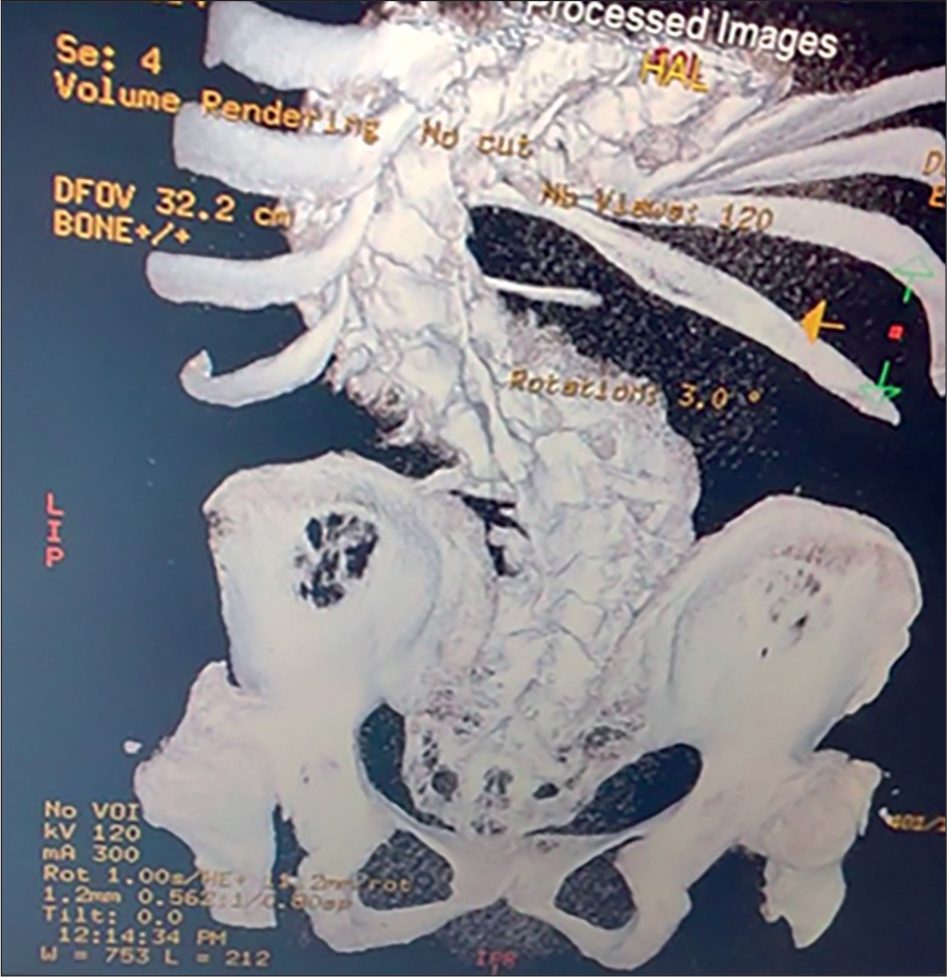
Figure 1.
MRI findings of DD patient: Scoliosis (4th grade), osteochondrosis, spondyloarthritis of the spine. Protrusions of disks C3-C4, C4-C5, C5-C6, C6-C7, L5-S1
The patient has the skull of normal size with a disproportionately short skeleton, short lower extremities, brachydactylia, lack of interphalangeal creases, and hitchhiker thumb (abduced, located proximally) (Figures 2, 3, 4). The patient also has a vision defect, specifically myopia. Deviations in intellectual development were not observed. She has two healthy children born by caesarean section.
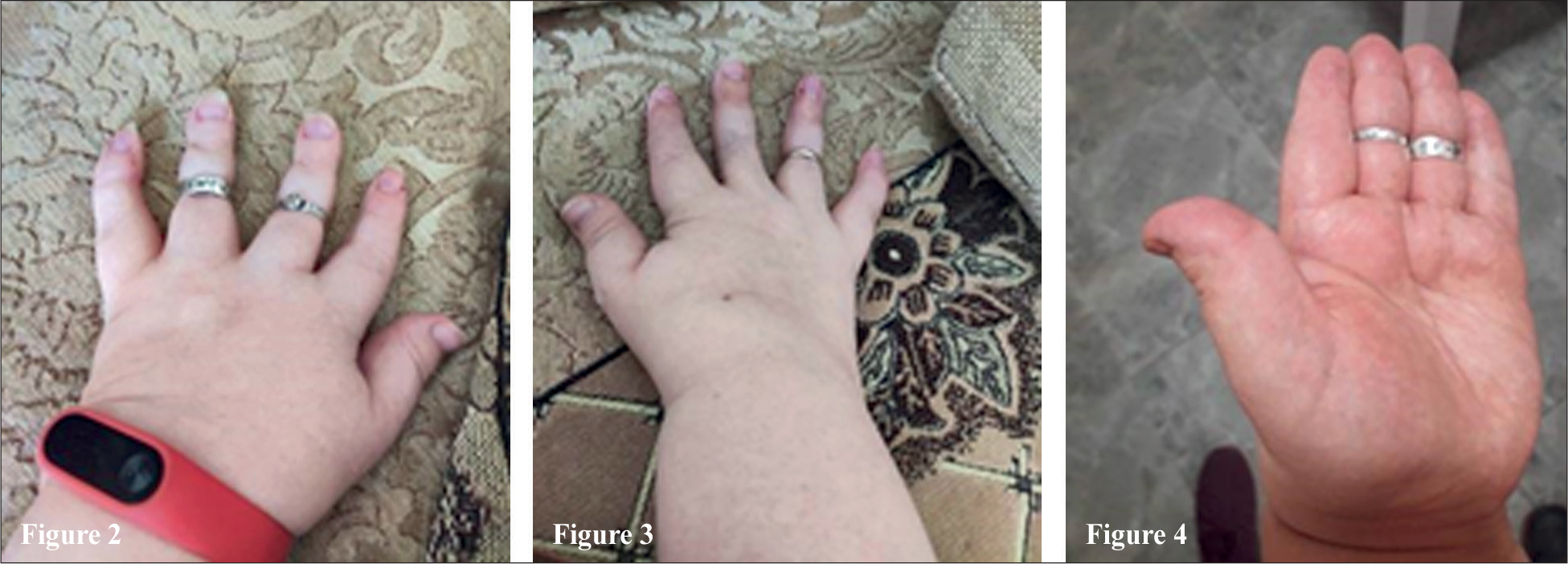
Figure 2, 3, 4.
The phenotypic traits of DD patient: brachydactylia (short fingers), absence of flexion creases of the fingers, and proximally placed, abducted «hitchhiker thumb».
Due to the observed phenotype and skeletal deformities, the genetic testing of the panel genes involved in the etiology of skeletal disorders was performed by the next generation sequencing (NGS) method. The selected diagnostic test evaluates complete sequencing and deletion/duplication of 320 genes (Appendix 1) for variants, which are associated with genetic disorders that have phenotype of skeletal dysplasia. Two pathogenic variants in the SLC26A2 gene and two variants with uncertain value were revealed in the patient. The SLC26A2 gene mutations c.1020_1022del (p.Val341del) and c.1957T>A (p.Cys653Ser) were confirmed.
In LTBP2 gene, a Variant of Uncertain Significance, or c.3913G>C (p.Asp1305His), was identified.
The LTBP2 gene is related to microspherophakia and autosomal recessive primary congenital glaucoma (PCG). The LTBP2 gene also shows preliminary evidence asserting association with autosomal recessive Marfan-like syndrome and autosomal recessive type 3 Weill-Marchesani syndrome (WMS). In the TTC21B gene, a Variant of Uncertain Significance, c.3932G>A (p.Arg1311His), was identified. The TTC21B gene correlates with asphyxiating thoracic dystrophy and autosomal recessive nephronophthisis. (Table 2)
Table 2.
The identified in DD patient gene variants.
| GENE | VARIANT | ZYGOSITY | VARIANT CLASSIFICATION |
|---|---|---|---|
| SLC26A2 | c.1020_1022del (p.Val341del) | heterozygous | PATHOGENIC |
| SLC26A2 | c.1957T>A (p.Cys653Ser) | heterozygous | PATHOGENIC |
| LTBP2 | c.3913G>C (p.Asp1305His) | heterozygous | Uncertain Significance |
| TTC21B | c.3932G>A (p.Arg1311His) | heterozygous | Uncertain Significance |
Two pathogenic variants, c.1020_1022del (p.Val341del) and c.1957T>A (p.Cys653Ser), were identified in SLC26A2, and the diagnosis of diastrophic dysplasia was confirmed. This condition has an autosomal-recessive manner of inheritance. Two descendants of the patient had normal phenotypes and both were heterozygous carriers of the mutation. SLC26A2 mutation testing for future partners was recommended during the medical-genetic consultation.
DISCUSSION
Skeletal dysplasias belong to a genetically heterogeneous group of dysplasias, which may be caused by different mutations in more than 300 genes [19]. The main phenotypic presentation for those are growth disorders. The diagnosis of diastrophic dysplasia implies the conjunction of clinical, radiological, and histopathological symptoms. Establishing an accurate diagnosis is a complicated task, and the results of genetic testing play a key role here.
In the presented case, the 42-year-old woman was found to have SLC26A2 mutations 1020_1022del (p.Val341del) and c.1957T> A (p.Cys653Ser). The SL-C26A2 c. 1957T> A (p.Cys653Ser) pathogenic variant is the third prevalent one among the described in DTD patients. The SLC26A2 gene is considered to be related to autosomal recessive achondrogenesis, type IB (ACG1B), atelosteogenesis type 2(AO2), diastrophic dysplasia (DTD), and multiple epiphyseal dysplasia 4 (EDM4). If two causative variants are present on opposite chromosomes, then it is consistent with a diagnosis of SLC26A2-related conditions. SLC26A2-related conditions fall under the spectrum of skeletal dysplasias demonstrating a variable manifestation rate. ACG1B and AO2 (also known as De la Chapelle dysplasia) involve significant shortening of extremities and compromised skeletal ossification, and these are typically lethal in the perinatal period. DTD can be lethal in infancy; EDM4 is the mildest SLC26A2-associated disorder and is characterized by clubfoot, double-layered patellae, flat epiphyses, mild feet and hands deformations, and joint pain. This condition causes recessive multiple epiphyseal dysplasia (rMED) in the presence of homozygous carrier or rMED and DTD when in combination with other morbigenous variants [17].
The parents of the patient are not available to identify the trans- or cis- position of two pathogenic variants on the chromosome. Two healthy descendants of our proband are healthy heterozygous carriers, confirming the location of the SLC26A2 variants on different chromosomes. We have seen no evidence of an excessive probability of degenerative joint disease. We have advised on examination of their partners in future to prevent the DTD in offspring.
Nutritional counseling to prevent obesity is important for such patients, as well as a multidisciplinary approach to their management [15, 16].
Future study shows the need to clarify the significance of different types of DTD among patients of Ukrainian origin with skeletal dysplasia symptoms and to estimate heterozygous carrier rates in the population. The results of the genetic testing and evaluating of the DTD-involved gene could be important for the selection of management and new treatment development.