Figure 1
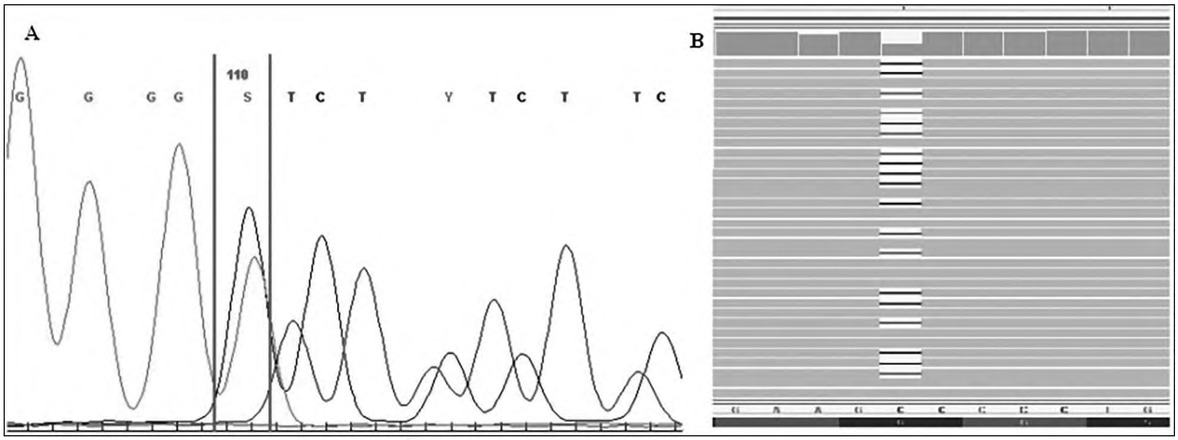
The detected de novo heterozygous frameshift deletion in the KMT2D gene. (A) Sanger sequencing confirmed a heterozygous frameshift deletion at NM_003482.3: c. 11093delG in the KMT2D gene in the patient and excluded this deletion in the patient’s parents (data not shown). (B) Presentation of the de novo heterozygous frameshift deletion in the KMT2D gene at position chr12: g.49427394GC>G (hg19). The deletion in our patient after running the NGS analysis is shown as black lines in empty space using Integrative Genomics Viewer (IGV).
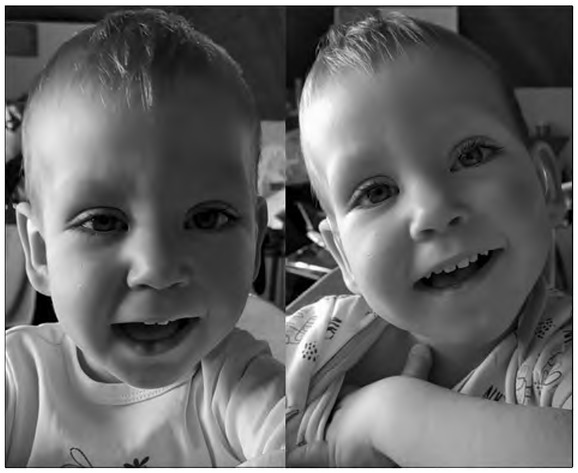
Figure 2
Mild facial features of KS were observed in our patient during his follow-up at age 2.5 years. A written informed consent was obtained from the patient’s parents for publication of proband’s pictures.
Table 1
Comparison of features observed in our proband with the most commonly observed features in individuals with heterozygous pathogenic mutation in the KMT2D gene.
| Phenotypic Features in Patients with KMT2D Mutations | Features Present in Our Proband |
|---|---|
| Intellectual disability (IQ <70) | not tested |
| Fetal fingertip pads | no |
| Congenital heart defect | yes |
| Long palpebral fissures | yes |
| Large, prominent or cupped ears | yes |
| Hypotonia | yes |
| Eversion of the lower eyelid | no |
| Arched or broad eyhrows | yes |
| Cleft palate | yes |
| Brachydactyly | yes |
| Short columella with depressed nasal tip | yes |
| Short stature | yes |
| Microcephaly | yes |
| Oligodontia and/or abnormal incisors | no |
| Feeding difficulties | yes |
| Developmental delay | yes |
| Latent eyebrows, sparse or notched | yes |
| Hearing loss | yes |
| Non traumatic joint dislocation | no |
| Hypogammaglobulin or low serum IgA | yes |
| Hyperinsulinemic hypoglycemia in infancy | no |
| Lip pits | no |
| Malpositioned kidneys | no |
| Idiopathic thrombocytopenia purpura (ITP) | no |
| Hypospadias in males | no |
Table 2
Phenotypic scoring system for KS proposed by the international consensus diagnostic criteria. This table was adapted from the studies of Makrythanasis et al. [13] and Adam et al. [4].
| Clinical Findings | Possible Score | Scored Features | Feature Present/Number of Points |
|---|---|---|---|
| Facial features | 0-5 pointsa | abnormal dentition | [–] |
| arched eyebrows, sparse lateral one-third | [+] | ||
| blue sclerae | [–] | ||
| broad nalal root | [+] | ||
| averted lower eyelids | [–] | ||
| flat nasal tip | [+] | ||
| high or cleft palate | [+] | ||
| large dysplastic ears | [+] | ||
| lip nodules | [–] | ||
| long palpebral fissures | [+] | ||
| micrognathia | [–] | ||
| oligodontia | [–] | ||
| ptosis | [–] | ||
| strabismus | [–] | ||
| thin vermillion of the upper lip and full lower lip | [+] | ||
| a 0-3 features = 1 point; 4-6 features = 2 points; 7-9 features = 3 points; 10-12 features = 4 points; 13-15 features = 5 points | 3 points | ||
| Limb/extremity features | up to 1 pointb | brachydactyly or clinodactyly | [+] |
| hip dislocation | [–] | ||
| lax joints | [–] | ||
| persistent fetal pads | [–] | ||
| b 0-1 feature = 0 point; 2-4 features = 1 point | 0 points | ||
| Heart | 1 point | 1 | |
| Kidney | 1 point | 1 | |
| Microcephaly | 1 point | 1 | |
| Short stature | 1 point | 1c | |
| Summary | 1-10 points | 3+0+4=7 | |