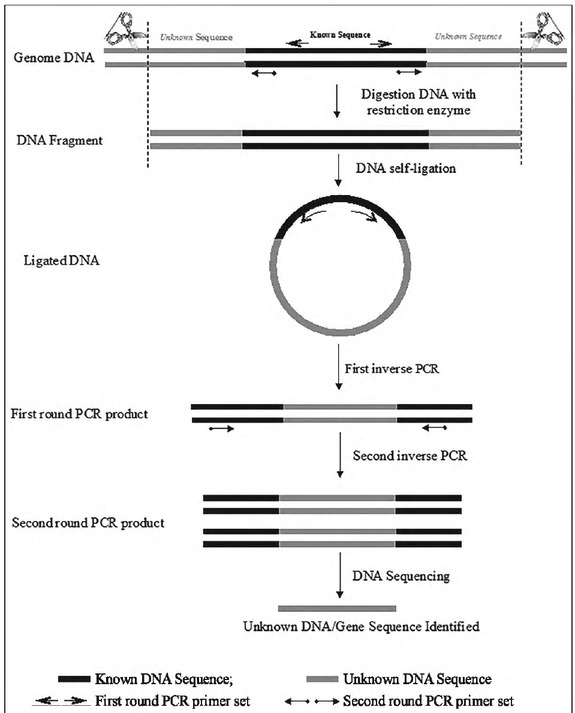
Figure 1
Schematic diagram of nested iPCR.
Table 1
The primer sequences of nested inverse polymerase chain reaction
| Primer | Sequences (5’>3’) |
|---|---|
| First iPCR-F | AAA ATA ATA ATA ACC GGG CAG GCC A |
| First iPCR-Sox2-R | CCT TCT TCA TGA GCG TCT TGG TTT T |
| First iPCR-Oct4-R | GTG TCC CTG TAG CCT CAT ACT CTT C |
| First iPCR-Klf4-R | CTT TGC TAA CAC TGA TGA CCG AAG G |
| First iPCR-c-Myc-R | TCT TCT CCA CAG ACA CCA CAT CAA T |
| Second iPCR-F | CAG CAC AGT GGT CGA CGA TAA AAT A |
| Second iPCR-Sox2-R | TTC AGC TCC GTC TCC ATC ATG TTA T |
| Second iPCR-Oct4-R | TTT GCA TAT CTC CTG AAG GTT CTC A |
| Second iPCR-Klf4-R | GGG TTA GCG AGT TGG AAA GGA TAA A |
| Second iPCR-c-Myc-R | CCTCCAAGTAACTCGGTCATCATCT |
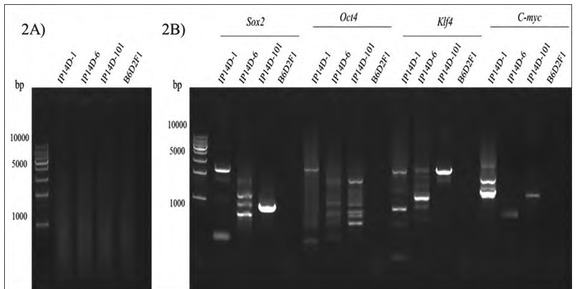
Figure 2
Nested iPCR. (A) Restriction digestion of genomic DNA. M: 1 kb marker. (B) The result of nested iPCR. M: 1 kb marker; Oct4, Sox2, Klf4, c-Myc: exogenous TFs.
Table 2
The identified integration sites and their flanking genes.
| Flanking Genes and Their Distance | |||||||||
|---|---|---|---|---|---|---|---|---|---|
| Reprogramming Factors | iPSCs | Chromosome No. of Integration Site | GenBank Acc. No.e | Integration Sit | Gene | 5’ | Distance (kb) | 3’ | Distance (kb) |
| Sox2 | IP14D-1 | 10 | NC_000076.6 | intergenic | Phlda1 | 8.3 | Krr1 | 450.0 | |
| 10 | NC_000076.6 | intergenic | Aldh8a1 | 301.0 | Sgk1 | 185.0 | |||
| IP14D-6 | 1 | NC_000076.6 | intergenic | Cops7b | 28.2 | Nppc | 35.7 | ||
| IP14D-101 | 11 | NC_000077.6 | introns | Vat1 | |||||
| 8 | NC_000074.6 | intergenic | Nanos3 | 20.9 | Zswim4 | 14.3 | |||
| IP14D-1 | 15 | NC_000081.6 | intergenic | Cdh6 | 2390.0 | LOC101055956 | 461.1 | ||
| 14 | NC_000080.6 | intergenic | Rarb | 287.3 | Thrb | 554.7 | |||
| Oct4 | IP14D-6 | 16 | NC_000082.6 | intergenic | Atp13a3 | 111.0 | Tmem44 | 14.1 | |
| 7 | NC_000073.6 | introns | Samd4 | ||||||
| IP14D-101 | 5 | NC_000071.6 | intergenic | Alox5ap | 102.8 | Medag | 15.7 | ||
| 2 | NC_000068.6 | introns | Slc13a3 | ||||||
| 7 | NC_000073.6 | intergenic | Rassf10 | 196.2 | Amtl | 128.1 | |||
| IP14D-1 | 8 | NC_000074.6 | intergenic | Kbtbd11 | 2.7 | Myom2 | 25.4 | ||
| 5 | NC_000071.6 | intergenic | Fryl | 57.7 | LOC105244150 | 5.8 | |||
| Klf4 | 6 | NC_000072.6 | introns | Jagn1 | |||||
| IP14D-6 | 11 | NC_000077.6 | intergenic | Hspa4 | 6.3 | Zcche10 | 18.1 | ||
| IP14D-101 | 4 | NC_000070.6 | intergenic | Lsm10 | 13.8 | Stk40 | 6.2 | ||
| 6 | NC_000072.6 | intergenic | Ankrd7 | 1579.0 | Kcnd2 | 766.4 | |||
| IP14D-1 | 3 | NC_000069.6 | intergenic | Abcd3 | 126.2 | Arhgap29 | 33.7 | ||
| c-Myc | 6 | NC_000072.6 | intergenic | Olfr456 | 1.4 | Olfr455 | 49.3 | ||
| IP14D-6 | 8 | NC_000074.6 | introns | Dctn6 | |||||
| IP14D-101 | 6 | NC_000072.6 | intergenic | Kcna4 | 459.7 | Mettl15 | 1289.0 | ||
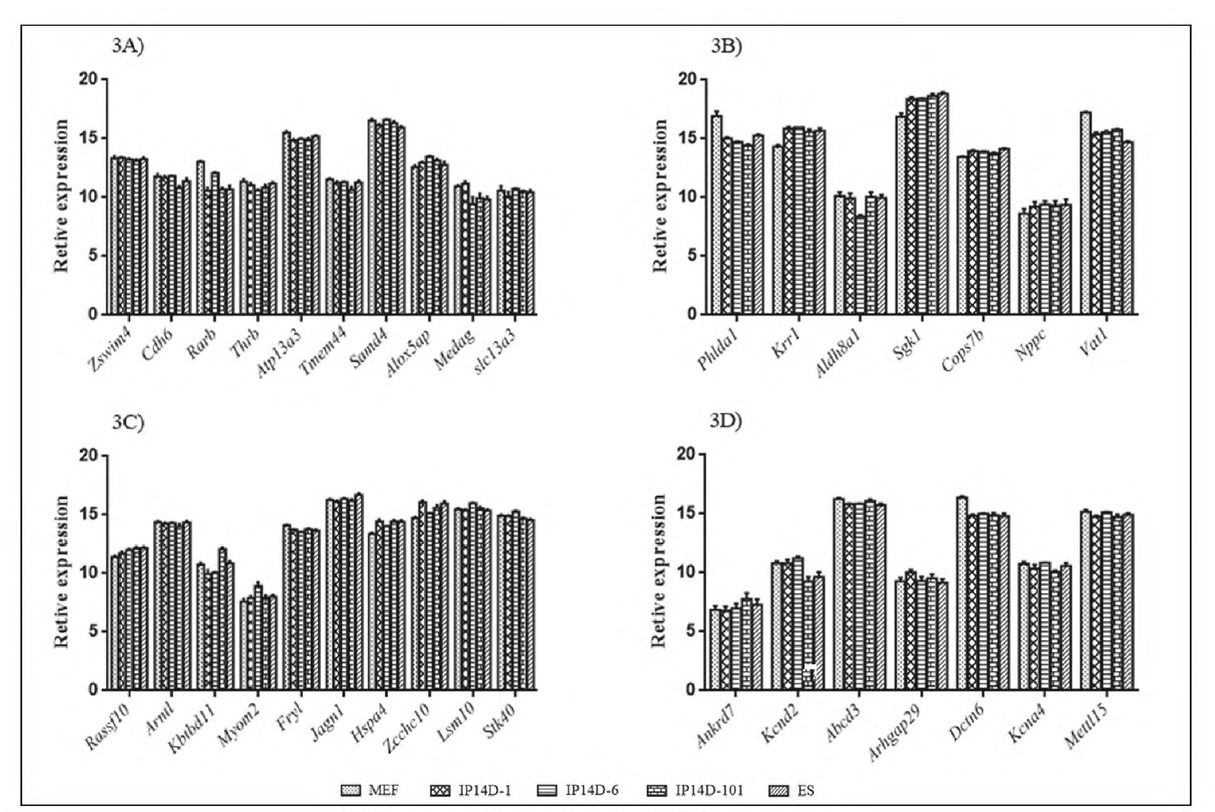
Figure 3
Expression profiles of flanking genes from microarray analysis. (A) Expression profiles of Oct4 flanking genes. (B) Expression profiles of Sox2 flanking genes. (C) Expression profiles of Klf4 flanking genes. (D) Expression profiles of c-Myc flanking genes.
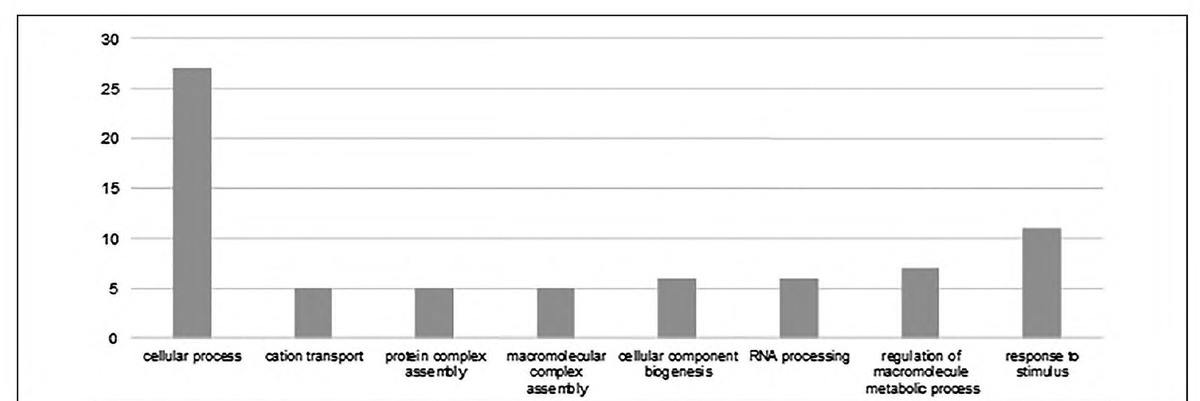
Figure 4
The GO classification of flanking genes.
Table 3
The molecular functions of flanking genes.
| Genes | Function | Mainly Process Involved |
|---|---|---|
| Phlda1 | protein binding | cell apoptosis; programmed cell death |
| Krr1 | RNA binding; POLY-A binding | biosynthesis of ribosomes; rRNA process |
| Vat1 | Zn2+ binding; oxioreductase activity | negative regulation of mitochondrial fusion; redox |
| Lsm10 | RNA binding; histone precursor mRNA binding | positive regulation of mitosis from G1 to S phase |
| Stk40 | kinase activation; ATP binding | embryonic ectoderm differentiation; glucose metabolism |
| Nanos3 | RNA binding; Zn2+ binding | oogenesis; spermatogenesis |
| Zswim4 | metal ion binding; Zn2+ binding | biochemical process |
| Samd4 | POLY-A binding | negative regulation process of synapse; translation |
| Alox5ap | protein binding; enzyme binding | metabolism process of leukotrienes |
| Medag | catalysis; binding | adipocyte differentiation |
| Rassf10 | catalysis; binding | biochemical processes; signal transduction |
| Arntl | DNA binding; RNA binding; protein binding | regulation of gene expression related to circadian clock |
| Hspa4 | ATP binding; protein complex binding | introduction of mitrochondrial outer membrance proteins |
| Zcchc10 | metal ion binding | biochemical processes |
| Ankrd7 | catalysis; binding | support cell maturation |
| Kcnd2 | ion channel activation | K+ transmembrane transport |
| Dctn6 | kinetic protein binding | motochondrial cavity |
| Olfr456; Olfr455 | protein binding | olfactory receptors; signal transduction |
| Atp13a3 | ATP binding; ATP enzyme activation | Na+ transmembrane transport; cation transport |
| Tmem44 | transmembrane protein binding | biochemical processes |
| Kbtbd11 | N/A | transcriptional regulation |
| Myom2 | components of cytoskeleton structural | muscle contraction |
| Jagn1 | molecular function (basic cell activity) | neutrophil-fungal-induced mediated immune immune response response; |
| Fryl | protein binding | biochemical processes |
| Cops7b | transmembrane protein functional molecule | deubiquitination |
| Nppc | peptide hormone receptor binding; hormone activity | vasodilation; endochondral growth |
| Aldh8al | aldehyde dehydrogenase activity | retinoic acid metabolism |
| Sgk1 | ATP binding; protein binding; kinase activity | positive negative regulation regulation of of Naapoptosis + transportation; |
| Abcd3 | ATP binding; protein binding | transmembrane transportation; long chain fatty acid metabolism |
| Arhgap29 | activity of GDP enzyme; protein binding | intercellular signal transduction |
| Cdh6 | Ca2+ binding; metal ion binding | cell adhesion |
| Slcl3a3 | cotransport activity; transmembrane transport activity | succinic acid transportation; Na+ transportation |
| Rarb | binding; retinoic acid receptor | positive digestive regulation system development; of cell proliferation; neurogenesis |
| Thrb | thyroxine; activity of receptor thyroxine | intracellular receptor of signaling pathway; organ morphonenesis |
| Mettl15 | activity of methyltransferase | methylation; ribosomal methylation |
| Kcna4 | K+ binding; ion channel activation | ion transport; K+ transmembrane transport |