Have a personal or library account? Click to login
Clinical next generation sequencing reveals an H3F3A gene as a new potential gene candidate for microcephaly associated with severe developmental delay, intellectual disability and growth retardation Cover

Clinical next generation sequencing reveals an H3F3A gene as a new potential gene candidate for microcephaly associated with severe developmental delay, intellectual disability and growth retardation

Open Access
|Dec 2019

Figures & Tables

Figure 1

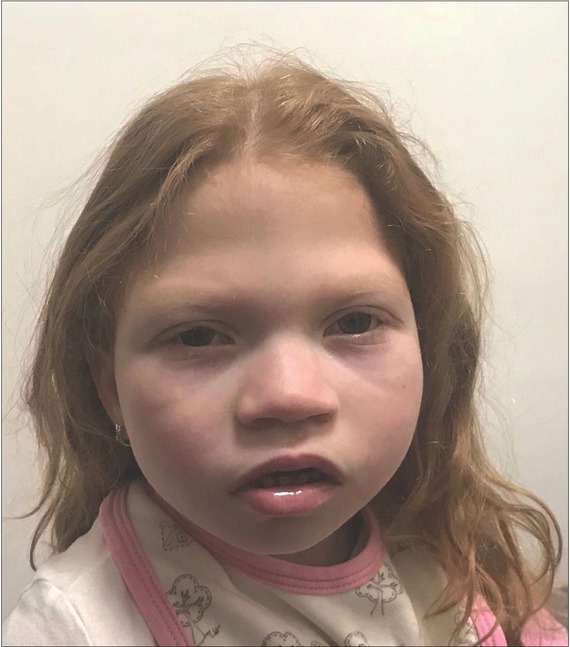
Facial features of the patient with a heterozygous de novo H3F3A gene variant p.(Leu62Arg) include wide and depressed nasal bridge, hypertelorism, hypotonic face and poorly formed, posteriorly set ears.
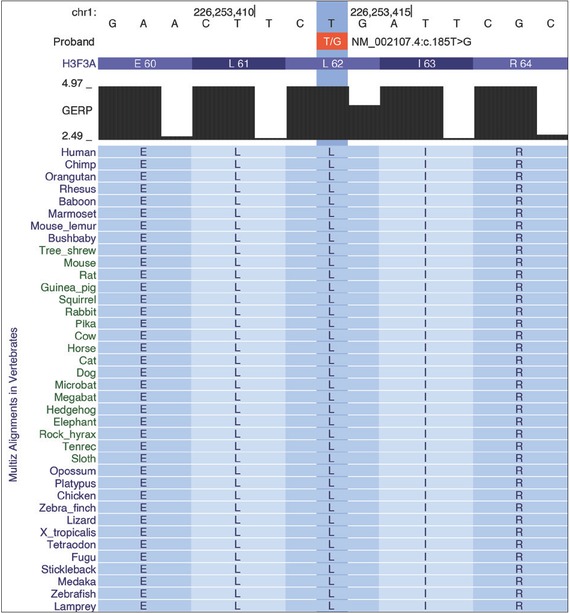

Figure 2

The identified H3F3A gene variant affects a highly evolutionary conserved leucine at amino acid position 62 in the Histone H3 protein, which is invariant in all the surveyed species (according to Multiz alignments). Figure was generated using the University of CA Santa Cruz (UCSC) genome browser (https://genome.ucsc.edu/)
Language: English
Page range: 65 - 68
Published on: Dec 21, 2019
Published by: Macedonian Academy of Sciences and Arts
In partnership with: Paradigm Publishing Services
Publication frequency: 2 issues per year

© 2019 A Maver, G Čuturilo, Stojanović J Ruml, B Peterlin, published by Macedonian Academy of Sciences and Arts
This work is licensed under the Creative Commons Attribution-NonCommercial-NoDerivatives 3.0 License.