Table 1
Prentally detected abnormalities of 22 cases of tetrasomy 9p.
| Refs. | Facial Dysmorphism | Cleft Lip/ Palate | IUGR | CNS Anomalies | Cardiac Anomalies | Genitourinary Tract Anomalies | Skeletal/ Limb Anomalies | Amniotic Fluid Volume Anomalies |
|---|---|---|---|---|---|---|---|---|
| Our case | [+] | [+] | [–] | [–] | [–] | [+] | [+] | [–] |
| [5] | [+] | [+] | [–] | [–] | [–] | [-] | [+] | [–] |
| [5] | [+] | [–] | [+] | [+] | [–] | [+] | [–] | [–] |
| [6] | [+] | [–] | [+] | [+] | [–] | [–] | [+] | [+] |
| [52] | [–] | [–] | [–] | [–] | [+] | [–] | [–] | [–] |
| [51] | [–] | [–] | [–] | [–] | [–] | [–] | [+] | [–] |
| [4] | [–] | [–] | [+] | [–] | [–] | [–] | [–] | [–] |
| [45] | [+] | [+] | [–] | [+] | [–] | [+] | [+] | [–] |
| [39] | [+] | [+] | [+] | [+] | [+] | [+] | [+] | [+] |
| [34] | [–] | [–] | [–] | [–] | [–] | [–] | [–] | [–] |
| [46] | [+] | [+] | [+] | [–] | [–] | [–] | [+] | [+] |
| [40] | [+] | [–] | [–] | [+] | [+] | [–] | [+] | [+] |
| [37] | [–] | [–] | [–] | [+] | [–] | [+] | [–] | [–] |
| [47] | [–] | [+] | [–] | [+] | [–] | [–] | [+] | [–] |
| [33] | [–] | [–] | [+] | [+] | [–] | [–] | [–] | [–] |
| [38] | [–] | [+] | [–] | [–] | [+] | [–] | [+] | [–] |
| [38] | [–] | [+] | [+] | [+] | [–] | [–] | [–] | [–] |
| [1] | [–] | [+] | [+] | [–] | [–] | [-] | [–] | [–] |
| [1] | [–] | [–] | [+] | [–] | [–] | [-] | [+] | [+] |
| [32] | [–] | [+] | [–] | [+] | [+] | [+] | [+] | [–] |
| [3] | [–] | [–] | [+] | [+] | [–] | [+] | [–] | [+] |
| [15] | [–] | [–] | [–] | [+] | [–] | [–] | [–] | [–] |
[i] IUGR: intrauterine growth retardation; CNS: central nervous system; [+]: present; [–]: not present.
Table 2
Detailed karyotype results in prenatally detected cases of tetrasomy 9p.
| Refs. | Karyotype | Molecular Karyotype | Confirmatory Studies |
|---|---|---|---|
| Our case | CVS: 47, +i(9p)(ql3) = 100.0% [Figure 1(a) and 1(b)] | arr[hgl9] 9p24.3pl3.2(204,193-38,815,475)x4 [Figure 1(c)] | muscle: 100.0% |
| [51]? | CVS: +i(9p) = 100.0% | – | no |
| [1] | CVS: 47,XY,+i(9p) = 100.0%; AC: 47,XY,+i(9p) | – | no |
| [4] | CVS: 47,XY,+i(9p)(ql2) = 100.0%; AC: 47,XY,+i(9p)(ql2) = 100.0% | – | |
| [37] | CVS: 47,XY,+i(9p)(ql2) = 100.0%; AC: 47,XY,+i(9p)(ql2) = 100.0% | – | no |
| arr[hgl9] 19p24.3qll(214,367- | |||
| [5] | CVS: +i(9p) = 100.0%; AC: +i(9p) = 100.0% | 39,816,368)x4 | liver: 100.0% |
| [45] | AC: 47,XY,+i(9p)= 100.0% | – | no |
| [39] | AC: 47,XY,+i(9p)(ql3) = 100.0% | – | no |
| [46] | AC: 47,XY,+i(9p)= 100.0% | – | no |
| blood: 95.0%; | |||
| [47] | AC: 47,XX,+i(9p) = 100.0% | – | cord blood: |
| 85.0% | |||
| [38] | AC:47,+i(9p) = 96.3% | – | no |
| cord blood, | |||
| [38] | AC:47,+i(9p)=100.0% | – | lung, placenta: |
| 100.0% | |||
| [1] | AC:47,XY,+i(9p) = 96.7% | – | no |
| [32] | AC:47,+i(9p)=100.0% | – | no |
| [15] | AC: 47,XY,+i(9p)= 100.0% | – | no |
| AC: 47,XX,+i(9p)(ql2) = 20.0%; | skin, lung: | ||
| [34] | Repeat AC: 47,XX,+i(9p)(ql2) = 16.7% | 0.0%; cord | |
| blood: 48.0% | |||
| [5] | AC:+i(9p) = 72.0% | – | fetal lung |
| [6] | AC: 47,XX,+i(9pXql2) = 100.0% | 9p24.3-pl3.1 (38,55 Mb) | no |
| AC: 47,XX,+i(9pXql2) = 21.4%; Repeat AC: 47,XX,+i(pXq21.11) = 16.7%; | arr(hgl9) 9p24.3pl3.1 (0-40,450,202)x3.4; | fetal bloo± | |
| [4] | FISH (on cultured amniocytes): 47,XX,+i(9p)(q21.11) = 47.1% | 9pl3.1q21.11(40.576.977-71.026.063)x3 | 32.5% |
| [52] | AC: 47,XX,+i(9pXql2) = 15.8%; Cord blood: 47,XX,+i(9p) = 59.7% | – | skin: lung: 24.016.0%; % |
| [33] | AC: 47,XX,+i(9p)(ql3) =50.0%; Cord blood: 47,XX,+i(9p)(ql3) = 25.0% | – | peripheral |
| blood: 75.3% | |||
| [3] | Cordocentesis: 47,XX,+i(9p) = 100.0% | – | skin: 100.0% |
[i] CVS: chorionic villus sampling; AC: amniocentesis; FISH: fluoresent in situ hybridization.
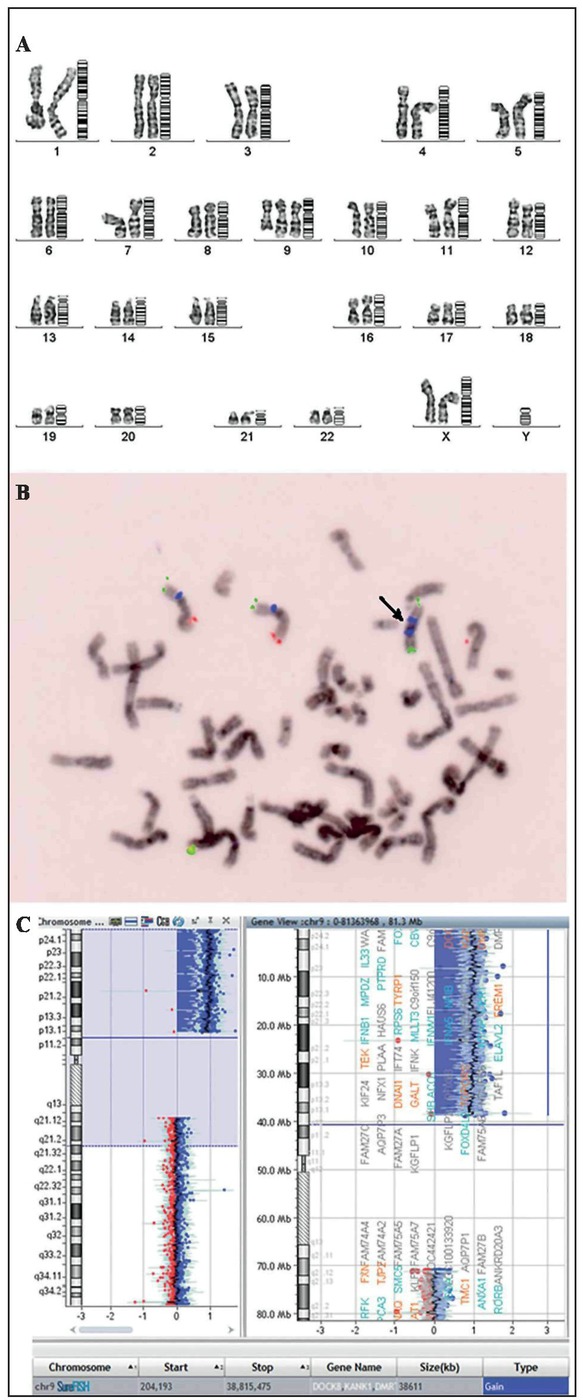
Figure 1
Prenatal genetic analysis reported additional cases of tetrasomy 9p. (A) Fetal karyotype analysis revealed two normal chromosomes 9 and additional i(9p). (B) Fluorescent in situ hybridization using Vysis (Abbott Laboratories) probes: TelVyson 9p SG and TelVyson 9q SO and Vysis CEP 9 SAq. Isochromosome 9p is marked with an arrow. (C) Microarray analysis, revealing four copies of 9p.
Table 3
Prenatally detected (ultrasound assessment), abnormalities in the case of full tetrasomy 9p (full) and mosaic tetrasomy 9p (mosaic), according to the pregnancy trimester.
| Parameter | First Trimester | Second Trimester | Third Trimester | Unspecified Time |
|---|---|---|---|---|
| CNS anomalies | – | 6 full [7,15,32,37,39,45]; 2 mosaic [5,33] | 2 full [3,40] | 2 full [38,47] |
| Cardiac anomalies | – | 2 full [32,39]; 1 mosaic [52] | 1 full [40] | 1 mosaic [48] |
| IUGR | 1 full [1] | 2 full [7,39; 2 mosaic [5,33] | 5 full [3]; 1 mosaic [1] | 5 full [38,46]; 1 mosaic [4] |
| Skeletal/limb anomalies | 2 full [5,51] | 5 full (our case [7,32,39,45] | 1 full [40]; 2 mosaic[1] | 1 full [47]; 1 mosaic [38] |
| Genitourinary tract anomalies | – | 5 full (our [case [32,37,39,45]; 1 mosiac [5] | 1 full [3] | 1 mosaic [38] |
| Facial dysmorphism | 1 full [5] | 4 full (our case [7,39,45]) | 1 full [40] | 1 full [46] |
| Cleft lip/palate | 2 full [1,5] | 4 full (our case [7,49,45]) | – | 3 full [38,46,47]; 1 mosaic [38] |
| Amniotic fluid volume anomalies | – | 2 full [7,39] | 2 full [3,40]; 1 mosaic [1] | 1 full [46] |
| Increased NT | 4 full (our case [5,39,45]) | – | – | – |
[i] CNS: central nervous system; IUGR: intrauterine growth retardation; NT: nuchal translucency.