Table 1
Disorders associated with persistent hyperinsulinemic hypoglycemia of infancy.
| General Characteristics | |||
|---|---|---|---|
| Gene | Mode of Inheritance | Laboratory and Clinical Characteristics | |
| PHHI due to K ATP channel mutation | Kir6.2: KCNJ11 gene; SUR: ABCC8 gene; imprinted region | Diffuse form: AR or AD; focal form: heterozygous paternal mutation, clonal loss of maternal 11p15.1 | ↑ Glucose requirement (up to 30.0 mg/kg/ min.); during hypoglycemia: ↓ ketone bodies, ↓ FFA (serum), insulin incompletely suppressed, normal blood gases and lactate, n/↑ ammonium, IGFBP-1 (<120.0 mg/mL), normal glucagon response |
| Glucokinase activating mutations | GCK gene | AD | Heterozygous: familial mild non progressive hyperglycemia, gestational diabetes; homozygous: neonatal diabetes |
| HI/HA syndrome | GLUD1 gene | AD | Hyperammonemia (100.0-200.0 μmol/L), usually asymptomatic, may be prominent early but may disappear later in childhood; often leucine-sensitive |
| Exercise-induced hyperinsulinemic hypoglycemia | SLC16A1 promoter mutations | AD | Children/adults with syncopal episodes after exercise |
| SCHAD deficiency | HADH gene | AR | Intermittent unpredictable hypoglycemia with seizures; ↑ C4-OH-carnitine, ↑ 3-OH-glutarate (urine) |
| Beckwith- Wiedemann syndrome | Chromosomal imbalance 11p15 | e.g., paternal UPD | Hyperinsulinism (disappears in most patients within weeks); typical facial characteristics (macroglossia, ear creases, omphalocele, visceromegaly, hemihypertrophy) |
[i] PHHI: persistent hyperinsulinemic hypoglycemia of infancy; AR: autosomal recessive; AD: autosomal dominant; ↑: elevated; ↓: low/decreased; FFA: free fatty acids; IGFBP-1: insulin-like growth factor-binding protein; HI/HA: hyperinsulinism-hyperammonemia; SCHAD: short-chain hydroxyacylCoA dehydrogenase; CA-OH-carnitine: 3-hydroxy-butyryl-carnitine; 3-OH-glutarate: 3-hydroxy-glutarate.
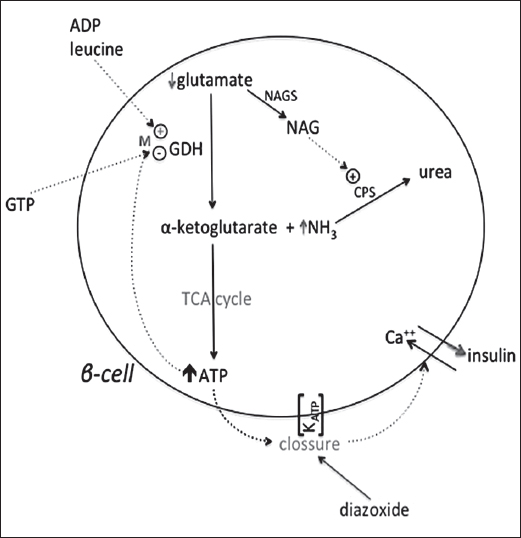
Figure 1
Patophysiological mechanism of hyperammoniemia in GDH deficiency.
M: mutation; GDH: glutamate dehydrogenase;
TCA: tricarboxylic acid; ATP: aden-osine triphosphate;
ADP: adenosine diphosphate; GTP: guanosine triphosphate; NAG: N-Acetylglutamate;
NAGS: N-Acetylglutamate synthase; CPS: carbamoyl-phosphate synthetase.