
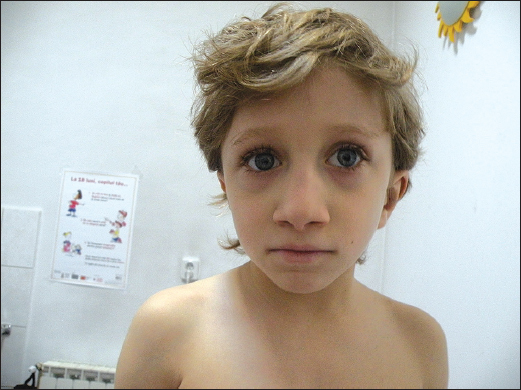
Figure 1
Frontal view of the patient’s face showing dysmorphic facial features: a triangularly-shaped face, deep-set eyes, long eyelashes, low-set malformed ears, a long nose with narrow bridge, a short philtrum, thin lips.
Table 1
Comparison of clinical features reported in the literature (cases with a SRCAP gene mutation) and in our present patient.
| Features | Literature | This Study | |||
|---|---|---|---|---|---|
| References | [4] | [5] | [6] | [8] | |
| Facial gestalt | 13/13 | 6/6 | 52/52 | 5/5 | [+] |
| Language delay | 13/13 | 6/6 | 52/52 | 5/5 | [+] |
| Growth deficiency | 13/13 | 6/6 | 39/52 | 5/5 | [+] |
| Delayed bone age | 13/13 | 6/6 | 23/25 | 4/5a | [+] |
| Skeletal anomalies | 10/13 | 6/6 | [+]b | 5/5 | [+] |
| Intellectual disability | 6/13 | 3/6 | 37/43c | 4/5 | [+] |
| Behavioral problems | NR | NR | [+]d | 3/5 | [+] |
| Eye anomalies | 4/13 | 2/6 | 13/43 | 0/5 | [–] |
| Ear anomalies | 4/13 | 0/6 | 15/52 | 2/5 | [–] |
| Dental issues | 4/13e | NR | 21/38 | 1/5 | [+] |
| Genitourinary malformations | 8/13 | 1/6 | 5/24 | 0/5 | [+] |
| Cardiac malformations | 3/13 | 3/6 | 3/52 | 0/5 | [–] |
| Gastrointestinal malformations | 2/13 | 0/6 | 5/24 | 0/5 | [–] |
| Seizures | 0/13 | 1/6 | 6/52 | 0/5 | [–] |
| Hypothyroidism | NR | 0/6 | 2/52 | 0/5 | [–] |
Table 2
Checklist of Floating-Harbor syndrome clinical features to facilitate clinical diagnosis and management.
| Features | Category |
|---|---|
| Characteristic face | mandatorya |
| Language delay | mandatory |
| Short stature | frequenta |
| Delayed bone age | frequent |
| Skeletal anomalies | frequent |
| Intellectual disability | frequent |
| Behavioral problems | recurrentb |
| Eye anomalies | recurrent |
| Ear anomalies | recurrent |
| Dental issues | recurrent |
| Genitourinary malformations | infrequentb |
| Cardiac malformations | infrequent |
| Gastrointestinal features | infrequent |
| Seizures | infrequent |
| Hypothyroidism | infrequent |
a Diagnosis of FHS requires meeting both mandatory criteria and at least one criterion from the frequent features category.
a Diagnosis of FHS requires meeting both mandatory criteria and at least one criterion from the frequent features category.