
I. Introduction
On a web site listing Key West's dead, Daniel Winchester Whitehurst, a 19th century Florida doctor, explorer, journalist, lawyer, politician, and soldier, is celebrated as a “jack-of-all-trades.” 1 Yet despite his diverse talents, Whitehurst does not have a Wikipedia page; 2 there is no known picture of him; 3 and his headstone, erected long after his death, contains incorrect information. 4 Moreover, while a scattered handful of sources recount his exploits, almost all contain errors of one sort or another. Accordingly, this article seeks to set matters straight. To do so, it first corrects what the existing sources say about Whitehurst. It then provides important new information about his education, political career, and death.
II. Corrections
A. Who Was Who Entry
Perhaps the easiest source to find about Whitehurst is his short entry in Who Was Who in Florida (“WWWF”). After giving the years of his birth (1807) and death (1872), it summarizes his life as follows:
A native of Virginia, [Whitehurst] came to Florida and settled in St. Augustine. He served as a major during the Second Seminole War of 1835–1842. After the war he practiced law and became editor of the St. Augustine News. Whitehurst then studied medicine and in 1843 received his degree as a medical doctor from New York University. He moved to Key West to become post physician at Fort Taylor and later was the post physician at Fort Jefferson. While serving at Fort Jefferson he assisted the famous Dr. Mudd during the terrible yellow fever epidemic of 1866 [sic]. 5
B. McMurtie's Article
There likewise is a brief description of Whitehurst in the Florida Historical Quarterly. In an article about early Florida newspapers, Douglas C. McMurtie explains that Whitehurst “established the St. Augustine News in November, 1838[,] published [it] until the end of 1840[,] and remained as editor through part of the next year, when he left Florida for New York.” 6
In the News’ first issue, Whitehurst penned a long editorial in which he laid out his goals:
A paper, bearing the title of “The News,” is this day issued, and seeks from the countenance of the public, such support as its merits may deserve. In thus adding another newspaper to the many which are already on occupied ground, the Editor candidly admits he feels the extent of the responsibilities, which necessarily attach to a faithful discharge of the duties incurred, and enters upon the field with no little solicitude, as to the success of an undertaking, in which more able and experienced hands have not unfrequently met with failure and defeat. . . .
Three years have now passed by, and the territory is still the theatre of war. Her people have ever shown a ready zeal to encounter any danger, which the exigencies of the times have demanded; and have repeatedly given proof in action of their fidelity and courage. Yet, with this amount of suffering and privation endured, her inhabitants have been misrepresented and abused, and error perpetuated, by ex parte statements, which have had their full influence aboard. To correct these impressions, and exonerate our people from the sweeping charges of anonymous or avowed authors; to disseminate such intelligence as will best develop the capabilities of our soil, and advance the agricultural interests of the country;—to support a system of education, which shall embrace every free white citizen of the country,—and to allay the discordancies of party, by a mild and equable course of conduct, will be his anxious and studious effort. . . .
The Editor disclaims all attachment to party, other than the cause of correct principles, the truth, and morals.
His columns are open, therefore, to all temperate communications, which do not entrench on private character, or which would strike at conscientious obligation.
These are the landmarks which shall guide him in the conduct of this paper. 7
Whitehurst quickly abandoned the neutrality promised in his editorial. Like most East Floridians, he was a supporter of the Whigs, 8 and when the party succeeded in electing William Henry Harrison president in 1840, Whitehurst joined other Whig newspaper editors at a celebratory dinner in Washington, D.C. When his turn came to speak, Whitehurst praised his fellow editors as “[t]he sentinels on the watch-tower of freedom—the conductors of the Whig press: Neither bound in ‘golden shackles’ nor intimidated by the ‘iron hand of despotism.’” 9
In operating the News, Whitehurst showed a distinct taste for yellow journalism:
Established in 1838 by Peter Sken Smith and Daniel W. Whitehurst to promote Whig party principles, the News was generally more a purveyor of sensationalism than its arch rival, the St. Augustine Florida Herald. Most articles and editorials were written by Whitehurst, who had served in the Indian war as a staff officer for Brigadier General Joseph M. Hernandez, a commander of the East Florida militia. Thus, his interest in and knowledge of military affairs came naturally. Whitehurst depended on the ship captains who entered St. Augustine harbor enroute to and from southern military posts like Fort Lauderdale for much of his information about the war. 10
On January 15, 1841, Whitehurst sold the News to Aaron Jones, Jr., and Thomas T. Russell. 11 In announcing the sale, Whitehurst made it clear he was staying on as editor:
The Subscriber has this day sold the Press, types, debts, &c, of “The News,” to Messrs. THOMAS T. RUSSELL and AARON JONES, Jr., who will continue to issue it in [the] future as the proprietors thereof. The connection of the Subscriber for the present, will continue to exist as Editor. 12
On March 5, 1841, however, Whitehurst resigned as editor. He subsequently bid the paper's readers good-bye by writing:
The Subscriber's connection with “The News,” was dissolved on the 5th inst. In withdrawing his association from a Press, which he controlled over two years under much difficulty and opposition, he has reason to congratulate himself, that the strenuous efforts of personal and political enemies toward its destruction, were alike fruitless, and have left him unscathed from the combinations of undisguised malignancy. To his friends, he owes much for their forbearance and cordial assistance—to his opponents, nothing. With his brethren who have interchanged a friendly relation, he extends the warm hand of attachment—all that he can offer; and to those who have stood by him in “good and evil report,” the assurances of his gratitude. 13
C. Smiley's Essay and Wickman's Book
With a bit more effort, a researcher can go beyond Whitehurst's WWWF entry and McMurtie's article and find what until now has served as Whitehurst's biography: an essay by Nora K. Smiley in Martello, the former annual journal of the Key West Art and Historical Society. 14 It lists Whitehurst's full date of birth (September 29, 1807); his birth city (Norfolk); his full date of death (January 19, 1872); his wife's maiden name (Henrietta Weedon); and explains (somewhat incorrectly) that the couple had a son (Dr. Mason Whitehurst) and two daughters (whose names are omitted).
In addition to mentioning his war record, newspaper editorship, and medical studies, Smiley reports: “As a young man [Whitehurst] was active in the American Colonization Society [(“ACS”)]. It was in connection with this group that he made a trip to Liberia [c. 1831 to 1835], a considerable adventure in those days.” 15 Smiley also adds that Whitehurst represented Key West at Florida's 1865 state constitutional convention. 16
For the most part, however, Smiley focuses on two other events in Whitehurst's life. First, in 1843, Whitehurst received as a wedding present from his new father-in-law, Dr. Frederick R. Weedon, the head of the Indian warrior Osceola. Weedon had treated Osceola during the latter's confinement at Fort Moultrie in South Carolina and, following Osceola's death there in 1838, had taken his head as a trophy. Whitehurst, in turn, presented the relic to Dr. Valentine Mott, one of his NYU professors. 17
In describing Weedon—who she repeatedly misidentifies as “Weeden” 18—Smiley mentions that he “had served as a colonel in General Andrew Jackson's army . . . and . . . had settled in St. Augustine before Whitehurst.” 19 Patricia Riles Wickman, in her much later book focusing on Weedon's theft of Osceola's head, describes how Weedon and Whitehurst likely became acquainted:
While Minorcan and Spanish inhabitants and American settlers banded together to form militia companies for physical protection, they also met compatriots in fraternal organizations. Frederick Weedon was a Freemason. Among the members of his lodge in little St. Augustine was a criollo (local-born Spaniard), Joseph M. Hernández, who was also the brigadier general commanding forces east of the St. Johns River. By at least mid-1837, Daniel Winchester Whitehurst, another Freemason, also was residing in St. Augustine. Whitehurst, originally of Norfolk, Virginia, was thirty years old that July when he became a lieutenant of a company of East Florida Mounted Volunteers in Col. John Warren's regiment. Whitehurst spent his six-month enlistment (13 July 1837 to 4 February 1838) at duty stations at Picolata and along the St. Johns River, close enough to St. Augustine to enhance his association with the Weedon family. . . .
The records do not show when and where Whitehurst and Weedon met, but their overlapping spheres of interest in such a small town, and relative social stations must have thrown them together quickly. 20
After leaving the army in February 1838, 21 Whitehurst in short order became a lawyer, 22 started the News, and began pursuing various commercial ventures. 23 But as Wickman says, throughout this time Whitehurst was giving serious thought to becoming a doctor, 24 and in 1841, after selling the News, he enrolled in NYU's medical school (no doubt using at least some of the sale's proceeds to pay his tuition). 25
The decision to go to NYU was an easy one. In 1841, Florida had no medical schools. 26 Thus, to get his degree Whitehurst had no choice but to look outside the territory. More importantly, NYU's fledgling medical school (“University Medical College”) was making no secret of the fact that it was willing to accept just about anybody. 27
As noted in his WWWF entry, Whitehurst received his degree in 1843. 28 As soon as he did, he rushed back to St. Augustine “to be married, on [30] April of that year, to Henrietta Weedon, the eldest surviving daughter of his friend Frederick.” 29 At 35, Whitehurst was considerably older than Henrietta, who was 22 and considered “a dark-haired beauty.” 30
Shortly after the wedding, the couple moved to Dade County, where Whitehurst was named a justice of the peace. 31 Whitehurst's decision to relocate from St. Augustine to South Florida raises a host of questions, especially given that neither he nor Henrietta had ever visited the region (as far as I can tell); the couple had no friends or relatives in the area (ditto); and it was during this period that the pair began to have children. The most obvious explanation is that Whitehurst, angry at how he had been treated while at the News, wanted to get away from St. Augustine and make a fresh start somewhere else. 32
In 1845, the couple moved again, this time to Key West. After years of dithering, the federal government finally was going ahead with its plan to build a series of massive forts in the Florida Straits. First up was Fort Zachary Taylor in Key West, 33 where, as his WWWF entry explains, Whitehurst was given the job of base physician. Undoubtedly, Whitehurst's military service gave him a leg up for the position and made the prospect of serving at a fort appealing.
Two years later, work began on Fort Thomas Jefferson at Garden Key in the Dry Tortugas, 68 miles to the west of Key West. 34 Having proven his mettle at Fort Taylor, Whitehurst, as his WWWF entry further reports, now became Fort Jefferson's physician. Whitehurst also was appointed the installation's bookkeeper at a combined salary of $150 per month. 35
In 1860, however, Whitehurst's Confederate sympathies cost him these jobs. 36 Whitehurst's change of status also meant that he could not remain at Garden Key. Thus, the family returned to Key West. 37 Once back in the city, Whitehurst became the captain of a band of local citizens called the “Island Guard,” which looked for ways to drum up support for the rebels’ cause. In a story in the Charleston Daily Courier, for example, readers learned about a Guard event that had served as a counterweight to a similar Union event:
In military circles we observe no important changes at this port [Key West,] except the increase of the [federal] garrison [at Fort Taylor] from a skeleton to a full Company. Captain Brannan, in command of Fort Taylor, fired a national salute on the 22d [George Washington's birthday, considered a sacred day by both the Union and the Confederacy]. The Island Guard, a volunteer Company in command of Capt. D.W. Whitehurst, also celebrated the day by an oration, speeches, &c. 38
The second event discussed at length by Smiley is Whitehurst's battle to control Fort Jefferson's 1867 yellow fever outbreak. Whitehurst had been summoned from his home in Key West on September 7th after Dr. John S. Smith, the fort's physician, died. 39 Upon reaching the fort, Whitehurst found Dr. Samuel A. Mudd, one of the prisoners, caring for the sick. 40
Mudd had been imprisoned at the fort following his conviction for aiding in the assassination of President Abraham Lincoln. 41 Because of Mudd's untiring efforts during the outbreak, 42 many of Mudd's patients, as well as Whitehurst himself, sent numerous letters to federal officials asking that Mudd be released.
In a letter to Major George P. Andrews, dated February 24, 1868, for example, Whitehurst wrote:
I regret to inform you, that I have no copy of my letter addressed [to] you in September or October last, in relation to the meritorious conduct of Dr. Mudd, during the epidemic of yellow fever at Fort Jefferson, last summer. I have subsequently to that letter to you, in a report to the Surgeon General, entered into much detail regarding those valuable services to me as the medical officer in charge, and to the sick, from his unwearied and constant devotion night and day in the wards.
Major Stone, and Lieuts’ Orr + Gordon each spoke to me, in unqualified terms of admiration, of his excellent conduct; and their design to represent it to the government, in the hope that its clemency and justice, would be exercised to his benefit. These gentlemen all fell, victims to the fever, and when I wrote you, I thought it but just to their memories, that their feelings and views on this subject should be made a matter of record.
The services of Dr. Mudd, eminently valuable as they were, derive an additional value, from the fact, that he volunteered them, at a time when the sick were without direction, by the illness of Surgeon Smith, whose attendant he was. 43
D. Family Papers
With still more effort, a researcher likely will come across the Weedon and Whitehurst Family Papers at the University of North Carolina (“WWFP”). 44 Although the bulk of this collection concerns the Weedons, it includes, for example, Whitehurst's Sierra Leone “permission to enter” pass. Dated May 8, 1832, the pass identifies Whitehurst by his full name; lists his birthplace as Norfolk, Virginia; and indicates that he is 24 years old. 45 It also provides the only known physical description of Whitehurst, reporting that he is 5′6″ tall, has a pale complexion, brown hair, grey eyes, an aquiline nose, and an “as usual” mouth. 46
In response to the question, “Purpose for which Alien came into the Colony[?],” the pass states: “[F]or the benefit of his health.” 47 As Wickman explains: “After a shipwreck and an escape from hostile natives, [Whitehurst] found refuge in Sierra Leone and recuperated there for more than three years.” 48
As previously discussed, in 1831 Whitehurst agreed to go to Liberia to conduct a fact-finding mission for the ACS. That he would have appeared haggard to the authorities in Sierra Leone (Liberia's northern neighbor) after nearly losing his life twice is quite believable. 49 Whitehurst's own later reporting confirms that he remained in Sierra Leone until 1834. 50
Another document in the WWFP collection is Whitehurst's September 29, 1865, Amnesty Oath. 51 As explained above, Whitehurst was forced to leave Garden Key in 1860 because of his pro-South leanings. In 1863, he was ordered to leave Key West for the same reason, but the order was rescinded at the last minute. 52 In his Amnesty Oath, Whitehurst promised to resume being loyal to the United States.
Like many other well-to-do Southerners, Whitehurst was a slave owner:
Beginning in 1845 at the Key West fort [Fort Taylor] and in 1847 at Fort Jefferson on Garden Key [in the Tortugas], rented slaves worked ten-hour days in subtropical heat. Harsh conditions and open waters inspired dreams of escape. The first summer, seven slaves . . . disabled nearly all the vessels at the wharf and sailed away. Doctor Daniel Whitehurst organized a pursuit, but another posse caught the slaves. . . .
Doctor Whitehurst's slaves were considered the best workers at Fort Jefferson until the army ruled that as an officer in federal employ, he could not be paid for their labor. To skirt this ruling, he acquired many slaves in his wife's name. . . .
[T]he Whitehursts [later] added Weedon family slaves to their own. Over the years they bought twelve-year-old Sam, ten-year-old Lucy, and seven-year-old Sarah for $500, then Charly, who was thirteen, and Mary, about four, for $550. Contracts granted the slaves to Henrietta Whitehurst and her heirs “for their own proper use and benefit, for ever.” The couple later acquired seven more slaves, including an eighteen-month-old girl, and the rights to “the future issue and increase of the females.” 53
The merging of the Weedon and Whitehurst slaves occurred in 1853, when Whitehurst's father-in-law Frederick Weedon moved to Garden Key. In exchange for Whitehurst and Henrietta's written promise to care for him for the rest of his life, Frederick turned his slaves over to them. 54
In the 1860 federal census, Whitehurst's real property is valued at $3,160, 55 while his personal property is valued at $15,550. 56 Nearly all ($15,000) of the latter amount represents Whitehurst's slaves; the rest likely reflects his law books and medical equipment. 57 The total ($18,710) is the modern-day equivalent of $547,003.20. 58
General Robert E. Lee's surrender at Appomattox (Apr. 9, 1865) therefore dealt Whitehurst a double blow. Not only did it extinguish the political cause he had so zealously championed (and for which he had sacrificed his government salary), it meant his slaves were free. 59 Thus, in the blink of an eye, Whitehurst lost 80% of his wealth. 60
E. Nichols's Report
With much more work, a truly determined researcher will find, in the files of the St. Augustine Historical Society, a typed 10-page report by Robert E. Nichols, an amateur historian, called Who Was Eliza C. Whitehurst? 61 Although it devotes most of its attention to Whitehurst's mother Eliza, it offers additional details about Whitehurst.
As Nichols explains, Eliza was born in Georgetown, South Carolina, 62 most likely in 1779. 63 Her parents were Elizabeth and Daniel Roland (spelled “Rolain” or “Rowland” in some sources). On October 6, 1807, Eliza married a man named James Whitehurst in Norfolk, Virginia. 64 James, whose birth year is unknown, originally was from Princess Anne County (present-day Virginia Beach). 65
Within just a few years of the marriage (neither Nichols nor I can pin down an exact date), James and Eliza moved to South Carolina. Although both the 1810 and 1820 city censuses show them in Charleston, Nichols explains that the couple lived in Georgetown (Eliza's hometown) from 1812 to 1816:
[M]any historical notes concerning South Carolina politics during and subsequent to the British Invasion of 1812 firmly place the family in nearby Georgetown Parish some 40 miles to the north of Charleston during the better part of the 1810-20 decade. Eliza's future expertise as a hostess and innkeeper during this decade are apparent in the 1812–16 journal of Gen. Peter HORRY. It is repeatedly recorded that travelers of note to Georgetown often were guests of the family and were given food and lodging during their stay at the WHITEHURST home. According to his journal, Gen. HORRY frequently corresponded with James WHITEHURST, and his own family and guests were welcomed on many occasions by “Mrs. WHITEHURST.” 66
In 1816, James and Eliza moved back to Charleston to run a popular restaurant called the Carolina Coffee House. 67 As Nichols reports, in 1823 James died of unknown causes. 68
During their 16-year marriage, Eliza and James had four children: Daniel; a second son named James (1810?–Apr. 30, 1816); and two daughters. 69 The name of the first daughter is unknown. Nichols speculates that she was born sometime between 1812 and 1816 and died prior to 1829. The second daughter was named Anna (1819?–June 29, 1855). 70
In 1822, Eliza's sister Margaret Cook moved to St. Augustine with her husband Samuel, a Charleston tailor she had married in 1810. 71 Margaret and Samuel undoubtedly were lured to Florida by the fact that, after nearly 300 years as a Spanish colony, the territory now was in U.S. hands. 72
In describing this part of Whitehurst's life, Nichols writes:
[Whitehurst's] name first appears among the list of unclaimed letters at the St. Augustine Post Office on April 1, 1823. The young Daniel, not yet sixteen years of age, probably was living with his Uncle Samuel and Aunt Margaret COOK at the time the letter in his name was received at the Post Office. Although speculative, but because he was his father's only male heir, the letter very likely notified him of the death of his father. 73
Based on subsequent events discussed later in this article, it almost is a certainty that the letter went unclaimed because Whitehurst, having helped Margaret and Samuel move to St. Augustine, already was on his way back to South Carolina when the letter was sent. It also seems likely that the letter was mailed by Eliza, or someone acting on her behalf.
As Nichols explains, in 1826 Samuel died. 74 Over the next four years, Margaret turned one of their properties—the three-story Ximenez building on Hospital Street—into a boarding house. 75 In 1829, Eliza agreed to move to St. Augustine to help Margaret run the business. 76 Accompanying Eliza was Whitehurst's 10-year-old sister Anna. 77 On April 13, 1837, Whitehurst, by now 29, scratched his name and the date into one of the building's windows. In 1939, the building was turned into a museum with Whitehurst's handiwork preserved for all to see. 78
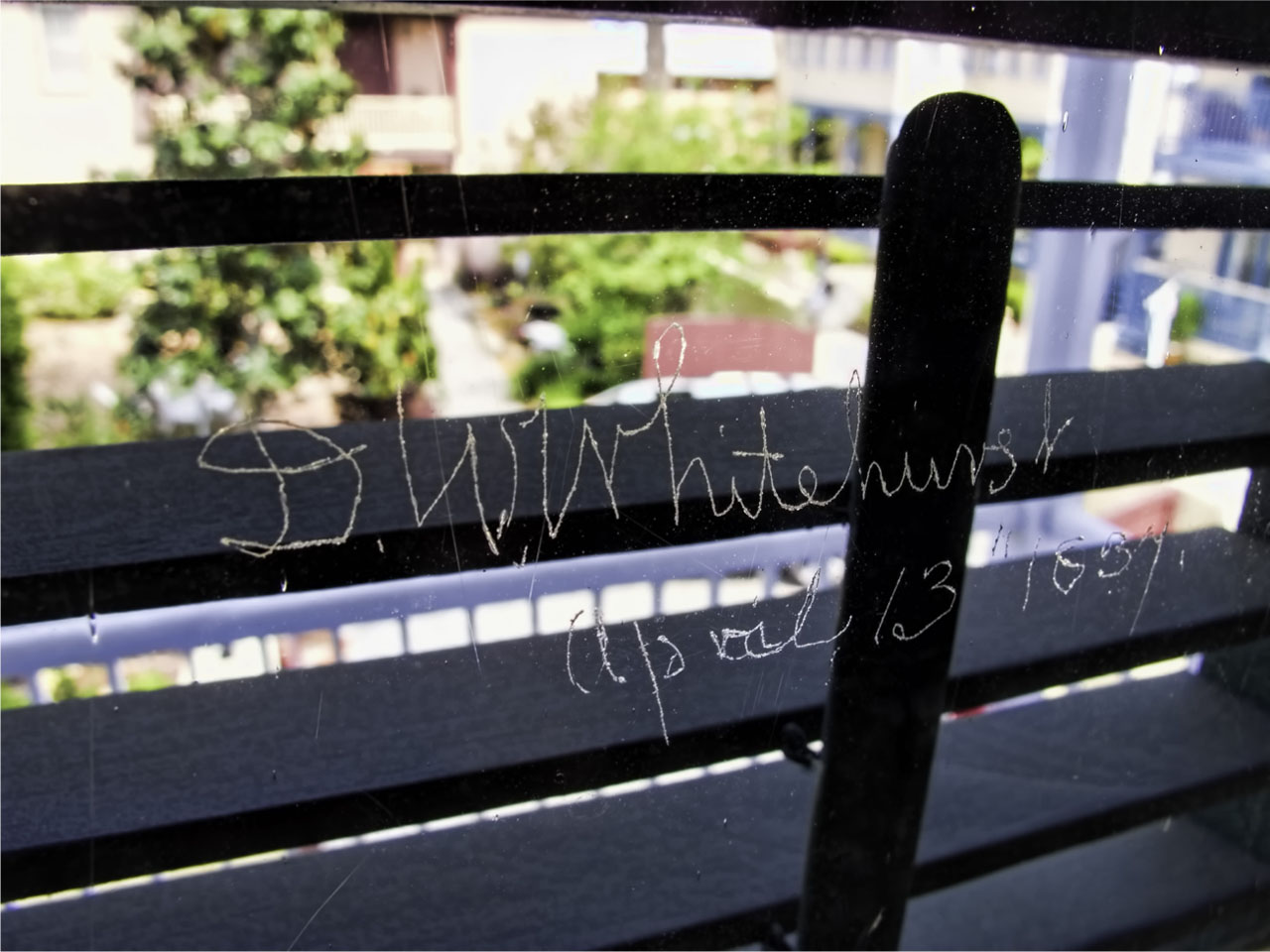
Dr. Daniel W. Whitehurst's April 13, 1837 “scratched-in” window signature
Photograph (taken 2014) courtesy of the Ximenez-Fatio House Museum
There are three other interesting tidbits in Nichols's report. First, he gives the location of Whitehurst and Henrietta's wedding—St. Augustine's Cathedral Basilica 79—and points out that Henrietta was Catholic (Whitehurst likely was Presbyterian). 80 Second, he notes that Whitehurst's senior thesis at NYU, “unlike those of his classmates, was not written about [a] medically technical area[;] rather, the subject of his thesis was ‘Woman.’” 81 Third, he partially fills in a gap in Smiley's article by giving the names of Whitehurst's two daughters: Catherine and Laura. 82
In fact, Whitehurst had five children, as Wickman reports in her book (as will be seen, some of her other information is wrong):
Henrietta Williams Weedon (1821–1885) and Daniel Winchester Whitehurst (1808–1874) had five children: Clarence (died at sea, no issue); Mason (1853–1881, also a physician); Mary Katherine, or “Kate” (1858–1924); Laura (1860–1925); and Manning. Laura never married. Kate was married to a Spanish military officer, but the two never lived together as man and wife. The two sisters spent the rest of their lives together. 83
As is obvious, Wickman misreports Whitehurst's birth and death years. With respect to Henrietta, Wickman correctly lists her middle name and her birth and death years. Elsewhere in her book, she reports that Henrietta was born in Huntsville, Alabama, on January 25, 1821, and that the Weedons moved from Alabama to Tallahassee when she was six years old. 84 These facts line up with the 1870 federal census, which shows Henrietta being 49 years old, a native of Alabama, and “keeping house” for Whitehurst, Mason, Kate, Laura, and Manning. 85 Henrietta also appears in the 1880 federal census 86 and the 1885 Florida state census, 87 which was taken shortly before she died. 88
With respect to Whitehurst's children, the following corrections are in order:
Clarence. Clarence was Whitehurst's first child and appears in both the 1850 federal census (where he is listed as being seven years old) 89 and in the 1860 federal census (where he is listed as being 16 years old and still living with his parents). 90 Based on these entries, he was born in 1844. 91 By 1862, Clarence was a student at the Maine Wesleyan Seminary in Kent's Hill, Maine. 92 In the 1880 federal census, there is a “Clarence W. Whitehurst” (the “W.” almost certainly an abbreviation for “Weedon”) living in Live Oak County, Texas, and working as a “stock raiser” (i.e., rancher). 93 That this is Clarence is supported by his race (White) and the fact that he gives his birthplace as “Florida”; his father's birthplace as “Virginia”; and his mother's birthplace as “Alabama.” 94 Although Wickman says that Clarence perished at sea, this is incorrect. Instead, shortly after the 1880 census was taken he moved to New York City and died there on March 26, 1893, at the age of 49. 95 Although he was married at the time of his death, we do not know his wife's name or whether he had any children. 96 The only other thing we know about Clarence is that he apparently had some sort of disability as a child, for a stranger who met him when he was 12 remarked: “Mrs. Whitehurst has two boys under six—the eldest a little cripple—he was a pitiable object.” 97
Mason. As Wickman reports, Mason (middle initial “J.”) was born in 1853 and followed in his father's footsteps. After graduating from the University of Maryland's medical school in 1875, 98 Mason returned to Key West and moved in with his mother and sisters. 99 On June 9, 1881, he married Irene Bethel, 100 but died soon thereafter of unknown causes. 101 In 1884, James L. Harn, a Jacksonville lawyer, sued Mason's estate to foreclose on his only asset: a single lot of land in Jacksonville. 102
Mary. Mary was Whitehurst's middle child. As will be explained shortly, she ended up having the greatest impact on Whitehurst's life. For the moment, however, it suffices to say that she was born in 1857 (not 1858 as Wickman reports) and that the correct spelling of her middle name was “Catherine,” and not, as Wickman indicates, “Katherine,” nor as her headstone proclaims, “Catharine.” This is made clear by her 1919 passport application, which includes her photograph. 103 Given the actual spelling of her middle name, Mary's use of the nickname “Kate” is puzzling. As Wickman partially reports, Mary died on March 5, 1924, in Tampa. 104
Laura. As Wickman states, Laura (middle initial “H.”) was born in 1860. But contrary to her account, Laura was married. Her husband was an optometrist named Bernardo Gallo, 105 and the couple took their vows in Key West on April 2, 1902. 106 Later, they moved to Tampa, where they spent the rest of their lives. Bernardo died on December 9, 1924; 107 Laura passed away four months later (Apr. 7, 1925). 108 Laura's Find-A-Grave web page includes a photograph showing her and Bernardo's joint Key West headstone. 109 Wickman is correct that Kate lived with Laura, but she did so as part of Bernardo and Laura's household. This is made clear by the 1910 federal census, which identifies Kate as Bernardo's widowed sister-in-law. 110
Manning. Manning (middle initial “E.”) was Whitehurst's youngest child. He is listed in the 1870 federal census as being nine years old, 111 which means he was born in 1861. In 1875, he is included on the roster of preparatory students at Mount Saint Mary's College in Emmitsburg, Maryland. 112 In the 1880 federal census, he is shown living in Jacksonville and working as a clerk in a dry goods store. 113 A July 16, 1885, newspaper story reports that Manning traveled from Florida to Keyport, New Jersey, where he threatened to kill and eat a “Captain R.R. Sewell” for insulting a member of his family. 114 After being arrested, Manning calmed down, retracted his charges, and eventually was released. According to the newspaper: “The affair was a most mysterious one to all onlookers. . . . One could not but feel that the man might not be sound in mind. His variableness would seem to indicate that he was laboring under some infirmity.” 115 On October 30, 1886, Manning can be found among the inmates in a Huntsville, Texas prison—unfortunately, the prison register does not indicate the reason for his arrest. 116 Despite diligent searching, the only further trace of Manning after this date are several 1892 newspaper articles that mention that a “Manning Whitehurst” is the president of the Topeka (Kansas) Bi-Chloride of Gold Club, an organization for recovering alcoholics. 117 Whether this Manning Whitehurst is Whitehurst's son is impossible to say.
Mason, Mary, and Laura all died childless. If Clarence and Manning also died without children (which, from the available evidence, seems likely), Whitehurst's direct line has died out. As previously explained, however, his sister Anna had six children, 118 so it is likely that Whitehurst has distant relatives who currently are alive.
III. Additions
Collectively, Whitehurst's WWWF entry, McMurtie's article, Smiley's essay, Wickman's book, the WWFP collection, and Nichols's report would seem to provide a thorough recounting of Whitehurst's life. In fact, however, they all overlook four very important details.
A. Expulsion from West Point
In the Fall of 1826, Whitehurst enrolled as a student at the United States Military Academy at West Point. 119 He had tried to enroll in 1825, but there had been no slot for him. 120
Following his first semester, Whitehurst was expelled for taking part in the “Eggnog Riot.” 121 Although the revolt began as an innocent Christmas party in the North Barracks, it quickly spiraled out of control. In all, 90 cadets (out of 260) were implicated and 20 were court-martialed, including future U.S. Supreme Court Justice John A. Campbell, future Mississippi Governor Benjamin G. Humphreys, and future Texas Secretary of State Samuel A. Roberts. 122
Unlike many of his fellow cadets, Whitehurst was largely blameless. Indeed, the most damning thing anyone could say about him was that he had gotten drunk. 123 The uprising, however, gave the school an excuse to clean house and it did not miss the opportunity:
[T]he academic board, [not to be confused with the Court of Inquiry, which was separately trying the court-martialed cadets,] having finished examining the cadets, made [its own] recommendations. . . . Jim Hamilton, for instance, had been cited by many as a central figure in the mutiny, but before his role in the disturbances could be adjudged . . . “the board . . . recommended that he be discharged.” Hamilton packed his bags and left. . . .
The board also recommended that several other cadets be dismissed for lack of aptitude in certain academic disciplines or for bad conduct. Among them were Walter Otey, Charles Schoolfield, George Skipwith, Charles Whistler, and Daniel Whitehurst, all fourth classmen [i.e., freshmen]. These and several cadets in the other classes departed for home not long after Hamilton. 124
It is not known what kind of reception Whitehurst received when he got home. It likely was not a very pleasant one. 125
B. Election to the Florida Senate
On November 29, 1865, Whitehurst was elected to the Florida Senate. A total of 123 votes were cast, with Whitehurst receiving 119 votes; John J. Philbrick netting three votes; and an “H. Albury” garnering one vote. 126
Under Florida's 1865 constitution (which Whitehurst had helped write three weeks earlier as a member of the state's constitutional convention), senatorial terms were two years. 127 During his term, Whitehurst was one of three senators appointed to a special committee to study the advisability of establishing a State Medical Board. On November 22, 1866, the committee unanimously recommended that the board be created. 128
On the same day as the committee's recommendation, Whitehurst introduced a bill reconfiguring Dade County. 129 In 1823, when Monroe County was created out of St. Johns County (one of Florida's two original counties), all the Florida Keys (Upper, Middle, and Lower) were made part of it. 130 In 1836, however, when Dade County was carved out of Monroe County, the Upper and Middle Keys were included in its boundaries at the urging of the notorious Jacob Housman. 131 Whitehurst's bill corrected this anomaly by returning the Upper and Middle Keys to Monroe County.
I have found no contemporaneous newspaper stories discussing (or even mentioning) Whitehurst's bill. 132 As a result, all we have is the bare legislative record, which reveals that the bill passed the Senate (unanimously and without debate) on November 24, 1866; passed the House of Representatives (also unanimously and without debate) on December 6, 1866; and was signed into law by Governor David S. Walker on December 8, 1866. 133
C. Election as Mayor of Key West
Upon his return from Tallahassee, Whitehurst was elected mayor of Key West and served from 1868 to 1869. 134 Remarkably, there is no record of Whitehurst's election or his activities while in office. In his 1912 book about Key West, however, Jefferson B. Browne includes a full list of the city's mayors and provides the following description of Whitehurst: “Dr. Daniel W. Whitehurst, both physician and attorney, was a quiet, cultured, lovable gentleman of the old school, a man of education, travel and experience.” 135
D. Death
Whitehurst died at his home in Key West on January 19, 1872. 136 Because he was 64, it has been taken for granted that he died of old age. 137 And because his obituary has not survived, 138 there has been nothing to fact check. 139
However, in a paragraph near the end of his 1974 book about Dr. Mudd, Samuel Carter III states:
Whitehurst himself had retired to Key West where his only daughter [sic] became engaged to a visiting European count. The doctor raised passionate objections to this mismatch with “Count No-account.” The daughter insisted on going ahead with the marriage even if it broke her father's heart. Whitehurst refused to attend the wedding ceremony. Instead he stayed home and killed himself by taking poison. 140
At the back of his book, Carter explains the basis for his provocative statement. In its entirety, it reads: “Whitehurst papers in Dade [sic] County Public Library, Key West.” 141
There are two obvious problems with Carter's story. First, Whitehurst had two daughters, not one. Second, of course, the Key West Public Library is in Monroe, not Dade (now known as Miami-Dade), County. 142 But because he died in 1988, it is not possible to ask Carter about these errors.
Nevertheless, Carter's reputation makes it impossible to simply dismiss his assertion:
Sam died on Dec. 28, 1988, at the Pomperaug Health Center, near his home in Southbury, Conn. His literary career, one of the longest and most distinguished among Princeton alumni, began on the campus with the Triangle Club, which fired his interest in music, the stage, and writing. After study at Oxford and the Sorbonne, Sam lived in Europe and poured out short stories and articles for the Saturday Evening Post, Colliers, and other magazines. He returned to America in the 1930s and began a career of several decades in radio, television, and movies, in N.Y.C. and California. He wrote innumerable scenarios, rewrote popular plays for radio, staged productions with original casts, and was associated with prestigious companies. The editors of the Reader's Digest highly valued his literary prowess and advised him to concentrate on books. The result was a stream of brilliant works—20 in all—on American history, especially the War of 1812 and the Civil War. . . . 143
As will be recalled, Wickman in her book states: “Kate was married to a Spanish military officer, but the two never lived together as man and wife.” 144 In her 1919 passport application, Kate explains that her husband was Elias Moscoso; that he was born in Ferrol, Spain; that he immigrated to the United States from Havana in November 1871 and proceeded to live in Key West until 1875; that he never became a U.S. citizen; and that he died in 1879. 145 These facts line up with Carter's insistence that Whitehurst was distraught over Kate's marriage to a European suitor.
Further support for Carter's contention is contained in Browne's 1912 book about Key West. While writing about another disreputable local figure he identifies only as “the Spanish Doctor,” Browne says “he was, as Dr. Mason Whitehurst said, a second ‘Count Fosco.’” 146 The name “Fosco” is close to “Moscoso,” and Browne was recalling what Mason had said after the passage of more than three decades. Moreover, Mason refers to Fosco as a count, the same title used by Carter in describing Moscoso.
On Ancestry.com, a member named Geoffrey Thompson has put up his family tree. Thompson reports that “Elias Moscase [sic] y Marcet [sic]” married “Mary Catharine [sic] Whitehurst” on January 19, 1872, in “Monroe [sic], Florida,” and that the couple had no children. 147 Ignoring his various misspellings and omissions, Thompson's posting provides Carter's tale with additional support.
That Kate and Moscoso did get married in Key West on January 19, 1872, is indisputable. The ceremony took place at Saint Mary Star of the Sea, Key West's oldest Catholic church (founded 1852), 148 and their marriage license records are readily available on-line. 149 Whether Kate was a practicing Catholic, or simply gave into Moscoso's wishes, is unknown. Certainly, however, Henrietta, being Catholic, would have pushed her oldest daughter to have a church wedding.
If one searches for Moscoso in the Hispanic Digital Library, 150 one finds 10 articles, published in various Spanish periodicals, that report on his naval career. 151 The last one appears in the July 6, 1870, issue of La Iberia. It describes Alférez (Spanish for “Ensign”) Moscoso's participation in a successful effort to recover a cache of munitions that had been landed by Cuban rebels from aboard the steamer George B. Upton. 152
Moscoso deserted the Spanish Navy shortly after the Upton raid. On October 5, 1870, Commander Tomás Valarino y Badino ordered Moscoso to present himself within 30 days and explain why funds entrusted to his care while serving as the executive officer on the gunboat Eco could not be located. 153 Receiving no reply, Valarino reissued his order on December 12, 1870 154 and again got no reply. Four days earlier, a New York newspaper had reported:
Another naval paymaster has absconded with funds entrusted to his care, and sough safety with his ill-gotten gains upon American shores, where extradition treaties with Spain are not known. The guilty fellow this time is Lieutenant Elias Moscoso, paymaster of the . . . gunboat Eco, and the amount of his defalcation foots up $18,000. Verily, Admiral [José] Malcampo is having a vexing time of it with the paymasters of his fleet, among whom honesty seems to be at a discount. 155
If Whitehurst did kill himself on the day of Kate's wedding, Wickman's reporting that Moscoso and Kate never lived together as man and wife makes sense—it would be hard to imagine a more challenging way to begin a marriage. And it also would explain why, after more than three years of waiting, Moscoso decided to leave Key West in 1875. It appears, however, that the family and Moscoso did not harbor any ill will towards each other. In September 1872, for example, Henrietta had Moscoso serve as one of her two witnesses when she decided to sell a plot of land at the corner of Duval and Greene Streets for $1,000 to a local grocer named Jacinto Borroto. 156
In the previously mentioned 1880 federal census, Kate is identified as “Kate Moscoso” and is shown living with her mother Henrietta, sister Laura, and brother Mason. 157 In all later records that I have been able to find, including her death certificate, Kate's last name always appears as “Whitehurst.”
Going into the marriage, Moscoso had four strikes against him: 1) he was much older than Kate; 158 2) he had known Kate for only a short period of time; 159 3) he was a military deserter; 160 and 4) he was a thief. 161 These facts undoubtedly would have been very upsetting to Whitehurst. 162 Moreover, as a doctor, Whitehurst would have known exactly how much poison to take to kill himself. 163 Thus, as noted at the outset of this section, Carter's claim that Whitehurst committed suicide cannot be dismissed easily.
IV. Conclusion
Even with the foregoing corrections and additions, Whitehurst remains an elusive character. Clearly, however, his role in the development of Key West deserves more notice. Likewise, his successful effort to reunite the Keys should be more widely lauded. Lastly, his death provides tantalizing clues for future research on 19th century suicides. 164
For their help with this article, many thanks are due to Giselle Alonso (Miami-Dade County Public Library); Jane Arnold (National Society of the Colonial Dames of America in the State of Florida); Chad Germany (St. Augustine Historical Society); Tamara Hallo (Hallo Genealogical Services); Tom Hambright (Monroe County Public Library); Melissa Jerome (University of Florida Library); Stefanie Kite (Ximenez-Fatio House Museum); Alison Rosenberg (NSU Panza Maurer Law Library); Breana Sowers (Monroe County Public Library); and Payson Tilden (Ximenez-Fatio House Museum).