
I. Introduction
In his landmark A Manual of Parliamentary Practice: For the Use of the Senate of the United States (1801), Thomas Jefferson wrote, among many other legislative practices of the time, “[a]mendments may be made so as totally to alter the nature of the proposition[.]” He even continued that “[a] new bill may be ingrafted by way of amendment on the words ‘Be it enacted, &c.’” 1—referring to a procedure now known as “gut-and-amend.” 2 As Jefferson was the Senate’s Presiding Officer as part of his role as U.S. Vice President from 1797 to 1801, 3 both these quotes could easily be interpreted to validate the practice of complete substitution. This practice occurs when an amendment(s) replaces the substance of all significant parts of a whole legislative proposal—such as a bill or report—with entirely different parts. Jefferson’s quotes also suggest complete substitutes may have occurred with some frequency in early Congress.
Surely, Jefferson’s manual influenced both his contemporary and later congressmen. For instance, by as early as 1802 the Senate invoked rules from Jefferson’s manual about keeping sensitive treaty proceedings secret, 4 and in 1811 a representative referenced the manual during a question of order. 5 In 1812, the House circulated manual copies for general reference along with the House’s rules of procedure, and the Senate took a similar action in 1828. 6 By 1837, the House even officially adopted the manual to help govern its proceedings. 7 Accordingly, the manual’s apparent claims about the permissibility of complete substitutes most likely influenced the understanding of Jefferson’s contemporary and later congressmen regarding the proper scope of amendments.
A. Known Complete Substitutes in U.S. Congress
Hinds’ Precedents of the House of Representatives of the United States (1907), which documents the House’s early procedural precedents, contends the House permitted complete substitutes throughout much of the 1800s. 8 Hinds’ earliest example is from 1826, when Representative Daniel Webster of Massachusetts tried to gut-and-amend the “Panama resolution.” 9 Hinds offered several examples of complete substitutes in ensuing decades, such as one in 1836 involving the gut-and-amend of a resolution calling for no abolition of slavery in the District of Columbia 10 and another in 1850 involving the swap of a bill establishing boundaries in Texas for another bill providing a territorial government in New Mexico. 11
More recent publications have described several complete substitutes in Congress after the Civil War. For instance, scholar Michael Evans (2004) documents the Senate’s attempt in 1872 to completely replace a House bill reducing taxes on tea and coffee with a bill aiming to abolish the federal income tax and alter the tariff system. 12 Evans also examines two revenue laws passed in the 1980s—the Tax Equity and Fiscal Responsibility Act (TERFA) of 1982 13 and the Tax Reform Act of 1986 14—that began as the Senate’s complete substitutes to House revenue bills. Professor Rebecca Kysar (2014) notes several more recent examples of revenue laws resulting from the Senate’s “gut-and-amend” procedures, including the Emergency Economic Stabilization Act (EESA) of 2008, the Patient Protection and Affordable Care Act (PPACA) of 2010, and the American Taxpayer Relief Act (ATRA) of 2012. 15 However, according to this article, only PPACA is a true complete substitute 16 because the “gut-and-amend” procedures for EESA and ATRA actually preserved significant parts of their respective House bills. 17
B. Jefferson’s Quotes and Known Complete Substitutes: Relevance to the Origination Clause
Jefferson’s two above quotes and all these just-mentioned examples of Congress’ complete substitutes are relevant to discussions of the Constitution’s Origination Clause. This clause, ratified as part of the original Constitution in 1788, reads (emphasis added), “All Bills for raising Revenue shall originate in the House of Representatives; but the Senate may propose or concur with Amendments [on House revenue bills] as on other Bills.” 18 As Professor Priscilla Zotti and scholar Nicholas Schmitz (2014) have documented, the Origination Clause’s stipulation that only the House may originate revenue bills lodged the important tax power in the chamber closest to the people. The House has proportional representation and direct elections every two years compared to the original Constitution’s election of two Senators each by state legislatures every six years. 19 Permitting the Senate to amend revenue bills was primarily intended to prevent the House from “tacking” non-revenue measures to revenue bills that the Senate would have only been able to approve or reject in their entirety. 20
Historical legal arguments justifying the Senate’s practice of complete substitution to House revenue bills—particularly in the case of PPACA—have heavily relied on Jefferson’s two quotes and the mentioned examples of complete substitutes since the Civil War. 21 For instance, in the case Sissel v. U.S. Department of Health & Human Services (2015) about whether PPACA violated the Origination Clause, the U.S. Court of Appeals cited Jefferson’s two quotes when arguing for complete substitution. The Court said, “Congress’s longstanding practice has been to permit Senate amendments of exactly the kind at issue here, in which the Senate essentially guts the House bill and replaces the House language with Senate language.” 22 And Evans—drawing largely on the examples of the Senate’s complete substitutes to House revenue bills in 1872 and the 1980s—concluded “the Senate has virtually unlimited power to amend House revenue bills[.]” 23
The other main evidence some of these historical legal arguments rely on is a quote by Delegate William Grayson in the Virginia Convention to ratify the Constitution on June 14, 1788. 24 Grayson stated a Senate amendment to a House revenue bill “could strike out every word of the bill, except the…introductory word, and…substitute new words [and a new revenue bill] of their own.” However, Zotti and Schmitz have noted that James Madison—perhaps the most influential Founding Father—immediately contradicted Grayson. Madison argued that the Origination Clause’s requirement that revenue bills must originate in the House precludes the Senate from originating any revenue bills as amendments. 25 Also, my previous research shows that later in the Virginia Convention on June 24, Grayson even totally contradicted himself. While arguing for some amendments to the new constitution, Grayson said (emphasis added), “[t]he late [Philadelphia] Convention were not [even] empowered totally to alter the present [Articles of] Confederation [i.e., the then-compact between states]. The idea was to amend. If they lay before us a thing [i.e., the new constitution] quite different, we are not bound to accept it.” 26 At the time, many ratifiers and others—not just Grayson—argued the new constitution amounted to a complete substitute to the Articles when the Philadelphia Convention’s mission was only to amend the Articles. 27 Madison’s above response to Grayson and Grayson’s self-contradiction nullify the importance of Grayson’s comment supporting complete substitution.
But of course, as Zotti and Schmitz have noted, the Origination Clause applies only to bills for raising revenue and to Senate amendments on these bills. 28 Each chamber’s “Rules of its Proceedings” 29—not the Origination Clause—governs any amendments to non-revenue bills or to other such legislation as resolutions or reports. Nevertheless, Jefferson’s two manual quotes and any examples of complete substitutes—whether to revenue or other legislation—in early Congress may help suggest what the word amendment had meant vis-à-vis the Origination Clause at the time of the Constitution’s ratification or how congressional understanding of amendments may have changed after ratification.
C. My Previous Research versus Complete Substitutes: New Research Questions
My previous research examined the original public meaning of amendment, which of course had the same meaning relative to revenue bills as to “other bills,” such other legislation as resolutions, and even constitutions. 30 The original public meaning of a constitutional word or provision is how a “reasonable speaker of English” during the founding era would have understood that word or provision. 31 I, along with many originalist legal scholars, believe the Constitution should be interpreted according to the original public meaning—unless unrecoverable—of its words and provisions. In analyzing founding-era dictionaries and articles, pamphlets, and other writings from the Constitution’s ratification period, my article concluded the original meaning of amendment is a change or alteration to something that must 1) be germane (i.e., relevant) to that something, 2) preserve at least the essence—but not necessarily the same language—of a significant part of the substance of that something (a “significant part” being a distinct portion that served a function within that something), and 3) make that something transform from bad to better. 32 This definition, particularly the second part requiring some significant preservation of the thing being amended, disallows amendments to be complete substitutes. 33
The original public meaning of amendment appears to conflict with the practice of complete substitution that Jefferson’s quotes seemingly validate and that Hinds’ Precedents and later publications have documented since the mid-to-late 1800s. However, I have found no research detailing any actual complete substitutes—whether to bills, resolutions, or other legislation—in the important post-ratification period of 1789 to 1799 (First through Fifth Congresses), which represents the republic’s first decade and which can be the most suggestive of original meaning, 34 or even around publication of Jefferson’s manual in 1801. When and how did complete substitutes emerge in Congress, and did actual amendment practice during the important first decade confirm the original public meaning of amendment or Jefferson’s quotes?
Answers to these questions may have important implications for debates surrounding the Origination Clause. It is true many originalist scholars give post-ratification history little importance when determining the original meaning of a constitutional word or provision. A primary reason is even congressmen in the First Congress may have taken actions inspired more by political considerations than by any constitutional fidelity. 35 However, at the least, post-ratification history can serve as secondary or confirmatory evidence of the original meaning of a given word or phrase 36 or can help indicate if there was a “post-ratification shift in meaning.” 37 If Jefferson’s quotes are correct in apparently suggesting the post-ratification history of amendment practice supports complete substitution, then an explanation of my definition of the original public meaning of amendment in light of such evidence would be appropriate. Conversely, if Jefferson’s quotes are wrong or largely unsubstantiated in their apparent suggestion, then there would be strong confirmatory evidence that the original public meaning of amendment disallows complete substitutes. Also, the historical legal arguments for allowing the Senate’s complete substitutes to House revenue bills would be unable to show that complete substitution was an accepted, let alone a consistent, practice in early Congress. These arguments would then lack a significant foundation in originalism.
D. Complete Substitution versus Tacking a New Revenue Bill
One should note complete substitution is not the only legal controversy surrounding the Origination Clause. Another important controversy is if Senate amendments may originate a new revenue bill by simply “tacking” it to a House revenue bill. 38 For instance, the Senate could have originated PPACA by tacking it to a House revenue bill instead of completely replacing one. Although this article does not focus on this “tacking” controversy, previous research examining the Origination Clause’s original meaning indicates the clause bans such a practice. Zotti and Schmitz showed that the Origination Clause’s requirement that (emphasis added) “All Bills for raising Revenue shall originate in the House of Representatives” meant the Senate has no power whatsoever—even by amendment—to create a revenue bill. 39 The authors found that a revenue bill is “any act which might tax the people,” 40 and scholar Chris Land (2020)—in analyzing British revenue legislation in the revolutionary era and evidence from American state legislatures in the founding era—had the same finding. 41 Andrew T. Hyman, Esq., has even noted that the Origination Clause’s stipulation that the Senate may propose amendments to House revenue bills “as on other bills” appears to further disallow Senate origination of a revenue bill through amendments. As the Senate may not amend any non-revenue (i.e., “other”) bills by adding a revenue bill (because all revenue bills must originate in the House), so the Senate may not amend a House revenue bill by adding a new revenue bill. 42 And, as a possible further impediment to “tacking,” Zotti and Schmitz, Robert Natelson (Senior Fellow of the Independence Institute), and my previous research have shown that any Senate amendment to a House revenue bill must be germane to that revenue bill. 43 I have seen no significant originalist evidence that all taxes are germane simply because they are taxes and raise revenue. 44 Thus, it appears dubious to claim the Senate may take a House bill proposing, say, a tax on land and germanely tack, say, a tax on an object(s) unrelated to land, such as a medical device(s).
II. Background Topics: The Rise of Complete Substitutes
Before delving into early congressional records to track the rise of complete substitutes, it is worth examining several background topics. These topics include A) proper context to Jefferson’s two manual quotes, B) any occurrences of complete substitutes in British Parliament and American legislative bodies before the Constitution’s ratification and the First Congress, C) the general permissibility of extensive amendments in British and early American history, and D) any rules of procedure addressing complete substitutes in the early Congresses.
A. Proper Context to Jefferson’s Two Quotes
To best understand and weigh the evidentiary strength of Jefferson’s two manual quotes, this article must first place Jefferson’s quotes in proper context. In a section titled “Amendments,” Jefferson’s manual presents the two quotes together as one paragraph that reads, in full, as follows:
Amendments may be made so as totally to alter the nature of the proposition; and it is a way of getting rid of a proposition, by making it bear a sense different from what was intended by the movers, so that they vote against it themselves. 2 Hats. 79, 4, 83, 84. A new bill may be ingrafted by way of amendment on the words, ‘Be it enacted, &c.’ 1 Grey. 190, 192.
No other part of this “Amendments” section—or the rest of the manual—addresses the permissibility of a complete substitute.
In any case, Jefferson’s two quotes do not necessarily indicate that legislative amendments could completely replace an original item with totally different and non-germane text. As shown above, Jefferson’s first quote that “[a]mendments may... totally...alter the nature of the proposition” is actually followed by a semicolon and then this clarification (emphasis added): “[I]t is a way of getting rid of a proposition, by making it bear a sense different from what was intended by the movers, so that they vote against it themselves.” This clarifying quote—particularly the mention of “bear[ing] a sense different”—suggests amendments may be significant or extensive but not necessarily dramatic and blunts any conclusion that an amendment could be totally unrelated to an original proposition. Also, “totally...alter[ing] the nature of...[a] proposition” could involve simply adding the word “not” to the proposition to give it opposite meaning. Perhaps such an amendment is all Jefferson meant. Regarding Jefferson’s second quote that (emphasis added) “[a] new bill may be ingrafted by way of amendment on the words ‘Be it enacted, &c.,’” it is unclear what he meant by “[a] new bill.” My previous research showed a “new bill...by way of amendment”—at least in the case of the Massachusetts legislature of the 1780s—may have just meant a new version of a given bill following extensive amendments, which would have kept original elements. 45 It seems extensive amendments got so complicated that it was easiest to present all bill amendments through a new, clean version of a given bill.
In addition, Jefferson based much of his manual on—and even borrowed both the “totally...alter” and “new bill...ingrafted by way of amendment…” quotes from—his Parliamentary Pocket-Book written years earlier. 46 This pocket-book was a compilation of notes on legislative procedure—mostly British parliamentary practice—that Jefferson first drafted as a student at the College of William and Mary (Williamsburg, Virginia) in the early 1760s. Jefferson evidently modified these notes at various times throughout his life, such as in the 1770s while serving in the Virginia General Assembly and in the 1790s after being the U.S. Minister to France. 47 Although historians have not pinpointed the exact date Jefferson completed his pocket-book, Jefferson probably completed it before becoming the Senate’s Presiding Officer. 48 Given that Jefferson was Presiding Officer from March 4, 1797, to February 28, 1801, which overlapped by one day with publication of his manual on February 27, 1801, 49 it would be reasonable to think Jefferson’s presiding experience largely formed the basis of his two quotes. But this situation does not appear true for either quote.
Furthermore, Jefferson’s sources for both manual quotes address the procedures of British Parliament, not U.S. Congress or other American legislative bodies. The “totally...alter” quote cites John Hatsell’s Precedents of the Proceedings in the House of Commons (1785), 50 which covered proceedings of Parliament’s lower house. And the quote that “[a] new bill may be ingrafted by…amendment…” cites a Commons debate from 1669. 51 In fact, the pocket-book version of the “[a] new bill...by way of amendment” quote read, in full, as follows (emphasis added): “[a] new bill [may be] engrafted by way of amendment on the words, ‘be it enacted by the Lords & Commons [of British Parliament].’” Thus, it is evident that for the manual-version of this quote Jefferson deleted the pocket-book version’s direct mention of the Lords and Commons. 52
Moreover, as Natelson has indicated, neither of these citations for Jefferson’s quotes even provide much background support for Jefferson’s claims. 53 The pages in Hatsell’s Precedents that Jefferson cites for his “totally...alter” quote have such entries as follows (emphasis added): “On…February [24], 1728 [in the Commons], the sense and meaning of a question, totally altered by amendments; and on the 12th of March following a question is so much changed that it passes in the negative.” 54 Hatsell also mentions that (emphasis added) “[a] mode of avoiding a question, is by altering it by amendments, till it bears a sense different from what was intended by the proposers: This…is not quite fair, but has been often done; and the instance relating to the Duke D’Aremberg, of…April [10], 1744, is a very remarkable one.” 55 Hatsell provides no actual details of the mentioned episodes, and Jefferson evidently took Hatsell’s claims at face value.
And the Commons debate from 1669 that Jefferson cites when claiming “[a] new bill may be ingrafted by way of amendment...” provides even more dubious background support. This debate discussed a controversial bill from the House of Lords “for taking away Privilege, and increasing the numbers of Peers upon tryals.” A member of Parliament said, “save this Bill if it have [sic] ten good lines,” and another member announced he would “retain the Bill to mend it.” Later, a third member remarked—perhaps sarcastically in response to these calls to mend and save ten lines of the bill—that “One line only to be grafted upon in this Bill, viz. ‘Be it enacted by the Lords and Commons.’” 56 Despite this reference to gutting-and-amending, no part of the debate passage indicates this member necessarily believed replacement language could not have involved some rewording of a significant part(s) of the original. There is also no indication that the “gut-and-amend” idea was officially motioned, voted on, or even approved. But Jefferson apparently used this episode as enough basis to validate the practice of complete substitution in the Senate.
All this proper context to Jefferson’s quotes is insufficient grounds to outright dismiss Jefferson’s quotes as evidence for the permissibility of complete substitutes in early Congress. For instance, it would be reasonable to argue Jefferson included these quotes in his manual because he thought they fairly represented actual Senate practice. Nevertheless, this proper context to Jefferson’s quotes indicates his quotes are not close to being conclusive evidence for the permissibility of complete substitutes.
B. Complete Substitutes Before Ratification and First Congress
What was the precedence of complete substitutes in British Parliament and American legislative bodies before the Constitution’s ratification on June 21, 1788, and the First Congress’ start on March 4, 1789? 57 According to this article, an actual complete substitute occurs when a legislative body considers and officially votes on the complete substitute for approval or rejection. A complete substitute that is held out of order, withdrawn, or otherwise not even voted on—what I call an “attempted complete substitute”—is not an actual one. British parliamentary practice in the Eighteenth Century is relevant to this discussion because, as Zotti and Schmitz—and more recently Chris Land—have meticulously documented, British practice heavily influenced American legislative practice of this time and in particular the development of the Origination Clause. 58
My previous research examined British parliamentary practice from 1688 to 1789, the century leading up to the Constitution’s ratification, using relevant volumes of Cobbett’s Parliamentary History of England. 59 The volumes include parliamentary debates, various newspaper accounts of proceedings, and various entries from the journals of the Lords and the Commons. I found no bill amendments that were complete substitutes and several debates revealing a general prohibition on complete substitutes. 60
I found only one example of a complete substitute to non-bill legislation. This example occurred in the Lords on November 25, 1779, and involved the Lords’ response address to a speech by King George III to Parliament. 61 The King’s speech called for continued support for the ongoing Revolutionary War in America and encouraged Parliament’s involvement in strengthening Britain’s kingdom in Ireland. The Earl of Chesterfield presented for debate a lengthy response address to the King. This address echoed the King’s speech, promising full support of the war and consideration of ways to strengthen the kingdom in Ireland. Soon thereafter, the Marquis of Rockingham proposed an amendment that completely replaced the response address except for its brief, customary expression of thanks for the Crown’s speech. The amendment brazenly asked the King to reflect on the recent decay of kingdom affairs and suggested the only way to strengthen the kingdom was to permit “new councils and…counsellors” throughout its lands. A long debate ensued about the proposed language’s political merits, but Lord Stormont quicky noted this complete substitute’s novelty to British Parliamentary practice as follows (emphasis added):
The [Marquis’] Amendment was not a correction of a few words of the Address, which he [Lord Stormont] had ever considered to be the sort of amendment warranted by parliamentary usage; but the substituting of entire new matter, totally foreign to the address, and equally foreign to the whole business of the day.
No other lord challenged Lord Stormont’s objection, but it surprisingly garnered no further commentary. After more debate on the political merits of the Marquis’ amendment, it lost by a vote of 82 to 41. 62
Turning to American legislative bodies, my previous research assessed the existing evidence of complete substitutes from the Continental Congress, state legislatures, and state conventions between 1774 and 1790. This roughly 15-year period included the years between the start of the First Continental Congress and when all original states had ratified the Constitution. 63 My previous research had verified only three known complete substitutes in American legislative bodies, being two in the Virginia legislature in 1780 and one in the North Carolina ratifying convention in 1789. 64 However—upon applying greater scrutiny to these three episodes using the original public meaning of amendment—this article will show that these examples involved only significant or extensive amendments.
The first supposed complete substitute was in the Virginia House of Delegates and occurred on June 6, 1780. 65 The House was considering the following series of related resolutions (emphasis added):
That…certain funds ought to be established, for sinking the quota of the continental debt due from this State in ten years.
That certain funds ought to be established for furnishing to the continent the quota of this State, for the support of the war for the current year.
That a specific tax ought to be laid for the use of the continent in full proportion to the abilities of the people.
After the House changed the word “ten” in the first resolution to “fifteen,” a delegate proposed the following replacement language to the first resolution (emphasis added):
[T]hat this Commonwealth will take upon itself its due proportion of the…[$180 million of debt] issued by Congress, and recommended to be speedily called in by taxes or otherwise; and that the General Assembly will redeem or call in the same, and also establish certain funds for the redemption of this Commonwealth’s due proportion of the new money to be issued in lieu thereof [.]
However, this amendment to the first resolution, which was quickly rejected, did not amount to a complete substitute. As indicated with the above italics in the original first resolution and its proposed substitute, both these versions contained the same call for Virginia to pay its share of the national debt. Specifically, the original called for “certain funds to be established [by Virginia]” to pay off Virginia’s “quota of the continental debt,” while the substitute called for establishment of “certain funds” to pay off “this Commonwealth’s due proportion” of the continental debt of $180 million. Also, the proposed amendment was no complete substitute because the amendment was to replace only one of a series of related resolutions, not the entire series. A series of related resolutions—much like a series of sections in a bill—are presented together for consideration and should be treated as a whole legislative proposal.
The second supposed complete substitute was on December 19, 1780, and again involved the House of Delegates. 66 The House was considering the following series of related resolutions (emphasis added):
That the delegates representing this State in Congress, ought to be allowed a certain fixed and genteel support…[of] two pounds six shillings in specie per day for every day that he shall attend…Congress[.]
That the treasurer of this Commonwealth ought to take effectual measurers to lodge a sufficient credit in Philadelphia, for the purpose of furnishing the delegates their pay as aforesaid.
That the said Meriwether Smith, is guilty of a misapplication of the public money, and that he ought to be forthwith recalled from Congress to answer for such misapplication.
After the House approved the first two resolutions, a delegate proposed—and the House approved—a substitute to the third resolution in these words (emphasis added):
[T]hat the accounts of Meriwether Smith…appear to be unsatisfactory, inasmuch as the sum of 8,000/. and upwards remains thereby unaccounted for. And the Speaker of this House is desired to write to the said Meriwether Smith…and to require of him a full and explicit settlement of his accounts with the Commonwealth, as a delegate of this State in Congress[.]
This approved substitute was not a complete substitute for two reasons. First, as indicated with the italics in the original third resolution and its substitute, the substitute kept the original’s call to hold Meriwether Smith accountable for—and get his input regarding—an apparent unauthorized use(s) of state funds. The original alleged Smith was guilty of misusing funds and should “answer for such misapplication,” and the substitute more diplomatically said that Smith’s accounts show some funds “unaccounted for” and that there should be a “full and explicit settlement [by Smith] of his accounts.” Second, the approved substitute replaced only one of a series of related resolutions, not the entire series.
The third supposed complete substitute, which occurred in the North Carolina ratifying convention, was surely extensive. 67 On November 21, 1789, the following simple report, which was originally proposed on November 17, was under debate (emphasis added):
Whereas the General Convention, which met in Philadelphia in pursuance of a recommendation of Congress, did recommend to…[U.S.] citizens…a Constitution…in the following words, viz:
(The Constitution.)
Resolved, That this Convention, in [sic] behalf of the freemen, citizens and inhabitants of the State of North Carolina, do adopt and ratify the said Constitution and form of government.
Then, a delegate proposed the following substitute, which was subsequently rejected (emphasis added):
The Convention…have taken under their consideration the Constitution proposed for the future [U.S.] government…yet as some of the great… parts of the…proposed Constitution have not undergone the alterations… thought necessary…Therefore,
Resolved, That previous to the ratification in [sic] behalf and on the part of the State of North Carolina, the following amendments be proposed… before Congress, that they may be adopted and made part of the said Constitution, viz:
[Five specific amendments, such as this one: “That Congress shall not introduce foreign troops into the United States without the consent of two-thirds of the members present of both Houses.”]
At first glance, the proposed substitute may appear to be a complete substitute, as the original report calls for immediate ratification of the Constitution while the substitute essentially calls for specific constitutional amendments. However, both reports shared mention of the fact that the Philadelphia Convention had proposed a new constitution for consideration by states, which served as an introduction for the reports’ respective calls to action. And, more importantly, both reports called for ratification of the Constitution. The original report obviously calls for immediate ratification, and the substitute calls for ratification “in [sic] behalf and on the part of the State of North Carolina” after incorporation of the proposed amendments.
All considered, during the 15 years (1774 to 1789) leading up to the Constitution’s ratification and the First Congress there was a precedence of only one actual complete substitute in British Parliament, which involved a parliamentary address to the King, and zero actual complete substitutes in American legislative bodies. Of course, it is uncertain that no compete substitutes occurred in American legislative bodies during this period. For instance, as Natelson has noted, analysis of paper-only records in state legislative archives could reveal unknown amendments, 68 some of which could have been complete substitutes. Also, even though previous research has not found actual complete substitutes in the Continental Congress, 69 Hinds’ Precedents suggested some may have occurred. Hinds said the practice of “proposing an entirely different matter” to avoid deciding on another given proposition inspired a rule of proceeding in 1781 against a “new motion…under colour of amendment as a substitute for [another motion].” 70 Unfortunately, Hinds provided no citation for his claim. I searched the Journals of the Continental Congress from 1774 through 1781 71 for “substitute” and found no actual complete substitutes. However, I discovered one attempted complete substitute, which was non-germane, on May 8, 1779. 72 Hinds could have been referring to this attempt or perhaps even an undiscovered actual complete substitute(s).
C. General Permissibility of Extensive Amendments
It bears emphasis that extensive, germane amendments short of complete substitutes are consistent with the original public meaning of amendment. There were a significant number of these amendments in British Parliament and American legislative bodies leading up to the Constitution’s ratification. 73 For instance, in British Parliament on June 12, 1737, the Commons saw a bill ultimately pass after having “run a very great risk of being lost; for after all the Amendments had been made, the Bill then appeared to be so very different from what had been sent them by the Lords[.]” 74 Such extensive amendments in American legislative bodies include a significantly-reworded resolution in the North Carolina legislature in 1777 and “[h]eavily amended” money bills in the Massachusetts legislature in 1784. Not to mention some ratifiers and others argued the U.S. Constitution amounted to an extensive amendment to the Articles of Confederation, the legal compact between states from 1781 to 1789. 75
D. Rules of Procedure Addressing Complete Substitutes
During early U.S. Congresses, the situation regarding rules of procedure for complete substitutes was somewhat complicated. The Senate never had a rule governing a motion “under color of amendment as a substitute” as in the Continental Congress. 76 Thus, complete substitutes by the Senate—whether germane or non-germane—were always theoretically possible. The Senate’s Presiding Officer (including Jefferson from 1797 to 1801) always had exclusive power over deciding any questions of order—including questions over proper amendments—although the officer could “call for the sense of the Senate” if he so chose. 77 Things were different in the House, which continuously had the same rule from the Continental Congress that disallowed a “new motion...under color of amendment as a substitute for [another motion.]” 78 Thus, it appears the House had outright banned complete substitutes. However, since the First Congress, rule enforcement in the House has depended on the will of either the Speaker of the House or the majority. The Speaker always decided any questions of order—including questions over proper amendments—but Speaker decisions have been subject to a full-house appeal if initiated by any two representatives. 79 So even in the House, complete substitutes could have occurred with Speaker or majority support. Natelson even suggested the Continental Congress’ rule against substitute amendments may have applied only to non-germane complete substitutes. 80 Thus, there is the additional possibility that the House rule permitted germane substitutes.
E. Deductions from These Background Topics
This proper background to examining Congress’ rise of complete substitutes has involved discussions of A) context to Jefferson’s two manual quotes, B) the precedence of complete substitutes before the Constitution’s ratification and the First Congress, C) the general permissibility of extensive amendments, and D) the situation in early Congresses regarding rules of procedure for complete substitutes. These discussions allow for several important deductions. First, as Jefferson’s quotes are non-conclusive evidence for complete substitutes in early Congresses, one should not necessarily expect to find complete substitutes in early Congresses. Second, the lack of a significant precedence of complete substitutes in British Parliament and American legislative bodies indicates how novel complete substitutes as an accepted practice may have been to Congress once they emerged. Third, the permissibility of extensive amendments in the original public meaning of amendment gives Congress much leeway in making amendments despite the implicit ban on complete substitutes. Finally, even though the House continuously had a rule of procedure in early Congresses that seems to have banned complete substitutes, there was ample opportunity for complete substitutes to occur in Congress, especially in the Senate.
III. Methodology
I examined congressional amendment practice vis-à-vis complete substitutes between 1789 and 1805, a period spanning from the First Congress (beginning March 4, 1789) through the Eighth Congress (ending March 3, 1805). This period included the important first decade (1789–1799) and the years leading up to and soon after publication of Jefferson’s manual in 1801. To examine amendment practice, I first searched for and highlighted every mention of “amend” and words with the root of “amend,” such as “amendment” and “amended,” in the following main sources of early congressional records:
– Journals of the House 81 and Senate, 82 which contain daily summaries of major proceedings.
– Annals of Congress, 83 which detail major debates and proceedings.
– Journal of the Executive Proceedings of the Senate, 84 which summarizes proceedings of the Senate’s consent to treaties and confirmations of presidential appointments.
In these three main sources (and excluding the Annals’ lengthy indices), I found a grand total of 29,079 mentions of “amend” and its derivative words.
Then, I searched for and highlighted every mention of the following 25 key words historically associated with “gut-and-amend” procedures to best identify any possible complete substitutes to any legislation:
– All after
– Alter
– Enacting
– Entire
– Except
– “Expung” (for expunge, expunging, etc.)
– In lieu
– Insert
– “Modif” (for modify, modified, etc.)
– New bill
– New resolution
– “Originat” (for originate, originating, etc.)
– Replace
– Residue
– “Revis” (for revise, revision, etc.)
– Strike out
– Strike out all
– Striking out
– Striking out all
– Struck out
– “Substitut” (for substitution, substituted, etc.)
– To the end
– Under color
– Whole bill
– Whole resolution
Finally, I went page by page in these sources analyzing the text surrounding any mention of “amend” and its derivative words or the above 25 keywords. I recorded any instance where a complete substitute may have occurred. Such instances included when congressmen used a “gut-and-amend” procedure (e.g., “strike out all after the enacting clause and insert...”) and when it was otherwise evident a whole proposal may be at stake (e.g., a committee to amend a bill proposes a “new bill”). As needed and to verify whether a complete substitute actually occurred, I consulted available legislative texts (or exerts of or references to these texts) found in the journals, Annals, Congress.gov, 85 U.S. Statutes at Large, 86 ProQuest (Congressional), 87 and the National Archives Building, Washington, DC. 88
I was unable to examine the totality of available paper records of early Congresses at the National Archives Building, Washington, DC. The British military burned the Capitol building, including the early congressional records stored there, during the War of 1812. 89 However, surviving records include 1) reports and other records of committees assigned to review or amend proposed bills and 2) original or engrossed versions of all House and Senate bills. 90 Committee records contain some details not in the journals or Annals, and it is possible a proposed bill aiming to amend an existing law sought to completely replace the given law. 91 Future research should examine these archival records for any possible complete substitutes not recorded elsewhere.
It is important to emphasize that my analysis considered an amendment to be a complete substitute if the item being amended was a whole entity and not just a part of a larger whole. Key examples of a whole entity include a bill, stand-alone resolution, series of related resolutions, report, order, and an address to the U.S. president. Key examples of items that are not whole entities and are part of a larger whole include 1) a resolution that is one of a series of two or more related resolutions presented together for consideration, 2) a proposed amendment to the Constitution that is one of a series of two or more proposed amendments presented together for consideration, and 3) an individual amendment as occurs when one tries to amend an amendment to a piece of legislation (unless, of course, the amendment being amended is a complete substitute to a whole entity). Afterall, this article is debating complete substitutes to whole bills—that is, whole entities—not complete substitutes to clauses, sections, or other parts of a bill. It would be erroneous to use an example of a complete substitute to a part of a whole entity as evidence for permitting complete substitutes to whole entities.
IV. My Findings: Rise of Complete Substitutes in U.S. Congress, 1789–1805
My analysis of the journals and Annals of Congress between 1789 and 1805 found 32 episodes involving at least one “gut-and-amend” or similar procedure. Of these episodes, 20 (60%) occurred in the Senate and 12 (40%) occurred in the House. A bill was involved in 16 (50%), a resolution or series of related resolutions was involved in 15 (47%), and an order was involved in one (three percent).
This Part first discusses the episodes where I verified complete substitutes were actually—or most likely—involved (the “Yeses”). I also discuss when complete substitutes were attempted—that is, held out of order, withdrawn, or otherwise not voted on. Then, this Part presents a tentative timeline of these actual versus attempted complete substitutes. The timeline shows all these complete substitutes relative to the only actual complete substitute in British Parliament and to such other relevant milestones as the Constitution’s ratification date. Finally, this Part addresses the episodes where it turns out a complete substitute clearly—or most likely—did not occur (the “Nos”).
A. The “Yeses”: Attempted or Actual Complete Substitutes
I found a total of six complete substitutes, including four attempts and two actuals. These six episodes represent a relatively small number of complete substitutes overall considering that, as mentioned earlier, I found over 29,000 mentions of amend or its derivative words in the journals and Annals. This Section chronologically discusses each episode.
1. First Attempt
Surprisingly, the first attempt was in the House in the First Congress on May 31, 1790. The House was considering a resolution that “Congress shall meet and hold their next session at --” (with “--” indicating a location to be determined later). A congressman then declared there was “more important business...before the House” and proposed a non-germane complete substitute. This substitute read, “a permanent seat for the [U.S.] Government…ought to be fixed at some convenient place on the banks of the river Delaware, and [--]” (with “--” indicating a location to be determined later). After the Speaker decided the amendment was out of order, an appeal was made to the entire House. With the Speaker casting a tie-breaking vote to make the tally 30 to 29, the House upheld the non-germane substitute as out of order. Although neither the journal nor the Annals recorded why the House held the amendment improper, the reason was most likely that this proposition was done “under color of amendment as a substitute.” 92 Certainly no House rule at that time explicitly required germaneness. 93 Political considerations of the 29 supporting the substitute had evidently overridden their fidelity to the rule against substitutes and the meaning of amendment.
2. First Two Actuals
No other attempted complete substitute occurred in either chamber until the first actual complete substitute, which was almost a decade later in the Senate on March 6, 1800 (Sixth Congress). The important background to this episode was Presiding Officer Thomas Jefferson, a Republican, was surely considering entering a close race for U.S. president that year against then-President John Adams, a Federalist (Jefferson ended up being nominated in May and ultimately won the election). 94 And Federalists in the Senate had crafted a controversial bill titled the “bill prescribing the mode of deciding disputed elections of President and Vice President of the United States” that many Republican congressmen and others believed was intended to ensure Adams’ reelection. 95 The bill aimed to create a committee filled with select members of the then-Federalist majority in Congress and a Federalist justice of the Supreme Court to—with no oversight—vet the legality of states’ electoral votes and thereby ultimately determine the victors. 96 In articles published on February 19 and 20, the General Advertiser of Philadelphia, which supported Jefferson and his political allies, leaked a version of this controversial bill and accused Senate Federalists of conspiratorial behavior, attempting to undermine voter will, and other charges. 97
Under Senate debate on March 6 was a resolution calling for a congressional investigation into the General Advertiser’s controversial articles and into William Duane, the newspaper’s editor and Jefferson’s political ally. The resolution essentially read as follows:
That the Committee of Privileges [shall] inquire who is the editor of…the General Advertiser… and by what means the editor became possessed of [and published] the copy of [the] bill…which was printed [on February 19]…And generally to inquire the origin of sundry assertions in the same paper, respecting the Senate…and why the same were published; and make report to the Senate. And that the…committee have power to send for [relevant] persons, papers, and records[.] 98
In short, this resolution requested a legislative committee investigate this editor and his source(s), even by summoning persons, papers, and records.
A congressman, clearly in opposition to this resolution, proposed the following substitute amendment:
[T]he constitution…does not vest in…Congress…any other powers… of privilege than those mentioned [such as punishing its members for disorderly behavior.] [T]herefore, to assume any other privilege would be to diminish the [people’s] rights[,] to encroach on the [judiciary’s] powers…; to disparage the right of trial by jury; and to establish…that a single branch…can…in their own case, punish for reasons on which the constitution has given them no power to decide. 99
This proposed amendment criticized—albeit indirectly—the perceived lawlessness of the original resolution’s proposed investigation of a newspaper editor, so the amendment was germane to the original resolution. However, the amendment lacked the essence of any significant part of the original resolution, such as a grant to a legislative committee or other entity to investigate the newspaper editor or his sources. Instead, the amendment essentially communicated that any assumption by Congress of having such an extra-constitutional privilege as the authority to investigate an editor would be an abuse of power that violates people’s rights.
After some debate on this obvious complete substitute, the Senate adjourned for the day. Two days later on March 8, the Senate reconsidered, slightly reworded, and ultimately rejected the substitute by a vote of 19 to 8. But, as this substitute was voted on and not held out of order, it qualifies as an actual complete substitute. Surprisingly, neither Thomas Jefferson—who in his role as the Senate’s Presiding Officer had sole power over holding an action out of order—nor any other senator so much as questioned if the complete substitute was proper. 100 Of course, Jefferson had not been in an impartial position to rule on the substitute’s propriety. As Duane, the editor, was Jefferson’s political ally and the election bill at the heart of the affair—if passed—could have blocked Jefferson’s path to the presidency, Jefferson had an understandable but vested interest in seeing the substitute pass. Immediately after the substitute’s rejection, another “gut-and-amend” procedure was used, but this amendment was no complete substitute. 101
The first actual complete substitute in the House of Representatives was months later on December 22, 1800, representing Congress’ second actual complete substitute overall. A representative had proposed the following resolution about controversial government actions in the Mississippi Territory under Governor Winthrop Sargent:
That the laws passed by the Governor and Judges of the Mississippi Territory…heretofore presented to the House, together with all the documents relative thereto, be transmitted to the [U.S.] President[.] 102
Immediately, another congressman proposed the following substitute amendment:
[A] committee be appointed to inquire into the official conduct of Winthrop Sargent, Governor of the Mississippi Territory, and to report thereon to this House; and that the said committee have power to send for persons, papers, and records[.] 103
The original resolution and the amendment were germane because they addressed certain actions (i.e., “laws passed” in the original versus “official conduct” in the amendment) by Governor Sargent of the Mississippi Territory. But the original called for all the House’s materials on this topic to be transferred to the U.S. president (presumably for possible executive action), while the amendment—in a totally different approach—would establish a House committee to investigate the Governor’s conduct. Neither Speaker Theodore Sedgwick nor another representative objected that the amendment was a substitute. After significant debate on the amendment’s exact wording, the House passed the amendment with a vote of 70 to 11. 104
3. Three More Attempts
After this actual complete substitute in the House, I found no more actual but a few more attempted complete substitutes—all in the Senate. The next attempt was on January 19, 1802 (Seventh Congress), when Aaron Burr of New York was the Senate’s Presiding Officer in his role as Jefferson’s Vice President. This episode involved a resolution stating that “[T]he act passed last session respecting the Judiciary Establishment of the United States, be repealed.” A substitute amendment was proposed requesting a “committee be appointed to inquire if any, and what, alterations are necessary in the Federal Judiciary system.” This amendment kept the topic on the judiciary. However, the amendment’s suggested course of action of having a committee consider possible alterations to the general judiciary system was completely different than the original resolution’s call to outright repeal a specific judiciary law. After all, any committee list of possible alterations to the general judiciary system would not necessarily include a call to repeal the mentioned judiciary law. Burr rejected the proposed amendment as out of order, although the Annals do not state why. 105 As discussed earlier, the Senate had no rule banning complete substitutes in early Congresses. The only relevant rule Burr could have invoked was Rule 8, which stated (emphasis added), “While a question is before the Senate, no motion shall be received unless for an amendment, for the previous question, or, for postponing the main question, or to commit it…or… adjourn.” 106 It is possible that Burr, contrary to Jefferson’s at least situational permissiveness of complete substitution, enforced the meaning of amendment. Regardless, after Burr’s decision another amendment was proposed but rejected to have the original resolution request the given judiciary law be “revised” and “amended” instead of repealed. 107 Finally, the original resolution passed. 108
Another attempted complete substitute occurred on January 6, 1803 (Seventh Congress). The Senate was debating a resolution “that a committee be appointed to bring in a bill for giving effect to the laws of the United States within the state of Ohio.” Before the Senate adjourned that day, a senator motioned an amendment with this replacement text:
[A] committee be appointed to inquire whether the people of the eastern division of the territory northwest of the river Ohio have formed a constitution and state government agreeably to the constitution and [U.S.] laws…and the ordinance of Congress for the government of the territory of the United States northwest of the river Ohio, and make report thereon. 109
Both the original resolution and the amendment called for appointing a committee on the topic of the Territory Northwest of the River Ohio, but this similarity establishes only germaneness. The original specifically called for a committee to report a bill for extending U.S. laws to the entire territory, whereas the amendment called for a committee to inquire and report on whether the territory’s eastern division has a constitution and government agreeable to federal laws and the Constitution. The amendment did not further stipulate that federal laws could be extended to the entire territory or its eastern portion and thereby was a complete substitute. The next day, this proposed amendment was withdrawn with no reason provided. The Senate then passed another amendment that reworded the original resolution. 110
The last attempted complete substitute was on February 2, 1805, during the Twenty-Third Session of the Executive Proceedings of the Senate (Eighth Congress). This episode involved a proposed treaty between the United States and the Creek Nation. Under debate was the following resolution, which was originally proposed on January 22: “[T]he Senate do advise and consent to the ratification of the treaty, made in [sic] behalf of the United States with the Creek nation of Indians…on [November 3, 1804.]” 111 A congressman then proposed to delete all the resolution’s text for this new language:
[T]he further consideration of the treaty entered into…on [November 3rd]…be postponed until…December next; and that the [U.S.] President…be requested to enter into further negotiations with the Creek nation of Indians…to effect, if possible, such modification of the terms contemplated by said treaty, as well relative to price, as to the mode of payment, as may be more conformable to…[U.S.] interest[s].
Clearly the substitute was germane to the original, as both versions addressed the proposed treaty with the Creek Nation. However, the original resolution requested immediate consent to the treaty, while the amendment requested 1) the president to restart negotiations with the Creek Nation to improve U.S. benefits and 2) postponement of further treaty consideration until December 1805 (presumably to give the president time for renegotiations). The amendment’s proposer may have envisioned eventual consent to the treaty (with the stated changes), but the amendment did not mention eventual consent. This amendment could have ended up being an actual complete substitute, but the Senate decided not to delete the original text and thus held no vote on the new language. The Senate then rejected the original resolution. 112
4. Summary of the “Yeses”
My analysis of congressional records from 1789 to 1805 (First through Eighth Congresses) revealed six complete substitutes, including four attempts and two actuals. All six substitutes involved resolutions and never revenue bills or other legislation. Figure 1, provided below, shows a tentative timeline of these actual versus attempted complete substitutes. The figure also shows the first actual complete substitute in British Parliament and other relevant milestones, such the Constitution’s ratification date and Jefferson’s tenure as the Senate’s Presiding Officer. The House had the first attempted complete substitute in 1790 (First Congress), which was held out of order. Neither chamber had another attempt until almost a decade later with the Senate’s first actual complete substitute in March 1800 (Sixth Congress), which was voted on and rejected. Later that year in December, the House followed suit with its own actual complete substitute, which passed. In the ensuing years until 1805 (Eighth Congress), there were three more attempted complete substitutes—all in the Senate—including a germane one in 1802 held out of order.
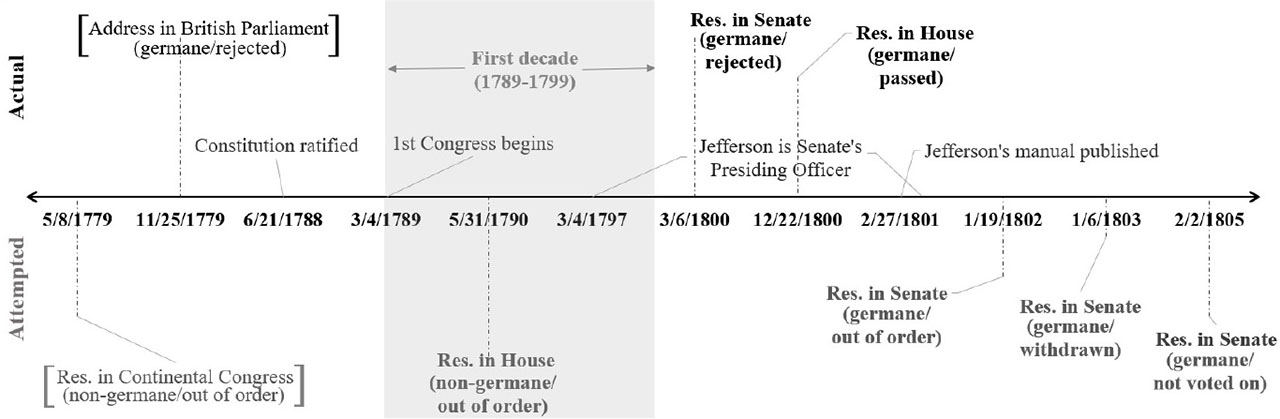
Figure 1:
Tentative Timeline of Actual versus Attempted Complete Substitutes in U.S. Congress, 1789–1805
B. The “Nos”: Not—in Fact—Complete Substitutes
Twenty-six of the 32 episodes I identified as involving at least one “gut-and-amend” or similar procedure were clearly—or most likely—not complete substitutes. This Section chronologically discusses the 10 of these 26 episodes that are more complicated and require elaboration. For instance, for almost all these 10 episodes, neither the journals nor the Annals provided the full text of either the original legislation or its amendment and I had to piece together evidence of what happened. The Appendix chronologically documents the other 16 of these 26 episodes, which are easier cases to prove. For each episode, the Appendix presents a brief textual comparison of the original legislation to its amendment indicating the commonality involved.
1. Ten Episodes Requiring Elaboration
a. First Episode
The first episode occurred in the House early in the First Congress on June 29, 1789. The committee on the “bill to regulate the collection of the duties imposed on goods, wares, and merchandises imported into the United States” reported “an entire new bill, as an amendment and substitute to the former bill.” 113 Neither the journal nor the Annals provide the full text of the original bill or the amendment. However, regarding the original bill, the Annals documents on June 2, 1789, that it had a section establishing specific ports of entry and delivery for purposes of collecting import duties. 114 And the Annals on July 3, 1789, mentions the amendment aimed to establish enumerated ports of entry “at which foreign vessels might enter.” 115 Thus, at the least, the original bill and the amendment shared language establishing specific ports of entry to help collect import duties.
b. Second Episode
The second episode involved a House resolution proposed on April 7, 1794 (Third Congress). The resolution requested a halt to commercial intercourse with Great Britain and its economic allies unless Great Britain compensated America for several perceived grievances, such as “loses and damages” imposed by hostile British vessels on U.S. ships. This resolution generated multiple days of debate. 116
During a debate on April 14, William Smith of South Carolina argued against the resolution’s wording. His primary objection was that the resolution’s threat to halt commercial intercourse was an unproductive negotiation technique. In a lengthy speech, Smith said he supported asking Great Britain for “reparations, in decent terms, unaccompanied with threats.” 117
More debate on the resolution continued the next day. Smith then “presented his modification of the original [that]…was declared to be a substitute by the Chair, and therefore out of order.” 118 Neither the journals nor the Annals nor the records of the National Archives have the text or any elaboration on the exact nature of Smith’s amendment. 119 However, Smith’s stated preference the day before to have the resolution more politely request British reparations indicates Smith’s amendment would have most likely done just that and omitted any economic threats. Such an amendment would have preserved—at least in essence—the original resolution’s list of perceived grievances and reparation requests.
c. Third Episode
The third episode was on April 13, 1796 (Fourth Congress), and involved a House resolution addressing the prospect of implementing several new treaties. The resolution read as follows:
Resolved, That provision ought to be made by law for carrying into effect, with good faith, the Treaties lately concluded between the Dey and Regency of Algiers, the King of Great Britain, the King of Spain, and certain Indian tribes Northwest of the Ohio.
William Giles of Virginia moved to “strike out all the words after ‘Resolve[d],’ that the resolution might be filled up with other words.” 120 The journals and Annals do not provide the exact “other words” comprising the amendment, and the National Archives has no record detailing his amendment. 121 However, right after proposing his amendment, the Annals noted Giles (emphasis added) “hoped the Committee would adopt…[his] proposition…to have the resolution differently worded.” 122 Becoming “differently worded” is far from being a complete substitute with entirely different text, and it seems the amendment simply reworded the original.
In addition, the Annals provide several details about Giles’ reaction to the original resolution and its other proposed amendments indicating Giles’ “other words” amendment was most likely no complete substitute. For one, Giles supported the part of the original resolution addressing the Spanish Treaty, and he strongly felt that each treaty was “proper for a separate resolution.” 123 Second, before proposing his “other words” amendment, Giles had opposed a different amendment, in part, for being a “substitute.” The different amendment he had opposed read, “[I]t is expedient to pass the laws necessary for carrying the Treaty with Spain into effect.” 124 This amendment was even on Giles’ preferred topic of the Spanish Treaty and was worded similarly to the original resolution. But this amendment was different enough from the original to be a substitute in Giles’ opinion. Third, later on after proposing his “other words” amendment and after the House ultimately made the original resolution mention only the Spanish Treaty, Giles supported preserving the original resolution’s language that “provision ought to be made by law for carrying into effect” the Spanish Treaty. 125 Perhaps the same or similar language had comprised Giles’ “other words” amendment.
d. Fourth Episode
The fourth episode occurred on January 8, 1798 (Fifth Congress), after the House began discussing the “Bill for the relief of the legal representatives of certain deceased officers and soldiers.” This bill read as follows:
That the representatives of such officers and soldiers of the [U.S.] Army… as died after [March 24, 1783]…, and before [November 3, 1783]...shall be entitled to all the emoluments to which the said officers and soldiers would respectively have been entitled if they had lived to the end of the war between the United States and Great Britain [i.e., the Revolutionary War.]
Thomas Evans of Virginia motioned to “strike out all the bill after the enacting clause...to introduce words which went expressly to declare the period of the termination of the war.” 126 Neither the journal nor the Annals provide the exact words of Evans’ amendment. However, his amendment focused on mentioning the Revolutionary War’s correct end date, which was a qualifier for the rest of the bill compensating representatives of the war’s veterans. Surely, Evans’ amendment would have preserved this main part of the bill compensating the representatives.
e. Fifth Episode
The fifth episode occurred on April 13, 1798 (Fifth Congress), when the House considered a Senate amendment to the House’s “bill providing an appropriation for completing the necessary buildings in the city of Washington.” The Senate’s amendment “struck out all the bill, except the enacting clause, and inserted in its place a provision for a loan of [$]100,000[.]” Neither the journals nor the Annals provide the full text of the original House bill or the Senate’s amendment. But the House resolution on which the bill was based, which passed on March 13, read as follows:
[That 200,000] dollars be appropriated for completing the buildings requisite for the [U.S.] Government…at the city of Washington[.] 127
And right after the Annals mentioned the Senate’s “gut-and-amend” proposition, the Annals noted “[t]he original bill, as sent from this House, proposed a grant of [$]200,000,” which was consistent with the bill’s corresponding resolution. The House passed the Senate’s amendment after a congressman remarked “this [loan of $100,000 in the Senate amendment] was all that could be got at this time,” and the bill’s title remained unchanged. 128 Thus, it is clear the Senate’s amendment allotted $100,000—instead of the original bill’s $200,000—toward completing government buildings in Washington.
f. Sixth Episode
The sixth episode began on June 1, 1798 (Fifth Congress), in the House with the “bill providing for the assessment and collection of direct taxes.” The House submitted the bill to a committee for amendment after deleting the bill’s first section, which comprised “the principle of the bill,” and requiring “many [other] alterations.” Several days later on June 5, the said committee reported its amendment as a “new bill” with a different title, being the “bill providing for the valuation of lands and dwelling houses, and for the enumeration of slaves in the United States.” One congressman even said this “new bill” excluded “everything which relates to the collection of the taxes [from the original bill], and...confine[d] it to the assessment only[.]” 129 It appeared at least much of the original bill was gone, and it was unclear if the new bill’s assessment language was essentially the same or only germane to the original bill’s assessment language.
Unfortunately, neither the journals nor Annals contain full text of the original bill or the committee’s new bill. Nevertheless, a debate about the committee’s “new bill” on June 8 revealed the following commonality between the two bills: “[T]he original bill provided that every dwelling house with its appurtenances [i.e., items like fences tied to the land]…above…$200, should be separately enumerated; but in the…[new] bill the provision is extended to all houses above…$100.” 130 The original and new bills, therefore, shared at least one assessment provision, being the enumeration of dwelling houses and their appurtenances starting at a certain value for purposes of assessing taxes.
g. Seventh Episode
The next episode occurred a month later in the House on July 6, 1798 (Fifth Congress). The House was discussing the Senate “bill to declare the Treaties between the United States and the Republic of France void and of no effect.” This bill had one section reading as follows:
That the Treaty of Amity and Commerce, and the Treaty of Alliance, between the United States and the French Government...and the Consular Convention between the same parties…are hereby declared, void and of no effect[.] 131
Congressman William Giles of Virginia then suggested “whether a declaration of war might be moved as an amendment to the bill.” The Annals noted that “[t]o his mind, there seemed…little difference between saying the treaties were at an end, and declaring war.” A war declaration may seem like a significant step beyond ending treaties between nations. However, according to the Eighteenth Century understanding of declaring war, such a proposed treaty termination could be tantamount to declaring war and a war declaration could be interpreted as indicating any treaty(ies) (except for wartime provisions) between warring countries was void. 132 Thus, Giles’ amendment idea to declare war preserved the essence of the original bill’s declaration that the given treaties were void. In any case, Giles never even officially proposed his amendment. 133 Two other amendments using a “gut-and-amend” procedure were later proposed, but neither amendment was a complete substitute. 134
h. Eighth Episode
The eighth episode happened several years later in the Senate in April 1800 (Sixth Congress) with the “bill to amend the act establishing the Judicial Courts of the United States.” This bill originated on April 8 from a committee led by Nathaniel Chipman of Vermont. The Senate decided to appoint this committee weeks earlier on March 12 with this purpose (emphasis added):
[T]o inquire whether any, and what, amendments are necessary in the act to establish the Judicial Courts of the United States [from 1789], particularly the provision in said [1789] act for summoning jurors to serve in the Courts of the United States, and to report by bill or otherwise. 135
Neither the journals nor the Annals provided the original text of the original committee bill, but given the committee’s above assignment, the original bill most likely amended the then-current process for summoning jurors to serve in U.S. courts. 136
After the Chipman committee bill’s second reading on April 16, the Senate sent the bill to a committee led by Wilson Nicholas of Virginia for possible amendment. On April 28, this Nicholas committee reported the following recommendation, which proposed to gut-and-amend the Chipman committee bill as follows (emphasis added):
Strike out the whole of the bill after the word “serve”...and insert “in the courts of the United States, shall be designated by lot, or otherwise, in each state or district respectively, according to the mode of forming juries, to serve in the highest courts of law therein, now practised [sic]; so far as the same shall render such designation practicable by the courts and marshals of the United States.” 137
Clearly, this amendment text aimed to establish a process for summoning jurors to serve in U.S. courts, which—as discussed above—the original Chipman committee bill most likely had as well.
The next day on April 29, the Senate brought up the Nicholas committee amendment but never voted on it. 138 The Senate made no further amendments to the Chipman committee bill and passed it in its final form, which was the same text as the Nicholas amendment minus a couple commas. 139 This final form thereby indicates—without a doubt—that the Nicholas committee amendment was no complete substitute to the Chipman committee bill and attempted only minor grammatical corrections.
i. Ninth Episode
The ninth episode occurred in early 1801 (Sixth Congress) in the Senate and involved the House “bill to erect a mausoleum for George Washington.” The original bill’s full text is not in the journals or Annals, but the Annals provides the original bill’s first section as follows:
That a mausoleum of American granite and marble, in a pyramidal form, one hundred feet square at the base, and of a proportionate height, shall be erected, in testimony of the love and gratitude of…[American] citizens… to George Washington.”
A debate on this bill further noted the original bill allotted $70,000 toward building the mausoleum. 140
On January 22, 1801, a Senate committee on this bill proposed—and the full Senate accepted—an amendment that struck out “the whole of the [original] bill” for this replacement text:
In testimony of the respect and gratitude of…[American] citizens… to George Washington…there…hereby is…appropriated a sum not exceeding -- thousand dollars…and to adopt all other measures necessary and proper for the due execution of this act. 141
This new text had several blanks to be determined later (indicated by “--”), and the new text did not explicitly mention the appropriation would create a mausoleum. However, after this amendment passed, the title remained unchanged. 142 Thus, all the amendment’s language—given the title—was obviously for the purpose of erecting a mausoleum for Washington. And, considering the original bill’s allotment of $70,000 toward the mausoleum compared with the Senate amendment’s allotment of “a sum not exceeding -- thousand dollars,” this episode surely involved no complete substitute.
j. Tenth Episode
The tenth and final episode requiring elaboration occurred in the Senate on April 7, 1802 (Seventh Congress). Under debate was the “bill to revive and continue in force an act, entitled ‘An act to augment the salaries of the officers therein mentioned,’ passed the second day of March, 1799.” 143 The Annals does not provide this bill’s full text but does say the bill declared the “said act [from 1799 to augment the salaries of officers] be revived” for three years. 144 The 1799 law’s first section read as follows:
That in lieu of the salaries heretofore allowed by law to the [U.S.] officers…herein mentioned, the following compensations be…granted to the said officers…
[The section then allotted various salaries up to $5,000 to 14 U.S. officers, such as the Secretary of State, Treasurer, and Postmaster General.]
The second section then declared the law would be valid for three years.
A senator then motioned that the original bill under debate (declaring this 1799 law’s revival) be replaced with new amendment text. However, this amendment simply duplicated all the 1799 law’s text, putting blanks (“…”) for the salaries of the 14 U.S. officers to be determined later. 145 The amendment thereby restored the 1799 law’s actual language and preserved the essence of the original bill to revive the 1799 law.
2. Summary of the “Nos”
These 10 episodes of a “gut-and-amend” or similar procedure involved varying levels of complexity. However, each amendment clearly or most likely preserved at least the essence of one significant part of the original legislation. The Appendix documents the 16 other similar episodes.
V. Conclusions
A. When and How: Rise of Complete Substitutes
According to my analysis of congressional records from 1789 to 1805 (First through Eighth Congresses), the year 1800 marked the rise of complete substitutes—at least to resolutions and not revenue bills or other legislation—in Congress. In March that year, the Senate—with Thomas Jefferson as Presiding Officer—saw an actual complete substitute to a resolution requesting a congressional investigation into the General Advertiser’s publications about a controversial election bill and into William Duane, the paper’s editor and Jefferson’s political ally. And months later in December, the House followed suit with its first actual complete substitute, which was to a resolution about William Sargent’s controversial governing of the Mississippi Territory.
Of course, trying to propose complete substitutes as amendments was not novel to U.S. Congress in 1800. As documented, the year 1779 saw one attempted complete substitute to a resolution in the Continental Congress and an actual complete substitute to an address to the King in British Parliament.
But in U.S. Congress before 1800, complete substitutes—whether germane or non-germane—were evidently not accepted as proper amendments. For instance, the House’s rule against new motions under color of amendment, adopted during the First Congress, appears to have outright banned any complete substitutes. And from 1789 to 1799, the House had only one attempted complete substitute, which was in 1790 and which was held out of order. Furthermore, the Senate—even though it had no explicit rule against complete substitutes—never had an attempted complete substitute before its first actual complete substitute in 1800.
It evidently took Jefferson, whose Manual of Parliamentary Practice seems to have approved of complete substitutes, to permit the rise of complete substitutes in Congress. As thoroughly documented, the first actual complete substitute, which involved the Duane resolution, was during Jefferson’s tenure as the Senate’s Presiding Officer. In this role, Jefferson had sole power over deciding if a given amendment was in order. But, of course, Jefferson was in no impartial position to determine the permissibility of that complete substitute, which directly bore on the freedom of his ally Duane and Jefferson’s own presidential ambitions that year. It is therefore unclear if Jefferson permitted the substitute consistent with a pro-complete-substitute interpretation of his two manual quotes or during an understandable moment of political expediency.
B. Post-Ratification History Confirms Original Public Meaning of Amendment
In any case, Congress’ early amendment practice confirms the original public meaning of amendment and not Jefferson’s two manual quotes that seemingly approve of complete substitutes. Between 1789 and 1805, the Senate made no complete substitutes to House revenue bills. And Congress’ first two actual complete substitutes to any legislation—in these cases resolutions—were in 1800, which was obviously after the important first decade (1789–1799/First-Fifth Congresses). There was thus no trace of any accepted, let alone consistent, practice of complete substitution in the earliest Congresses. This trend of no actual complete substitutes between 1789 and 1800 continued the rejection of complete substitutes in the Continental Congress and evident lack of complete substitutes in American legislative bodies between 1774 and 1790. Similar to how the British Parliament’s complete substitute to an address to the King in 1779 was an anomaly to the long British history opposed to complete substitution, Congress’ two complete substitutes to resolutions in 1800 were evidently anomalies to American legislative history. All considered, Jefferson’s two manual quotes—and any historical legal arguments for permitting the Senate’s complete substitutes to House revenue bills—lack any significant support from either the ratification period or the important first decade and thus have no significant foundation in originalism.
C. Return of the Original Public Meaning of Amendment?
Jefferson, as the Senate’s Presiding Officer, appears to have unwittingly validated the apparent claim in his own manual that congressional amendments may be complete substitutes. He thereby created a precedent for and surely enabled Congress’ later complete substitutes, including the Senate’s substitutes to House revenue bills. Of course, this later Senate practice totally disregarded the original public meaning of amendment in the Origination Clause. But perhaps, given this article’s findings, this original meaning will return to prominence. Then, at the most, a Senate amendment to a House revenue bill could—without originating a new revenue bill—replace all parts of the House bill except for the essence of one significant part with new, germane parts.
I thank my following reviewers: Marion and Michael Smyth; Andrew T. Hyman, Esq.; and Michael D. Ramsey, Hugh and Hazel Darling Foundation Professor of Law, University of San Diego School of Law.
Appendices
Appendix:
All Other Episodes Involving a “Gut-and-Amend” or Similar Procedure but Not a Complete Substitute
| Date & Source | Episode (emphasis added) | Original (emphasis added) | Amendment (emphasis added) | Commonality (between Original and Amendment) |
|---|---|---|---|---|
| 1) May 25, 1790 (1st Congress) 1 Senate Journal, supra note 82, at 145–46. | The Senate was considering the House’s “bill, entitled an act for finally adjusting and satisfying the claims of Frederick William de Steuben” (see Original). The committee on the bill proposed this amendment: “In the second line, strike out from the word ‘order’ inclusive, to the end of the bill, and insert [see Amendment.]” | That, in order to make full and adequate compensation to Frederick William de Steuben, as well for the sacrifices and eminent services, made…to the United States during the late war… there be paid to the said Frederick…seven thousand dollars…and…an annuity of… [2,000] dollars during life…to be paid in quarterly payments [.] 146 | That, in consideration of the eminent services of the Baron de Steuben, rendered to the United States during the late war, there be paid to him an annuity of two thousand dollars…in quarterly payments [.] | Both provided Frederick William de Steuben a lifetime annuity of $2,000 paid quarterly for his wartime services to the United States. |
| 2) Aug. 7, 1790 (1st Congress) 1 Senate Journal, supra note 82, at 208–09. | The Senate began discussing the House’s “bill, entitled ‘An act making an appropriation for discharging the claim of Sarah Alexander, the widow of the late Major General Lord Stirling, who died in the service of the United States’” (see Original). The committee on the bill reported this amendment: “Strike out of the section all subsequent to the word ‘that,’ in the second line, and substitute as follows…[see Amendment.]” | [No text of the original bill is in the journals or Annals. However, the Annals contains the following House resolution from August 2, 1790, which was in response to “the petition of the widow [Sarah Alexander] of the late General Sterling” and which was the basis of the original House bill:] Resolved, That the sum of [$6,972]…being the half-pay of a Major General in the late American army, for the term of seven years, be allowed. 147 | The Register of the Treasury shall…grant unto Sarah [Alexander], the widow of the late Major General Earl of Stirling, who died in the service of the United States, a certificate, to entitle her to a sum equal to an annuity for seven years half pay of a Major General[.] [This amendment contained several other allotments for other similarly situated individuals.] | Most likely, both provided Sarah Alexander—as a Major General’s widow—the half-pay of a Major General. |
| 3) March 3, 1795 (3rd Congress) 2 Senate Journal, supra note 82, at 184. | The Senate was discussing the House “bill, entitled ‘An act to authorize the [U.S.] President… to obtain a cession of claim to certain territory’” (see Original). Aaron Burr of New York then proposed “to amend the bill, to be read as follows…[See Amendment.]” | [No text of the original bill is in the journals or Annals. However, the Annals contains the following House resolution from February 26, 1795, which was in response to “the disposition of Indian lands by the Legislature of the State of Georgia” and which was the basis of the original House bill:] Resolved, That the [U.S.] President…be authorized to obtain a cession of the State of Georgia of their claim to the whole, or any part, of the land within the present Indian boundaries. 148 | Be it enacted...That the [U.S.] President…be… authorized…to obtain, by purchase or donation, a relinquishment and cession of the whole or any part of the lands claimed by or under the state of Georgia, and without the ordinary jurisdiction thereof[.] | Most likely, both authorized the U.S president to obtain a cession of the Indian lands claimed by the State of Georgia. |
| 4) June 12, 1795 (10th Session of Executive Proceedings of the Senate in 3rd Congress) 1 Senate Executive Journal, supra note 84, at 179. | The Senate was considering a treaty with Great Britain that President George Washington had sent the Senate on June 8. That day, the Senate had approved a resolution “[t] hat the Senators be under an injunction of secrecy on the communications this day received from the [U.S.] President…until the further order of the Senate.” On June 12 when the treaty was being discussed, a resolution was proposed to publish the treaty (see Original). But immediately thereafter, a motion was made and approved “to modify the motion [to publish the treaty] as follows…[see Amendment].” | [T]hat the said treaty be published [i.e., rescind the enjoined secrecy and make the treaty widely and publicly known]. | That so much of the resolution of [June 8]… as enjoins secrecy upon the Senators with respect to the communications on that day received from the President, be rescinded. | Both removed the secrecy of the treaty. |
| 5) Jan. 9, 1798 (5th Congress) 7 Annals (House), supra note 83, at 814–17. | The House began discussing a resolution about a land dispute between Indians and the State of Tennessee (see Original). William Clairborne of Tennessee then “moved to strike out all the words of the resolution after the word ‘for,’ in second line, and to insert [see Amendment.]” | Resolved, That the sum of---dollars be appropriated for the relief of such [Tennessee] citizens…as have rights to lands within the…State…and have made actual settlements thereupon, and who have been deprived of the possession of the said lands by the operation of the act for regulating the intercourse with the Indian tribes. The said sum to be subject to the order of the [U.S.] President…to be expended under his direction… in extinguishing the Indian claim to the above described lands, in case he shall deem it expedient to hold a treaty for that purpose[.] | Resolved, That the sum of---dollars be appropriated for the extinction of the Indian claim to all or any part of the land within the limits of the State of Tennessee, in case the [U.S.] President…shall think it expedient to hold a treaty for that purpose. | Both shared key components, such as an appropriation toward the extinction of the Indian claim to land said to be within the limits of the State of Tennessee. |
| 6) March 24, 1800 (6th Congress) 3 Senate Journal, supra note 82, at 56. | The Senate was in the middle of an episode, partially discussed earlier, in which the Senate ultimately tried arresting editor William Duane of the General Advertiser newspaper for publishing a leaked version of a controversial election bill and for comments critical of Federalists in power. 149 On this date, a Senator introduced a resolution essentially stating that Duane be allowed to be heard by counsel (see Original). Immediately, another Senator motioned “to strike out all the motion subsequent to the word ‘Duane,’ and insert [see Amendment.]” | Resolved, That William Duane be permitted to be heard by counsel, he having appeared… and requested that he might be heard by counsel. | Resolved, That William Duane, having appeared at the [Senate] bar… and requested to be heard by counsel on the charge against him…be allowed the assistance of counsel[.] | Both permitted William Duane to be heard by counsel. |
| 7) April 24, 1800 (6th Congress) 3 Senate Journal, supra note 82, at 80. | The Senate brought up the “bill supplementary to the act to suspend part of an act, entitled ‘An act to augment the army of the United States, and for other purposes’” (see Original). The committee on the bill reported this amendment: “Line 2, after the word ‘that,’ strike out to the end of the bill, and insert [see Amendment].” | Be it enacted...That all further appointment of officers authorized by the act intitled “an act to augment the army of the United Sates and for other purposes,” shall be suspended until the further order of Congress; unless in the recess of Congress…war should break out between the United States and the French Republic, or imminent danger of [French] invasion…shall, in the opinion of the [U.S.] President…be discovered to exist[.] 150 | Be it enacted...That, it shall be lawful for the [U.S.] President… to suspend any further military appointments under the act to augment the army of the United States, and for other purposes… according to his discretion[.] | Both authorized the suspension of military appointments being made under the given act with possible exceptions at the president’s discretion. |
| 8) April 25, 1800 (6th Congress) 10 Annals (House), supra note 83, at 159; 689; 698–99. | The House discussed a Senate amendment to the House’s “bill to divide the Territory of the United States Northwest of the Ohio into two separate governments” (see Original). At the time, there was a large territory in the United States called the “Territory of the United States North-West of the River Ohio.” The bill aimed to split up this territory into two governments. The Senate amendment to the bill recommended “striking out the whole bill, and inserting a new one [see Amendment].” | Sec. 1. Be it enacted...That the territory of the United States, north-west of the river Ohio, shall, for purposes of temporary government, be divided into two districts…and that part of the said territory which lies to the westward of the said line, shall form one district, to be called the ----territory, and that which lies to the eastward of said line, shall form one other district, to be called the ----territory... 151 | That from and after the fourth day of July next, all that part of the territory of the United States, north west of the Ohio river… shall, for purposes of temporary government, constitute a separate territory, and be called the Indiana Territory.
152 [Five other sections further established the two governments, such as a section establishing the seats of the governments of the Indiana Territory and the reshaped Territory of the United States North-West of the Ohio river.] | Both split the “Territory of the United States Northwest of the Ohio River” into two separate territories. |
| 9) February 6, 1801 (6th Congress) 3 Senate Journal, supra note 82, at 121–22; 10 Annals, supra note 83, at 896–97; 900. | A Senator read the “bill providing for the more convenient organization of the courts of the United States” (see Original). A senator suddenly motioned to “strike out the whole of the bill” after the second line and insert a lengthy new bill (see Amendment). | [Text of the entire bill is not in the journals or Annals. However, the Annals mentions the following two sections of the bill:] Sect. 13: The circuit courts shall have cognizance of all actions, or suits, matters or things, cognizable by the Judicial authority of the United States… where the matter in dispute shall amount to ---- hundred dollars, and where original jurisdiction is not given by the Constitution...to the Supreme Court. Sect. 48: [An annual salary of $2,000 shall be assigned to] each of the Circuit Judges... to be appointed by virtue of this act[.] | Passing of this act, there shall be four circuits [i.e., circuit courts] in the United States; the first to consist of the district[s] of Maine… New Hampshire…and Rhode Island: the second to consist of the district[s] of Connecticut… New York, and New Jersey; [and so on.] | Both established U.S. circuit courts. |
| 10) Dec. 14, 1801 (7th Congress) 11 Annals (House), supra note 83, at 313; 319–24. | The House continued discussing a motion made by Joseph Nicholson of Maryland on December 8. This motion called for an accounting of the oversight by the [Treasury] Secretary of public money spent by Timothy Pickering, a former Secretary of State (see Original). Nicholson decided to “modify his [own] motion” by proposing a different motion in its place (see Amendment.) Another representative immediately responded that he was “well pleased with the substitute[.]” | Resolved, That the [Treasury] Secretary…be directed to lay before this House an account of all moneys received by Timothy Pickering, Esq., former Secretary of State, together with Mr. Pickering’s account of disbursements, and his vouchers for the same. | Resolved, That a committee be appointed to inquire and report, whether moneys drawn from the Treasury [which surely include Timothy Pickering’s transactions] have been faithfully applied to the objects for which they were appropriated…and to report…whether any further arrangements are necessary to … secure the accountability of persons entrusted with…public money. | Both requested a legislative accounting of Treasury transactions involving Timothy Pickering. |
| 11) April 5, 1802 (7th Congress) 11 Annals (House), supra note 83, at 1133–34; 1139–41. | The House was considering a resolution by Roger Griswold of Connecticut. This resolution called for, given a recent Convention between the United States and France, legislative oversight of the finances involved in repairing the French ship corvette Berceau captured by U.S. forces in 1800 (see Original). The following two amendments were proposed in tandem to produce a “gut-and-amend” procedure: 1) Griswold decided to amend his resolution to add language asking the Navy Secretary for “all…documents related to the sale, purchase, and repairs of the vessel” (see Amendment) and then 2) Samuel Smith of Maryland proposed to “strike out all the resolution, excepting that which called for papers.” | Resolved, That the Secretary of State be directed to report to this House whether the sum of $32,839 54 [sic], laid out in repairing the corvette Berceau…was expended… agreeably to the stipulations of the Convention between the United States and France. | Resolved, That the Secretary of Navy be directed to lay before this House copies of all… documents which relate to the sale, purchase, and repairs of that vessel [corvette Berceau]. | Both directed a U.S. secretary to provide the House information regarding the repair of the corvette Berceau ship as part of legislative oversight of the finances involved. |
| 12) Feb. 23, 1803 (8th Congress) 3 Senate Journal, supra note 82, at 266; 270–71; 273–75. | The Senate was considering a series of related resolutions presented together for consideration on February 16, 1803, that addressed growing concerns of a hostile France, which then controlled the Louisiana Territory and Mississippi River (see Original). John Breckinridge of Kentucky then proposed to “amend the resolutions under consideration, by striking out all that follows the word ‘resolved,’ and inserting as follows…[see Amendment].” | Resolved, That the United States have an indisputable right to the free navigation of the river Mississippi, and to a convenient place of deposite for their produce and merchandise in the island of New Orleans… -That he [the U.S. president] be authorized to call into actual service any number of the militia of the states of South Carolina, Georgia, Ohio, Kentucky, Tennessee, or of the Mississippi territory, which he may think proper, not exceeding fifty thousand, and to employ them, together with the military and naval forces of the Union, for effecting the objects above mentioned. -That the sum of five millions of dollars be appropriated to the carrying into effect the foregoing resolutions [.] | Resolved, That the [U.S.] President…is hereby, authorized, whenever he shall judge it expedient, to require of the executives of the several states to take effectual measures to organize, arm, and equip, according to law, and hold in readiness to march, at a moment’s warning, 80,000 effective militia, officers included… Resolved, That -- dollars be appropriated for paying and subsisting such part of the troops aforesaid, whose actual service may be wanted[.] | Both shared several key components, including authorizations for 1) the president to mobilize tens of thousands of militia troops (from various states) and 2) an appropriation to fund this mobilization. |
| 13) Jan. 11, 1804 (8th Congress) 4 House Journal, supra note 81, at 527–28. | The House was discussing a committee report on the “memorials of Alexander Moultrie, of the State of South Carolina, in [sic] behalf of himself and others, and of the Virginia Yazoo Company, by William Cowan, their agent.” This report involved a complicated land dispute involving multiple parties. A resolution was proposed that would, regarding the report, allow a specific company to be heard by its agent at the Bar of the House (see Original). Another representative motioned to “amend the same, by striking out all the words from the word ‘Resolved,’ in the first line, to the end of the motion, and inserting, in lieu thereof, the following words…[see Amendment].” | Resolved, That the South Carolina Yazoo Company be heard by their agent, on Monday next, at the Bar of the House. | Resolved that this House will, on Monday next, hear all the agents of the different companies [such as South Carolina Yazoo Company], claiming lands South of the State of Tennessee, who may choose to speak at the Bar of this House. | Both allowed at least one company to speak about the given topic at the Bar of the House. |
| 14) Jan. 3, 1805 (8th Congress) 3 Senate Journal [Trial of Samuel Chase], supra note 82, at 514–15. | The Senate was conducting the trial of Samuel Chase, a Supreme Court justice and well-known Federalist. The House had impeached Chase over allegations of violating principles of justice with partisan rulings. Stephen Bradley of Vermont proposed an order compelling Chase to respond to the charges by a specific deadline (see Original). William Giles of Virginia then motioned “to amend the motion, and to strike out all that follows the word ‘Ordered,’ and insert [see Amendment.]” | Ordered, That Samuel Chase file his answer with the Secretary of the Senate, to the several articles of impeachment exhibited against him by the House of Representatives, on or before the -- day of --. | Ordered, That -- next shall be the day for receiving the answer, and proceeding on the trial of the impeachment against Samuel Chase. | Both gave Samuel Chase a deadline to submit his response to the impeachment charges. |
| 15) Feb. 5, 1805 (8th Congress) 3 Senate Journal, supra note 82, at 446; 14 Annals (Senate), supra note 83, at 39. | The Senate resumed discussion of the “bill, entitled an act to regulate the clearance of armed merchant vessels” (see Original) and a previously proposed amendment to it. The Annals suggest that this previously proposed amendment was the one made by the committee on the bill on January 21, 1805, as no other amendment was proposed to the bill after this one was proposed. In any case, the committee amendment proposed to “strike out the whole of said bill, after the enacting clause, for the purpose of inserting an amendment [see Amendment].” | Be it enacted…That, after due notice of this act at the several custom-houses, no merchant vessel armed, or provided with the means of being armed at sea, shall receive a clearance…to leave the port where she may be armed or provided, without bond, with two sufficient sureties being given by the owner…or by the master or commander, to use of the United States, in a sum equal to double the value of said vessel…Provided, That the regulations herein contained shall not be construed to extend to vessels bound to any port or place in the Mediterranean, or beyond the Cape of Good Hope... 153 | Be it enacted...That after due notice of this act at the several custom houses, no armed merchant vessel, or vessel prepared for armament, the property of any [U.S.] citizen … or person residing therein, shall receive a clearance, or be permitted to depart from any port in the United States, to any island in the West Indies, or any port or place in this continent, situated between Surinam and the western boundary of the United States, unless the owner or owners, agent or agents, and the commander of such vessel for the intended voyage, shall give bond in a sum equal to double the value of such vessel, her arms, tackle, apparel, and furniture… 154 | Both permitted an armed merchant vessel to get clearance to depart a port if a bond at least equal to double the vessel’s value is provided by the vessel owner or the master/commander. |
| 16) Feb. 16, 1805 (8th Congress) 3 Senate Journal, supra note 82, at 455–56. | The Senate was considering the “bill further providing for the government of the territory of Orleans” (see Original). Back-to-back amendments were proposed to “gut-and-amend” the bill. The first amendment was to “[s]trike out of the first section of the bill all that follows the enacting clause, and insert [see ‘Sec. 1’ of Amendment].” And the second amendment was to “[s]trike out the residue of said bill, and insert in lieu thereof the following…[see Sect. 2 – Sect. 6 of Amendment].” | [Sec. 1.] Be it enacted...That the [U.S.] President…is hereby authorized to establish within the Territory of Orleans, a government in all respects similar (except as is herein otherwise provided) to that now exercised in the Mississippi Territory[.] Sec. 2. And be it further enacted…the Governor of the said Territory shall cause to be elected twenty-five representatives, for which purpose he shall lay off the said Territory into convenient election districts, on or before the --day of-- next, and give due notice thereof throughout the same and first appoint the most convenient place within each of the said districts, for holding the elections; and shall nominate a proper officer or officers to preside at and conduct the same, and to return to him the names of the persons who may have been duly elected[.] 155 | [Sec. 1.] That, for…the people of Louisiana to enjoy the right of self government, the [U.S.] President…is hereby authorized to cause the territory ceded by the Republic of France to the United States, by the treaty concluded at Paris on the 30th of April, 1803 [i.e., what became the territories of Louisiana and Orleans], to be laid off on or before the -- day of -- into convenient election districts, having reference to population and location, and not exceeding the number of -- districts; and to appoint the most convenient time thereafter, as well as place, within each of said districts, for holding an election; and to appoint in each district a proper person or persons, inhabitants of the same, respectively to preside at and conduct the election which is hereinafter described[.] [Sect. 2 – Sect. 6 further provided for the government.] | Both established 1) “convenient election districts...for holding an election” by a certain deadline in the Territory of Orleans and 2) the “most convenient place[s]” for elections with “proper officers” to preside over and conduct the elections. |
146 2 Annals, supra note 83, at 1556–57.
147 2 Annals, supra note 83, at 1717–18.
148 4 Annals, supra note 83, at 1256–57.
150 Bill supplement augmentation of the army. April 3rd 1800; Sen 6A-B1, Box 1, Folder 2, Internal Ref: 12E2C 5/9/2; RG 46, NAB.
151 H.R. 39 - 6th Congress (1799–1801): A Bill, To divide the Territory of the United States North-West of the Ohio, into two separate Governments, 6th Cong. (1800), https://www.congress.gov/bill/6th-congress/house-bill/45/1800/03/20/text.
152 Message to Congress, April 21, 1800 (Senate Amendment): A Bill, To divide the Territory of the United States North-West of the Ohio, into two separate Governments, 6th Cong. (1800), https://www.congress.gov/bill/6th-congress/century-of-lawmaking-historical-document/73/1800/04/21/text?s=1&r=1.
153 14 Annals (Senate), supra note 83, at 722–23.
154 Report of the Committee to whom was referred the Bill, entitled “An act to regulate the clearance of armed merchant vessels.” January 21, 1805. Sen8A-D1, Box 5, Internal Ref: 12E2C 5/11/2; RG 46, NAB.
155 14 Annals (Senate), supra note 83, at 45–46.