
I. Introduction
Anticipation for a successful negotiation of a post-Brexit U.S.-UK FTA is high. Both President Trump and Prime Minister Johnson are eager to finalize the trade deal. But there are certain realities and obstacles to surmount, some of them political, including a third-party, EU, indirectly influencing the negotiations. While UK has a transitional period until December 31, 2020, absent an extension, to reach an exit deal with EU, including an FTA, both sides have significant unresolved issues. 1 That deal is expected by EU to be balanced on UK agreeing to continue its obligations on labor and other issues, such as that the UK commit in writing to stay in the jurisdiction of the European Court of Human Rights, 2 which could affect and influence the UK-U.S. FTA negotiations, especially on labor standards.
As those negotiations progress, the US presidential elections approach, and as much as the Trump Administration may want to finalize a U.S.-UK FTA, the U.S. Congress must approve it. Congress may not want to provide President Trump with a pre-election trade victory and Congress could hold up final approval. 3 Further slowing the negotiations is the coronavirus Pandemic and the uncertainties in the market. 4 Still, it is expected the U.S.-UK FTA negotiations will continue. 5
The UK also is working to replicate existing EU deals with non-EU countries. The EU has more than 40 trade agreements with around 70 countries. During the transition period, EU trade agreements continue to apply to the UK. As of June 2020, the UK had signed continuity deals covering over 8% of total UK trade with close to 50 countries or territories, including Switzerland, Liechtenstein, Chile, Israel, and South Korea. … Also, as part of its “Global Britain” strategy, the UK is taking steps to pursue new trade deals. … Rather than rolling over the EU-Japan FTA, Japan seeks to quickly negotiate new terms with the UK in time for Japan to pass an FTA in autumn. The UK also launched FTA negotiations with Australia and New Zealand and seeks to join the regional Comprehensive and Progressive Agreement for Trans-Pacific Partnership (CPTPP) …. U.S. Trade Representative (USTR) Robert Lighthizer has committed to pursuing a comprehensive agreement that would be subject to congressional approval and not a limited, ‘skinny’ deal. He warned, however, that negotiations will take time and likely not be complete in advance of the upcoming presidential election. 6
The agenda for the labor issues likely will flow from each country's prior FTA obligations; for the U.S. it will be the USMCA and for the UK, it will be the EU's CETA. Both FTAs agree to the ILO core labor obligations, albeit with added nuances and obligations, but they have also added new provisions which, in the case of the US, may be ahead of its current law, such as protecting the right to strike. 7 Likewise, the provisions for dispute resolution have differed. 8
The recent USMCA provides obligations on gender discrimination, including gender identity and LGBTQ+, and pay gap issues; it also deals with migrant workers’ rights, a hot issue in each country, as well as family care and paid medical leave, and it recognizes the right to strike. CETA, which included UK as an EU Member at the time of the signing, also has a list of progressive labor obligations. These include labor standards committing the UK to the ILO Decent Work Agenda and the Declaration on Social Justice for a Fair Globalization that are more progressive than those required by the USMCA. 9 Leaders of the major unions of both countries have weighed in with their union's agenda for the new FTA. 10
The article in Part II identifies the labor obligations agreed to by the Parties in their previous FTAs and sets them up as likely agenda items; Part III compares these agenda items with existing labor legislation in each country and identifies potential trouble spots likely to be put on the negotiating agenda; Part IV provides analysis of the challenges of uncertainty and the likely emerging agenda for negotiation of the labor issues in the U.S.-UK FTA; Part V concludes.
II. Non-Legal
A. Post-Brexit Drama: “Three Parties” in Bilateral Negotiations–U.S., UK, and EU and the “Leaked Draft”
UK's trade realignment with the EU following Brexit matters significantly on the level of labor and human rights standards in the US-UK negotiations. Is the UK still bound to EU standards and the European Charter and other EU legal institutions? 11 If so, this can provide a higher bar for worker protections than just UK labor laws. Therefore, American negotiators will pay close attention to the ongoing and possibly concurrent UK-EU negotiations on many matters, including labor.
The UK likewise must evaluate the risk of completing a UK-U.S. FTA before reaching agreement with EU on its future arrangement. The U.S.-UK trade (import, export, and services) is reported for UK to be at about 15 percent of its trade versus UK-EU trade is at about 49 percent. U.S. standards are often lower than that of EU, e.g., on food and health service drugs; and loss of EU trade protections could affect the viability of FDI and supply chains using UK as a base. 12 Assuming the UK would need to make concessions to the U.S., one can predict UK's negotiations and arrangements with EU may certainly be complicated. 13
The UK's position on a trade deal with EU was first presented by Prime Minister Boris Johnson. 14 Its negotiation goals, particularly on labor issues, were laid out by the UK Government as follows.
“The UK aims for a relationship based on ‘friendly cooperation between sovereign equals’ with both sides respecting each other's ‘legal autonomy’. It will not abide by EU rules and states the UK ‘will not negotiate any arrangement in which the UK does not have control of its own laws’, will not accept any ‘obligations’ to be aligned with EU laws, or the ‘EU institutions, including the court of justice’. The UK wants a “comprehensive free trade agreement” but in the same paragraph states it wants a Canada-style agreement ‘supplemented’ by a range of other agreements including ‘fisheries law enforcement … judicial cooperation in criminal matters, transport and energy’. [Re]Workers’ rights: Here the government is committing to ‘reciprocal commitments not to weaken or reduce the level of protection afforded by labor laws and standards.’ However, it wants to reserve the right to ‘adopt or modify its labor laws.’” 15
A leaked draft of the EU's early proposals for the Brexit agreement affecting trade (UK-EU FTA) shows EU proposals would make some actions of future British governments irreversible, such as “social rights” which include labor rights. 16
The agreement drawn up by the European Commission and seen by The Independent insists that “future levels of protection” brought in by both sides must be maintained as a condition of UK access to European markets. The plan goes further than a simple “non-regression” pledge to maintain existing rules at the point of Brexit, and means any future UK government that brings in new social rights could see its changes become untouchable, as long as they are endorsed and matched by Brussels. The rule is the latest bid by the EU to ensure Britain does not unfairly deregulate itself into “Singapore-on-Thames” after Brexit, to unfairly undercut European businesses with lower standards. 17
The EU also insists on the requirement that the UK commit in writing to remain in the jurisdiction of the European Court of Human Rights. The document says both parties must have a “continued commitment to respect the European Convention on Human Rights.” 18 It is expected that EU's proposals will be resisted by UK negotiators, “who have accused Brussels of trying to hold Britain to conditions that it is not holding other countries with free trade agreements. 19 But EU officials are adamant that the UK's proximity to and links with Europe require a strong ‘level playing field’ of regulations.” 20
B. Agenda Items: Looking Back to the Future (USMCA and CETA)?
It is likely the Parties to the U.S.-UK FTA will draw upon recently negotiated FTAs, which for the U.S. would be USMCA and for the UK would be CETA, negotiated by the EU for its members, which at the time included the UK. The UK would also likely look to keep other EU residual obligations remaining after its withdrawal from the EU is final, perhaps including the Charter of Fundamental Rights of the European Union (EU Charter) and labor standards in a UK-EU FTA, if negotiated. 21
1. USMCA22
The labor rights provisions in the USMCA can be organized as follows.
Each Party agrees to maintain in its statutes and regulations, and practices thereunder, for the following rights, as stated in the basic ILO core labor standards in the ILO Declaration on Rights at Work, including the freedom of association (and now including the right to strike) and the right to collectively bargain, the elimination of forced or compulsory labor, the abolition of child labor, and the elimination of discrimination in respect of employment and occupation. 23 The USMCA now also provides for “acceptable conditions of work with respect to minimum wages, hours of work, and occupational safety and health.” 24
Non-Derogation and Enforcement of Labor Laws: The Parties recognize that it is inappropriate to encourage trade or investment by weakening or reducing the protections afforded in each Party's labor laws. 25 They also agree to fully enforce the labor provisions of the agreement and create processes to mediate and resolve labor conflicts. 26
Violence, threats, or intimidation against workers for exercising their labor rights under Article 23.3 in a manner affecting trade or investment between is prohibited. 27
Migrant Workers are recognized as vulnerable and in implementing Article 23.3, each Party shall ensure that migrant workers are protected under its labor laws, whether they are nationals or non-nationals of the Party. 28
Eliminating discrimination in employment and occupation 29 is recognized and the parties support the goal of promoting equality of women in the workplace and agree to implement policies 30 that it considers appropriate to protect workers against employment discrimination on the basis of sex, including with regard to sexual harassment, pregnancy, sexual orientation, gender identity, and caregiving responsibilities; provide job protected leave for birth or adoption of a child and care of family members; and protect against wage discrimination.
Dispute Settlement:
Labor consultations and an enforceable panel report are available upon disagreement whether a labor violation has occurred, 31 procedures are provided, and a retaliatory remedy is available under the State-to-State Dispute Settlement mechanism for a breach of the labor provisions. 32 Procedures for Individual-Investor (ISDS) (between only the U.S. and Mexico). There also is a new labor-related dispute resolution applicable only to U.S.-Mexico. The rapid response enforcement mechanism is to hear complaints against facilities for violating the right of freedom of association and collective bargaining. 33 State to State dispute mechanism is provided and allow a choice of international forums including UNCITRAL. 34 A Party may request consultations regarding any matter arising under this Chapter. 35 A third party that considers it has a substantial interest in the matter may participate in the labor consultations, 36 and the requesting Party may request the establishment of a panel. 37 Procedures of good offices, conciliation, and eventually a fact-finding panel are available to determine if there were activities inconsistent with the agreement, and the panel can issue a final report. 38 If no timely resolution is reached over the purported nonconformity pursuant to a panel's final report, the Suspension of Benefits Clause becomes available. 39 Under this provision, suspension must first be sought in the same sector affected by the dispute; that is, benefits conferred under the labor provisions must be considered. 40
In proving violations, the USMCA has added provisions, 41 such as in Article 31.11(2)(b) that explicitly state that “The Rules of Procedure shall include rules of evidence, which shall ensure that: (b) the disputing Parties have the right to submit anonymous testimony and redacted evidence, in appropriate circumstances.” 42 Further, Article 23.5 requires the US not to fail to effectively enforce its labor laws through a sustained or recurring course of action in a manner affecting trade or investment. The newly revised USMCA provides a rebuttable presumption that a failure to comply does affect trade or investment. 43 Providing the necessary evidence in contested cases to overcome presumptions may prove challenging, for example in cases such as under U.S. law, legally permitting the permanent replacements of strikers while granting the right to strike; or sex discrimination.
The Parties also may decide to use alternative methods, such as “arbitration, mediation, online dispute resolution and other procedures for the prevention and resolution of international commercial disputes between private parties in the free trade area. 44
Another avenue of resolution, permits referrals to judicial or administrative forums:
If an issue of interpretation or application of this Agreement arises in a domestic judicial or administrative proceeding of a Party that a Party considers would merit its intervention, or if a court or administrative body solicits the views of a Party, that Party shall notify the other Parties and its Section of the Secretariat. The Commission shall endeavor to agree on an appropriate response as expeditiously as possible. 2. The Party in whose territory the court or administrative body is located shall submit an agreed interpretation of the Commission to the court or administrative body in accordance with the rules of that forum. 45
2. CETA 46
The Parties affirm their commitment to respect, promote and realize the principles and rights in accordance with the obligations of the ILO and its core labor standards relating to freedom of association and the right to collective bargaining, the elimination of forced or compulsory labor, the abolition of child labor; and the elimination of discrimination in respect of employment and occupation. 47
Further, each Party shall ensure that its labor law and practices promote the ILO Decent Work Agenda, and in accordance with the ILO Declaration on Social Justice for a Fair Globalization of 2008, 48 and other international commitments: “(a) health and safety at work, including the prevention of occupational injury or illness and compensation in cases of such injury or illness; (b) establishment of acceptable minimum employment standards for wage earners, including those not covered by a collective agreement; and, (c) non-discrimination in respect of working conditions, including for migrant workers.” 49
The Parties have the right to regulate and establish levels of protection 50 and they recognize non-derogation, 51 providing it is inappropriate to encourage trade or investment by weakening or reducing the levels of protection afforded in their labor law and standards.
Dispute resolution 52
For any labor dispute that arises under this Chapter, the Parties shall only have recourse to the rules and procedures provided in this Chapter on labor. 53 The Parties shall make every attempt to arrive at a mutually satisfactory resolution of a dispute. At any time, the Parties may have recourse to good offices, conciliation, or mediation, and all consultation procedures provided in Article 23.10 to resolve that dispute.
The Parties understand that the obligations included under this Chapter are binding and enforceable through the procedures for the resolution of disputes provided in Article 23.10. Within this context, the Parties shall discuss, through the meetings of the Committee on Trade and Sustainable Development, the effectiveness of the implementation of the Chapter, policy developments in each Party, developments in international agreements, and views presented by stakeholders, as well as possible reviews of the procedures for the resolution of disputes provided for in Article 23.10. 54 In the EU, the legality of investor–state dispute settlement (ISDS), including in the form of an Investment Court System (ICS), in EU trade agreements under EU law (e.g., CETA) was a contentious issue, but in 2018 it was confirmed as legal. 55 Since then, the Parties have renegotiated a clear break from the current ISDS system and are committed to establishing a multilateral investment tribunal for trade issues. 56
C. International Perspective
1. U.S. and UK Unions’ Agendas 57
U.S. union leader of the AFL-CIO, President Richard Trumka, joined with the British union leader of TUC, General Secretary Frances O’Grady, to announce to the White House and Downing Street that any UK-U.S. trade deal must put workers’ jobs and rights first. U.S. and UK unions demand fair trade and will vigorously oppose any deal that seeks to promote the narrow interests of multinational corporations over those of working people. 58
The TUC and AFL-CIO – union federations which together represent over 18 million workers – agree that the UK's first priority should be negotiating a good trade deal with the EU. Their statement outlines a series of needed requirements for any UK-U.S. deal, including:
Enforceable commitments to protect workers’ rights.
Exclusion of all kinds of special courts which allow foreign investors to sue governments for actions that threaten their profits, such as Investor-State Dispute Settlement (ISDS) or the Investment Court System (ICS).
Contain enforceable commitments to respect International Labor Organization core conventions on labor rights including the right to take industrial action, to join and form a trade union and the right to collective bargaining, with swift and certain enforcement mechanisms applied to business and governments when labor rights are abused;
Include a rapid-response labor enforcement mechanism that would provide for facility specific inspections and appropriate sanctions including denial of entry of goods and access to the government procurement market for businesses that violate the agreement's labor standards commitments.
Before undertaking negotiations on any trade deal involving the UK and US, and throughout any negotiations, our governments must engage with trade unions to ensure the objectives of any deal are to promote good jobs and protect high standards of employment, environment and safety. 59
2. Post-Brexit UK Reaches for International Trade Connections
As the UK exits from the EU, it also reaches out to other states to form new trade relations. As EU members cannot enter separate FTAs and must be under the umbrella of the EU, the UK will now be free to is move ahead with future individual FTA arrangements with numbers of countries. 60 A compilation of its recent trade activities is shown below.
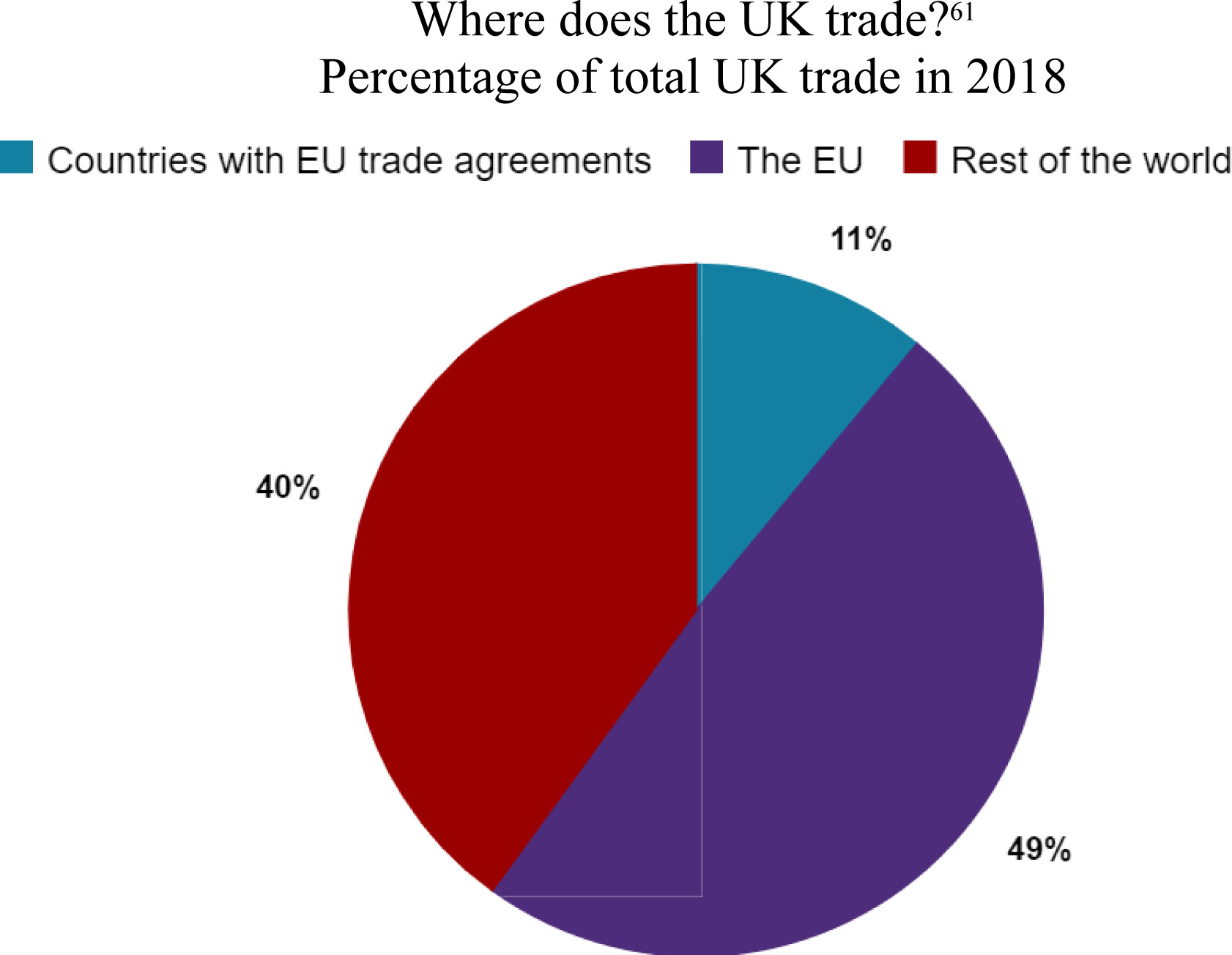
After Brexit and since March 2020, the UK has made 19 trade deals to be effective following its transition from the EU on December 31, 2020. While it was an EU member, the UK was automatically part of around 40 trade deals the EU had struck with more than 70 countries. The UK has been trying to copy these arrangements. So far, 19 such deals, covering 50 countries or territories, have been rolled over. These deals represent just over 8% of total UK trade. [A number of] deals are expected to take effect at the end of the transition period, according to the Department for International Trade. 62
The UK will need an agreement with the EU to stop new tariffs and other trade barriers coming into force after the transition period ends on 31 December 2020. If any trade deals are reached, either with the EU or other countries, they will not start until the transition period ends. The UK and the EU currently share the same rules in areas like workers’ rights, competition and environmental policy - they’re known as level playing field rules.
If negotiators fail to reach a deal, the UK faces the prospect of trading with the EU under the basic rules set by the World Trade Organization (WTO). If the UK had to trade under WTO rules, tariffs would be applied to most goods which UK businesses send to the EU. This would make UK goods more expensive and harder to sell in Europe. Having WTO terms would also mean full border checks for goods, which could cause traffic bottlenecks at ports. And the UK service industry would lose its guaranteed access. Qualifications would no longer be recognized, and it would be much harder for workers to travel to the EU. 63
III. Legal
A. Comparative Agenda Issues of U.S. and UK Domestic Labor Laws
Under the USMCA, the labor agenda earlier identified and summarized below, is followed by brief highlights of UK and U.S. relevant labor laws, allowing a comparison to help further identify potential trouble spots in the negotiations.
Labor Rights: ILO Core Labor Standards and acceptable conditions of work with respect to minimum wages, hours of work, and occupational safety and health. The UK has ratified all eight core conventions whereas the U.S. has ratified only two. 64 The USMCA added the right to strike as part of the freedom of association and “acceptable conditions of work with respect to minimum wages, hours of work, and occupational safety and health.” 65 Both countries have laws regulating wages, hours, and safety, 66 as well as the topics of the ILO core labor standards. 67
UK's Trade Union and Labour Relations Act provides for unionization and collective bargaining, 68 the right to strike, 69 and prohibits terms in a collective agreement that restrict employees’ right to engage in a strike or industrial action. 70 Employees’ termination must be for a “fair reason” 71 and the law protects employees whose business is being transferred to another business. 72 UK laws create a minimum standard of employment rights, located in various Acts, including the National Minimum Wage Act 1998, 73 the Working Time Regulations 1998, 74 the Employment Rights Act 1996, 75 and the Pensions Act 2008. 76 The Modern Slavery Act prohibits any form of compulsory or forced labor. 77
U.S. law provides private and federal government employees the freedom of association and private employees the right to collective bargain and strike, 78 while federal employees can bargain, but not over wages, with strikes prohibited in the public sector. 79 Employees are employed “at will,” except in certain public sector jobs, unless protected by contract or statute. 80 Wages, hours and non-discriminatory pay are also regulated, as is occupational health and safety. 81
Non-Derogation and Enforcement of Labor Laws: The Parties recognize that it is inappropriate to encourage trade or investment by weakening or reducing the protections afforded in each Party's labor laws. They also agree to fully enforce the labor provisions of the agreement and create processes to mediate and resolve labor conflicts.
The UK has accepted this in EU FTAs, and it is of current concern to the EU in its negotiations with the UK that the UK maintain high labor standards and enforcement after Brexit and not become a competitive cheap labor country.
U.S. FTAs typically include these provisions and the U.S. has a strong record of law enforcement.
Violence, threats, or intimidation against workers for exercising their labor rights under Article 23.3 in a manner affecting trade or investment between the Parties is prohibited.
UK employers are obligated to provide workers a general duty of care to protect them from threats and violence at work. 82 The Trade Union and Labour Relations Act of 1992 is the primary source of U.K. labor protection relating to unionization, collective bargaining, and the right to strike. 83 Under the Equality Act, “victimization (retaliation) is prohibited as it pertains to protected categories of workers. 84
U.S. laws, in addition to criminal laws, provide for government statutory and administrative protection for exercise of labor rights and from retaliation for their exercise. 85
Migrant Workers are recognized as vulnerable and each Party shall ensure that migrant workers are protected under its labor laws, whether they are nationals or non-nationals.
UK migrant workers are granted labor rights, and under the law, “are entitled to receive pay equal to British workers doing the same job and must be paid at least the national minimum wage. They are protected by UK employment laws, have the right to be paid annual leave and statutory sick pay, and must pay tax and national insurance.” 86 However, advocates of migrant domestic workers argue the laws are insufficient, and practices sometimes appear to violate forced labor laws. 87
U.S. legal migrant workers have the same legal rights as US citizens, although the remedies for illegal aliens are sometimes lower under particular labor laws. 88
Although agricultural migrant workers have a series of labor protection laws, it is often argued to be inadequate. 89
Agricultural workers, including migrants who often make up a large percentage of that labor force, are excluded from federal legislation that provides basic protections like the right to a minimum wage, overtime pay, freedom of association, and health and safety guarantees while at work. Domestic service employees may or may not have the full protections of the labor laws, but are provided some protections, such as minimum wages, depending on a variety of federal and state laws. 90
The USMCA provides for the elimination of gender-based workplace discrimination in employment and occupation, promoting equality of women, and implementing policies appropriate to protect workers on the basis of sex, including sexual harassment, pregnancy, sexual orientation, gender identity, and caregiving responsibilities; provide job protected leave for birth or adoption of a child and care of family members; and protect against wage discrimination.
UK has the Equality Act of 2010 that enumerates characteristics protected from discrimination including age, disability, gender reassignment, marriage and civil partnership, pregnancy and maternity, race, religion or belief; sex, and sexual orientation. 91 The non-discrimination prohibition includes wages, 92 yet the gender pay gap in the UK ranks high compared with EU member states. 93 Sexual harassment is also prohibited 94 as is discrimination based on LGBTQ+, including gender reassignment and sexual orientation. 95 Disputes are typically resolved in the Advisory, Conciliation and Arbitration Service (Acas) which is similar in function to the EEOC in the United States and it provides dispute resolution procedures on employment rights and issues between employers and employees and is the step before the Employment Tribunal. 96 Family leave policies exist and generally are paid for certain durations with the right to return to work without discrimination. 97 Maternity protection is provided by the Equality Act of 2010 that also covers the right to equality of pay throughout pregnancy-related maternity leave. 98 Other areas of family care are also provided for under UK law, such as paternity leave. 99
U.S. laws include anti-discrimination laws 100 covering gender and wages, though there is a significant wage gap in the U.S. 101 Sex harassment 102 and pregnancy discrimination are prohibited, though maternity benefits are not required by law. 103 Unpaid family leave is provided, though with qualifying time eligibility requirements, that allows for time off from work for family health and care needs. 104 The question of whether federal anti-discrimination law includes prohibitions against sexual orientation and gender identity was decided on Monday, June 15, 2020, when the United States Supreme Court ruled that the prohibition against sex-based discrimination in employment set forth in Title VII of the Civil Rights Act of 1964 includes claims of sexual orientation and gender identity-based discrimination. 105
5. Dispute Settlement:
UK ‘s labor dispute resolution takes place first in the Advisory, Conciliation and Arbitration Service (Acas). 106 It emphasizes the importance of attempting to resolve disputes informally before going to the Employment Tribunal 107 and issues guidelines for labor dispute resolution which, though not legally binding, are nevertheless referred to by UK courts. 108
U.S. law provides the parties may resolve most individual or collective contract or statutory labor disputes through voluntary non-governmental arbitration whose decisions are deferred to by the courts, assuming certain standards are met. 109 In the U.S., each labor law has an administrative agency to enforce the statutory labor rights under the law; these agencies typically investigate and render a decision, deferred to by the courts if there is substantial evidence supporting it. 110 Where there is no deferral or if the statute permits it, the courts decide the issues. 111
B. Emerging Agenda: Trouble Spots
Violations “in a Manner Affecting Trade or Investment?”
The most contentious labor issues or the ones with political risks of domestic law not meeting the obligations of the negotiated FTA are emerging as follows. Keep in mind also that to claim violations of obligations under the language of the USMCA, the violation must be shown to be “in a manner affecting trade or investment.” So, one can ask: “what evidence demonstrates a claim and what evidence overcomes the presumption under the FTA that it did not affect trade or investment?”
1. Right to Strike
The ILO does not expressly mention the right to strike but the Freedom of Association Committee through ongoing rulings established principles on the right to strike as an essential element of the freedom of association protected by Convention No. 87. 112 Only the International Covenant on Economic, Social and Cultural Rights contains a clause protecting the right to strike; however, like the Social Charter of 1961, the Covenant permits each signatory country to abridge the right to strike. The ILO has also concluded striker replacement, while not in contravention of ILO agreements, carries with it significant risks for abuse and places trade union freedoms in “risk of derogation from the right to strike.” 113
The EU Charter of Fundamental Rights establishes a right to strike, and the right to associate, in the European Convention on Human Rights, but leaves it to national legislation how it will be administered; therefore, UK law and an applicable FTA are determinative. 114
United Kingdom
In the UK, workers and employers, or their respective organizations, have, in accordance with the Trade Union law and national laws and practices, the right to negotiate and conclude collective agreements at the appropriate levels and, in cases of conflicts of interest, to take collective action to defend their interests, including strike action. However, this right is limited. 115
There is no explicit legal right to strike in the UK, but there is limited protection for individuals from unfair dismissal. 116 The so-called ‘right to strike’ only exists provided that certain procedures and conditions are met. 117 “Strikes and other forms of industrial action invariably involve a breach of contract. Therefore, it may be lawful for an employer to dismiss employees for it and to refuse pay for a service not provided.” 118
UK's Trade Union Act 119 places tight limits on what constitutes legitimate industrial action; and, in the words of TUC General Secretary Frances O’Grady, “attacks the right to strike – a fundamental British liberty. Workers will still technically have a right to strike, but the Act makes the right much harder to access.” 120
There is protection to strike when: “the dismissal is within 12 weeks of the action starting; it is after 12 weeks but the employee ceased the action within the 12-week period; the employer failed to take reasonable procedural steps to resolve the dispute. It is important to note that an employer can legally dismiss all those who take part in unlawful action.” 121 As to strike replacements, it appears after 12 weeks striking employees can be dismissed, so presumably that includes being permanently replaced at that time. The issue of strike replacements during the strike is addressed by the following Regulation.
Regulation 7 of the Conduct of Employment Agencies and Employment Businesses Regulations 2003 (SI 2003/3319) precludes the provision of temporary workers to perform the duties normally performed by a worker who is taking part in a strike or other industrial action. 122
United States
The U.S. grants the right to strike and at the same time allows the employer to hire striker replacements; and, for economic strikers, but not unfair labor practice strikers, 123 the replacements can be permanent. 124 Advocates argue this basically negates the right to strike in the U.S., removing a union's greatest economic weapon. 125
The permanent-replacement doctrine is not used only against workers’ exercise of the right to strike. Employers aggressively use the threat of permanent replacement in campaigns against workers’ efforts to form and join a union and to bargain collectively. In every organizing drive examined by Human Rights Watch for this report, management raised the prospect of permanent replacement in written materials, in captive-audience meetings, and in one-on-one meetings where supervisors spoke with workers under their authority.
The United States is almost alone in the world in allowing permanent replacement of workers who exercise the right to strike. Some of the United States’ key trading partners take a polar opposite approach. In Mexico, for example, federal law requires companies to cease operations during a legal strike. 126 Permanent replacements are also prohibited throughout Canada. In Quebec, even temporary striker replacements are banned, and a company may only maintain operations using management and supervisory personnel. In most European countries the law is silent on the subject because permanent replacements are never used and the very idea of permanent replacement of strikers is considered outlandish. 127
2. Discrimination in the Workplace
The USMCA prohibits employment discrimination on the basis of sex (including with regard to sexual harassment), pregnancy, sexual orientation, gender identity, and caregiving responsibilities; provide job protected leave for birth or adoption of a child and care of family members; and protect against wage discrimination. 128
Could violations of these provisions provide an advantage to the employers and the country that utilizes this work, made cheaper by discriminating and avoiding having to pay higher wages and benefits costs? 129 Could it be demonstrated that violations of these obligations are in a manner affecting trade or investment? So, again, one can ask: “what evidence demonstrates a claim and what evidence overcomes the presumption under the Treaty that it did not affect trade or investment?”
United Kingdom
Laws on gender rights and benefits in the UK are comprehensive and of a higher standard than the U.S., bolstered in part by EU standards and the government enforcement mechanisms are regularly used; 130 however, as in many countries, in practice there is a wide wage gap between male and female labor. 131 There has been concern that without continuing legal ties with EU and its standards, the UK could become a “cheap labor” country with a competitive advantage over EU countries and perhaps the U.S.?
Therefore, from the U.S. perspective an argument could be made that if the UK's post-Brexit arrangement with EU does not maintain the EU standards, the UK could allow its gender laws to weaken, providing a less expensive market for U.S. investors. Whether that could manifest itself into violations of an FTA “in a manner affecting trade or investment” is certainly speculative at this point as arguably the US already provides fewer gender-based benefits than the UK.
United States
The answer for the U.S. was provided by footnote 15 of Article 23.9 of the USMC.
The United States’ existing federal agency policies regarding the hiring of federal workers are sufficient to fulfill the obligations set forth in this Article. The Article thus requires no additional action on the part of the United States, including any amendments to Title VII of the Civil Rights Act of 1964, in order for the United States to be in compliance with the obligations set forth in this Article. 132
So, it would seem if the U.S. were able to use this approach of a footnote agreement to there being no violations, it would not be a trouble spot for the U.S.
3. Migrants
In Article 23.8 of the USMCA, migrant workers are recognized as vulnerable and each Party shall ensure that migrant workers are protected under its labor laws, whether they are nationals or non-nationals.
United Kingdom
The UK policies on migrant labor is now in a bit of a flux, and it has recently proposed policies that would limit foreign workers who often are the ones doing the dirty, dangerous jobs that British citizens do not want to do. In February 2020, Britain announced it is considering a policy to close its borders to unskilled workers and those who can’t speak English as part of a fundamental overhaul of immigration laws that will end the era of cheap EU labor in factories, warehouses, hotels and restaurants. 133 Employers from coffee shops to agriculture to factories have raised a huge outcry as to the likely lack of workers for their businesses. 134 The below chart shows the allocation of foreign migrant labor coming into the UK from EU countries.
Low-skilled factory and construction 21%; Factory and machine operators 17%; Food preparation and other skilled trades 13%; Low-skilled administration and service 12%; Drivers and mobile machine operators 11%; Skilled construction and building trades 9%; STEM professionals 9%; Leisure, travel and related personal service 8%; STEM associate professionals 7%; Culture, media and sports 7%. 135
While UK laws may provide basic rights and benefits for these workers, the absence of these workers certainly would be a factor affecting labor costs and possibly impact trade and investment. It appears this policy, if implemented, it would not drive UK toward cheap labor, but just the opposite, making the migrant issue a possible plus for US traders who can supply the more UK products which have become more expensive. Thus, if the UK policy stays after it is finally separated from EU, the migrant issue likely would not be a trouble spot in the negotiations.
United States
Generally, in the U.S., migrant workers fall into two main categories: domestic and foreign. Domestic workers are legal immigrants who have moved to the U.S. to work and who either are in the process of obtaining citizenship, or who have citizenship. 136 Foreign migrant workers are non-immigrant workers who are in many cases seasonal workers, especially in the agricultural professions, as well as in the difficult jobs of meat plant production and construction. Non-immigrant foreign workers typically must apply for a visa, and in the case of agricultural labor, an H-2A visa. 137 It is estimated that about 11.3 million people are currently living in the U.S. without authorization, with many of their job categories listed below. 138
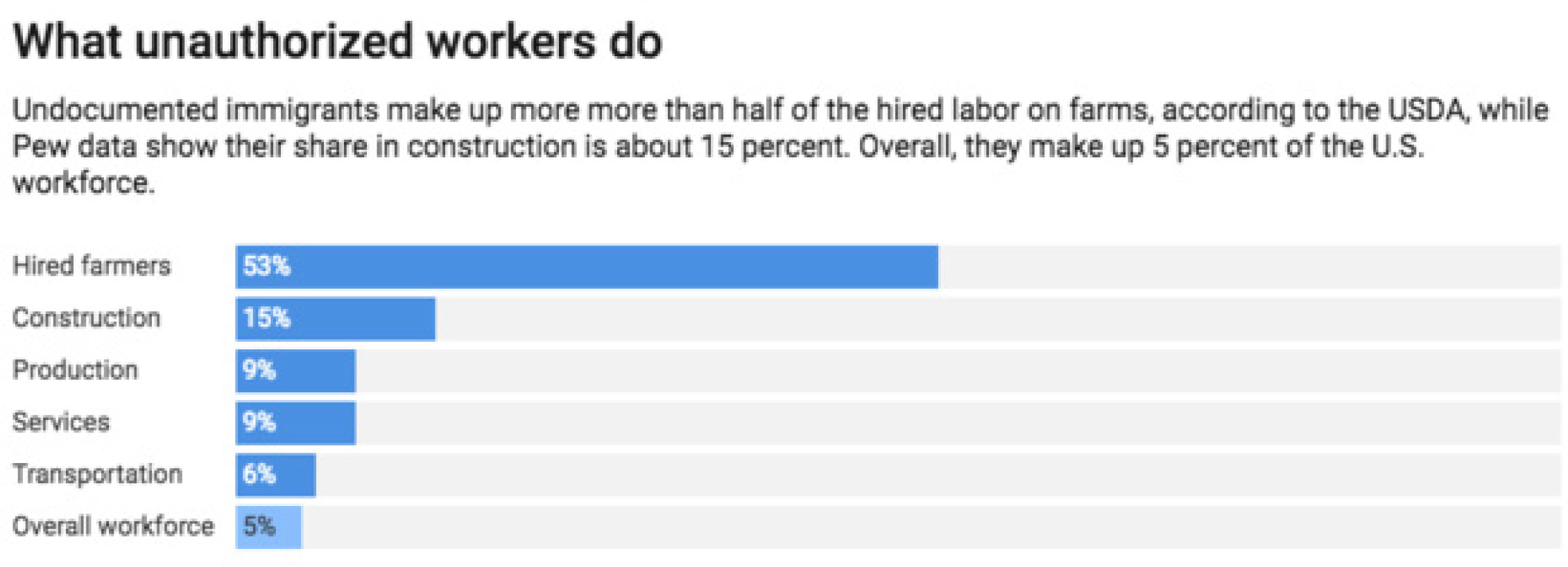
The Conversation, CC-BY-ND Source: USDA, Pew Research Center
Advocates of migrant workers’ rights point out they can be easily exploited and provide the country with a cheap labor supply, especially for the dirty, dangerous jobs that American citizens do not want, that can greatly reduce the cost of labor for employers. 139
Our current immigration system isn’t working for workers. Instead, it benefits low-road employers who exploit the immigration status of unauthorized immigrants and authorized guest workers through a legal framework that puts downward pressure on wages and leaves migrant workers powerless to enforce their labor rights and hold employers accountable. This hurts both migrants and the U.S. workers—citizens and lawful permanent residents—who work alongside them. 140
Could it be demonstrated that violations of USMCA-style labor obligations relating to migrant labor are occurring and are in a manner affecting trade or investment?
U.S. total exports of agricultural products to the United Kingdom totaled $2.0 billion in 2018. Leading domestic export categories include wine & beer ($261 million), tree nuts ($197 million), prepared food ($168 million), soybeans ($109 million), and live animals ($90 million). 141
So, again, one can ask: “what evidence demonstrates a claim and what evidence overcomes the presumption under the Treaty that it did not affect trade or investment?” 142
4. Related Issues
a. Dispute Resolution Mechanisms: Process and Remedies
United Kingdom
The EU approach to dispute resolution mechanisms in FTAs, to which the UK has been a party, is to provide an exclusive section for trade and a different one for labor. The labor settlement process is a series of consultations and negotiations, but no penalties or real remedies at the end of the process. This contrasts with the U.S. approach of a unified dispute resolution process including both labor and trade issues with a possible penalty in the end versus the EU approach of having a separate path for each with labor issues not having an enforceable remedy for a violation. 143 CETA is going through modifications of its ISDS provisions and breaking from the ISDS system and is establishing a multilateral investment tribunal for trade. 144
United States
The USMCA presumes that labor violations affect trade and investment, shifting the burden of proof to the party alleged to have violated USMCA labor provisions to prove otherwise. The State to State dispute settlement provisions of Chapter 31 of the USMCA apply “when a Party considers that an actual or proposed measure of another Party is or would be inconsistent with an obligation of this Agreement or that another Party has otherwise failed to carry out an obligation of this Agreement;” 145 Following a possible choice of forum and consultations, mediation and an arbitration panel may be formed and its final report may include enforceable, economic remedies. 146 Therefore, it is unknown whether the UK will negotiate a unified or a dual dispute resolution system, but for labor, it is most likely to seek to negotiate the dual path without penalties and the issue will be whether the US will prevail with no ISDS and have a unified system of dispute settlement with penalties?
b. Proof of Violation: Alleging and Disproving “in a Manner Affecting Trade or Investment Between the Parties”
The USMCA is instructive in its “determinative footnotes” that lay out the path for finding violations of the Labor Article. The summary conclusion from the multiple explanatory footnotes in Article 23 is that a violation occurs if it is “in a manner affecting trade or investment between the Parties” and “a panel shall presume that a failure is in a manner affecting trade or investment between the Parties, unless the responding Party demonstrates otherwise.”
More specifically, the footnotes of the Labor Article provides the “obligations set out in this Article: i. as they relate to the ILO, refer only to the ILO Declaration on Rights at Work; 147 ii. the definition of trade and investment; 148 iii. the “sustained or recurring course of action or inaction” regarding enforcement of labor laws;” 149 and iv. “presume that a failure is in a manner affecting trade or investment between the Parties, unless the responding Party demonstrates otherwise.” 150
One can predict these footnotes will be used in a future US-UK FTA.
IV. Analysis
A. Current Status: Uncertainty
1. Pandemic
The impact of the Pandemic on the global economy and the ability of governments and businesses to trade and invest is still unknown as of this date. How this may affect US-UK negotiations for a FTA is uncertain. 151 Even if negotiated, will the Parties and businesses be ready to implement it? On the other hand, might it not be better to have the rules of investment and trade in place when and as the threats of the Pandemic recede and global commerce increases? On May 4, 2020, it was reported the “United States and Britain launched formal negotiations on a free trade agreement …, vowing to work quickly to seal a deal that could counter the massive drag of the coronavirus pandemic on trade flows and the two allies’ economies.” 152 A recent report from Harvard suggested a “full FTA with the US before the summer of 2020 is impossible given the impacts of Covid-19 and roadblocks and risks involved. A ‘mini-deal’, however, is a possibility.” 153
2. Role of EU: Residual EU Obligations?
Following Brexit, the European Parliamentary Briefing in 2020, summarized the future EU-UK trade relationship as follows.
The withdrawal of the United Kingdom (UK) from the European Union (EU) came into effect on 1 February 2020, [and the] transition period began on the same day and is due to run until the end of 2020. During this period, although no longer part of the EU institutions, the UK remains in the customs union and single market, and within the jurisdiction of the Court of Justice of the EU (with some exceptions). Negotiations during the transition period are aimed at reaching agreements that will shape the future EU-UK relationship in a range of domains, and especially that of trade.
In the Political Declaration accompanying the Withdrawal Agreement, the EU and the UK ‘agree to develop an ambitious, wide-ranging and balanced economic partnership’. However, some major obstacles have surfaced. The UK insists that it is unwilling to submit to EU Court of Justice jurisdiction, and demands autonomy in its regulatory and trade policies. The UK indicates that it seeks a free trade agreement similar to that agreed between the EU and Canada: comprehensive, but very different to the previous relationship. The EU has taken note of the UK objectives, but emphasizes that the deeper the trade agreement, the more UK regulations and standards must align with those of the EU. To the EU, alignment is essential to preserve a level playing field, on the grounds that the EU and UK are close neighboring economies and strongly interconnected. The European Commission's 3 February 2020 recommendation for a Council decision authorizing the opening of negotiations on the future relationship confirms this approach.
In this context, time is critical. The Withdrawal Agreement allows for an extension to the transition period, but the UK Withdrawal Act explicitly prohibits extension. In addition, to allow for ratification, the trade agreement should be ready well ahead of the end of the transition period…. Time constrained negotiation may give rise to a limited economic and trade agreement that covers only priority areas, rather than the ambitious single comprehensive agreement sought under the Political Declaration and Commission recommendation. 154
The important question for the U.S.-UK negotiations will be how much, if any, will the UK still be bound by any residual obligations from laws and institutions of EU, especially regarding EU labor standards which are higher than that of UK and U.S. laws. Again, the answer is uncertain at this time.
3. U.S. Politics on Congressional Approval
The reality of U.S. politics is that a Democratically controlled House of Representatives, in its involvement with the text of the FTA, would be very reluctant to give Republican President Trump a ‘win” of a new FTA with the UK. It therefore would be reluctant to finalize the text in the treaty before the issue of Senate consent arose, and before the November Presidential election. 155 Additionally, labor advocates will be pushing hard for even better labor standards more like those in the EU than those in the USMCA, which may slow down and politicize the process of passage. 156
Further, some trade experts hypothesize that while both Johnson and Trump had advertised the trade deal as a top priority, the Johnson administration will likely focus on the domestic economy for the foreseeable future. This and the U.S. politics may force President Trump to focus more on the domestic economy and getting past the economic impacts of the Pandemic. 157
B. Going Forward
In the ongoing negotiations ahead, with all the attendant uncertainties, many think it prudent to wait for the UK-EU separation and possible UK-EU FTA to be completed. In December, 2019, it was reported that the “U.S. and UK have announced a desire to pursue a free trade agreement as soon as the U.K. completes its exit from the EU.” 158 In May 2020, it was announced that the UK and U.S. were to begin negotiations on their FTA. 159 In July 2020, the U.S. stated it would not likely be completed before the November 2020 U.S. presidential elections. 160
The issue to consider is to whose advantage, if anyone's, is it to complete the U.S.-UK FTA first before knowing the extent of any residual obligations of EU laws and institutions that the UK may retain in its UK-EU trade relationship? This definitely is a debatable point.
V. Conclusion
The background in this paper provides a primer for understanding and identifying the variables of some of the more pressing points on labor and employment issues facing the negotiators in the future U.S.-UK FTA. It also can provide for some reflection on the future contents of labor and dispute settlement provisions in a future U.S.-EU FTA (TTIP). As stated earlier, although the future cannot be predicted, it can be prepared for. 161