
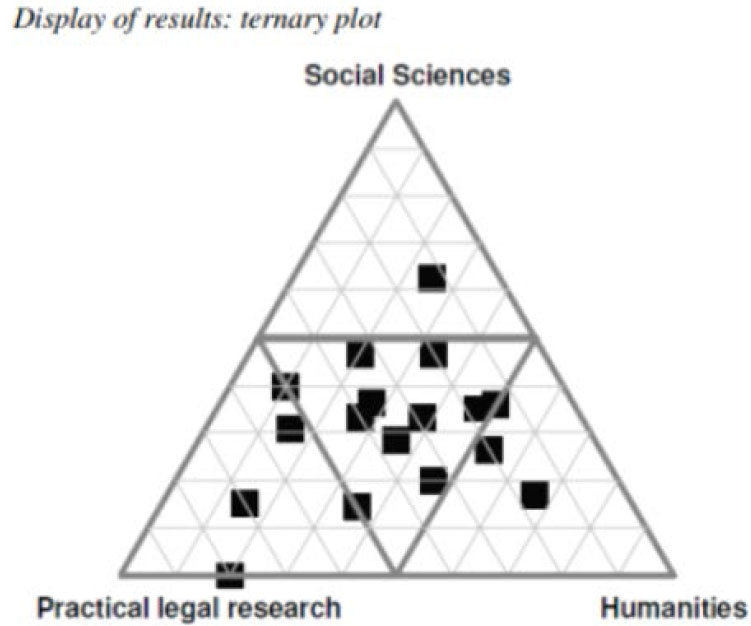
Figure 1
Mapping Legal Research109
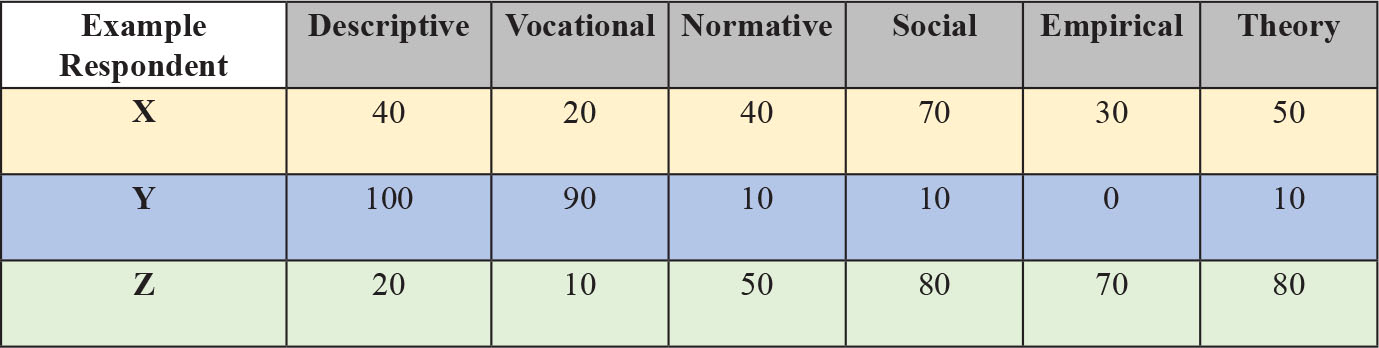
Figure 2
Example Legal Research Profiles.
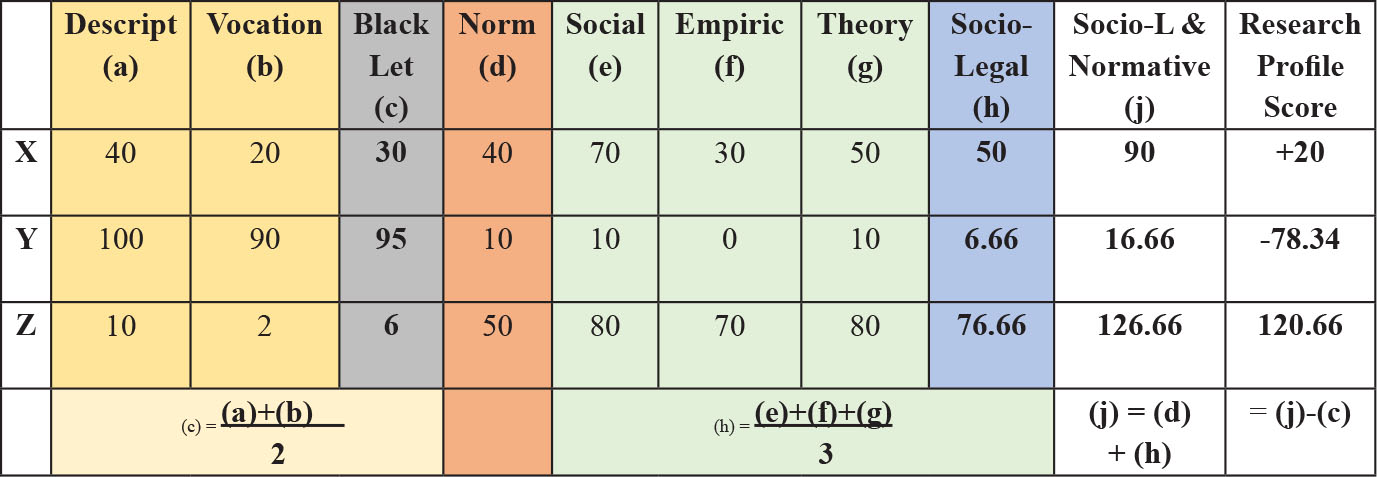
Figure 3
Calculating the Research Profiles.
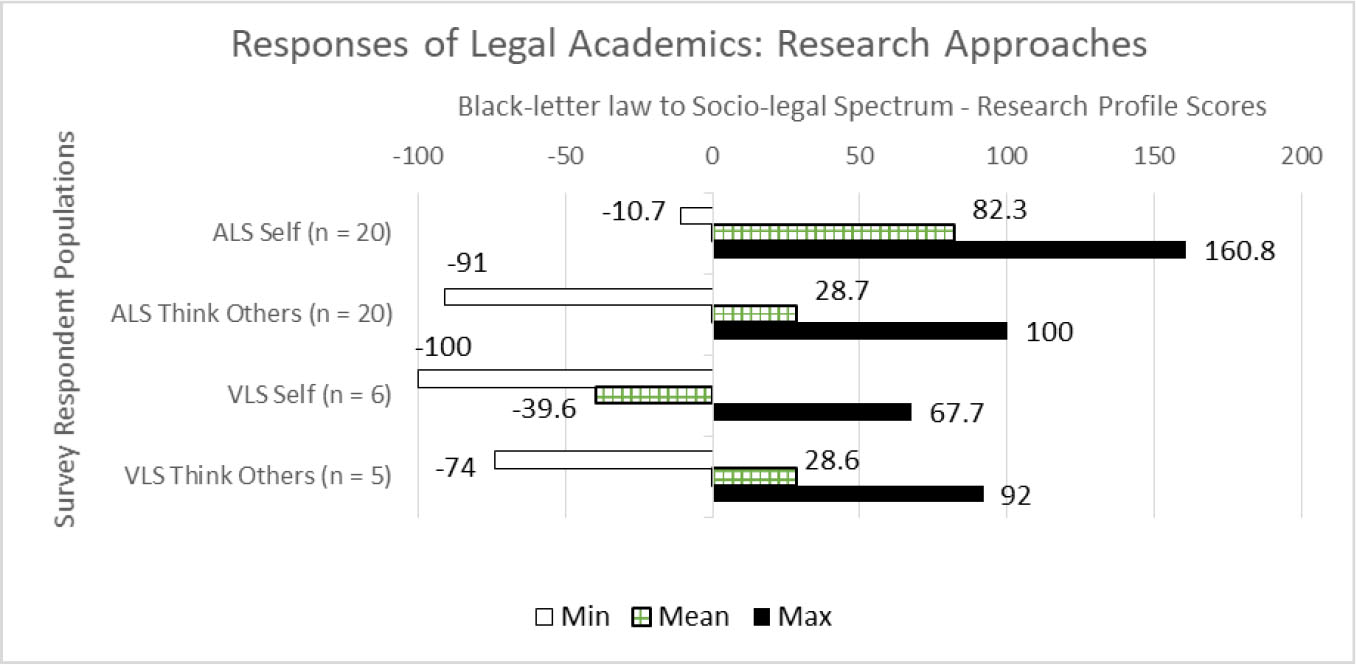
Figure 4
Research Approaches (Responses of Legal Academics).

Figure 5
Shifts in Means from Self-Assessment to Imagined ‘Other’/’Outsider’ (n = 25).
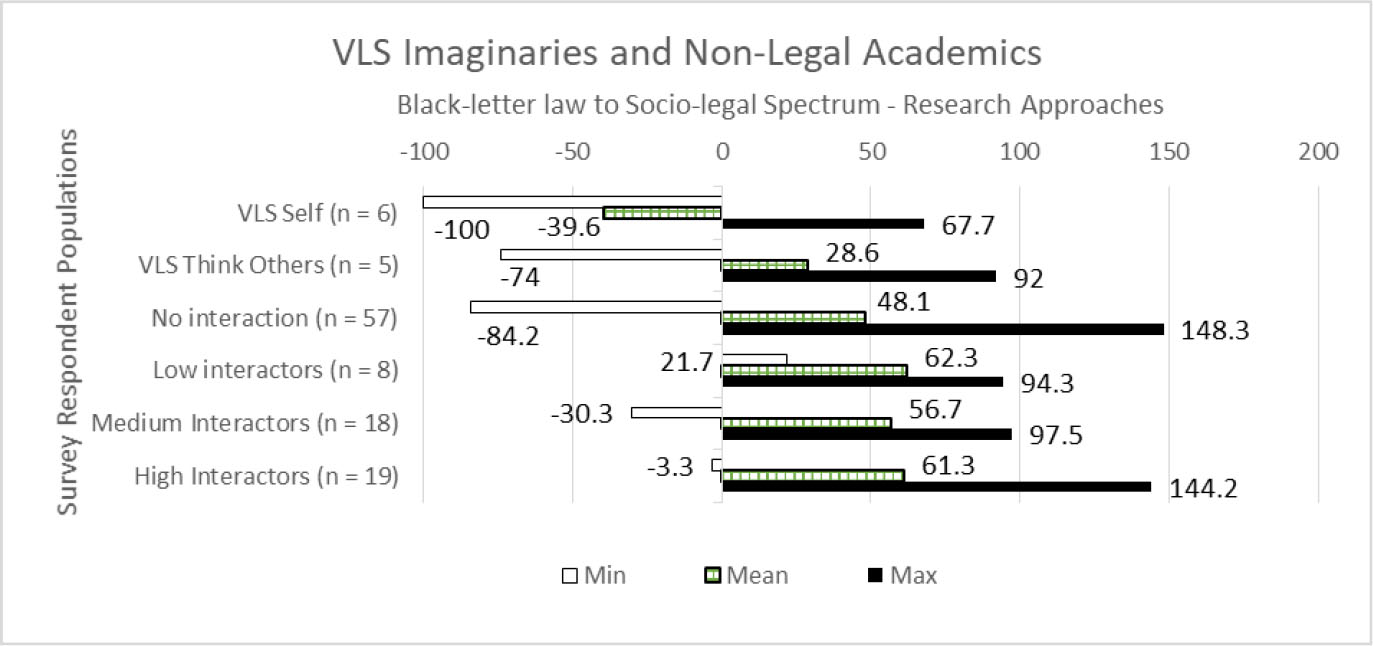
Figure 6
VLS Imaginaries and Non-Legal Academics.
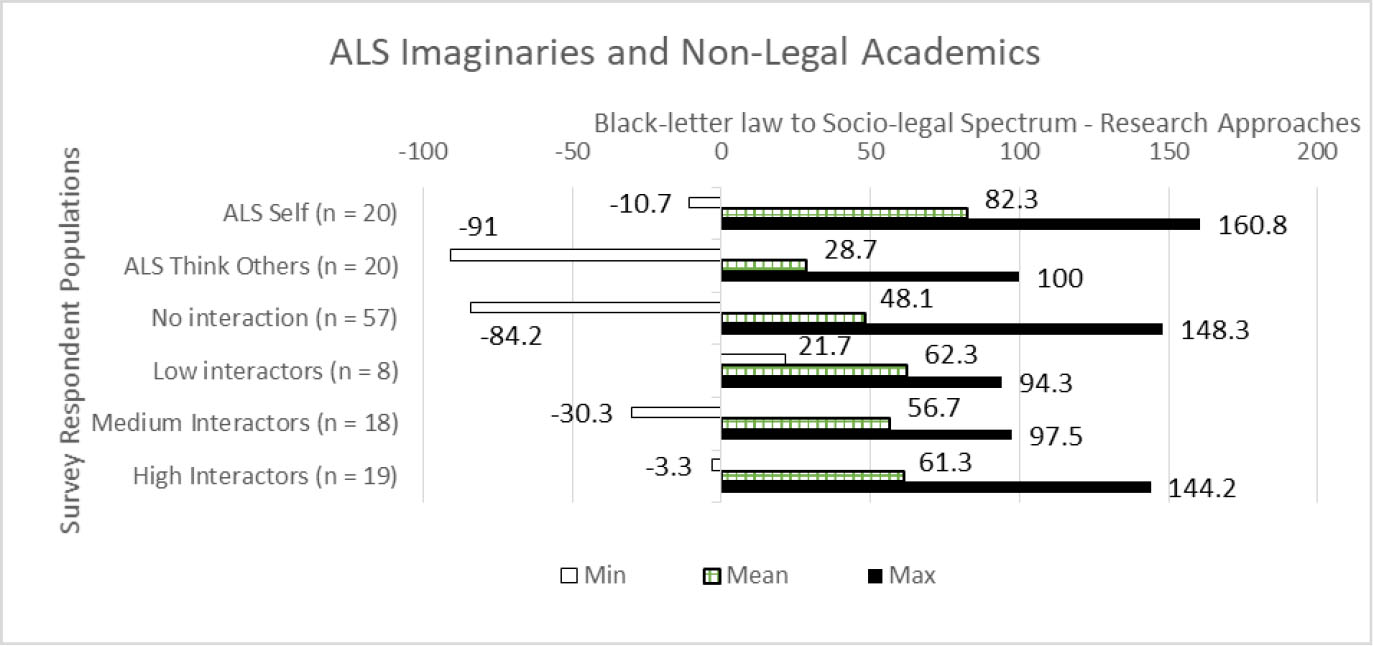
Figure 7
ALS Imaginaries and Non-Legal Academics.
Table 1
| Phase One Survey – Non-Legal Academics at Cardiff University (Main Survey) | ||
|---|---|---|
| No. | Statement/Questions | Response choices |
| 1 | Interactional Assessment – Intensity | |
| Please select the frequency that you meet/talk/work with legal academics |
| |
| 2 | Interactional Assessment – Contexts | |
| In which contexts, if any, have you met/interacted with legal academics (you may select all those that apply)? |
| |
| 3 | Interactional Assessment – Quantifying | |
| Please make a rough assessment of how many legal academics you know in a teaching or research context (e.g. joint supervision/teaching, interaction in research groups, reading groups etc.). |
| |
| 4 | Interactional Assessment – Engagement with Research and Legal Scholarship | |
| Please select statements below that best represent you (you may select all those that apply) |
| |
| 5 | Beliefs and knowledge about legal academia as a discipline | |
| Please indicate, by clicking on the appropriate radio buttons, which attributes you believe best describe law as an academic discipline (you may choose as many as you wish). | Practical, Scientific, Creative, Innovative, Academic, Boring, Fragmented, Modern, Methodological, Vocational, Coherent, Interesting, Unapplied, Unscientific, Reliant on Documents, Empirical, Arcane, Dealing in pure ideas, theoretical, applied, uncreative. | |
| 6 | Describing Personality Traits of Legal Academics | |
| 13 Personality factors are listed below, each is subdivided into 4 primary personality traits and individual qualities. Please select only 1 primary personality trait per factor that you believe best describes legal academics (this may be on the basis of generalising about the legal academics you know, or in the absence of this, what kinds of personality traits you believe legal academics generally possess). | Warmth, Reserved, Attentive to Others, Caring, Impersonal; Reasoning, Concrete, Deliberative, Abstract, Quick-thinking; Emotional Stability, Reactive, Co-operative, Assertive, Aggressive; Liveliness, Enthusiastic, Serious, Spontaneous, Careful; Social Boldness, Timid, Thick-Skinned, Socially bold, Threat-sensitive; Vigilance, Suspicious, Trusting, Unsuspecting, Skeptical; Abstractedness, Abstracted, Imaginative, Practical, Down-to-earth; Privateness, Genuine, Discrete, Private, Forthright; Openness to Change, Experimenting, Conservative, Attached to Familiar, Open to Change; Self-Reliance, Individualistic, Group-orientated, Affiliative, Solitary; Perfectionism, Perfectionistic, Tolerates disorder, Organized, Flexible; Rule-Consciousness, Non-conforming, Expedient, Rule Conscious, Dutiful. | |
| 7 | Prestige Markers in Legal Academia | |
| Please rate the extent to which you think that the following items constitute research prestige markers (for career, promotion) for legal academics. | [Slider bar – between 0 [low prestige] and 100 [high prestige]
| |
| 8 | Nature of and Approach to Legal Research | |
| Please highlight on sliding scale how much you think these subjects and approaches best describe the research and research approaches of legal academics. |
| |
| 9 | Sources of Belief/Understanding | |
| Please indicate how you have acquired your understanding of legal academia and legal academics (you may select all those that apply) |
| |
| 10 | General Interdisciplinary Attitudes | |
| How would you describe your approach to research in interdisciplinary terms? (You may select all those that apply) |
| |
Table 2
| Phase One Survey – Legal Academics at Cardiff University (Benchmarking Survey) | ||
|---|---|---|
| No. | Statement/Questions | Response choices |
| 1 | Interactional Assessment – Intensity | |
| Please select the frequency that you meet/talk/work with academics from other disciplines (i.e. non-legal academics) |
| |
| 2 | Interactional Assessment – Contexts | |
| In which contexts, if any, have you met/interacted with non-legal academics (you may select all those that apply)? |
| |
| 3 | Interactional Assessment – Quantifying | |
| Please make a rough assessment of how many non-legal academics you know in a teaching or research context (e.g. joint supervision/teaching, interaction in research groups, reading groups etc.). |
| |
| 4 | Interactional Assessment – Qualifying your Response | |
| If you wish you can expand on the above in the text box below. We are interested in learning more about your interactions with non-legal academics (e.g. are these at Cardiff? Do you collaborate on funded/unfunded projects? How (if at all) does these interactions impact upon your research and teaching? We are also interested in learning about those that collaborate with others outside of academic (e.g. business, external bodies, third sector, government, professional societies, etc.). |
| |
| 5 | Interactional Assessment – Engagement with Non-Legal Research and Scholarship | |
| This question seeks to identify whether you use scholarship from disciplines other than law in your research/teaching. Please select statements that best represent you (you may select all those that apply). |
| |
| 6 | Your Beliefs and Knowledge about Legal Academia as a Discipline | |
| How would you describe law as an academic discipline to a non-legal academic interested in what kinds of research, scholarship and enquiries populate the discipline as a whole? (This is a hard question but we’d value any response you can offer). |
| |
| 7 | Your Beliefs and knowledge about legal academia as a discipline | |
| Please indicate, by clicking on the appropriate radio buttons, which of the following pre-attributes you believe best describe law as an academic discipline (you may choose as many as you wish). | Practical, Scientific, Creative, Innovative, Academic, Boring, Fragmented, Modern, Methodological, Vocational, Coherent, Interesting, Unapplied, Unscientific, Reliant on Documents, Empirical, Arcane, Dealing in pure ideas, theoretical, applied, uncreative. | |
| 8 | Others’ Beliefs and knowledge about legal academia as a discipline | |
| The following list of attributes has been given to non-legal academics in order to ascertain how they typify legal academia. Please indicate, by clicking on the appropriate radio buttons, which attributes you think academics from other disciplines would select when asked to describe law as an academic discipline (you may choose up to five attributes). | Practical, Scientific, Creative, Innovative, Academic, Boring, Fragmented, Modern, Methodological, Vocational, Coherent, Interesting, Unapplied, Unscientific, Reliant on Documents, Empirical, Arcane, Dealing in pure ideas, theoretical, applied, uncreative. | |
| 9 | Describing Personality Traits of Legal Academics | |
| 13 Personality factors are listed below, each is subdivided into 4 primary personality traits and individual qualities. Please select only 1 primary personality trait per factor that you believe best describes you (You might experience difficulties completing this question, but it has been included for comparative purposes by virtue of an earlier study on academics undertaken in the early 1980s). | Warmth, Reserved, Attentive to Others, Caring, Impersonal; Reasoning, Concrete, Deliberative, Abstract, Quick-thinking; Emotional Stability, Reactive, Co-operative, Assertive, Aggressive; Liveliness, Enthusiastic, Serious, Spontaneous, Careful; Social Boldness, Timid, Thick-Skinned, Socially bold, Threat-sensitive; Vigilance, Suspicious, Trusting, Unsuspecting, Skeptical; Abstractedness, Abstracted, Imaginative, Practical, Down-to-earth; Privateness, Genuine, Discrete, Private, Forthright; Openness to Change, Experimenting, Conservative, Attached to Familiar, Open to Change; Self-Reliance, Individualistic, Group-orientated, Affiliative, Solitary; Perfectionism, Perfectionistic, Tolerates disorder, Organised, Flexible; Rule-Consciousness, Non-conforming, Expedient, Rule Conscious, Dutiful. | |
| 10 | Prestige Markers in Legal Academia | |
| Please rate the extent to which you think that the following items constitute research prestige markers (for career, promotion) for legal academics. | [Slider bar – between 0 [low prestige] and 100 [high prestige]
| |
| 11 | Nature of and Approach to Legal Research - YOU | |
| Please highlight on sliding scale how much you think these subjects and approaches best describe your research and scholarship. | [Slider bar, including ‘not applicable’ box]
| |
| 12 | Nature of and Approach to Legal Research – Beliefs of Non-Legal Academics | |
| Please highlight on sliding scale how you think academics from other disciplines would be likely to typify legal research. | [Slider bar, including ‘not applicable’ box]
| |
| 13 | General Interdisciplinary Attitudes | |
| How would you describe your approach to research in interdisciplinary terms? (You may select all those that apply) |
| |
Table 3
| Phase Two Survey – Non-Legal Academics at Cardiff University (Main Survey) | ||
|---|---|---|
| No. | Statement/Questions | Response choices |
| 1 | Interactional Assessment – Intensity | |
| Please select the frequency that you meet/talk/work with legal academics |
| |
| 2 | Interactional Assessment – Contexts | |
| In which contexts, if any, have you met/interacted with legal academics (you may select all those that apply)? |
| |
| 3 | Interactional Assessment – Quantifying | |
| Please make a rough assessment of how many legal academics you know in any of the above contexts. |
| |
| 4 | Interactional Assessment – Engagement with Legal Research and Scholarship | |
| Please select which of the statements that apply (you may select all those that apply). |
| |
| 5 | Prestige Markers in Legal Academia | |
| What kinds of publications, markers and activities do you think are likely to be most highly regarded in research prestige terms, for the career and promotion prospects of a legal academic? Here we give you a set of 10 items to select from. Please take these items from the list and rank them relative to each other in the ‘Prestige’ box. ‘1’ being the highest item in prestige, and 10 the lowest. |
| |
| 6 | Prestige Markers in Your Own Field/Discipline | |
| What kinds of publications, markers and activities are most highlight regarded in research prestige terms, for your career and promotion prospects in your field? Here we give you a set of 9items to select from. Please take these items from the list and rank them relative to each other in the ‘Prestige’ box. ‘1’ being the highest item in prestige, and 10 the lowest. We also want to learn about your discipline too. If you can think of one other item relating to your own field/discipline, we give you the option to fill in the ‘other’ text box. |
| |
| 7 | Nature of and Approach to Legal Research | |
| We want to know what kinds of subjects and approaches you believe are likely to describe the research/research approaches of legal academics, and those that you believe would be poor descriptors. Please choose four or more items from the list below and place into the relevant groups. | [Slider bar, including ‘not applicable’ box]
| |
| 8 | Sources of Understanding and Belief | |
| We have already asked you about a variety of interactive contexts where you might meet/mix with legal academics. We are keen to identify other sources of understanding/knowledge of legal academia and legal academics (you may select all those that apply) |
| |
| 9 | Your Own Research/Scholarship and Interdisciplinarity | |
| Which statements best describe you (You may select all those that apply)? |
| |
Table 4
| Phase Two Survey – Legal Academics at Cardiff University (Benchmarking Survey) | ||
|---|---|---|
| No. | Statement/Questions | Response choices |
| 1 | Prestige Markers in Legal Academia | |
| What kinds of research markers, outputs and activities do you think are most highly regarded in research prestige terms, for the career and promotional prospects of a legal academic (on a teaching and research, or research only contract)? Here we give you a set of 10 items to select from. Please take these items from the list and rank them relative to each other in the ‘Prestige’ box. ‘1’ being the highest item in prestige, and 10 the lowest. |
| |
| 2 | Prestige Markers | |
| Are there any items on this list that you think do not belong here at all (please leave comments if you wish)? |
| |
| Arts, Humanities and Social Sciences | 44 | Biomedical and Life Sciences | 42 | Physical Sciences and Engineering | 16 |
|---|---|---|---|---|---|
| Business | 4 | Biosciences | 7 | Architecture | 2 |
| English, communication and philosophy | 4 | Healthcare sciences | 14 | Chemistry | 1 |
| History, archaeology and religion | 9 | Medicine | 14 | Engineering | 8 |
| Politics143 | 7 | Optometry and Vision Sciences | 3 | Mathematics | 2 |
| Modern Languages | 1 | Pharmacy and Pharmaceutical sciences | 1 | Physics and Astronomy | 3 |
| Planning and Geography | 4 | Psychology | 3 | ||
| Social Sciences | 15 |
| Law Department | 26 |
|---|---|
| Centre for Professional Legal Studies | 6 |
| School of Law | 20 |
| All - Participation by Age | All – Job Title | All - Length of time working in the University | ||||||
|---|---|---|---|---|---|---|---|---|
| Non-Legal Academics | Legal Academics | Non-legal Academics | Legal Academics | Non-legal Academics | Legal Academics | |||
| Under 25 | 1 | 1 | Lecturer | 30 | 9 | Less than 5 years | 19 | 7 |
| 25–34 | 16 | 7 | Senior Lecturer Lecturer | 18 | 6 | 5–10 years | 21 | 4 |
| 35–44 | 28 | 6 | Reader | 9 | 3 | 10–15 years | 14 | 7 |
| 45–54 | 39 | 9 | Professor | 20 | 3 | 15–20 years | 22 | 4 |
| 55–64 | 14 | 3 | Research Assistant | 2 | - | 20+ years | 26 | 4 |
| 65–74 | 4 | - | Research Associate | 16 | - | |||
| Research Fellow | 4 | - | ||||||
| Other | 3 | 5 | ||||||
| Arts, Humanities and Social Sciences | 12 | Biomedical and Life Sciences | 8 | Physical Sciences and Engineering | 9 |
|---|---|---|---|---|---|
| Business | 2 | Biosciences | 1 | Computer Science | 6 |
| English, communication and philosophy | 3 | Healthcare sciences | 3 | Earth and Ocean Science | 3 |
| Music | 2 | Medicine | 1 | ||
| Politics144 | 1 | Psychology | 1 | ||
| Journalism Media and Cultural Studies | 3 | Dentistry | 2 | ||
| Social Sciences | 2 |
| Legal Academics | All – Gender | |||
|---|---|---|---|---|
| Law Department | 19 | Non-legal Academics | Legal Academics | |
| Centre for Professional Legal Studies | 1 | Female | 7 | 11 |
| School of Law | 18 | Male | 19 | 6 |
| Other | 3 | 1 | ||