
I. Introduction
When the great political writer, Alexis de Tocqueville, came to witness democracy in America, many in Europe were slowly persuaded that power in the hands of the many, not just the few was the best way to govern. 1 De Tocqueville recorded a “strong and independent” community, where the American citizen had “an interest in it because he shares in its management”. 2 Near the same time, in 1831, Wolfgang von Goethe famously wrote, “America, you’ve got it made – better than us here in the old world.” 3 This was why so many people, including one Frederick Trump in 1885, 4 would emigrate to the States over the 19th century. They escaped authoritarian government, the repression of democracy and social justice, and the worst excesses of the industrial revolution. They sought the spirit of liberty. America’s dream was one of a people who, as Pitt the Elder told Parliament in 1775, “prefer poverty with liberty to gilded chains and sordid affluence; and who will die in defence of their rights as men, as freemen.” 5
So it may seem natural that fascism has never yet taken hold in America. There were exceptions. 6 For example, during the 1920s and 1930s fascists had taken over Columbia University’s Casa Italiana, 7 (attended by one Salvatore Eugene Scalia) where students pledged allegiance to Mussolini. And today, many believe Donald Trump, the embattled presidential candidate in 2016, might be another exception. Words like “fascist” often churn through 24 hour media, unconnected to essential political concepts. 8 Nevertheless, Trump has been forced to defend himself. For example, during his campaign, after Trump quoted Mussolini in a tweet, a TV interviewer asked Trump, “You want to be associated with a fascist?” “No, I want to be associated”, replied Trump, “with interesting quotes.” 9 These developments are abnormal. As seen on reality TV, “the “Donald Trump” model of workplace relations” (represented by an authority figure barking “you’re fired”) has come to politics. 10 Of course, Trump the man, and his policies, are profoundly uninteresting in themselves: the psychological product of a damaged and insecure individual. However, the movement in politics, the claim that fascism is emerging in America, matters. We need to know the phenomenon’s causes, relative nature, and consequences to protect and strengthen democracy.
This article’s main argument is that America is not seeing a fascist movement, but a movement embedded in the neo-conservative politics of the last forty years. The political essence of fascism entails welfare protection of vulnerable individuals, who renounce all rights to a strong leader. The concern for welfare is lacking. 11 American politics is experiencing the consequences of monopoly capitalism, which has successfully shifted its search for economic power into the political realm, but is teetering on the brink of collapse. If we had to give it a name, this is “fascism-lite.”
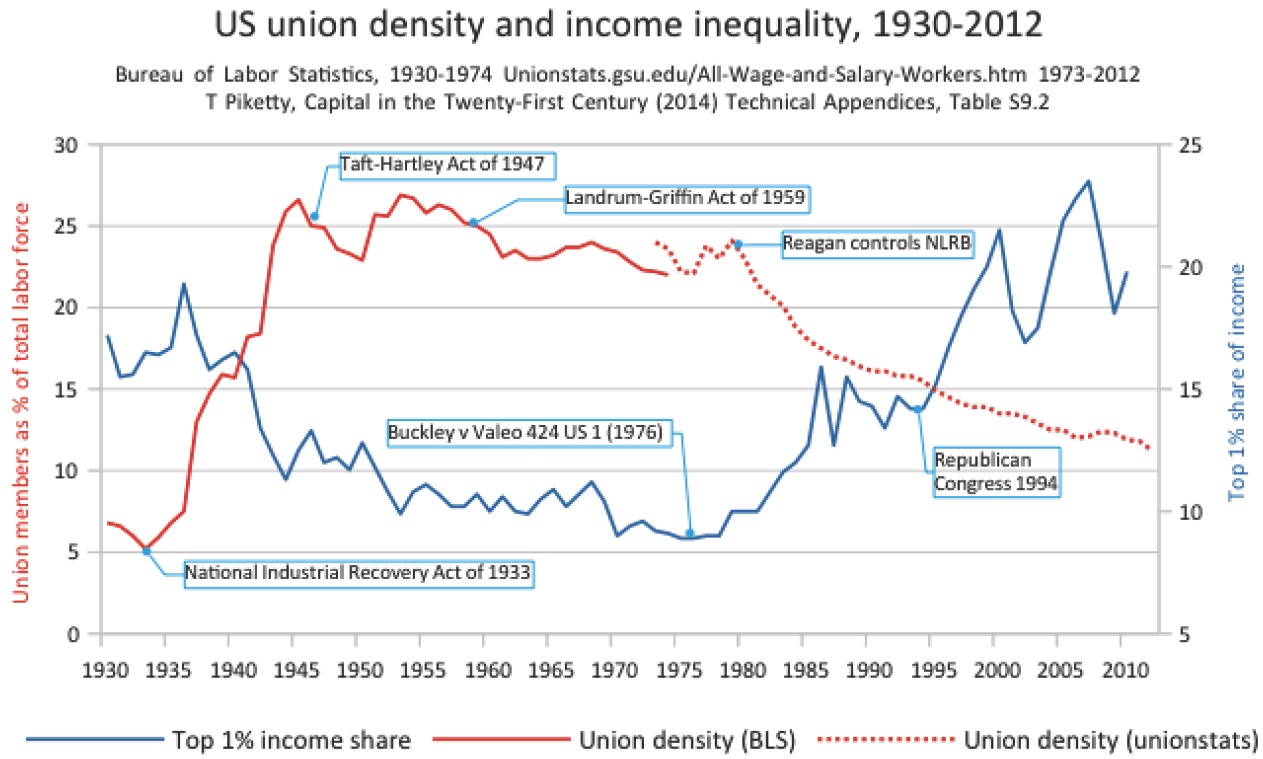
The long-term cause of the Trump episode begins with Buckley v. Valeo in 1976. 12 Forty years of Supreme Court decisions, and especially the decisions of the late Justice Antonin Scalia, 13 play the major role. But Buckley v. Valeo was the “Trump for President” decision because it decided, over powerful dissent, that the First Amendment to the U.S. Constitution protected unlimited spending of money on one’s own political campaign. As he proclaimed during his primaries, Trump financed himself with his inherited wealth, via loans from one of his companies. Buckley long pre-dates the also disastrous decision in Citizens United v. Federal Election Commission. 14 But it made Citizens United, neo-conservatism and Trump, possible.
This article focuses on the politics of law, rather than campaign finance law. 15 But it must be noted at the outset that the First Amendment prohibition on Congress passing laws “abridging the freedom of speech” has little or nothing to do with election spending. The powerful dissenting judgments in Buckley explained this, 16 and their reasoning has been mirrored in other democratic countries worldwide. 17 Unlimited election expenditures by anyone, like Trump, diminish other people’s freedom. Other people’s voices are drowned out in scarce media resources by those with the deepest pockets. This may be changing through the internet, which could allow an essentially unlimited supply of discourse so long as network monopolies on the web remain unpriced and open. But advertising opportunities on the web, radio waves and TV channels are fewer, media channels can be purchased, and politicians can be lobbied. This is why all democracies reject that money is speech per se. Buckley was not the product of reason. It was one of the first cases after Justice William O. Douglas had to leave the Court. It was the start of a decisive change in American governance. Antonin Scalia’s death, in 2016, marked a pause in a four decade phase in judicial composition, 18 but the Republican Party held out on a new appointment in Congress, won the Presidency, and got Neil Gorsuch on the Court. 19
What led to Buckley v. Valeo? It was the crowning success of a careful plan, started by Lewis Powell, in 1971. For the U. S. Chamber of Commerce, Powell wrote an extraordinary ‘memorandum’ entitled “Attack on American Free Enterprise System”. It explained how to roll back democratic organization in politics and the economy for the next generation. 20 Powell, a corporate lawyer, said a concerted effort to push their ‘side’ of the argument had to begin in public education, and journalism where news-stand literature was “advocating everything from revolution to erotic free love”. Powell also urged concerted action in the courts. As he put it,
it is essential that spokesmen for the enterprise system -- at all levels and at every opportunity -- be far more aggressive than in the past.... There should not be the slightest hesitation to press vigorously in all political arenas for support of the enterprise system. Nor should there be reluctance to penalize politically those who oppose it. Lessons can be learned from organized labor in this respect.... It is time for American business -- which has demonstrated the greatest capacity in all history to produce and to influence consumer decisions -- to apply their great talents vigorously to the preservation of the system itself. 21
This was largely assured when Richard Nixon appointed Powell himself to the U. S. Supreme Court. Even in 1971 it was preposterous to say, as Powell did then, that “the American business executive is truly the “forgotten man.” But once Buckley was decided, fewer and fewer people would ever say it again.
Since Buckley, American society has slowly drifted into something resembling monopoly capitalism. 22 Corporate boards, banks, and asset managers monopolize the votes in the economy, almost all with “other people’s money”. 23 They hold immense economic influence. Economic influence is translated into politics. Policies become law. Law is used to entrench economic privilege. The modern Republican party became a wholly owned subsidiary of large corporations and financiers, and the Democratic party has struggled to resist arrest. Democracy in America needs care and attention, or there will be another conclusion. Part II of this article explains a taxonomy of social ideals by which we may try to understand politics today. Part III outlines the essence of the U.S. Supreme Court’s case law. Part IV explains the social ideal of the politics of Donald Trump. Its basic argument is that Trump, and the law that makes him possible, is not fascist, but the extension of a system of monopoly capitalism. If we had to give it a name, the social ideal of Donald Trump may be termed “fascism-lite”.
II. A Taxonomy of Social Ideals
Probably the best taxonomy of politics was suggested by a remarkable Berlin Labor Court judge, who was forced to flee Germany in 1933. Otto Kahn-Freund defined four categories of political group in terms of their “social ideal”. 24 First, there was liberalism, which “condemns all combinations and leaves the structuring of social relations to the free play of social and economic forces”. Second, social conservatism “places the existentially isolated, uncombined individuals of the working class under the social protection of the state”. Third, collectivism “leaves the structuring of social relations to the conflict between the two classes which are party to the basic contradiction in society” – namely labor and capital. Fourth, there was fascism, a hybrid of those other ideals. It shared liberalism’s dislike of state intervention, social conservatism’s embrace of welfare provision for insiders, and collectivism’s view that associations are key actors in class conflict. On top of violence as a means of politics and diplomacy, fascism meant private ownership, paternalism and exclusion, coupled with victory for the “leader” in total class war.
A. Liberalism, Social Conservatism and Collectivism
Kahn-Freund’s categories were styled to fit with an older German politics that he saw in his day. They mirrored ‘ideal types’ of the bourgeoisie, Rheinland industrialists, socialist workers, and the brown-shirts. The purpose of his work was to explain the social ideal pursued by the Empire Labor Court (Reichsarbeitsgericht), in disputes between workers and employers, during the late 1920s and first years of the 1930s. In essence, Kahn-Freund had argued that the German courts had been pursuing a fascist doctrine in labor regulation, and he said it in 1931. But, as he later emphasized, it would have been wrong to imply the judiciary had any political self-awareness. 25
What has become of those categories today? Liberalism in its older guise met a rapid death, and not so strangely, between the first and second world wars. 26 It could not maintain its place on the progressive side of politics once it had succeeded in busting the trusts and robber barons in the U. S. 27 or breaking the landed aristocracy in Britain. 28 Those elemental shifts in power produced the conditions for political democracy.
Social conservatism – as it existed in Germany – would gradually diminish in its ‘social’ aspect over the later 20th century, as it absorbed the remnants of a liberal attitude toward economic relations. But simultaneously in continental Europe, conservatism was ‘christianized’ on a model that favored the coordination of the interests of members in a community. It had ceased to accept that people were unbound from moral obligations to one another. 29 The tension between this and liberalism remain. The same was not true of Anglo-American conservatism, which struggled to develop a coherent attachment to social values. Collectivism was manifested most starkly, at least in the eyes of its self-anointed believers, in 20th century communist movements. They emphasized the value of working class victory over the value of democratic organization. It collapsed with the Berlin Wall, when it became obvious that political and economic despotism was not compatible with promoting the rising popular demand for an agenda of human and social development. 30 This remains true today.
B. Fascism
Fascism, as we know, had to be defeated by military means, and at the cost of unspeakable humanitarian tragedy. But what, specifically, were the contours of fascist theory in relation to social organization? Within any association, everyone had to follow the leader. This was especially true in corporate law. A visiting scholar at Harvard, and a researcher for the German banking industry named Johannes Zahn, developed this view at length, summarized by the great contract lawyer, Friedrich Kessler, in an English language book review. In Zhan’s perception, American law was a model for German law. It had grown strong in the 1920s because,
American corporation law is based upon two fundamental principles: first, the leadership principle: the directors are the leaders of the corporation; second, the American corporation is a bundle of contractual relationships, between the corporation and the state, between directors and shareholders, between the shareholders mutually. 31
The corporation itself was no more than a fiction that concealed contractual relations. But ‘contracts’ were more than legal fictions themselves; they held the status of an ethical principle. The corporate fiction concealed the true ethical basis of the relations among individuals and the state. 32 Because shareholders – like all stakeholders – were irrational, strong leadership was needed by the board of directors. 33
Of course, U.S. corporate law at that time was not as Zahn described. His analysis contained serious, and probably willful misreadings of central cases, 34 all geared toward the belief that corporate directors should have limited accountability. As Kessler wrote, Zahn had merely “discovered what he wished to discover,” 35 because Zahn’s goal was to remake corporate law so that “democracy of capital will vanish just as it did in politics.” 36 It was riven with nonsense:
When a genuine leader-follower relationship develops between the board and the shareholders, the voting rights of shareholders will lose all practical meaning. In the first place, the shareholder will have much less to say than before. He will not, however, regard himself as a victim because he will trust the leadership. 37
If this reasoning was unpersuasive, it did not matter. “The triumph of the national revolution,” wrote Zahn, “has given this debate new impetus, and new direction.” 38 That direction was perfected in the fascist Aktiengesetz 1937 (Public Companies Act 1937). 39 It was drafted by a man named Ernst Geßler, but chiefly inspired by Zahn. 40
The same views played out in the fascist regulation of labor. 41 Everyone would follow the leader of the business, and pledge allegiance to the abstract conception of the undertaking. 42 On 3 May 1933, the Nazis replaced the free trade unions with the nationalized Deutsche Arbeitsfront (German Labor Front). Every person who worked for a living, eventually including employed and self-employed people alike, was socially compelled to join. 43 The DAF was a branch of the Nazi party, commanded directly by Hitler. 44 Its titular leader was Dr Robert Ley, a persistent alcoholic who committed suicide before his Nuremberg trial.
A primary task was to create ‘understanding’ among the ‘business leaders’ for their ‘followers’. In return the followers were to understand the situation and possibilities of the business, by finding the common basis of their ‘justified interests’ so long as those were in line with Nazi principles. 45 DAF periodicals were filled with propaganda. Meetings were compulsory, but discussion was absent. 46 In each workplace, DAF officials acted, in the words of Ley, as “the soldier-like kernel of the plant community which obeys the Leader blindly. Its motto is ‘the Leader is always right’”. 47 The same Führerprinzip prevailed in labor law as it would in company law. Fascism was never content until it thrust its pathological paranoia onto every association, even clubs for playing chess and collecting stamps. 48 The consequence of this self-contradictory, psychotic ideology was conquest and murder: “an aggressive imperialist system seeking to transform markets into colonies.” 49 It was not ended from within, only without.
C. Progressive Democracy
Which ideals filled the space that the decline or defeat of the others left? By far the most important was progressive democracy. It has continually prevailed over all competitors. 50 ‘Progressive democracy’ could probably cut across elements of each other ideal that Kahn-Freund identified, with the clear exception of fascism. It contains elements of liberalism’s ‘free play of social and economic forces’, but would never ‘condemn all combinations’. It would approve social conservatism’s protection of weaker parties, but was committed to inclusion of all, and would not admit that people were ‘existentially isolated’. It would endorse collectivism’s desire to leave groups to govern themselves, but not accept such a thing as a ‘basic contradiction in society’. Conflicts between capital and labor could be positively resolved through legislative enactment of social and economic rights, 51 to infuse law and justice into social relations of subordination and power. 52
By itself, the concept of ‘democracy’ involves a basic Periclean desire to see that “administration is in the hands of the many and not of the few.” 53 The desire was to socialize, not merely ownership, but power. 54 After a vote in politics was won socialists gradually shifted their emphasis from ‘common ownership of the means of production’ to focus on power, whether its form was property or not. They aimed for votes, not just in politics, but in the economy. Nationalization ceased to be an end in itself. In Germany, the trade unions (themselves having been nationalized by the Nazis) ceased uniformly to advocate government ownership of everything, rather than creating social ownership of specific enterprises. 55 In the UK, the post-war Labour Party, like democratic socialist parties across Europe, found state ownership, though far better than private monopolies, did not necessarily attain goals of social liberation, either at work or as citizens. This was reflected in the change of the Labour Party’s clause IV, as originally written by Sidney Webb. It was amended to echo Pericles: a “democratic socialist party” which believed power should be “in the hands of the many not the few”. 56 In any case, ownership of property had already ceased to be truly ‘private’ (in Marx’s definition of ‘capitalism’) in Marx’s own lifetime. 57 Mass production through mass enterprise, aggregating capital from millions of shareholders meant ownership had already become, not private, but social. This was why the architects of democratic socialism in Europe and the American New Deal, especially A.A. Berle, became so concerned with the distribution of economic power. 58 Ultimately, it implied voting in the economy had to become more equal.
There are, of course, multiple conceptions or “models of democracy”, 59 which build on the basic Periclean concept: liberal, conservative, social, and so forth. The core of any mass democracy was resolution of conflicts through representative voting. Other conceptions can involve direct participation; a broader ‘social contract’ containing reciprocal rights and duties; 60 greater or lesser integration of human rights and the rule of law to make voting genuinely free and informed; 61 deliberative debate through an inclusive process of social communication. 62 But whichever the conception, at the centre is a commitment to moral equality among people.
The concept of “progressive” democracy was expressed admirably well by one of its historical opponents, who happened to be the “father of modern company law” in the United Kingdom. 63 Robert Lowe MP fiercely opposed the Second Reform Act 1867. This extended the franchise to more working class people for the first time since 1832, by lowering the qualification of owning property in order to vote. In the Third Reading, Lowe said this:
This principle of equality which you have taken to worship, is a very jealous power; she cannot be worshipped by halves, and like the Turk in this respect, she brooks no rival near the throne. When you get a democratic basis for your institutions, you must remember that you cannot look at that alone, but you must look at it in reference to all your other institutions. When you have once taught the people to entertain the notion of the individual rights of every citizen to share in the Government, and the doctrine of popular supremacy, you impose on yourselves the task of re-modelling the whole of your institutions, in reference to the principles that you have set up... . 64
As Lowe said, brooking no rival, the “progressive” among democrats seeks to increase the number of fields in life, and particularly the number of social institutions, where power is in the hands of the many, not the few. This ideal sees people as having the capacity to fulfill their potential, and “lend a helping hand” to each other by organizing a just society devoted to human development. 65
After the fall of the Berlin Wall, it might have appeared there was no serious competitor to progressive democracy. There was, claimed Francis Fukuyama, an “end of history” when it came to American “liberal democracy”. 66 Against this view, many argued convincingly that ‘Varieties of Capitalism’ did and would persist in an economic sense. There was no necessary convergence around a supposed ‘liberal’ model of law and economics. 67 But it might have been agreed that in the political sphere, the challenge was over: nobody would seek to undo the basic structure of democratic society.
D. Neo-Liberalism and Neo-Conservatism
As the 21st century opened, it became clear that there were at least two major forms of ideal that did pose a challenge, though only one was real. The two ideals are loosely (and often pejoratively) labelled as ‘neo-liberal’, and ‘neo-conservative’. The social ideal of neo-liberalism views individuals as having the full capacity to take rational decisions, except where they organize through the ‘coercive’ organs of the state. 68 People acting in markets are rational, and people in government are not. Public sector administration, which is an important channel for collective action for progressive democrats, should be reduced except to set minimal “rules of just conduct”. 69 Indeed, it has been argued in a growing literature that the ideals of neoliberalism have created what is known as The Neo-Liberal State. 70
The trouble is that neo-liberalism – if we take its theoretical proponents at their word – has only ever existed in the pages of academic fantasy. A neo-liberal state is, in the literal sense of Robert Nozick’s book title, a “Utopia”. 71 You could not have the Nozick’s night watchman state, based only on principles of contract, tort and unjust enrichment, without impossible levels of poverty and coercion. An end to all consumer protection, all tenancy rights, road traffic regulation, labor rights, food safety inspections, public firefighters, securities regulation, town planning, let alone public education, health and social security would be beyond serious contemplation. You could not reduce everything to Friedrich von Hayek’s “just rules of the game” without the same consequences of disaster.
To take just one example, to have an economy operating only according to Hayek’s version of the “just rules of the game” would mean a return to damages for trade unions taking collective action, as before the Clayton Act of 1914 in the U.S., the Trade Disputes Act 1906 in the U.K., or the Anti-Socialist Acts of the Bismarckian era. 72 Various systems of criminalizing free association do operate today. Every despotic society has to suppress free trade unions, but that very suppression always entrenched poverty, and had to give way by overwhelming popular demand, to the creation of modern democracy. In practice, neo-liberalism could be manifested in political slogans. Margaret Thatcher said there was “no such thing as society”, because collective autonomy might be replaced by “individuals and families”. 73The Constitution of Liberty might be pounded into a table, and declared to be “what we believe”. 74 But it was a belief, not a reality. It was impossible to maintain any semblance of modern society without the apparatus of a welfare state. Without it, impossible poverty, unemployment, and riots would give way to democratic change (or its unforgiving alternatives) precisely because those things impelled social democratization to begin with.
III. The Social Ideals of the U.S. Supreme Court
While neo-liberalism has only existed in academic theory, neo-conservatism is indeed workable. Its essential trick was to utilize the state to achieve the goals of its interest groups. 75 It has been operating on the back of the jurisprudence of the U.S. Supreme Court. There are, however, effectively two Supreme Courts: the first represented by a Republican appointed majority, which presided from 1969 with a brief interlude in 2016. A second is represented by Democratic appointees. These judges largely reason and explain the law like other judges. But for the Republican appointees, what are the essential contours of their social ideal, of modern neo-conservatism?
The story must begin in 1976. Buckley v Valeo was one of the first decisions after Justice William O. Douglas, the last remaining judge nominated by Franklin D. Roosevelt, had become so elderly that he could no longer come to court and vote. It decided that a candidate for political office should be entitled to spend unlimited amounts of his or her money on campaigning. 76 Over the powerful dissents of Justices White and Marshall, 77 the Republican appointees struck down large parts of the Federal Election Campaign Act of 1971, especially the §608 limits on political expenditures, which served as a model for the limits in all other democratic countries. 78 Spending money was, apparently, an exercise of free ‘speech’ under the First Amendment.
We have good international evidence that the least democratic developing countries spend the most money on elections. 79 At its most stark, Buckley v. Valeo put American politics on the road to serfdom: politicians indentured to business, completely at odds with the will of the people. 80 Two years later in First National Bank of Boston v. Bellotti, Justice Powell held for a majority, over four dissenting votes, that state legislation could not restrict expenditure by corporations during a ballot. 81 Without these changes that Buckley began, the adminstrations of Reagan, the Bush family, and numerous state governors would just not have been possible. As money tried to buy both sides, it shifted all politics to the short-term interests of the rich.
After Buckley and Bellotti the Court’s Republican majority entrenched a hardline ‘free-enterprise’ philosophy, just as Powell and the U.S. Chamber of Commerce had envisaged. 82 They took away federal rights to organize from teachers at religious schools. 83 They allowed states to ban union representatives who were not of ‘good moral character’. 84 They allowed employees to be searched at work, like criminal suspects, by employing entities. 85 They hollowed out access to justice against securities fraud, allowing cases to go to arbitrators chosen by the contracting party with greater bargaining power. 86 They denied employees the right to claim for medical malpractice, when employers were the direct purchaser of a health care plan. 87 They removed protection for undocumented workers to the fundamental right to organize a union. 88 They tried to ensure that discrimination claims could not be brought where markets were themselves discriminatory. 89 They also tried to cancel discrimination claims brought after 180 days of an act, even if an employee had no way of knowing they had suffered, 90 though both decisions were reversed by a briefly functioning Congress. They held that votes cast in Florida could not be looked at in a recount, with the result that George W. Bush became President. 91 Then, the Supreme Court struck down a ban on handguns that had been established in Washington DC for 31 years, 92 and struck down a system for preventing southern states disenfranchising voters that had been in place for 48 years. 93 No modern judiciary has engaged in a more sustained assault on democracy and human rights. In particular, its attack on labor and democratic society made inequality soar.
But the most astonishing modern phase of jurisprudence began in Citizens United v. Federal Election Commission. 94 The Court ruled on whether the Federal Election Campaign Act 1971 §441b, which prohibited corporations and unions from using treasury money to fund ‘electioneering communications’, was ‘constitutional’. At issue was an extended ‘negative ad’ called Hillary: The Movie. The D.C. Circuit Court held the advertisement had violated §441b, because it was paid for by a political action committee and aired within a prohibited campaign period. The five Republican appointees on the U.S. Supreme Court reversed this and held that any expenditure by a corporation or a union for the purpose of election was a necessary part of the First Amendment, and so §441b, which had come from the Bipartisan Campaign Reform Act 2002 §203, was unconstitutional.
The insight that Citizens United gives into the Court’s social ideal is not merely its disregard for arguments that corporate money would corrupt politics, nor its view that a corporation is a ‘person’ like any other. Instead, the key is how it rationalized internal corporate power. When a corporation spends money, it necessarily uses resources that are generated by every stakeholder who contributes capital and labor to the enterprise: particularly the directors, shareholders, and employees. Out of all those people – potentially millions of ultimate beneficiaries behind institutional shareholders, especially those contributing through retirement savings, and maybe thousands of employees – who should determine the corporation’s political preferences? A poll of those stakeholders would usually reveal widely varying and conflicting views. In other countries, that problem is usually taken to indicate that nobody can really be said to represent a corporation and spend its money politically, or there must be a vote of some kind. 95
Yet the U. S. Supreme Court’s Republican appointees thought political spending should be determined in the same way that it thought all issues should be decided: by managerial prerogative. 96 In particular, Justice Scalia said that corporate speech was like that of a political party:
the speech of many individual Americans, who have associated in a common cause, giving the leadership of the party the right to speak on their behalf. The association of individuals in a business corporation is no different—or at least it cannot be denied the right to speak on the simplistic ground that it is not “an individual American.” 97
On this view, (which Scalia believed was how a political party should operate) people in an association are necessarily ‘giving the leadership’ their rights to be exercised on their behalf. 98 Supposedly, this occurs through the exercise of free will, both an implicit and chosen aspect of joining any association.
Second, in Burwell v. Hobby Lobby Stores Inc, the Supreme Court held that an employee’s right to contraception under health care plans regulated by the Affordable Care Act of 2010 was subject to an employer’s ‘religious freedom’. 99 The Religious Freedom Restoration Act of 1993 prevented government from placing a substantial ‘burden’ on a ‘person’s exercise of religion’. The shareholders and managers of Hobby Lobby Stores Inc, which employed around 22,000 staff, claimed that the requirement to provide health care plans, which included payments for four kinds of contraception that would prevent an egg developing in the uterus, burdened their exercise of religion. The majority of the Court, while declining to finally decide that this aspect of ‘Obamacare’ infringed the First Amendment, held the mandate violated the corporate owners’ religious rights.
During argument, Justice Scalia spoke forcefully in favor of the ‘leadership’ principle he had mentioned in Citizens United. He said “whoever controls the corporation determines what the corporation” does. 100 In the opinion for the Court, Justice Alito addressed the issue of who the legal fiction of ‘personhood’ of the corporation really protected:
the purpose of this fiction is to provide protection for human beings. A corporation is simply a form of organization used by human beings to achieve desired ends. An established body of law specifies the rights and obligations of the people (including shareholders, officers, and employees) who are associated with a corporation in one way or another. 101
Thus, the corporate form is designed for ‘protection for human beings’. But it protects some more than others. In essence, it protects ‘whoever controls the corporation’. It allows the people in control to impose their values on others, absolutely.
Third, in AT&T Mobility LLC v. Concepcion, the Supreme Court held that a corporation may include a binding clause in standard form contracts with consumers, under the Federal Arbitration Act of 1925, excluding the right to bring a civil or class action claim. According to the majority, those arbitration agreements must simply be enforced “according to their terms.” 102 This suggested that a business will select the people who decide a legal dispute, apparently even including one on compulsory consumer rights. This perfected the cases on securities arbitration in the 1980s, and a similar decision that employment rights could be taken away by contracts. 103 In the Lochner era, 104 the Supreme Court had struck down social and economic legislation as unconstitutional. In the Concepcion era, there was no longer any such need; the Republican appointees have said that any business can simply opt out of social duties. Some form of arbitration agreement is now estimated to cover a quarter of the American civilian workforce. 105 This privatization of justice means that consumers and employees have no inherent guarantee of a fair and impartial hearing, i.e. no rights for anyone, except for the ‘leader’ of the enterprise.
The result is, the U.S. Supreme Court’s ‘neo-conservative’ ideal has three main features. First, it emphasizes the absolute autonomy of ‘the leadership’ whenever there is a conflict. Second, it negates all rights for other members of an association: everyone is equal in their subordination to the leader. Third, it excludes the ability of law to protect the vulnerable in supposedly market or private affairs. It differs from neo-liberalism because state power is actively used to police social relations in favor of managerial dominance. It pursues a social ideal that almost conforms with the fascist theories of the 1930s, with one major exception. Neo-conservatism has abandoned fascism’s concern for the social welfare of insiders. Welfare has merely become optional, at the discretion of the leader of the organization.
This does not mean that the Republican judicial appointees were consciously pursuing any one ideology or another, that there is any documentary evidence Justice Scalia had fascist connections, or indeed that the remaining appointees do.
Justice Scalia, himself, made clear on various occasions that he simply thought the purpose of the U.S. Constitution was, not to empower the fullest participation of people in democratic life, 106 but to be a limit on government. 107 People have accused the judiciary of anti-democratic ideology before, but as Otto Kahn-Freund had said, that could overestimate “the political self-awareness of the judges.” 108 Another very different judge in the U.K., Lord Sumption, seemed to frame the issue accurately;
The process by which democracies decline is more subtle.... usually more mundane and insidious.... they are slowly drained of what makes them democratic, by a gradual process of internal decay and mounting indifference, until one suddenly notices that they have become something different. 109
IV. The Social Ideal of Donald Trump
If nobody had noticed before 2015 that ‘something different’ was taking place in U.S. politics, it became painfully clear as the Republican presidential primary for 2016 gathered speed. Once again, it is important to stress that Donald Trump, the individual, is profoundly uninteresting. He contributes nothing new to political science. He has an obvious personal struggle with self-esteem. The persona and campaign he has crafted reflect this. 110 Nevertheless, the combination of policy positions serves as a useful example of what monopoly capitalism, driven by neo-conservative politics on the U.S. Supreme Court, has led to.
The defining feature of the persona Trump cultivates is hardcore managerialism. This emphasizes his personal belief that he ‘wins’, and this is why he can ‘make America great again’. It begins with his previous reality TV show, The Apprentice, where Donald Trump in the ‘board room’ would tell candidates, who apparently sought jobs in his inherited real estate firm, each week ‘you’re fired’. The psychological spectacle, from the viewer’s perspective, invited a strange empathy with the cult of the business leader. Who would the leader fire? Would you agree with the leader? And if you did not agree, why were you wrong? It seems unlikely that Trump acted differently in real life. For example, Trump dismissed workers who were engaged in organizing a union at his hotels to improve their wages. 111 This behavior mirrors the leadership principle.
However, the key element lacking for Trump to be characterized as a real fascist is a concern for insider welfare. Like the Republican majority of the Supreme Court, Trump appears to be situated firmly in the neo-conservative frame and lacks the historical awareness to break out. Despite his talk of ‘jobs’ there is no commitment to full employment. There are pledges to cut the minimum wage. Despite criticizing bad trade deals, there is no commitment to putting labor and environmental standards in them. A Republican candidate, in order to complete the fascist profile, could, of course, pretend to swing sharply to the ‘left’ to capture voters whose living standards have stagnated and declined over the last 40 years. Elements of such a ‘strategy’ might have been detected in Trump denouncing the invasion of Iraq, blaming 9/11 on the Bush administration, criticizing trade agreements, or praising the National Health Service in Scotland. 112 Trump’s principles are, to put it mildly, not fixed. However, it is doubtful that any coherent fascist agenda has been thought through, rather than policies being made of-the-cuff. This is why, without any serious display of concern for welfare of insiders, 113 the social ideal of Donald Trump would accurately be termed, not as fascism, but fascism-lite.
Politically, Trump’s strong businessman image is consistent with key elements of fascist behavior. The same, however, is consistent with an indistinctive ‘Hobbesian’ monarch, 114 who would make everyone else’s lives nasty, brutish and short. The infallible leader pledges order and stability, while totally denying rights for individuals. The implicit, yet unenforceable, ‘social contract’ is that those on the inside may be protected, while those on the outside fare less well. So, among other things, Trump has said to combat military enemies “you have to go after their families”. 115 He pledges to do “a hell of a lot worse than water-boarding”. 116 He says there “has to be some form of punishment” for women who have abortions. 117 He promises a mass “deportation force” to be used against around 11 million undocumented migrants. 118 Under international humanitarian law, this means war crimes, torture, violence against women, and premeditated violations of rights of the child. 119 Under the U.S. Constitution this means inhumane and degrading treatment, infringing the right to privacy, and breaching due process of law. 120 That said, those very goals – minimizing torture, abolishing the right to choose, total aggression toward rights for outsiders – had been consistently supported by Justice Scalia in minority dicta and media interviews during his tenure on the court. 121 Trump makes what was implicit explicit, and carries the same ideals to their logical conclusion. The common thread is to proclaim an absolute right for the leader, and an absolute denial of rights for everyone else.
Why, in a democratic society, would anybody believe Trump would ‘make America great’, when policies are unrelated to the goal? The answer is, the ‘leader’ plays on systemic corruption. It is said that nothing gets done anymore, “America doesn’t win anymore”, and this contains an element of truth. 122 In the U.S., led by Ted Cruz, government shut down in 2013. Legislation reflecting the electorate’s will has only been possible in America in four years since 1980, two in Bill Clinton’s presidency, and two in Barack Obama’s, before the Congress was disabled by Republican winning majorities or blocking minorities. From the perspective of the most ideological, corporate election spending must ensure, not that Republicans win to implement policy (by now this has become quite irrelevant), but win to maintain a filibustering minority in the Senate, or a House of Representatives majority, and a grip on the Supreme Court. Everything must be done to prevent the reversal of Buckley v. Valeo. 123
Election spending must, of course, be accompanied by linguistic propaganda. Ideology often begins by taking ordinary concepts and extending them to inappropriate subject matter. 124 During the Lochner era of the U.S. Supreme Court, the most obvious example was ‘freedom of contract’. The important value of private autonomy, which can be seen as appropriate for commercial transactions, became a constitutional doctrine that legitimized unequal bargaining power in contracts between workers and employing entities, tenants and landlords, or consumers and corporations. 125 Similarly, the Powell memorandum in 1971 used the rhetoric of ‘free enterprise’ to defend, not partnerships or small business, but corporate directors, sheltered by asset managers and banks, who appropriate the shareholder votes in the economy with ‘other people’s money.’ 126 In Citizens United, the idea of free ‘speech’ under the First Amendment is extended from human beings to corporations, in order to corrupt the basis of democratic discourse. 127
Another strategy of linguistic propaganda, with similar effect, is to rebrand concepts with words favorable to the political cause. Instead of changing society to match people’s perceptions of what is right, people’s perceptions are changed to match society. Inheritance tax becomes ‘death tax’. Global warming and environmental damage becomes ‘climate change’. Oil drilling and fracking becomes ‘energy exploration’. Employers, who bark ‘you’re fired’, became ‘job creators’. Language becomes, not a contextually sensitive basis for deliberative discourse, 128 but in the words of Newt Gingrich ‘A Key Mechanism of Control’. 129 The essential goal is to take people’s trust, and abuse it by making them vote against their own interests. 130
The difficulty is, language games last only so long, before the politics of division will pay more. George W. Bush’s ‘ownership society’ was sharply redefined by Barack Obama as the ‘you’re on your own’ society. 131 Republicans who said they want ‘right to work’ states are called out for really wanting ‘right to work for less’ states. 132 The politics of division become ever more essential as government fails to solve the problems it is meant to: of escalating inequality, poverty, unemployment, and climate damage. Before 2015, the Republican Party had kept a lid on rampant racism, sexism, homophobia, while ensuring that the subtext of its policies still appealed to those sentiments. Donald Trump, however, has arrived at a time when matters are so extreme, it pays to make the implicit explicit. It spurs other politicians to do the same.
So, to distract people from the causes of social problems – of an authoritarian economy, where wealth and power are in the hands of the few – it is necessary to divide people. Citizens are turned against new immigrants. Christians against Muslims. Union members against their colleagues. Workers against the unemployed. White people against black people. Old against young. Educated against uneducated. Straight against gay. Men against women. Mothers against their own children. The politics of division are not accidental. They are meant to inhibit people’s sense of solidarity, the basis for taking collective action. They represent the essential strategy of an interest group that cannot win any other way. As all else fails, they lie and try to steal the vote. Sometimes, just sometimes, and whatever the positive law, there is an inherent right to resist, to “let justice be done, whatever be the consequence.” 133
V. Conclusion
American politics today may appear dangerous, but there is an alternative. The politics of ‘democracy and social justice’, to make a ‘living law’, 134 celebrated its 100th birthday in 2016, and remains far stronger. Social justice means everyone is empowered to achieve their fullest potential. It turns the ways of an old Platonic Republic on their head, so that instead of the individual being subordinated to society, 135 all law, every social institution, serves human freedom. 136 This means universal education, full and fair employment, social security, and democratic voice in every social institution: in government, the workplace, in enterprise, and public services. Power cannot be in the hands of the many, rather than the few until everyone can realize their potential. And people cannot realize their potential unless they have a voice in community decisions which make that possible. It is not an accident of history that half the Amendments to the U.S. Constitution since 1789 directly related to democratization, from votes for people who had no property, for people once classed as property, for women, for young people, for all. 137 When everybody can participate in the life of the law, reason, not rancor, prevails in discussion. Democracy makes the rule of law, not the rule of some man, legitimate.
The important question, in the next shift of politics, is how the interest groups that produced the Powell Memorandum, Buckley v. Valeo, and Trump, will be undone. Long-term political shifts are not about winning elections but altering the underlying forces of social power. Politics reflects this. Law entrenches barriers to democracy and social justice in three main ways. First, shareholders monopolize the votes in the economy, in corporations, over the voice of employees in general, and consumers or the public in regulated enterprises. This is the heart of “the ‘Donald Trump’ model of workplace relations”. 138 Second, shareholder voting rights are themselves monopolized, not by people whose money is invested, but asset managers and banks with ‘other people’s money’. 139 This has led to an ‘Enron economy’ prone to financial crisis. Third, wealth discrimination blocks equal freedom to be educated, to access public and private schools and universities. Rich parents bribe their way to the front of the college line, ahead of students with more merit. The tools to achieve modern social security, universal health care, equal campaign finance, fair trade, progressive tax, and an end to climate damage are well known. But for democracy and enterprise to revitalize, we need (1) votes at work, (2) votes in the economy, and (3) an end to wealth discrimination and segregation in all education. 140
In these problems, it should not be thought the United States is alone. Movements similar to the ‘Trumped-up’ Republican Party have been spreading. The ‘United Kingdom Independence Party’ and the ‘Brexiteers’, the German ‘Alternative für Deutschland’, the Austrian ‘Freedom Party’, and Putin’s ‘United Russia’. They thrive on social division. They have no principles, but to secure privilege for their industrial or financial masters, and their defining issue is climate damage. Russian backing for Trump and for Brexit, show its precarity. 141 Russian coal and oil are $183bn of its total $316bn in exports, 142 near 60 per cent of its export economy. So, Russia is backing political movements that deny climate damage. It will do anything to stall a zero-carbon future. For Russia’s kleptocrats, breaking American democracy and the European Union are questions, not just of business sense, but economic survival, because every lump of coal, every drop of oil, will be worthless when outcompeted by solar and wind. Compare China with fossil fuel exports under 2 per cent (but imports of 13 per cent), 143 the U.S. or U.K. under 8 percent, or France under 3 percent. 144 Russia must stop renewable energy among its UN Security Council partners at all costs. It cannot touch China, so it attacked the E.U. and U.S. 145 In 2016, climate damage became geo-political.
Where does that leave the neo-conservative politics that made Donald Trump? In this larger perspective, those business interests are in the process of being eclipsed. Coal powered the British Empire’s 19th century. Oil powered the Empire State’s 20th century. Renewable energy will power the 21st century. But sunshine and wind cannot be monopolized like fossil fuels. As a new plurality transforms the global economy, proprietary domination will matter less, networks more. The corporations building combustion motors, pumping oil they run on, and bankrolling oil’s extraction, may dominate the global economy today, but that will not last for long. 146 The unending barrage of crisis and moral collapse is beyond words. 147 The people who are growing up with this reality, the once silenced majority in America, are building strategies to contain those interests. This is the real and necessary “wall”. The United States of America risks descending into a new dark age, but the case for social transformation is compelling, and greater.