
Table 1
Proposed questionnaire items and key constructs for training programme evaluation
| Aspect | Questionnaire items | Key construct |
|---|---|---|
| Overall structure and methodological principles | Rate the overall structure of the program | Program |
| Rate the progression of intensity and/or volume | Progression | |
| Evaluate the extent to which the programme considers athletes’ preparedness | Individualization | |
| Assess the inclusion of different preparation components (technical, physical, tactical, etc.) | Diversity | |
| Rate the integration of injury prevention, rest, and recovery measures | Safety | |
| Combat sports specificity | Rate the exercises aimed at developing technical skills (strikes, stance, footwork) | Technical |
| Evaluate the extent to which the programme develops tactical skills (combinations, decision-making, strategy) | Tactical | |
| Rate the coverage of main physical qualities (strength, endurance, speed, agility) | Conditioning | |
| Assess the inclusion of psychological skills development | Psychological | |
| Rate the systematic use of partner work (sparring, pair drills) | Sparring | |
| Practicality and applicability | Rate the feasibility of implementation under typical training conditions (gym, equipment, time) | Feasibility |
| Evaluate the suitability of the programme for beginners in group training | Novices |
Source: Authors’ contribution.
Table 2
Comparative descriptive statistics of expert assessments for each training program
| Key construct | TP1, basic prompt | TP2, refined prompt | TP3, detailed prompt | |||
|---|---|---|---|---|---|---|
| Mean value ± SD | Median (IQR) | Mean value ± SD | Median (IQR) | Mean value ± SD | Median (IQR) | |
| Programme | 1.36 ± 0.50 | 1 (1–2) | 1.91 ± 0.70 | 2 (2–2) | 2.82 ± 0.75 | 3 (2–3) |
| Progression | 1.27 ± 0.47 | 1 (1–2) | 1.82 ± 0.75 | 2 (1–2) | 3.00 ± 0.77 | 3 (2–4) |
| Individualization | 1.18 ± 0.40 | 1 (1–1) | 1.55 ± 0.69 | 1 (1–2) | 2.09 ± 0.94 | 2 (2–2) |
| Diversity | 1.45 ± 0.52 | 1 (1–2) | 1.91 ± 0.70 | 2 (2–2) | 2.82 ± 0.75 | 3 (2–3) |
| Safety | 1.18 ± 0.40 | 1 (1–1) | 1.36 ± .050 | 1 (1–2) | 1.64 ± 0.67 | 2 (1–2) |
| Technical | 1.36 ± 0.50 | 1 (1–2) | 2.45 ± 0.52 | 2 (2–3) | 2.00 ± 0.77 | 2 (2–2) |
| Tactical | 1.18 ± 0.40 | 1 (1–1) | 1.64 ± 0.67 | 2 (1–2) | 1.73 ± 0.65 | 2 (1–2) |
| Conditioning | 1.64 ± 0.50 | 2 (1–2) | 2.00 ± 0.77 | 2 (2–2) | 2.64 ± 0.92 | 3 (2–3) |
| Psychological | 1.18 ± 0.40 | 1 (1–1) | 1.45 ± 0.52 | 1 (1–2) | 1.73 ± 0.65 | 2 (1–2) |
| Sparring | 1.18 ± 0.40 | 1 (1–1) | 1.45 ± 0.52 | 1 (1–2) | 1.91 ± 0.70 | 2 (2–2) |
| Feasibility | 1.55 ± 0.52 | 2 (1–2) | 1.64 ± 0.50 | 2 (1–2) | 2.82 ± 0.75 | 3 (2–3) |
| Novices | 1.36 ± 0.50 | 1 (1–2) | 2.18 ± 0.75 | 2 (2–3) | 1.82 ± 0.75 | 2 (1–2) |
| Overall expert rating | 1.33 ± .47 | 1 (1–2) | 1.78 ± 0.69 | 2 (1–2) | 2.25 ± 0.89 | 2 (2–3) |
Source: Authors’ contribution.
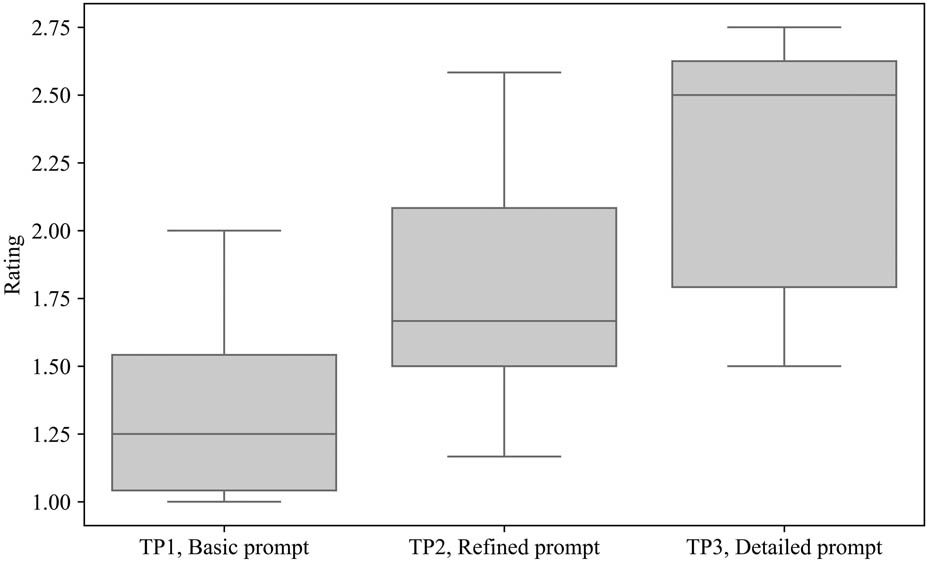
Figure 1
Boxplot of composite expert ratings for each training program
Source: Authors’ contribution.