
1. Introduction
Many jobs require working in a standing position for extended periods of time, and prolonged standing at work can have negative consequences, including the development of a number of musculoskeletal disorders (MSDs). Prolonged standing, especially for more than 30 min, can cause discomfort, fatigue, and back pain (Waters and Dick, 2015). Since prolonged standing and sitting causes adverse health, alternating between sitting and standing positions and moving the body to avoid static posture during working hours are helpful ways to reduce the risk of MSDs. According to a study, frequent breaks to sit, stand, and walk significantly lessened the discomfort than standing and sitting all day long at work (Kar and Hedge, 2020). An exoskeleton has been proposed as a way to limit exposure to activities that raise the risk of knee injuries and avoid positions that increase that risk.
A passive exoskeleton is a mechanical device that aids human joints or movements without the need for an external power source or battery. Although there are still obstacles to directly applying exoskeletons in the workplace, passive exoskeletons are comparatively simpler to implement without requiring major adjustments to the working environment than the active exoskeleton. Therefore, by lowering muscle activity, the passive exoskeleton is being explored in a number of domains to lessen physical tiredness (Kim et al., 2019). The lower-limb exoskeleton is one of the passive exoskeletons and it is an auxiliary device that enables the user to remain seated without the use of a chair. As an alternative to an active exoskeleton, the passive lower-limb exoskeleton has the advantages of being relatively lightweight and simple to wear with a belt or buckle (Pérez Vidal et al., 2021).
Current research shows that ergonomic interventions, especially chairless exoskeleton, can mitigate problems associated with prolonged standing. However, there is still a lack of thorough understanding of the various lower-limb exoskeletons developed to reduce fatigue and discomfort in industrial settings. The aim of this review is to classify and analyse types of lower-limb exoskeletons both commercial and research-based in order to reduce fatigue and discomfort experienced by industrial workers with prolonged standing.
2. Materials and methods
2.1. Eligibility criteria
2.1.1. Inclusion criteria
Population: Industrial workers
Intervention: Passive or semi-active lower-limb exoskeletons
Outcomes: Reductions in muscle activity, perceived discomfort, or metabolic cost
2.2. Literature search
This systematic review was conducted using the Preferred Reporting Items for Systematic Reviews and Meta-Analyses (PRISMA) 2020 criteria. In accordance with these guidelines, it is noted that a formal protocol for this review was not prospectively registered in a public database prior to commencement (Page et al., 2021). The final databases search was executed on 20 June 2025. A combination of the identified keywords was created using the Scopus, ScienceDirect, PubMed, and manual search. Table 1 shows the databases utilized and corresponding search terms.
Table 1
Databases utilized and corresponding search terms
| Database | Search query |
|---|---|
| ScienceDirect | “exoskeleton” AND “prolonged standing” AND “industrial workers” AND “lower limb” AND “muscle fatigue” |
| PubMed | (exoskeleton) AND (industrial workers) AND (muscle fatigue) |
| Scopus | “exoskeleton” AND “muscle fatigue” AND “lower limb” AND “standing” |
| Manual searching | lower limb exoskeleton in manufacturing industry for prolonged standing to reduce fatigue and discomfort |
Source: Author’s contribution
2.3. Literature screening procedure
The screening process was undertaken by two independent reviewers. After the main reviewer had completed the initial search and screening, a second reviewer independently confirmed the final selection of 17 articles and the extracted data. Any disagreements regarding inclusion were resolved by consensus. The most current studies published in the last 10 years were included, including research articles written in English and articles for which a full, free-text translation was available in English. Articles that were not fully accessible were not obtained. Only research papers on lower-limb exoskeleton were included in the study.
2.4. Search results
A total of 87 papers were identified (74 from 3 databases and 13 from manual searching). After screening the titles and abstracts, 25 records remained, as 62 were eliminated for not meeting the inclusion requirements. Duplicate articles were then eliminated from the 25 remaining entries after filtering the full-text articles for research publications released within the previous 10 years. Eight records were eliminated as a result of this approach, leaving 17 articles. The final 17 publications were chosen for data collection after one last check for duplication.
2.5. Quality assessment
The methodological quality of the 17 included studies was evaluated in order to calculate the risk of bias. Due to the wide range of study methods employed, including quasi-experimental laboratory studies and randomized controlled trials, the JBI Critical Appraisal Tool was used (Figure 1).
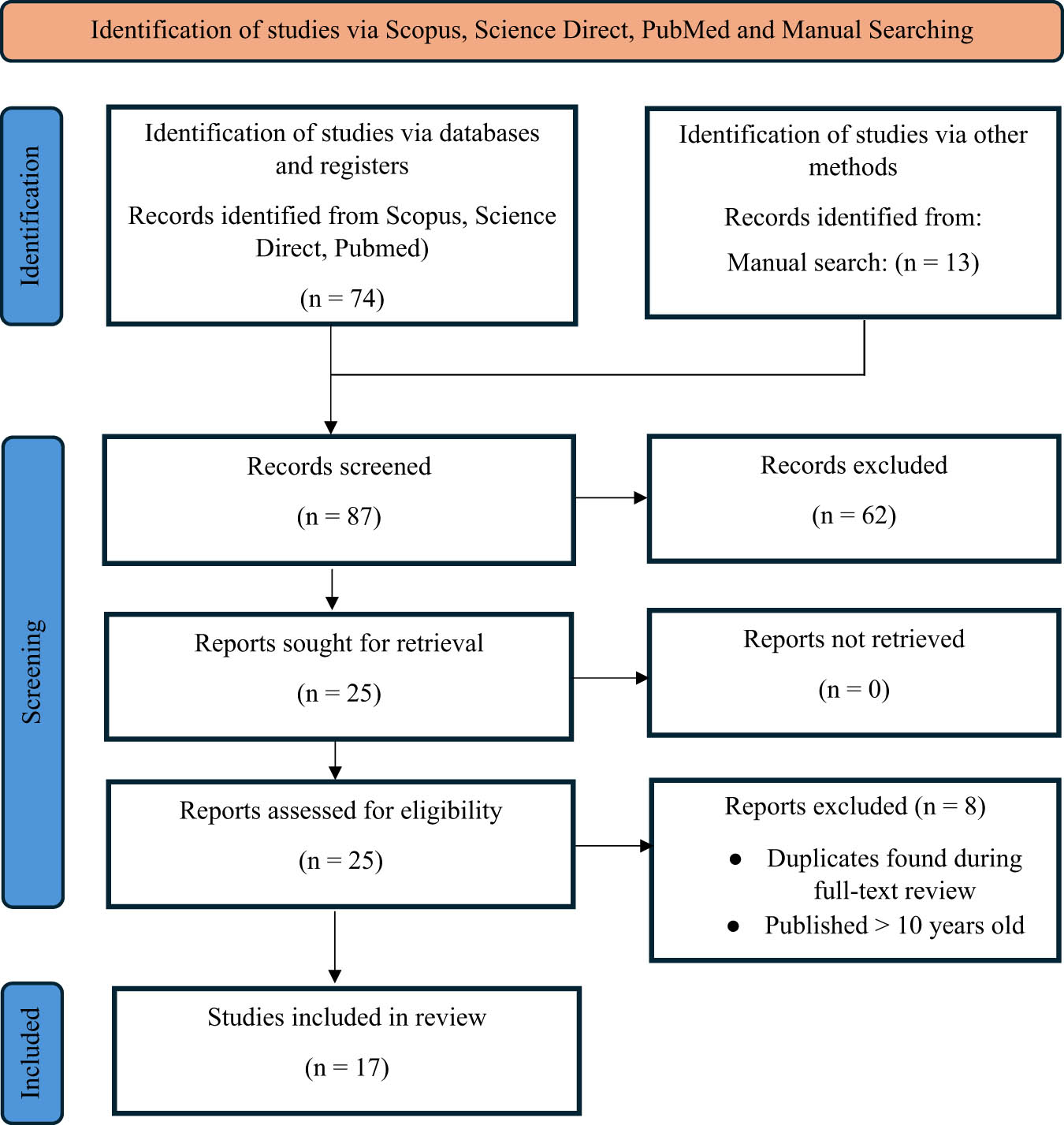
Figure 1
PRISMA flow diagram
Source: Author’s contribution
3. Results
3.1. Lower-limb exoskeleton (commercial)
The commercial lower-limb exoskeletons covered in this section, along with their features, composition, and performance results are shown in Table 2.
Table 2
Lower-limb exoskeleton (commercial)
| Name of Exoskeletons | Institute/country/year | Types of exoskeletons | Weight (kg)/Maximum load capacity of the device (N) | Materials | Assessment technique | Main findings | Citations |
|---|---|---|---|---|---|---|---|
| Noonee | Noonee AG./Switzerland/2014 | Passive (hydraulic) | 3.3/120 | Polymers | Electromyography (EMG) (muscle activity) | 64% reduction in lower extremity strain | Luger et al. (2019) |
| LegX | U.S. Bionics dba SuitX/USA/2018 | Passive (spring system) | 6.2/100 | — | EMG (muscle activity) | 56% reduction in muscle activity | Pillai et al. (2020) |
| H-CEX | Hyundai Motor Company/Korea/2018 | Passive (four-bar linkage) | 1.6/150 | — | EMG (muscle activity) and interview | 30.59–84.08% reduction, positive feedback on comfort | Kong et al. (2021) |
| Archelis | Nitto Ltd/Japan/2016 | Passive (mechanical lock) | 5/80 | Polymers | EMG (muscle activity) | Reduces iliopsoas muscle activation | Kawahira et al. (2018) |
| Honda bodyweight support | Honda R&D Co., Ltd/Japan/2016 | Active (Electric motor, 4-bar linkage) | 6.5/100 | — | EMG (muscle activity) and oxygen – energy consumption/11% | 18% reduction in muscle activity | Ikeuchi et al. (2009) |
Source: Author’s contribution
The 2014 launch of the NOONEE popularized the chairless chair. This, in turn, led to the development of similar commercial products, such as the LegX, H-CEX, and Archelis. Nonetheless, back in 2008, Honda R&D developed an alternative bodyweight support device for assembly workers.
The NOONEE wearable chair has the capability to adjust to the user’s height and offers a variety of seating positions. It has a comfortable seat and uses a hydraulic system to support body weight. NOONEE uses lightweight materials, such as carbon fibre and light metals to reduce its weight. Its control system blocks the hydraulic actuator and stops joint rotation by regulating an electronically controlled valve. This valve responds to the initial sitting angle, which is detected by an angle sensor at the joint of the lower and upper links. According to the developers, human research has shown that the NOONEE can reduce strain on the lower extremities by up to 64% (Luger et al., 2019).
The LegX was designed to support industrial workers in squat postures. This design varies from previously presented designs because of the laterally placed support structure. Furthermore, LegX has two working modes that can be switched with an active control system. In the dynamic mode, the device uses compression springs to assist sitting and standing by storing and releasing energy. In the static mode, the wearer can lock the device in three specific locations where it transmits the weight of the wearer to the ground. LegX has shown a 56% reduction in muscle activity during experimental evaluations (Pillai et al., 2020).
The H-CEX, a lightweight wearable device patented by Hyundai Motor Company in 2020, uses a four-bar linkage that deploys passively with knee flexion. An integrated elastic component assists dynamic movements like standing and sitting. This device enhances trunk stability due to its broad support base and offers three angle settings for multi-point sitting assistance (Hyundai, 2018). The developer claims that H-CEX can reduce lower body muscle activity by 30.59–84.08% (Kong et al., 2021). Positive feedback on comfort using H-CEX was obtained when interviewed.
The Archelis wearable was created to support surgeons during long procedures by providing seating for crouching and shifting positions in crowded operating rooms where traditional chairs are impractical due to cables. The Archelis is a passive device lacking electrical components to prevent interference with medical equipment. Its main objective is to prevent fatigue and encourage prolonged concentration in surgeons during surgeries. Study shows that the Archelis dramatically reduces iliopsoas muscle activation (Kawahira et al., 2018). It can sustain a full squat when required, although its ergonomic shape allows for only one locked sitting posture (Matsuzaki et al., 2019).
The Honda bodyweight support system, which was developed for Honda’s automotive employees, stands out from other designs because it does not have a static looking mechanism. This device uses active actuators to assist with walking, climbing, and squatting. The inter-leg seat continuously pushes upward, which lowers the user’s effective body weight on their feet. Two motors behind the wearer drive the actuation and foot pressure sensors continually detect force and modulate motor power to reduce foot strain (Ikeuchi et al., 2009). The test showed that the device reduced average muscular activity by 18% and energy consumption by 11%.
3.2. Lower-limb exoskeleton (research models)
Table 3 lists the various research models and their features, as well as the main findings of the assessment.
Table 3
Lower-limb exoskeleton (research models)
| Name of exoskeletons | Institute/country/year | Types of exoskeletons | Weight (kg)/maximum load capacity of the device (N) | Materials | Assessment technique | Main findings | Citations |
|---|---|---|---|---|---|---|---|
| Semi-active exoskeleton | University of Electronic Science and Technology of China, China/2020 | Semi-active (rigid-support mode, elastic-support mode, follow mode) | 2.6/– | Al alloy, carbon fibre | EMG (muscle activity) | Reduced muscle fatigue across three operating modes | Wang et al. (2021) |
| SIAT-leg | Huazhong University of Science and Technology/China/2020 | Passive | 2/100 | Mild steel, carbon fibre | EMG (muscle activity) and comfort scale | 44.8–71.5% reduction> 70% comfort rating | Yan et al. (2021) |
| Single-stand chairless exoskeleton | Universiti Teknikal Malaysia Melaka/Malaysia/2024 | Passive | 3/1,090 | Al alloy, polyurethane foam, nylon, steel | EMG (muscle activity) | Reduced contact pressure by 71% single-stand – system usability scale (SUS) of 79.5 (P-value < 0.05) | Halim et al. (2024) |
| HUST-EC | Huazhong University of Science and Technology/China/2019 | N/A | –/87 | Al alloy | EMG (muscle activity) | 80% average reduction in muscle activity | Han et al. (2019) |
| Chair X | University of Moratuwa/Sri Lanka/2019 | N/A | 13.4/80 | Al alloy, mild steel, glass fibre | EMG (muscle activity) | 20% reduction in muscle activity | Wijegunawardana et al. (2019) |
| Passive weight-support exoskeleton | Xi’an Jiaotong University/China/2018 | Passive (spring system) | 2/– | — | EMG (muscle activity) | 83% max reduction in muscle activity | Zhu et al. (2018) |
| CCES | Nehru College of Engineering and Research Centre/India/2018 | Passive (Gas strut) | 3.68/140 | Al alloy | — | — | Ramachandran et al. (2018) |
| Chairless chair | K J College of Engineering and Management Research/India/2017 | N/A | — | Mild steel | — | — | Siddha et al. (2018) |
| Knee assist robotic exoskeleton | Kwangwoon University/Korea/2016 | Active (pneumatic power) | 8/80 | — | EMG (muscle activity) | Muscle activity reduction in static postures | Noh et al. (2016) |
| SimpChair | University of Malaysia Pahang/Malaysia/2015 | Passive (gas strut) | 3/100 | Mild steel | — | — | Allias et al. (2015) |
| Passive weight- support LEE | Huazhong University of Science and Technology/China/2015 | Passive | 1.95/63.5 | Al alloy, mild steel | — | — | Lee and Wang, (2015) |
| Soft gait | Korea Advanced Institute of Science and Technology/Korea/2015 | Active (pneumatic power) | 8.25/650 | Metal | Foot reaction force | 83% reduction in reaction force | Hong et al. (2015) |
Source: Author’s contribution
The semi-active exoskeleton has three operating modes: follow mode, elastic support mode, and rigid support mode. In rigid support mode, the exoskeleton supports the wearer’s weight like a wearable chair, allowing for easy adjustment of the knee flexion angle between 0 and 135° when squatting or semi-squatting. The elastic support mode uses a torsion spring to offer support for tasks that require frequent adjustments in squatting height. Follow mode efficiently reduces muscle fatigue without obstructing mobility, enabling the exoskeleton to move passively with the wearer’s legs (Wang et al., 2021).
The SIAT exoskeleton is a wearable chair that allows employees to squat for extended periods of time. It helps users stand up by storing energy from the squatting motion in torsion springs, which are then released. The device supports the user’s weight with a mechanical ratchet that locks the exoskeleton in place. Its lightweight construction is the result of optimizing its dimensions. Studies have shown that the SIAT exoskeleton reduces muscular activity by 44.8–71.5% and has a user comfort rating of 70% or higher (Yan et al., 2021).
The single-stand prototype weighed 3 kg, could endure a maximum compression force of 1,090 kg, and was made from hardened steel, nylon, polyurethane foam, and an aluminium alloy. According to the muscle contraction investigation, when wearing the prototype, the contraction of the lower limb muscles was significantly reduced (P-value < 0.05). Additionally, the study found that contact pressure beneath the thighs was eliminated. A usability test revealed that the prototype’s SUS score was 79.5, surpassing the 67.3 score of the double-stand commercial exoskeleton (Halim et al., 2024).
The chairless chair concept forms the basis of several posture assistance technologies. For instance, passive weight-support exoskeleton with a posterior linkage system can provide three locking settings (Zhu et al., 2018). To facilitate posture shifts, this device often uses a linear spring actuation system. The HUST-EC exoskeleton also has a three-bar linkage to disperse load (Han et al., 2019). Both the passive-weight support exoskeleton and HUST-EC use slot slider mechanisms to lock the device. Both prototypes have shown a notable 80% decrease in muscular activity.
The linkage supporting the wearer’s shank is driven by an active linear actuator system in the ChairX (Wijegunawardana et al., 2019). In the desired sitting position, a mechanical ratchet lock stabilizes the thigh at the knee. With seven different seating positions, the device can accommodate forward and backward leg inclinations. Its fibre-reinforced plastic pads provide sufficient surface area for the shank and thigh, ensuring comfort. Additionally, ChairX can include passive or active actuators to assist with posture adjustments. Research indicates that ChairX lowers root mean square (RMS) sEMG by about 20%.
Most basic posture-assistance devices use gas shocks to assist with dynamic sitting and standing. They are attached to the back of the leg. To provide static support, they also integrate advanced locking mechanisms. The chairless chair uses joint stoppers (Siddha et al., 2018), while the SimpChair (Allias et al., 2015) and CCES (Ramachandran et al., 2018) employ telescopic link extensions for locking. However, these early prototypes are often large and heavy.
The knee assist robotic exoskeleton (Noh et al., 2016) helps people who are seated by using a four-bar mechanism that locks into place when it reaches its unique position. An absolute encoder directs an electric motor to retract the linkage to allow for mobility. A passive gas spring provides dynamic support during standing and sitting. A force sensor on the gas spring distinguishes between sitting and walking modes. Tests on prototypes show that it reduces muscular activation.
Another important category of posture-assistive equipment includes seats that support body weight. A well-known commercial example is the Honda bodyweight assist system. These designs usually use powered joints either active or passive to provide upward support. The passive weight-support LEE is an example of an exoskeleton that uses passive joints to mimic the compliant behaviour of the human knee (Lee and Wang, 2015).
Soft gait presents a comparable structure that uses powered pneumatic actuation. It provides passive support through linear springs aligned with the actuator, and foot pressure feedback controls its operation. During effectiveness evaluations, soft gait demonstrated an approximate 83% reduction in foot reaction force (Hong et al., 2015).
4. Discussion
The NOONEE, LegX, H-CEX, and Archelis are examples of commercial exoskeletons designed for specific user groups and tasks. The NOONEE, for example, was the first to introduce the “chairless chair” concept with its highly adaptable hydraulic system that supports a range of seating postures. A noteworthy finding is the reported 64% reduction in lower extremity strain, suggesting its effectiveness in mitigating the physical strain of prolonged static postures. The LegX has two working modes, static and dynamic, and is designed for industrial workers who squat frequently. It has been shown to reduce muscle activity by 56%. The H-CEX and the Archelis are two more examples of this application-specific strategy. The H-CEX is used in industry to lower muscle activity by 30.59–84.08%, and the Archelis is used by surgeons in confined operating rooms. The passive design of the Archelis and its absence of electrical components highlight a crucial design factor for its particular setting: preventing interference with delicate medical equipment. The Honda Bodyweight Support System stands out as an active system that aids in dynamic movements like walking and climbing. It reduces muscular activity by 18% and energy consumption by 11%.
Research prototypes explore additional mechanisms and operating methods. The SIAT exoskeleton uses mechanical ratchets and torsion springs, and the semi-active exoskeleton has “follow,” “elastic support,” and “rigid support” modes. Both exoskeletons experiment with multimodal operation. Like very effective commercial devices, the SIAT exoskeleton has been shown to reduce muscular activity by 44.8–71.5%. Despite their simpler linkage systems (posterior and three-bar, respectively) and slot slider mechanisms, other prototypes, such as the passive weight-support exoskeleton and the HUST-EC, have achieved remarkable results, including reducing muscular activity by up to 80%. Although the stated 20% RMS sEMG reduction of the ChairX is less than that of some passive designs, it stands out due to its active linear actuator mechanism and numerous seated configurations. These prototypes are essential for advancing the field because they test innovative actuation techniques, such as gas shocks and pneumatic actuation in soft gait, as well as locking mechanisms. However, they are often heavy and large, as seen with early prototypes like SimpChair and CCES. The knee assist robotic exoskeleton and passive weight-support LEE further demonstrate the investigation of active and passive joints to replicate human biomechanics and provide support.
According to the research results, the NOONEE exoskeleton is a good option for industrial workers who stand for extended periods of time. Its “chairless chair” design solves the issue of supporting one’s body weight while standing, which is a major source of weariness and pain. The exoskeleton can minimize lower extremity strain by up to 64%, demonstrating its efficacy. It is also adaptable to different body types and tasks that may require minor posture adjustments due to its ability to accommodate varying user heights and multiple seating positions. A hydraulic system, an electronically controlled valve, and lightweight materials such as carbon fibre and light metals work together to create a comfortable, efficient design for extended wear. Though primarily designed for squatting positions, devices such as the LegX and H-CEX have also shown excellent efficacy in reducing muscle activity. The NOONEE’s hydraulic technology and seating pads make it more appropriate for static standing or semi-standing duties when a user has to support their body weight without necessarily being in a deep squat. The Honda system is not ideal for extended standing because, although it is active, it is designed for dynamic motions such as walking and climbing. Due to its unique design and proven efficacy, the NOONEE is an attractive option for industrial settings where prolonged standing is a significant ergonomic concern.
In summary, this review highlights the potential of lower-limb exoskeletons particularly passive “chairless chairs” as a practical solution to fatigue and musculoskeletal strain caused by prolonged standing in industrial work. Commercial models such as NOONEE and LegX have demonstrated significant reductions in lower-extremity strain, while research prototypes show equally promising outcomes. Passive devices are advantageous due to their light weight, ease of use, and independence from external power sources, making them suitable for diverse industrial contexts. However, most available studies are laboratory-based, with limited long-term or large-scale trials. Future research should address user acceptance, cost-effectiveness, and longitudinal impacts on worker health and productivity. Effectively integrating exoskeletons into industrial safety strategies could represent a major step forward in preventing fatigue-related disorders and improving overall worker well-being.
4.1. Limitations of the study
Despite the encouraging results, it is important to acknowledge the review’s limitations. First, according to the formal quality evaluation conducted with the JBI Critical Appraisal Tool, there was a great deal of variation in the study designs, outcome measures (such as different EMG sensor locations) and experimental settings. It is difficult to draw firm conclusions about the long-term applicability in the real world because most of the included studies were short-term laboratory tests with relatively small sample sizes. Furthermore, while EMG-based results are useful for measuring muscle fatigue, long-term productivity and health statistics from real-world industrial deployment are also required to ensure broad effectiveness.
Acknowledgements
The authors would like to express their sincere gratitude to all individuals and institutions who contributed to the successful completion of this review article.
Funding information
This research did not receive any specific grant from funding agencies in the public, commercial, or not-for-profit sectors.
Authors contribution
The authors confirm contribution to the paper as follows: Conceptualization: Elisha Claret Wilson Dass, Karmegam Karuppiah Methodology: Elisha Claret Wilson Dass, Karmegam Karuppiah, Ayuni Nabilah Alias, Nina Fatma Ali Investigation: Ayuni Nabilah Alias, Nina Fatma Ali Formal analysis: Murugadas Ramdas, Hassan Sadeghi Naeini Writing – original draft: Elisha Claret Wilson Dass, Karmegam Karuppiah.
Conflict of interest statement
The authors have no competing interests to declare that are relevant to the content of this article.
Data availability statement
Data sharing is not applicable to this article as no new data were created or analyzed in this study. All data reviewed are fully available in the published scientific literature as cited in the Reference section.