
Introduction
Orthodontic treatment has become increasingly popular, and the availability of clear aligners as an alternative to traditional braces has provided more appliance options for consumers. Traditional braces offer precise control over tooth movement and have been proven to be highly effective in correcting a wide range of malocclusions.1 Alternatively, clear aligners have become popular due to their advantages, related to aesthetics, removability, comfort, and the convenience of oral hygiene.2,3
Consumer perceptions of, and satisfaction with, dental treatment is of great clinical importance for patient-centered healthcare.4 Orthodontics is usually not publicly funded in most countries and patients need to pay for the service. Public perceptions of orthodontic treatment are often related to aesthetic and psychological improvement rather than medical or functional need. Perceived value can be defined as the results or benefits customers receive in relation to total cost.5 The relationship of orthodontic treatment to the consumer’s physical appearance, expensive treatment costs and the specialist nature of orthodontic practice results in the perceived value of treatment being greater.6 Perceived value has proven to be a contributing factor towards consumer satisfaction and loyalty.4 Because consumers are aware of the costs associated with orthodontic treatment, they may be more critical of the treatment process and have higher expectations which ultimately influence their overall satisfaction.5 If consumers are dissatisfied with their orthodontic appliances or treatment outcomes, major repercussions may result particularly in countries such as New Zealand, where the provision of health services is underpinned by law including the Consumer Guarantees Act.7
Patient perception and satisfaction with traditional braces and clear aligners have been previously researched.6,8,9 However, the direct comparison between traditional braces and clear aligners by consumers is still poorly understood. Furthermore, previous studies have been largely quantitative, and often utilise a 5 or 6 point scale in response to a list of close-ended questions.10 Whilst scaled responses allow for easy comparison and statistical analysis, there is little about the patient’s day-to-day experiences with their appliance.11 The existing literature has separately investigated participant’s appliance perceptions or satisfaction but has not linked the changes caused by experiences with an appliance throughout treatment. Whilst it is possible to compare existing quantitative studies relating to braces and clear aligner perception and satisfaction, research is often conducted in different countries and populations, using differing treatment techniques which ultimately prevents reliable comparisons. Of the few qualitative studies relating to orthodontic treatment, investigations have been conducted to research patients’ perceptions and satisfaction with the entire orthodontic treatment process,6,12 including satisfaction with in-office visits and their practitioner. These factors can be subjective, thereby making it difficult to isolate the thoughts of participants regarding their orthodontic appliances and treatment outcomes. The influence of braces on patient satisfaction has been explored;10 however, there is no indicator of pre-treatment perceptions nor comparisons of clear aligners. The present study therefore takes an interpretive perspective by collecting qualitative data on patients’ experiences regarding their chosen orthodontic appliances.
The aim of the current study was to investigate and compare consumer perceptions and satisfaction with both traditional braces and clear aligners through a qualitative lens. Specifically, it was aimed to identify the influences affecting the selection of appliance type, how patients’ perceptions of their orthodontic appliance may change throughout the course of treatment and how these factors relate to overall satisfaction regarding their appliance. The objectives of the study included an understanding of the decision process of orthodontic patients as well as the satisfaction levels towards appliance type throughout their treatment. The present study further sought to assist practitioners to determine how their treatment advice can be improved and provide information tailored to the specific perceptions of their patients. It is expected that the study will allow practitioners to better support their patients by a better understanding of patient experiences regarding their appliances. In addition, the identification of areas of dissatisfaction may assist orthodontic appliance companies to improve their product for the benefit of consumers.
Materials and methods
Study design and participants
All participant responses were collected between May 2023 and August 2023 from 40 individuals who received treatment from the University of Otago Faculty of Dentistry (a public institution) and Dunedin ‘Lumino The Dentists’ (a private clinic). A qualitative, open-ended questionnaire was distributed by email using the 2023 Qualtrics XM Platform (Qualtrics, Provo, UT, USA). The questionnaire allowed for extended free-text responses and discussion of personal experiences by participants. Of the 40 participant responses received, 3 were incomplete and thus excluded. Ethical approval for the study was obtained from the University of Otago Human Ethics Committee (reference code DM096M) and all participants were presented with a comprehensive information sheet prior to consenting to participate in the survey. Participants over the age of 18 years were sought for inclusion and categorised into 6 groups depending on their treatment modality and stage. The 6 groups consisted of participants who were planning to wear braces or clear aligners, currently wearing braces or clear aligners, or finished with their braces or clear aligner treatment. All participants recruited for the finished treatment groups were debonded within the past year, to maximise recall accuracy.
Questionnaire and data collection
The study utilised a qualitative cross-sectional approach involving an open-ended response format of 16 free-text questions. The questionnaire consisted of 3 main sections, each encouraging participants to reflect on and share their experiences, beliefs and attitudes regarding different aspects of the treatment process: what influences people in selecting their treatment appliance, their perceptions towards the appliance prior to commencing treatment, and their ongoing perceptions and satisfaction with their appliance during or after treatment. Only the relevant questions were displayed to each participant group. For example, participants who were planning to wear braces or clear aligners were not displayed questions relating to perceptions of their appliance during/post treatment, nor questions relating to satisfaction with their appliance. In addition, basic participant demographic data was obtained including participant age, gender, ethnicity, occupation, and highest level of education.
Most prior research on this topic was qualitative and broadly generalisable. The present qualitative approach allowed for a richer and more nuanced understanding of how a patient’s individual and personal experiences with their appliance related to satisfaction. Recruiting participants at different stages of treatment allowed for visualisation of the participant’s views towards their appliance which may change after the beginning or after the completion of their treatment. The interpretive approach allowed for direct comparisons of both patient perceptions and satisfaction relating to traditional braces and clear aligners which, to the best of current knowledge, has not been previously investigated.
Statistical analysis
All responses to the questionnaire were compiled from the XM Qualtrics program and organised into themes using NVivo (version 14, Lumivero, Denver, CO, USA). Themes were analysed using the thematic analysis approach based on previous literaure.13 Reflexive thematic analysis is a validated methodical approach for the analysis and presentation of results.13 The method involves six stages, ranging from initial familiarisation with the data to the generation of codes, searching for overarching themes, reviewing and refining the themes, and finally reporting the narrative.
Results
Information sources
Participants were asked early in the survey from where they sought information about orthodontic appliances. Respondents from the traditional braces group predominantly received information from sources such as their general dentist, friends, and family. Three participants claimed to have also conducted independent research on the internet in addition to the sources previously listed. Interestingly, this was in contrast to many participants from the clear aligner groups who claimed to have received information from the internet, social media and TV advertisements which are sources of information not appreciated by those selecting traditional braces. Similar to those in the braces group, clear aligner participants also received information from friends.
When traditional braces participants were asked why they selected this treatment modality over clear aligners, more than half of the respondents claimed that they were not given a choice, or that they were informed that their malocclusion was too severe for clear aligner treatment. This was expected as clear aligners are known to be unsuitable for all cases requiring orthodontic treatment.14 “From my understanding my teeth were so far out of place that clear aligners weren’t an option” (finished braces participant 4). “Due to the severity of my crowding, it was recommended that I undertake traditional braces.” (wearing braces participant 6). Additionally, many participants also believed that they would have compliance issues with clear aligners due to their removable nature and did not want to deal with the hassle of “taking in and out when eating” (wearing braces participant 4). Some participants also stated that they had tried clear aligner treatment but had to switch due to reactions or dryness.
All clear aligner respondents were given both options (braces and aligners) for their orthodontic treatment, and almost all respondents selected clear aligners due to their aesthetic, “non-intrusive look”. Many participants also chose clear aligners due to their removable nature, perceiving that this would allow for easier oral hygiene and reduce the risk of tooth decay. A few aligner participants also enjoyed the flexibility of clear aligner treatment, noting that it required fewer appointments and less supervision.
Pre-treatment perceptions
As an aim of the present study was to compare perceptions between braces and clear aligner participants, both groups were asked about the concept of their appliance prior to starting treatment. The responses could be categorised into 4 different themes (aesthetics, duration of treatment, pain/convenience, efficacy). Both braces and clear aligner participants responded with many comments relating to the aesthetics of their appliance. Multiple braces participants commented that they disliked the appearance of braces and that wearing them was associated with younger age groups. “Looked hideous (and has a) stigma that is often associated with them” (finished braces participant 4). “(I) Disliked the appearance but wanted the job done” (finished braces participant 5). “Make people look younger/are associated with teenagers” (finished braces participant 2). “Little embarrassed as an adult getting braces” (finished braces participant 7). Braces participants appeared quite conscious of the impact that wearing braces had on their appearance but were also willing to make the sacrifice to correct their occlusion. Interestingly, one participant said they liked the look of braces which was an outlying response “looked cool and worked to straighten teeth quickly” (wearing braces participant 4).
This contrasted with clear aligner participants, who generally had more positive perceptions of their appliance’s aesthetics. “I felt they looked nicer and more discrete than traditional braces” (wearing aligner participant 8). “Prior to treatment, my perception was that they look so good and never really considered any other factors into my choice - Literally invisible treatment” (wearing aligner participant 1). Aligner participants also associated braces with younger age groups and liked the discrete, invisible appearance of aligners, as they believed them to be more appropriate for older age groups seeking orthodontic treatment.
The second theme commented on by many respondents related to the perceived duration of treatment for each appliance. All participants believed that their treatment process would be long, however, there were different views relating to the comfort of each treatment process. “Long painful process” (finished braces participant 4). “Concern about the look and length of time” (wearing braces participant 3). “Duration of treatment is longer than traditional braces” (wearing aligner participant 5).
The third theme related to the relative pain and convenience of their appliance. Many participants in the conventional braces group believed that their appliance would be painful and cause disruptions to eating and speech. “I learnt from my friends who were getting treatment that it hurts when they first put it on and every month adjustments” (finished braces participant 1). “A mild annoyance” (wearing braces participant 1). “Having to watch what food you eat etc. ” (wearing braces participant 9). Some participants were also aware of the issues with oral hygiene associated with wearing braces. “I knew oral hygiene was important to prevent demineralisation and decay. I knew you had to be careful of what you eat as you didn’t want to break a bracket off ” (wearing braces participant 4).
These findings contrast to those of clear aligner participants who provided mixed responses. Some in the aligner group shared similar concerns with braces participants regarding pain and the extra oral hygiene inconvenience. “I was a bit worried about maintenance during treatment time, as it requires extra level of cleaning and maintain” (wearing aligner participant 4). “I just thought they were ‘gonna’ be painful upon starting the treatment” (finished aligner participant 5). Despite this, many clear aligner participants also had positive perceptions related to the pain and convenience associated with their appliance, believing they were “fuss free” (finished aligner participant 7) and that their removable nature allowed for easier oral hygiene practices. In addition, no aligner participants cited concerns relating to the way that their appliance would affect their diet. “Clear aligners seem practical and easier to maintain than metal braces” (finished aligner participant 1). “Liked and I could floss and brush without having to faff around with metal braces ” (finished aligner participant 3).
The last theme from multiple respondents was the perceived efficacy of their appliance. As braces have been used for the correction of malocclusions for a longer time, it was not surprising that braces respondents viewed them to be the most effective and expressed more faith in overall treatment outcomes. “Expensive but really effective ” (wearing braces participant 5). “Effective method of moving teeth” (wearing braces participant 8). This contrasted with clear aligner respondents who were more skeptical and hesitant when talking about how effective they viewed their appliance. “(They) have their limitations” (wearing aligner participant 6). “I wasn’t totally sure about their effectiveness compared to traditional braces as they are newer to the market” (wearing aligner participant 8). “I didn’t believe they would be able to move teeth very far ” (wearing aligner participant 12).
Day-to-day impacts
Participants who were currently undergoing or had completed treatment were asked about the day-to-day impact of their appliance and any issues they may have faced as a result. This was considered important as many of the addressed issues related directly to satisfaction with their appliance and may have differed from their pre-treatment expectations. Participant responses could be largely grouped into 4 themes; impacts on diet, impacts on oral hygiene practices, issues with pain and issues with aesthetics.
Participants who were currently wearing or who had finished traditional braces treatment all had similar responses. Traditional braces were shown to consistently affect diet and eating. Participants most commonly had trouble eating solid/hard foods, particularly after appliance adjustment. Many participants suggested that they would avoid certain foods which were prone to getting stuck between their braces and teeth, such as apple pieces and nuts. Oral hygiene practices were affected as well, with participants explaining that they had difficulty cleaning around the braces, and some would bring interdental brushes to appointments. This resulted in more frequent cleaning and increased time brushing and flossing. One patient reported that having braces interfered with other received dental treatment, such as scaling (wearing braces participant 6). Some respondents claimed to have developed ulcers or had a wire which poked into their cheek. In addition, respondents faced issues with broken brackets. Interestingly, only one participant cited effects on self-confidence after beginning treatment, (wearing braces participant 5) but only for the first few weeks. Notably, no participants reported any difficulty with speech.
The biggest impact that the participants experienced when wearing aligners was the inconvenience of removing them when eating and drinking, particularly in public. Clear aligner patients are advised to remove their aligners prior to eating and drinking (except water) to avoid staining and discolouration which could compromise the aligner’s aesthetic nature.15 Patients reported that this was a major inconvenience which affected their eating habits, although this was not always viewed negatively. Some participants skipped meals or reduced snacking as a result, noting that it “could be an effective (way to) diet for some” (finished aligner participant 1). One participant claimed to “now drink a lot more water, which I really needed to do” (wearing aligner participant 1) as opposed to other beverages such as tea and coffee. As a result of the recommended hygiene instructions relating to clear aligners, participants also self-reported an increase in oral hygiene, due to their improved hygiene practices throughout the day. Some participants mentioned the disturbance of having to bring a toothbrush and planning meals to ensure their oral hygiene was not compromised, but this was generally viewed positively. Participants also noted that cleaning their aligners in the morning and at night also improved their oral care routine.
Multiple respondents reported pain upon starting a new set of aligners. “(They) needed trimming so not to dig into gums” (finished aligner participant 1). Only one participant reported issues with ulceration. Despite being marketed as an aesthetic alternative to braces,16 multiple participants reported issues with aligner discolouration about which they were self-conscious. A few mentioned the initial effects their aligners had on speech, which resolved over time. Some also reported issues of forgetting to wear the aligners or misplacing them which may affect treatment outcomes.17
Patient satisfaction with appliances
Participants from all groups were asked questions relating to satisfaction with their appliance and treatment outcomes. Responses were again categorised into similar themes associated with aesthetics, the duration of treatment, convenience/pain and treatment efficacy. Participants undergoing orthodontic treatment with braces provided different responses related to their satisfaction, when compared to clear aligner participants. When asked about the aspects of their appliance about which they were most satisfied, all participants mentioned that they were satisfied with their treatment outcomes and how quickly they were able to see results. “I thought my teeth would look nicer after braces but did not realise they would look pretty much perfect” (finished braces participant 2). “I’ve only had them for about 1.5 months and they have progressed quickly already.” (wearing braces participant 4). Interestingly, only one participant commented on “How easy they are to get used to. Even though I complained quite a bit earlier about braces, it is only for a short while they are a bother, but once you get over that stage, they are fine” (wearing braces participant 4).
When asked about the least satisfactory aspects of treatment, participants with traditional braces reported at length. The responses were relatively consistent with pre-treatment perceptions as participants faced issues regarding pain/ulceration and food getting trapped. “They can disrupt eating and talking significantly” (wearing braces participant 1). “After braces I was feeling sore and tired” but “still happy and excited to see my results” (wearing braces participant 2). “They get lots of food stuck in them.” (wearing braces participant 12). When asked about pre-treatment perceptions regarding the aesthetics of traditional braces, there were many concerns about how they were perceived by adults. Although a few participants commented that while they were least satisfied with the appearance of their appliance, pain appeared to affect satisfaction much more. Overall, however, satisfaction with braces was similar to that associated with clear aligners, except in regard to pain. Participants were very satisfied with their appliance due to their efficacy and treatment outcomes, would recommend their appliance to friends and family, and believed the pain to be worth the end result. All participants gave scores of at least 8/10 relating to satisfaction and would not change their treatment option.
When asked about which aspects of their appliance clear aligner respondents were most satisfied, almost all commented on the aesthetics. “That people didn’t realise I had them on at the time.” (finished aligner participant 1). “It didn’t look too obvious that I was under the treatment” (finished aligner participant 2). Some also commented on the relatively painless treatment process they had with their aligners. “Painless and easy without impeding much aesthetically” (wearing aligner participant 7). “The smooth treatment it offers without pain ” (wearing aligner participant 4).
Unsurprisingly, when clear aligner participants were asked about which aspect of treatment they were least satisfied, most current users commented on the inconvenience related to drinking and snacking, due to the need to remove and insert their aligners. These comments were only seen in participants currently undergoing clear aligner treatment. “It mentally limits my frequency of eating snacks and drinks” (wearing aligner participant 4). “Not being able to drink hot drinks with them on” (wearing aligner participant 6). Interestingly, this differed with respondents who had completed clear aligner treatment and who all responded by saying that they had no dissatisfaction. The shift in perception could be attributed to becoming used to the mechanics of the treatment over time (one respondent noted “after a few weeks, taking off and cleaning the aligners just become part of the daily routine and become less painful and less of a hassle.” (finished aligner participant 5), or that the resultant treatment satisfaction outweighed any concerns from the aligner patients. For an understanding of patient-patient recommendation and word-of-mouth, this finding is significant. While negative perceptions and dissatisfaction with particular treatment aspects endured for those in the traditional braces group, this was not the case with those in the aligners group, who ‘forgot’ any dissatisfaction post-treatment.
Overall, participants were very satisfied with their clear aligners and treatment results. Most participants commented on the increased confidence in their appearance and believed that their teeth looked much better than they did pre-treatment. These comments were re-inforced as all respondents gave at least a score of 8/10 when asked how satisfied they were and would recommend their appliance to family/friends. All participants would not have changed their treatment option.
Discussion
Orthodontic treatment is undertaken for aesthetic improvement but is a significant financial outlay for many consumers. Qualitative methods facilitate an investigation of consumer experiences regarding their treatment, and how perceptions can be shaped and changed by patient satisfaction with their appliance. Orthodontic practitioners should be the primary source of information regarding consumers’ treatment decisions and appliance selection, however, media and advertising proliferation has changed the way patients seek information and ultimately make decisions. It is expected that those considering orthodontic treatment may seek information from their family and friends prior to selecting an appliance type. Significantly however, participants’ perceptions of clear aligners were also influenced by external sources including social media, TV and the internet.
Social media has been increasingly used for health purposes and has been proven to be associated with an increase in health knowledge.18 In a study conducted on ‘Twitter’ in 2017, it was shown that 33% of ‘tweets’ related to clear aligners were advertisements, compared to only 7% for braces, which may explain the large number of people who cited social media as an informative resource for clear aligners.16 The influence of social media has been proven to influence a patient’s perception of orthodontic treatment and practitioners, and posts such as “before and after” transformations have an impact on attracting prospective patients.19 Despite this, consumers should be wary of social media advertisements and promises relating to orthodontic appliances as the advertised product may not be suitable for the participant’s treatment needs. Marketing campaigns may be inconsistent regarding clinical opinions as the use of orthodontic appliances such as clear aligners are case dependent, and comprehensive treatment plans should be formulated by a qualified practitioner for appropriate patient centered care. Furthermore, orthodontic marketing on social media may have a greater influence on female consumers and young adult perceptions as these groups are associated with higher social media usage.20 Consumers who seek orthodontic treatment are also associated with these demographics and females generally appear to pay more attention to aesthetics, thereby making clear aligners the more common choice, and possibly the result of advertising influence.21
Prior to beginning treatment, the perception of braces participants towards their appliance was primarily negative, believing that braces would be unaesthetic, painful and lead to inconvenience in the avoidance of certain foods and demanding oral hygiene. Despite this, many braces participants were still willing to proceed with their treatment and viewed braces as an effective way of correcting a malocclusion. It was not surprising that clear aligner participants perceived their appliance to be aesthetic. There were mixed perceptions by clear aligner participants regarding the convenience of their appliance as some perceived the appliance to be easy to maintain whilst others were concerned about the additional oral hygiene maintenance required and possible pain. Participants were also greatly skeptical about the efficacy of their appliance when compared to braces and believed clear aligners had treatment limitations. Despite this, pre-treatment clear aligner perceptions were overall generally more positive when compared to braces. The findings from the present study regarding the perception of braces aesthetics are consistent with the existing literature which has shown that consumers consider metal brackets the least attractive orthodontic treatment option.22 Clear aligners have been proven to be the most accepted option for adults who are willing to pay more for this aesthetic option.22 The convenience and perceived simplicity of an orthodontic appliance is known to be a factor influencing consumer treatment decisions.23 Previous literature has shown participants generally perceive clear aligners to be less painful and have a lesser impact on diet during treatment when compared to traditional braces.21 This was confirmed by the present study, however, it was also evident that some clear aligner participants had pre-treatment concerns regarding pain and the maintenance of their appliance. Respondents were aware that clear aligners were more limited in their treatment utility but confused this with the appliance being less effective. These concerns can be partially attributed to the recent rise in the popularity of aligners while marketing/advertising campaigns could equally raise skepticism in consumers.
When participants were asked about their perceptions and satisfaction with their appliance after undergoing or having completed treatment, it was clear that all groups were very satisfied, and no participants considered a change their choice of treatment appliance. Braces participants were least satisfied with the pain associated with their appliance, food getting trapped and increased oral hygiene needs. However, aesthetics was not as impactful as initially perceived for the braces group, as few participants referred to aesthetics when asked about the least satisfactory aspect of their appliance. All braces participants were satisfied with their treatment outcomes and the speed of improvement but mentioned no positive aspects about the appliance itself. Clear aligner participants were most satisfied with the aesthetic nature of their appliance (despite several responses referencing issues of staining and discolouration and participants were also impressed with the efficacy of their appliance and treatment results. Despite this, current users were least satisfied with the inconvenience associated with wearing aligners, particularly relating to the insertion and removal before and after eating and drinking. Although the impact of braces on daily life has been previously quantitatively explored,12,24,25 past literature does not relate findings to pre-treatment perceptions and post-treatment satisfaction nor compare the results with clear aligner participants. Earlier studies showed that many traditional braces consumers faced significant problems regarding pain, food entrapment and increased oral hygiene practices which is confirmed by the present study and proven to be the greatest influence on the satisfaction related to their braces treatment. The impact of clear aligners on satisfaction has not been greatly explored and the results from the present study address the gap in this area.
The present study complements the research of Wong et al. (2018)12 by showing that the initial perceptions of treatment type were moderated during the course of, and after, the completion of treatment. This was particularly evident in relation to clear aligners, in which satisfaction with outcome negated any perceptions of difficulty during treatment. This is a useful finding for practitioners, as it highlights the importance of emphasising successful treatment outcomes, irrespective of treatment type. Further, it indicates a need for greater discussion and consideration of patient perceived issues in the context of traditional braces, in which negative perceptions tend to continue post-treatment, and may affect patient-to-patient communication.
The high levels of satisfaction and improvement in self-esteem following orthodontic treatment is evident from previous studies.10,26 Despite the issues faced in both the braces and clear aligner groups, no participants would change their treatment appliance (except one clear aligner participant who stated they may have chosen braces due to compliance issues). This finding is consistent with a previous study in which participants became used to living with the appliance over time and were not bothered physically, socially, nor emotionally, possibly due to a phenomenon known as “dys-appearance”.24 A further study has also shown that, despite the negative views consumers may hold during their orthodontic treatment, these were often negated as consumers completed treatment with their desired aesthetic result.27
From the themes projected in thematic maps, orthodontic providers can clearly appreciate patient experiences during treatment and thereby better identify pre-treatment misconceptions and address pre-treatment concerns. Using thematic maps can also better equip future patients with credible expectations during their treatment. Providers may be able to ultimately increase consumer satisfaction by setting out realistic goals related to the appliances and by presenting the experiences of previous patients. Qualitative practice indicates that some research questions may be embedded in social contexts that are too complex to be reduced to numbers or statistical analyses.28 Hence, the current qualitative methods provided the tools necessary to explore the nuances of experience unique to individual patients (their beliefs, perceptions, and reflections), thereby capturing the complexity inherent in the personal experience of orthodontic treatment.29
Due to the qualitative nature of the study, the results are not generalisable based on participant demographic data. Despite this, the responses to the survey appeared to have reached saturation point, in which themes for each section were consistently repeated. A possible avenue of study is the conversion of the themes and results obtained from the present qualitative study into a quantitative survey. This would allow the generation of quantitative data with a sound theoretical basis which can then be used to improve generalisability and reconfirm the results of the present survey. The participants were selected from both the University of Otago (a public institution) and ‘Lumino the Dentists’ (a private clinic). Most orthodontic treatment is performed in private practices, while research is often confined to university settings and so the inclusion of participants from both university and private practice is clinically useful to reflect a real-world scenario. In future studies, more institutions and clinics with different practitioners could be included to increase result validity. In addition, participants were only recruited if they were aged 18 or over. A large group of orthodontic treatment consumers are children who were excluded from the present study. Children may not give meaningful answers to the open-ended questions presented in a survey and often do not participate as actively in their treatment that is often directed by parents. A future study with a more age-appropriate questionnaire may be compiled to determine the perceptions and satisfaction of under 18 patients and their parents.
As a self-response format was used to obtain data, the present study was unable clarify responses and invite certain participants to elaborate on their answers. Future studies could include conducting a similar qualitative study with an interview format directed at participants from all age groups and from a greater number of clinics. Consumers who are planning to undergo orthodontic treatment with braces and clear aligners (but have not yet begun) would give the most accurate pre-treatment perceptions due to fewer influences and no recall bias. Only 3 pre-treatment participants were surveyed in the present study. This was likely due to participants who were yet to begin treatment being less likely to complete the survey, thereby providing limited pre-treatment responses. Future studies may well include more pretreatment participants to help better understand early perceptions that participants have of their planned orthodontic appliance.
The perception of conventional braces could possibly be improved if online marketing campaigns were used as frequently as clear aligner advertisements to attract more consumers. Tailored marketing strategies by orthodontic companies and providers to emphasise the positive aspects presented by patients could also be utilised to increase service uptake. Specifically, advertisements could promote the way braces are effective due to a high satisfaction rate and highlight how clear aligners allow for improved and easier oral hygiene, less pain and greater aesthetics. In the future, clear aligner technology may well be improved to allow the treatment of a greater range of malocclusions. The present study lacked responses from participants who were planning to begin treatment and responses were only collected from a small sample pool aged 18 and over from two institutions. Future studies should address these limitations and consider converting the themes and results obtained from this qualitative study into a quantitative survey to confirm the findings and improve generalisability.
Conclusion
The present study highlighted distinct differences in the information sources, perceptions, daily impacts, and satisfaction between traditional braces and clear aligners.
Information sources: Braces consumers relied on dentists, friends, and family, while aligner consumers sought information from modern platforms like social media, internet research, and advertisements.
Pre-treatment perceptions: Braces consumers expressed concerns about aesthetics by their association with younger age groups, and anticipated pain and inconvenience. Aligner consumers valued the discrete appearance and perceived appliances as more convenient.
Day-to-day impacts: Braces significantly impacted eating, oral hygiene, and comfort, with challenges related to food impaction and wire-related issues. Aligners posed fewer dietary restrictions but were inconvenient to remove for eating and with users reporting increased oral hygiene routines.
Satisfaction: Both groups were highly satisfied with treatment outcomes. Braces were praised for efficacy, while aligners excelled in their aesthetics and ease of use, although ongoing users found appliance removal inconvenient. Of note, negative experience perceptions of treatment did not endure with aligner participants but did for braces participants.
The present findings suggest that while both appliances are effective, treatment choice should align with patient priorities related to aesthetics, convenience, and malocclusion severity. Furthermore, practitioners should be aware of the use of non-standard information sources (social media, internet, etc.) by those seeking clear aligner treatment. When braces are recommended by practitioners, more consideration and support for patient concerns regarding pain and aesthetics may increase post-treatment satisfaction and patient referral Figures 1 and 2, Table I.
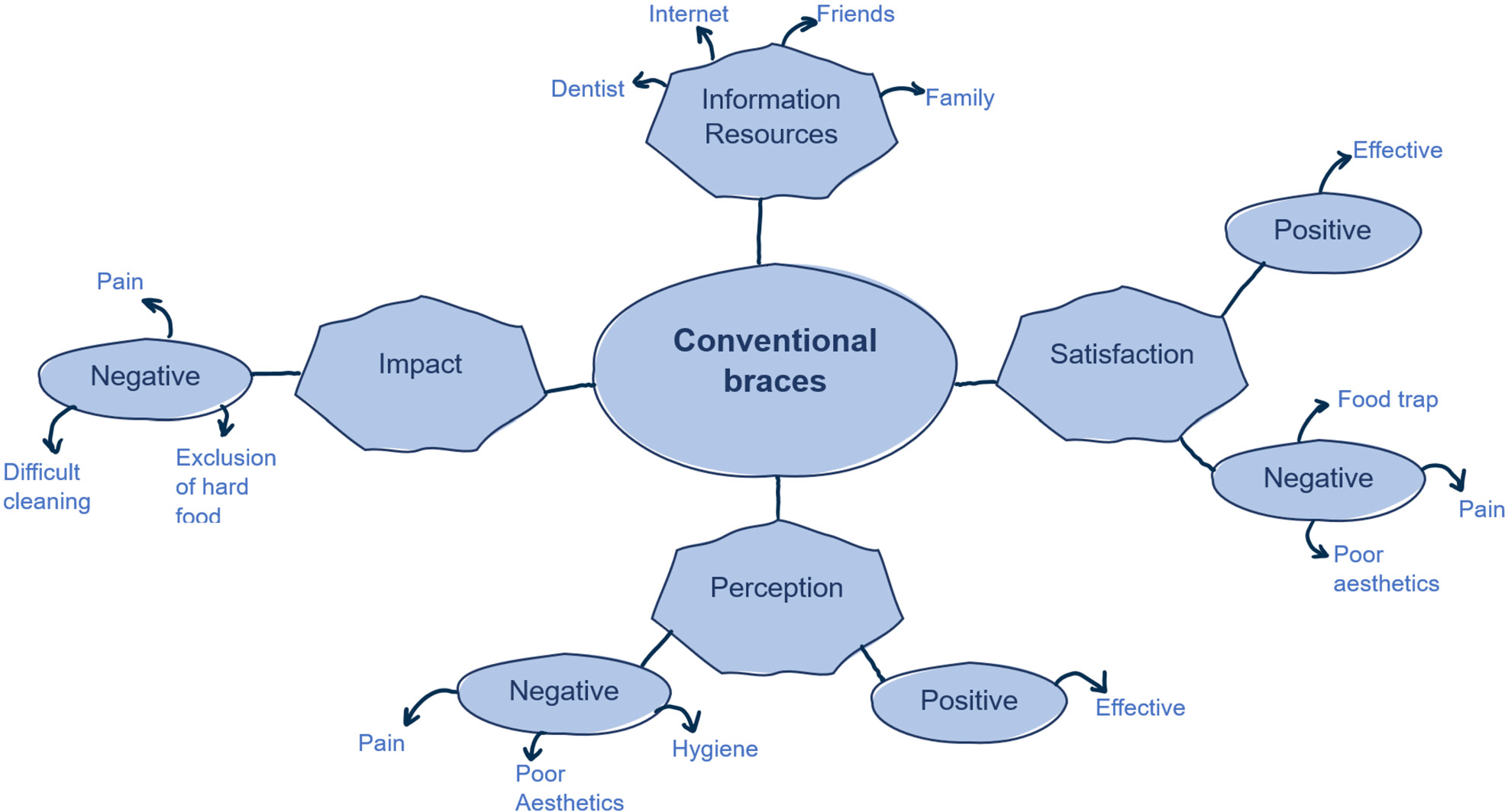
Figure 1.
Thematic map based on responses from the conventional braces participants.
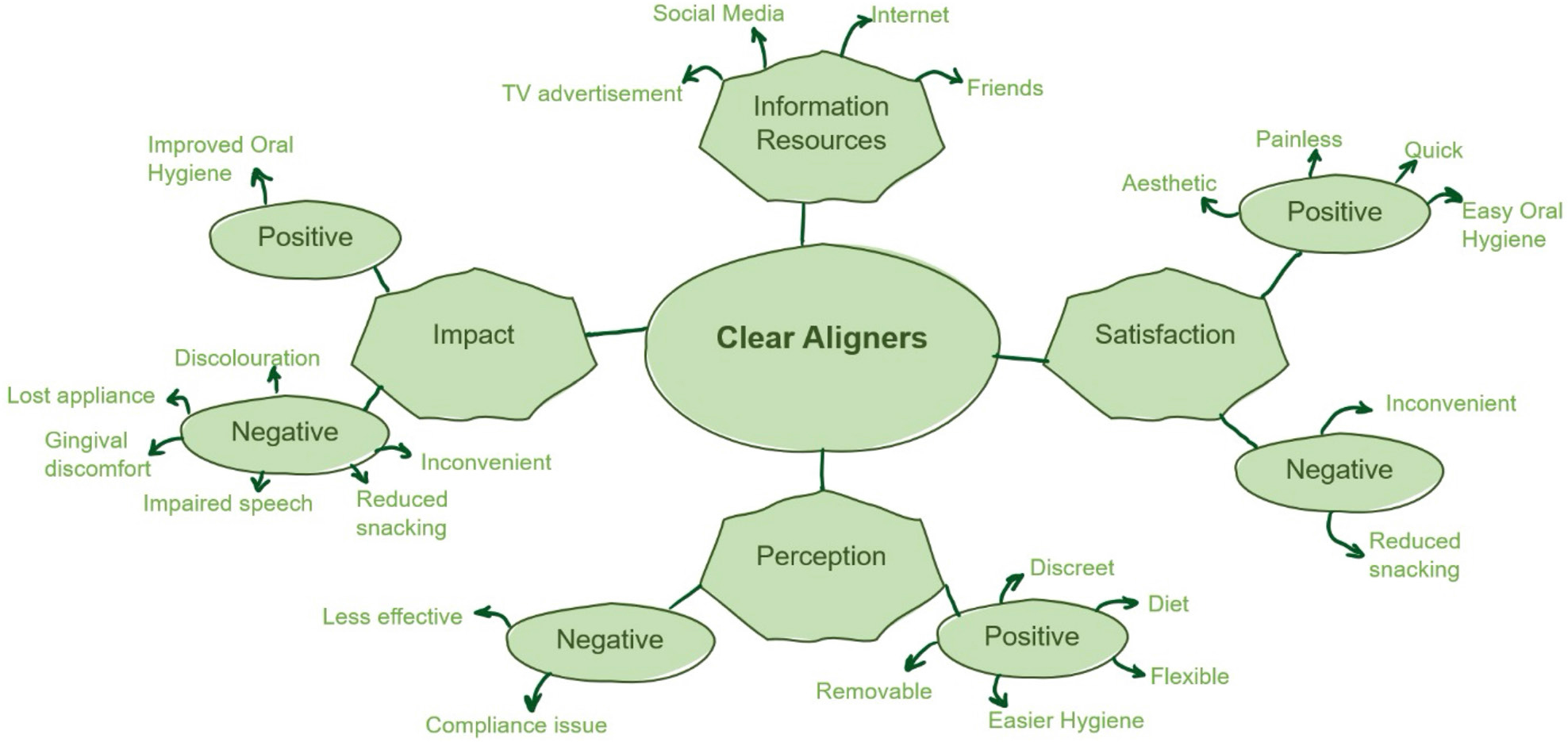
Figure 2.
Thematic map based on responses from the clear aligner participants.
Table I.
Participant demographics
| Number (%) | |
|---|---|
| Gender | |
| Male | 9 (22.5%) |
| Female | 31 (77.5%) |
| Age | |
| 18-24 | 15 (37.5%) |
| 25-34 | 9 (22.5%) |
| 35-44 | 8 (20.0%) |
| 45-54 | 4 (10.0%) |
| 55-64 | 3 (7.5%) |
| 65-74 | 1 (2.5%) |
| Ethnicity | |
| NZ European | 25 (62.5%) |
| Pasifika/Islander | 2 (5.0%) |
| Asian | 11 (27.5%) |
| Other | 2 (5.0%) |
| Education level | |
| Intermediate | 1 (2.5%) |
| Secondary | 11 (27.5%) |
| Tertiary | 28 (70.0%) |
| Treatment | |
| Public | 18 (45.0%) |
| Private | 22 (55.0%) |
Notes
[1] Conflicts of interest Conflict of interest
The authors declare that they have no competing interests.
[2] Contributed by Contribution
TSZ, MFK, RR, and TYW contributed to the study design, data collection, and drafting the manuscript; LSM and LM contributed to the study design, data analysis, and revising the manuscript.
[3] Data availability statement
Questionnaire is available on request.