
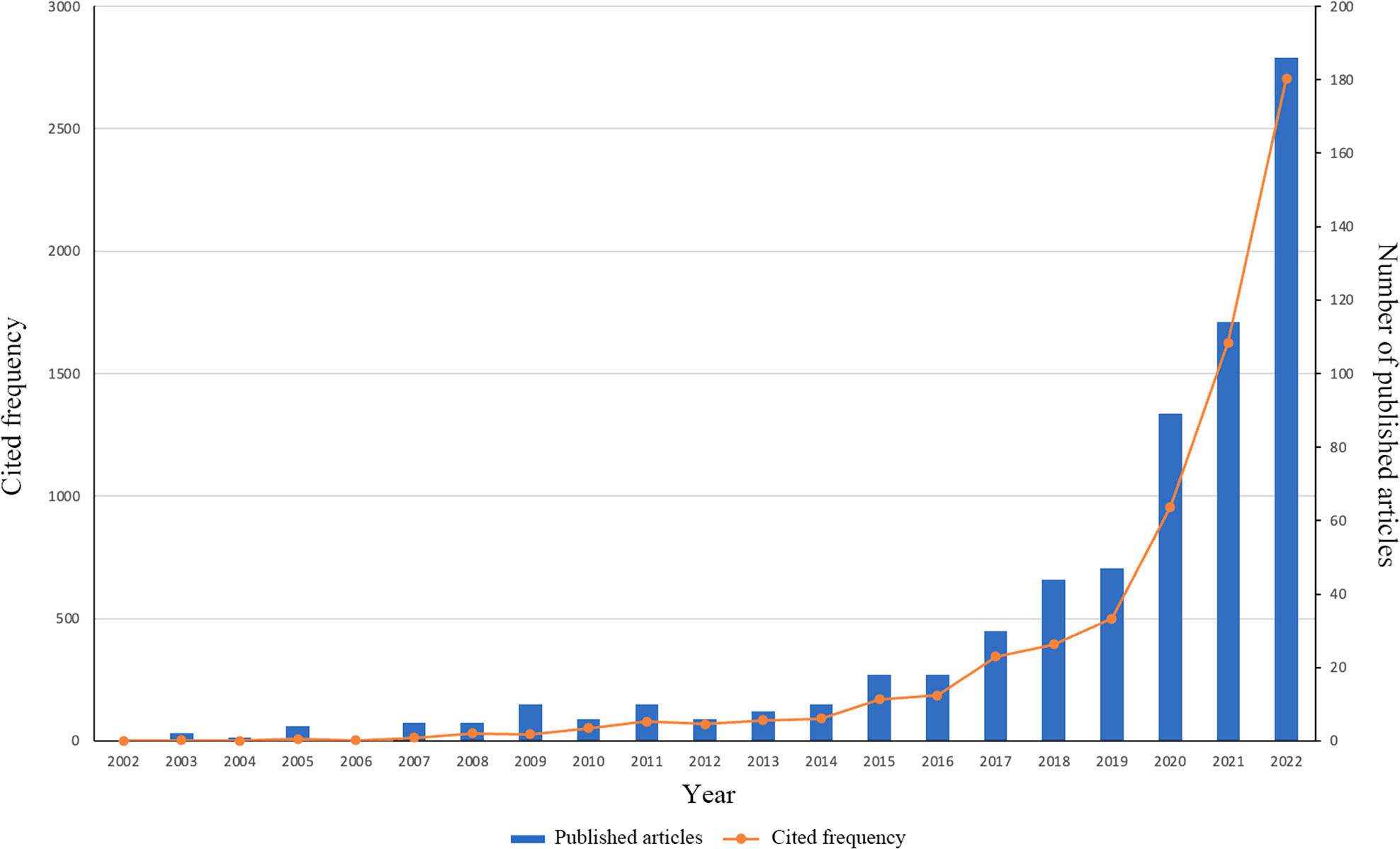
Figure 1.
Citation frequency and number of published articles over time.
Table I.
Top 10 Disciplines ranked according to the number of published articles
| Rank | Research area | Count | % Of 613 | Sum of cited frequency | Average citations per article | H-Index |
|---|---|---|---|---|---|---|
| 1 | Dentistry & Oral Surgery Medicine | 430 | 70.15% | 6400 | 14.88 | 42 |
| 2 | Materials Science Multidisciplinary | 47 | 7.67% | 246 | 5.23 | 8 |
| 3 | Physics Applied | 40 | 6.53% | 177 | 4.43 | 8 |
| 4 | Medicine General Internal | 33 | 5.38% | 186 | 5.64 | 8 |
| 5 | Chemistry Multidisciplinary | 22 | 3.59% | 35 | 1.59 | 3 |
| 6 | Engineering Multidisciplinary | 22 | 3.59% | 29 | 1.32 | 3 |
| 7 | Medicine Research Experimental | 22 | 3.59% | 113 | 5.14 | 5 |
| 8 | Metallurgy Metallurgical Engineering | 19 | 3.10% | 140 | 7.37 | 7 |
| 9 | Chemistry Physical | 17 | 2.77% | 139 | 8.18 | 7 |
| 10 | Physics Condensed Matter | 17 | 2.77% | 139 | 8.18 | 7 |
Table II.
Top 20 Journal with the Largest number of published articles
| Number | Journal | Count | % of 613 | H-Index | Sum of cited frequency | Rank | Averange citations | Sum of top 50 most-cited articles | Impact factor (2021) |
|---|---|---|---|---|---|---|---|---|---|
| 1 | American Journal of Orthodontics and Dentofacial Orthopedics | 79 | 12.89% | 21 | 1627 | 1 | 20.59 | 12 | 2.711 |
| 2 | Angle Orthodontist | 62 | 10.11 % | 22 | 1504 | 2 | 24.34 | 12 | 2.684 |
| 3 | Progress in Orthodontics | 34 | 5.55% | 15 | 559 | 3 | 16.56 | 4 | 3.247 |
| 4 | Applied Sciences-Basel | 21 | 3.43% | 2 | 22 | 1.05 | 2.838 | ||
| 5 | BMC Oral Health | 20 | 3.26% | 7 | 335 | 5 | 16.80 | 3 | 3.747 |
| 6 | Materials | 17 | 2.77% | 8 | 138 | 9 | 8.12 | 3.748 | |
| 7 | Australasian Orthodontic Journal | 16 | 2.61% | 2 | 13 | 0.81 | 0.269 | ||
| 8 | Journal of Orofacial Orthopedics | 15 | 2.45% | 8 | 278 | 6 | 18.50 | 2 | 2.341 |
| 9 | European Journal of Orthodontics | 14 | 2.28% | 11 | 513 | 4 | 36.64 | 6 | 3.131 |
| 10 | Korean Journal of Orthodontics | 14 | 2.28% | 6 | 181 | 8 | 12.93 | 1 | 1.361 |
| 11 | Dentistry Journal | 13 | 2.12% | 4 | 51 | 12.75 | 0.81 | ||
| 12 | Orthodontics & Craniofacial Research | 13 | 2.12% | 7 | 202 | 7 | 15.54 | 2 | 2.563 |
| 13 | Journal of the World Federation of Orthodontics | 10 | 1.63% | 5 | 52 | 5.20 | 0.4 | ||
| 14 | Seminars in Orthodontics | 10 | 1.63% | 5 | 100 | 10 | 10.00 | 1.34 | |
| 15 | Journal of Orthodontics | 9 | 1.47% | 2 | 13 | 1.44 | 0.5 | ||
| 16 | International Journal of Environmental Research and Public Health | 8 | 1.31% | 3 | 34 | 4.25 | 4.614 | ||
| 17 | Journal of Clinical Medicine | 8 | 1.31% | 4 | 49 | 6.13 | 4.964 | ||
| 18 | APOS Trends in Orthodontics | 7 | 1.14% | 2 | 9 | 1.29 | 0.19 | ||
| 19 | Biomed Research International | 7 | 1.14% | 3 | 55 | 7.86 | 3.246 | ||
| 20 | Journal of Craniofacial Surgery | 7 | 1.14% | 2 | 20 | 2.86 | 1.172 |
Table III.
Top 50 most cited articles on CAT from 2002 to 2022
| Rank | Title | First author | Corresponding author(s) | Journal | Year | Total citations | Annual citations | Top 25 citation burst |
|---|---|---|---|---|---|---|---|---|
| 1 | Efficacy of clear aligners in controlling orthodontic tooth movement: A systematic review | Rossini, G | Rossini, G | Angle Orthodontist | 2015 | 221 | 31.57 | Δ |
| 2 | How well does Invisalign work? A prospective clinical study evaluating the efficacy of tooth movement with Invisalign | Kravitz, ND | Kravitz, ND | American Journal of Orthodontics and Dentofacial Orthopedics | 2009 | 211 | 16.23 | Δ |
| 3 | Intraoral aging of orthodontic materials: the picture we miss and its clinical relevance | Eliades, T | Eliades, T | American Journal of Orthodontics and Dentofacial Orthopedics | 2005 | 165 | 9.71 | |
| 4 | Outcome assessment of invisalign and traditional orthodontic treatment compared with the American Board of Orthodontics objective grading system | Djeu, G | Djeu, G | American Journal of Orthodontics and Dentofacial Orthopedics | 2005 | 128 | 7.53 | Δ |
| 5 | Treatment outcome and efficacy of an aligner technique - regarding incisor torque, premolar derotation and molar distalization | Simon, M | Simon, M | BMC Oral Health | 2014 | 108 | 13.50 | Δ |
| 6 | Forces and moments generated by removable thermoplastic aligners: Incisor torque, premolar derotation, and molar distalization | Simon, M | Simon, M | American Journal of Orthodontics and Dentofacial Orthopedics | 2014 | 99 | 12.38 | Δ |
| 7 | A comparison of treatment impacts between invisalign aligner and fixed appliance therapy during the first week of treatment | Miller, KB | McGorray, SP | American Journal of Orthodontics and Dentofacial Orthopedics | 2007 | 91 | 6.07 | |
| 8 | Clear aligners in orthodontic treatment | Weir, T | Weir, T | Australian Dental Journal | 2017 | 83 | 16.60 | |
| 9 | The treatment effects of invisalign orthodontic aligners - A systematic review | Lagravere, MO | Lagravere, MO | Journal of the American Dental Association | 2005 | 82 | 4.82 | |
| 10 | Braces versus Invisalign (R): gingival parameters and patients’ satisfaction during treatment: a cross-sectional study | Azaripour, A | Azaripour, A | BMC Oral Health | 2015 | 77 | 11.00 | Δ |
| 11 | Clinical effectiveness of Invisalign (R) orthodontic treatment: a systematic review | Papadimitriou, A | Kloukos, D | Progress in Orthodontics | 2018 | 74 | 18.50 | |
| 12 | Periodontal health during clear aligners treatment: a systematic review | Rossini, G | Rossini, G | European Journal of Orthodontics | 2015 | 71 | 10.14 | Δ |
| 13 | Invisalign and traditional orthodontic treatment postretention outcomes compared using the American Board of Orthodontics Objective Grading System | Kuncio, D | Kuncio, D | Angle Orthodontist | 2007 | 68 | 4.53 | |
| 14 | Influence of attachments and interproximal reduction on the accuracy of canine rotation with invisalign - A prospective clinical study | Kravitz, ND | Kravitz, ND | Angle Orthodontist | 2008 | 67 | 4.79 | Δ |
| 15 | Invisalign® treatment in the anterior region: Were the predicted tooth movements achieved? | Krieger, E | Krieger, E | Journal of Orofacial Orthopedics | 2012 | 66 | 6.60 | Δ |
| 16 | Efficiency, effectiveness and treatment stability of clear aligners: A systematic review and meta-analysis | Zheng, M | Yu, Z | Orthodontics & Craniofacial Research | 2017 | 65 | 13.00 | |
| 17 | Effects of mechanical properties of thermoplastic materials on the initial force of thermoplastic appliances | Kohda, N | Iijima, M | Angle Orthodontist | 2013 | 64 | 7.1 1 | Δ |
| 18 | Adult patients’ adjustability to orthodontic appliances. Part 1 : a comparison between Labial, Lingual, and Invisalign (TM) | Shalish, M | Shalish, M | European Journal of Orthodontics | 2012 | 64 | 6.40 | |
| 19 | Stress relaxation properties of four orthodontic aligner materials: A 24-hr in vitro study | Lombardo, L | Arreghini, A | Angle Orthodontist | 2017 | 62 | 12.40 | |
| 20 | Activation time and material stiffness of sequential removable orthodontic appliances. Part 1 : Ability to complete treatment | Bollen, AM | Bollen, AM | American Journal of Orthodontics and Dentofacial Orthopedics | 2003 | 61 | 3.21 | |
| 21 | Has Invisalign improved? A prospective follow-up study on the efficacy of tooth movement with Invisalign | Haouili, N | Kravitz, ND | American Journal of Orthodontics and Dentofacial Orthopedics | 2020 | 58 | 29.00 | |
| 22 | Social perceptions of adults wearing orthodontic appliances: a cross-sectional study | Jeremiah, HG | Jeremiah, HG | European Journal of Orthodontics | 2011 | 59 | 5.36 | |
| 23 | A comparison of the periodontal health of patients during treatment with the Invisalign® system and with fixed lingual appliances | Miethke, RR | Miethke, RR | Journal of Orofacial Orthopedics | 2007 | 59 | 3.93 | |
| 24 | Esthetic orthodontic treatment using the invisalign appliance for moderate to complex malocclusions | Boyd, RL | Boyd, RL | Journal of Dental Education | 2008 | 58 | 4.14 | Δ |
| 25 | How accurate is Invisalign in nonextraction cases? Are predicted tooth positions achieved? | Grunheid, T | Grunheid, T | Angle Orthodontist | 2017 | 57 | 11.40 | |
| 26 | Management of overbite with the Invisalign appliance | Khosravi, R | Khosravi, R | American Journal of Orthodontics and Dentofacial Orthopedics | 2017 | 57 | 11.40 | |
| 27 | Evaluation of Invisalign treatment effectiveness and efficiency compared with conventional fixed appliances using the Peer Assessment Rating index | Gu,JF | Deguchi, T | American Journal of Orthodontics and Dentofacial Orthopedics | 2017 | 57 | 11.40 | |
| 28 | Initial Forces and Moments Delivered by Removable Thermoplastic Appliances during Rotation of an Upper Central Incisor | Hahn, W | Hahn, W | Angle Orthodontist | 2010 | 57 | 4.75 | Δ |
| 29 | Structural conformation and leaching from in vitro aged and retrieved Invisalign appliances | Schuster, S | Bradley, TG | American Journal of Orthodontics and Dentofacial Orthopedics | 2004 | 52 | 2.89 | |
| 30 | Effectiveness of clear aligner therapy for orthodontic treatment: A systematic review | Robertson, L | Mir, CF | Orthodontics & Craniofacial Research | 2020 | 52 | 26.00 | |
| 31 | A comparison of treatment effectiveness between clear aligner and fixed appliance therapies | Ke, YY | Zhu, YF; Zhu, M | BMC Oral Health | 2019 | 52 | 17.33 | |
| 32 | Predictability of orthodontic movement with orthodontic aligners: a retrospective study | Lombardo, L | Arreghini, A | Progress in Orthodontics | 2017 | 52 | 10.40 | |
| 33 | Discomfort associated with Invisalign and traditional brackets: A randomized, prospective trial | White, DW | Buschang, PH | Angle Orthodontist | 2017 | 52 | 10.40 | Δ |
| 34 | Maxillary molar distalization with aligners in adult patients: a multicenter retrospective study | Ravera, S | Ravera, S | Progress in Orthodontics | 2016 | 52 | 8.67 | |
| 35 | Dynamic stress relaxation of orthodontic thermoplastic materials in a simulated oral environment | Fang, DY | Bai, YX | Dental Materials Journal | 2013 | 46 | 5.11 | |
| 36 | Torquing an upper central incisor with aligners-acting forces and biomechanical principles | Hahn, W | Hahn, W | European Journal of Orthodontics | 2010 | 47 | 3.92 | |
| 37 | A novel pressure film approach for determining the force imparted by clear removable thermoplastic appliances | Barbagallo, LJ | Darendeliler, MA | Annals of Biomedical Engineering | 2008 | 47 | 3.36 | Δ |
| 38 | Accuracy of interproximal enamel reduction during clear aligner treatment | De Felice, ME | Grassia, V | Progress in Orthodontics | 2020 | 46 | 23.00 | |
| 39 | Accuracy of clear aligners: A retrospective study of patients who needed refinement | Charalampakis, O | Kim, KB | American Journal of Orthodontics and Dentofacial Orthopedics | 2018 | 46 | 11.50 | |
| 40 | A systematic review of the accuracy and efficiency of dental movements with Invisalign ® | Galan-Lopez, L | Galan-Lopez, L | Korean Journal of Orthodontics | 2019 | 45 | 15.00 | |
| 41 | The predictability of transverse changes with Invisalign | Houle, JP | Pinheiro, FHSL | Angle Orthodontist | 2017 | 44 | 8.80 | |
| 42 | Clinical limitations of invisalign | Phan, X | Phan, X | Journal of the Canadian Dental Association | 2007 | 42 | 2.80 | |
| 43 | Treatment outcome with orthodontic aligners and fixed appliances: a systematic review with meta-analyses | Papageorgiou, SN | Eliades, T | European Journal of Orthodontics | 2020 | 42 | 21.00 | |
| 44 | Effects of variable attachment shapes and aligner material on aligner retention | Dasy, H | Kwak, JH | Angle Orthodontist | 2015 | 42 | 6.00 | |
| 45 | Initial forces generated by three types of thermoplastic appliances on an upper central incisor during tipping | Hahn, W | Hahn, W | European Journal of Orthodontics | 2009 | 42 | 3.23 | |
| 46 | Comparative time efficiency of aligner therapy and conventional edgewise braces | Buschang, PH | Buschang, PH | Angle Orthodontist | 2014 | 41 | 5.13 | |
| 47 | Periodontal health during orthodontic treatment with clear aligners and fixed appliances A meta-analysis | Jiang, Q | Li, H | Journal of the American Dental Association | 2018 | 40 | 10.00 | |
| 48 | Variables affecting orthodontic tooth movement with clear aligners | Kuroda, S | Kuroda, S | American Journal of Orthodontics and Dentofacial Orthopedics | 2014 | 38 | 4.75 | Δ |
| 49 | Twitter analysis of the orthodontic patient experience with braces vs Invisalign | Noll, D | Shroff, B | Angle Orthodontist | 2017 | 38 | 7.60 | |
| 50 | Preparation and characterization of thermoplastic materials for invisible orthodontics | Zhang, N | Bai, Y | Dental Materials Journal | 2011 | 37 | 3.36 |
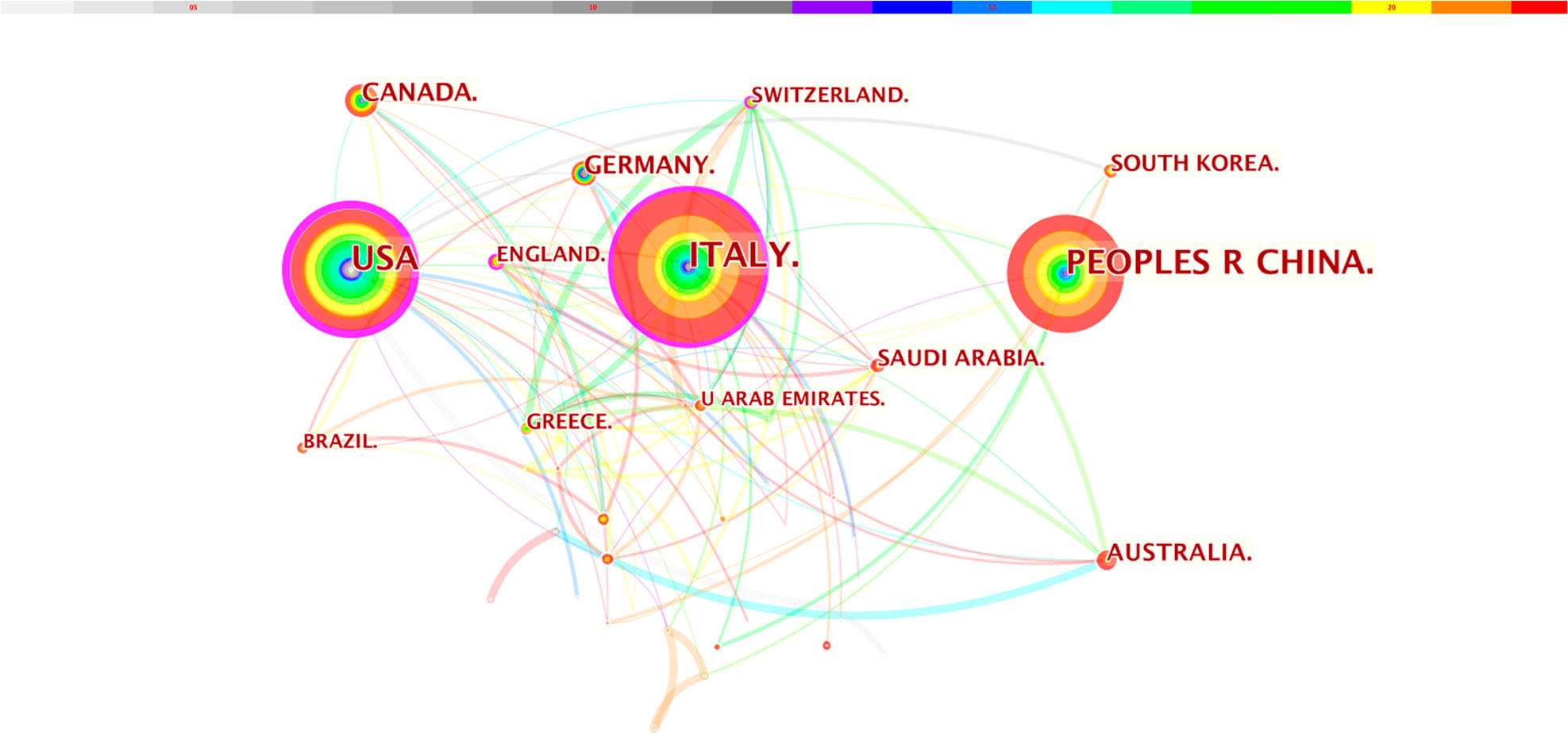
Figure 2.
Co-occurrence network map of countries/regions.
Table IV.
Top 10 Countries ranked by the number of published articles
| Number | Country | Count | % of 613 | Sum of times cited | Average citation per article | H-Index |
|---|---|---|---|---|---|---|
| 1 | Italy | 142 | 23.16% | 1543 | 10.87 | 22 |
| 2 | U. S. A | 116 | 18.92% | 2132 | 18.38 | 26 |
| 3 | People R China | 100 | 16.31% | 987 | 9.87 | 19 |
| 4 | Canada | 40 | 6.53% | 538 | 13.45 | 13 |
| – | Germany | 35 | 5.71% | 958 | 27.37 | 16 |
| 6 | Australia | 32 | 5.22% | 265 | 8.28 | 6 |
| 7 | Saudi Arabia | 29 | 4.73% | 111 | 3.83 | 5 |
| 8 | Greece | 24 | 3.92% | 582 | 24.25 | 12 |
| – | India | 23 | 3.75% | 125 | 5.43 | 5 |
| – | Switzerland | 22 | 3.59% | 337 | 15.32 | 10 |
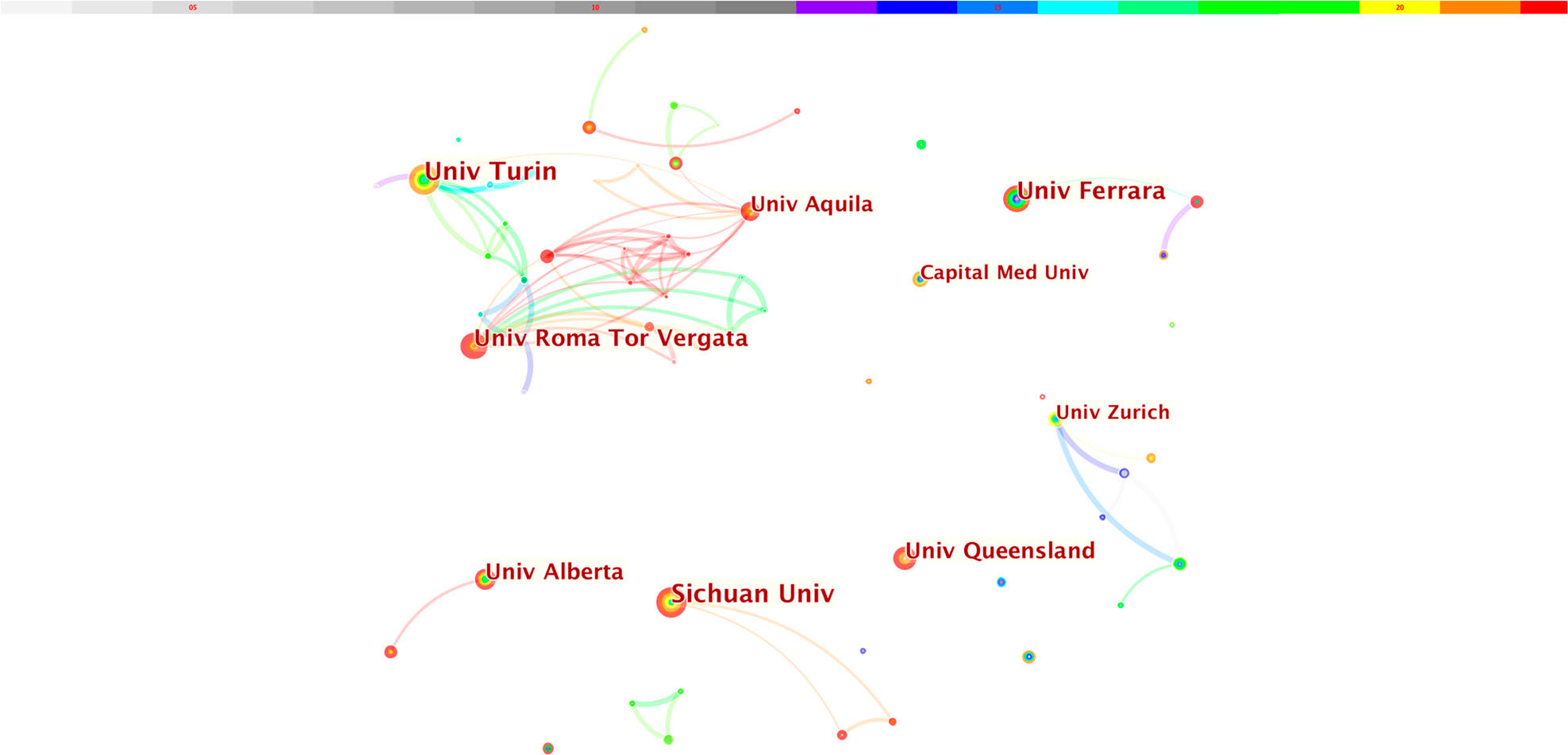
Figure 3.
Co-occurrence network map of institutions.
Table V.
The Top 10 authors with the largest number of published articles and citation (December 31, 2022)
| Number | Author | Count | % of 613 | Number | Author | Sum of times cited | Average citation per article |
|---|---|---|---|---|---|---|---|
| 1 | Castroflorio T | 21 | 3.42% | 1 | Castroflorio T | 535 | 25.48 |
| 2 | Deregibus A | 16 | 2.61% | 2 | Deregibus A | 480 | 30.00 |
| – | Siciliani G | 16 | 2.61% | 3 | Eliades T | 475 | 36.54 |
| 4 | Weir T | 15 | 2.45% | 4 | Rossini G | 396 | 39.60 |
| 5 | Vaid NR | 14 | 2.28% | 5 | Parrini S | 369 | 36.90 |
| 6 | Eliades T | 13 | 2.12% | 6 | Kravitz ND | 358 | 71.60 |
| – | Lombardo L | 13 | 2.12% | 7 | Siciliani G | 271 | 16.94 |
| 7 | Parrini S | 10 | 1.63% | 8 | Lombardo L | 259 | 19.92 |
| – | Cozza P | 10 | 1.63% | 9 | Simon M | 207 | 41.4 |
| – | D’anto V | 10 | 1.63% | 10 | Bai Y | 154 | 25.67 |
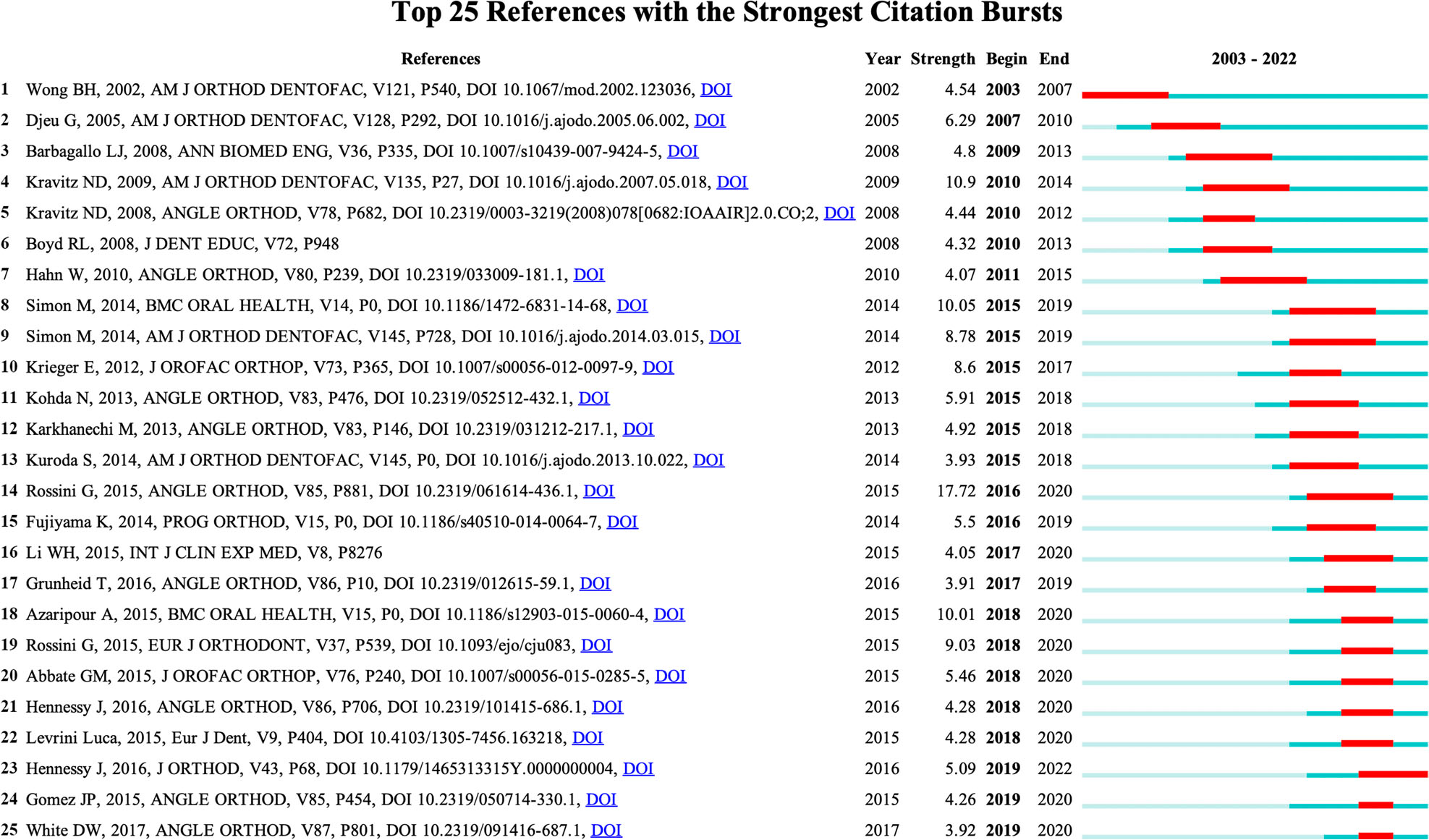
Figure 4.
Top 25 References with the Strongest Citation Burst Value.
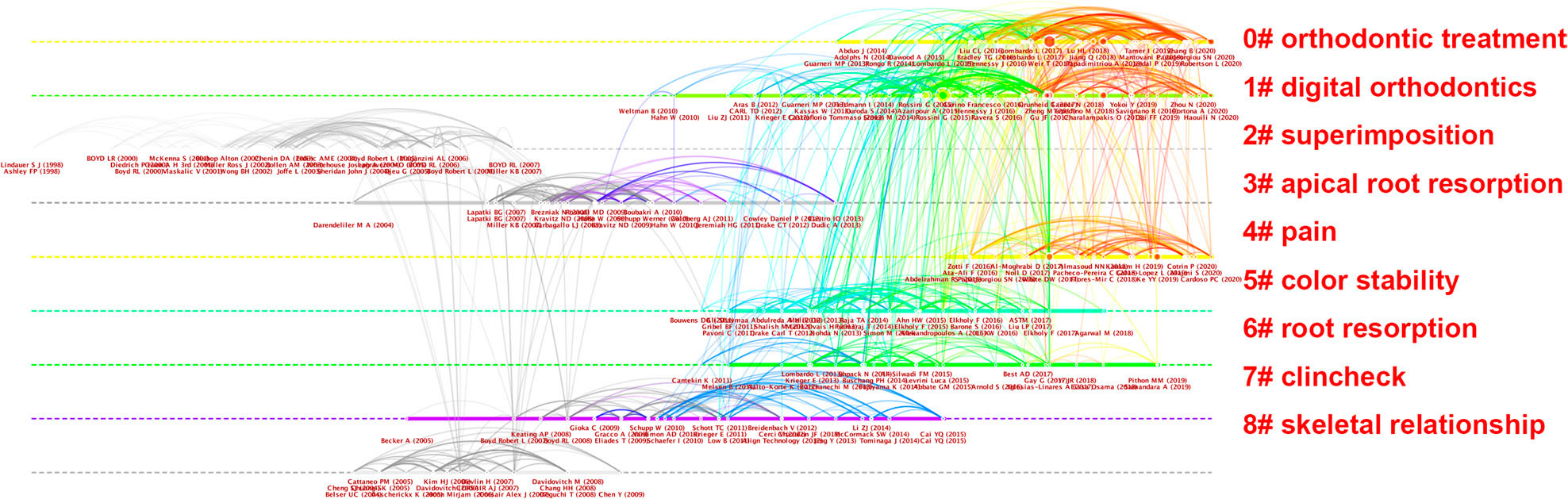
Figure 5.
Top 9 most frequently cited keywords.