
The Pacific white shrimp Penaeus vannamei (Boone, 1931) has been increasingly produced in the past years, becoming the top aquaculture species worldwide in 2022, with 6.8 million tons (FAO, 2024). This euryhaline species is mainly farmed in coastal areas using marine or estuarine water, but it can also be cultured inland (Roy et al., 2010; Pimentel et al., 2023) in oligohaline (0.5–5.0 g L−1) and mesohaline (5.0–18 g L−1) waters (Esteves, 2011), sourced from wells, underground aquifers, rivers, lakes, and artificial reservoirs, or by adding artificial sea salt or brine solution to freshwater (Roy et al., 2010; Pimentel et al., 2023). Production in regions with such diverse conditions has been viable due to the physiological plasticity of P. vannamei to tolerate a wide range of salinity (0.0–60 g L−1) and temperature (24–35°C) (Wyban et al., 1995; Araneda et al., 2008; Kumlu et al., 2010; Abdelrahman et al., 2019; Pimentel et al., 2023).
The expansion of P. vannamei farming to inland regions in the last years has been defended for various reasons. Lower land costs provide opportunities for new farmers without access to seawater, while bringing fresher products closer to markets that are often difficult to obtain. Farming P. vannamei away from the coast also helps isolate farms from the disease problems common in traditional marine systems, offering better control over pathogen spread (Roy et al., 2010; Pimentel et al., 2023). Water with a salinity above 0.5 g L−1 is generally unsuitable for human consumption without treatment (CONAMA, 2005) and cannot be suitable for agricultural use due to the risk of soil salinization, adversely influencing plant germination and growth, especially in semiarid and arid regions (Singh, 2022). Shrimp farming, however, offers an opportunity to use lands degraded by saline irrigation (Avnimelech, 2015).
Inland regions such as northeastern Brazil have many wells with conductivity above 0.20 mS cm−1 (Pimentel et al., 2023) and favorable climatic conditions for P. vannamei farming, with air temperatures often exceeding 30°C year-round (Alvares et al., 2013; INMET, 2024). These high temperatures are attributed to proximity of the region to the equator, which results in high solar radiation. However, during winter months, air temperature can fluctuate from 18 to 32°C, with daily mean around 23°C (INMET, 2024). These lower temperatures are challenging for P. vannamei, as the ideal temperature range for this species is from 27 to 30°C (Wyban et al., 1995), though effective production can still occur from 25 to 30°C (Kır et al., 2023). Temperatures outside these ranges for extended periods can negatively impact molting, growth performance, feed conversion ratio, and shrimp health (Wyban et al., 1995; Van Wyk et al., 1999; de Souza et al., 2016; Abdelrahman et al., 2019; Prates et al., 2023; Barajas-Sandoval et al., 2024).
While P. vannamei production in inland areas can be conducted using clear water systems, these systems require high rates of water exchange to maintain quality, potentially causing negative ecological and environmental impacts on local freshwater ecosystems (Avnimelech, 2015; Singh, 2022). To address these challenges and promote a sustainable expansion of shrimp production, culture systems based on water reuse, such as biofloc systems, have been proposed (Avnimelech, 2015; Bossier and Ekasari, 2017).
Biofloc technology (BFT) is an aquaculture technique used in intensive and super-intensive production systems to maximize productivity and mitigate environmental impacts, as it is based on zero or minimal water exchange (Wasielesky et al., 2006; Krummenauer et al., 2014; Bossier and Ekasari, 2017). BFT systems consist of increasing the carbon-to-nitrogen ratio through organic or inorganic carbon fertilization to promote the growth of microorganisms, such as heterotrophic and nitrifying bacteria. These microorganisms help maintain water quality by reducing harmful nitrogenous compounds like ammonia and nitrite (Wasielesky et al., 2006; Avnimelech, 2015; Bossier and Ekasari, 2017; Santos et al., 2025). Additionally, bioflocs can serve as supplementary feed for shrimp, which consume microbial biomass, converting it into animal protein (Wasielesky et al., 2006; Bossier and Ekasari, 2017; Santos et al., 2025). This can improve feed conversion rates, growth performance, and health status, as bioflocs are abundant in high-quality nutrients required for aquafeed (Bossier and Ekasari, 2017; Santos et al., 2025). In inland areas, BFT systems can help produce shrimp juveniles with uniform size, reduce cannibalism, optimize survival rates, and shorten the grow-out period (Samocha and Prangnell, 2019; Emerenciano et al., 2022). Furthermore, the BFT system can be used to maintain shrimp post-larvae at low or intermediate temperatures during winter months, ensuring growth recovery when exposed to optimal temperatures (Prates et al., 2023).
Although shrimp can be stocked at densities exceeding 100 shrimp m−2 in BFT systems, determining the most suitable stocking density for producing shrimp juveniles in low salinity and low temperature conditions is crucial. Stocking density significantly influences feed use, survival, growth performance, and health status due to factors such as competition for space, territory, feed, crowding stress, and water quality deterioration (Araneda et al., 2008; Liu et al., 2017; Bardera et al., 2021; Said et al., 2024). Thus, this study compared the production of P. vannamei juveniles in three stocking densities (75, 150, and 301 shrimp m−2) in a low salinity biofloc system during winter in northeastern Brazil, focusing on water quality and growth performance.
Material and methods
Study site, biological material, and acclimation
The research was executed over 75 days, from June to September 2019, at the Laboratório de Experimentação com Organismos Aquáticos (LEOA), part of the Unidade Acadêmica de Serra Talhada (UAST) at the Universidade Federal Rural de Pernambuco (UFRPE) (7.95671° S, 38.29505° W). P. vannamei post-larvae (PL) used in this study were sourced from Aquatec® in Canguaretama, RN, Brazil. The animals were acclimated to low salinity at the company and then to the conditions at the LEOA (Van Wyk et al., 1999) and maintained (5,000 PLs m−3) for 20 days in a 1.0 m3 nursery tank, filled with low salinity water (1.70±0.12 g L−1) from a well. The water was renewed every day and the parameters during acclimation were temperature 24.12±2.10°C, pH 7.5±0.6, and dissolved oxygen above 5.0 mg L−1. No ethical approval was required for this study in Brazil, but all experimental procedures were carried out with ethical treatment.
System design and conditions
P. vannamei post-larvae free from lesions or signs of diseases, with a mean body weight of 0.038±0.08 g, were selected. The experimental units were stocked with 64, 128, and 256 shrimp per tank (0.85 m2 tank bottom), corresponding to 75, 150, and 301 shrimp m−2, with quadruplicates per treatment. The units had a useful volume of 700 L tank, were covered with mesh lids to prevent shrimp escape, and were equipped with aeration systems (air stones connected to a blower) to keep the bioflocs suspended and dissolved oxygen around 5.0 mg L−1. All units were housed in a greenhouse covered with a 75% shade cloth to reduce solar radiation. No artificial heating was used for water temperature control.
At the start of the experiment, 140 L of biofloc inoculum from a Nile tilapia culture at the LEOA was transferred to the shrimp tanks (representing 20% of the total volume), and the tanks were filled with pre-filtered low salinity water (1.70 g L−1) from a well. Initial water quality variables were as follows: dissolved oxygen 5.71±0.53 mg L−1; temperature 24.95±0.09°C; salinity 1.70±0.03 g L−1; pH 7.58±0.18; alkalinity 127.08±7.22 mg CaCO3 L−1; total hardness 358.33±10.30 mg CaCO3 L−1; electrical conductivity 3.16±0.10 mS cm−1; total ammonia nitrogen 0.25±0.02 mg L−1; nitrite-N 0.09±0.01 mg L−1; nitrate-N 27.52±2.76 mg L−1; phosphate 6.21±0.17 mg L−1, total suspended solids 310.00±19.42 mg L−1; and settled solids 7.42±0.73 ml L−1.
Shrimp were fed three times daily at 7:00 am, 12:00 pm, and 5:00 pm with a commercial feed containing 40% crude protein. The initial feeding rate was 20% of shrimp biomass, adjusted every two weeks (Van Wyk et al., 1999) and on any observed mortality. Feeding trays were used to monitor the consumption within one hour to assure that the feed was fully eaten and adjust the offered feed because the temperature during the study was lower than the ideal range (27–30°C) for the species, and values outside this range can affect feed consumption and conversion efficiency (Wyban et al., 1995; Barajas-Sandoval et al., 2024).
Water quality and management
Temperature, dissolved oxygen, and pH were measured twice daily, while salinity and electrical conductivity were recorded weekly using a multiparameter instrument (YSI ProPlus). Air temperatures (maximum, mean, and minimum) at the study site were monitored using data from the UAST meteorological station (INMET, 2024), as shown in Figure 1.
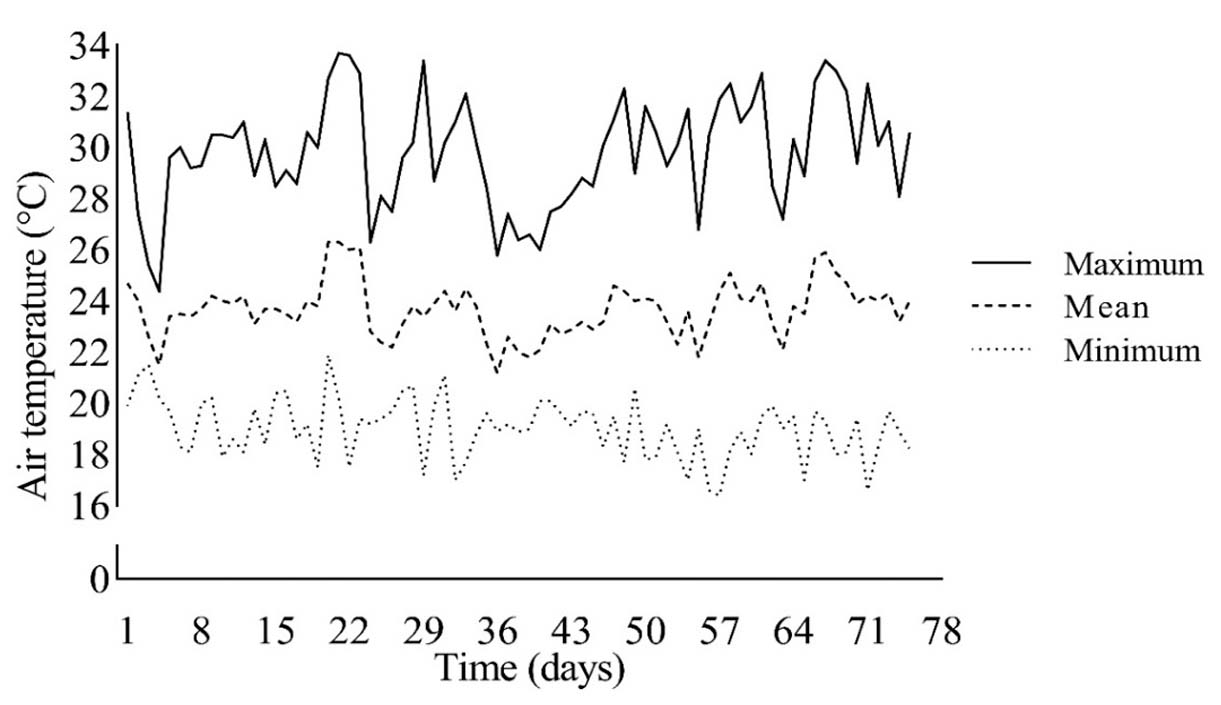
Figure 1.
Maximum, mean, and minimum air temperature data were monitored in the city during a study with Penaeus vannamei post-larvae in a low salinity biofloc system in winter in northeastern Brazil
Water samples were collected weekly to check the contents of total hardness (CaCO3), alkalinity (CaCO3), total ammonia nitrogen (TAN), nitrite (NO2−-N), nitrate (NO3−-N), and orthophosphate (PO43-) with a photometer (YSI 9500). Total suspended solids were determined according to Strickland and Parsons (1972), using fiberglass filters, while settleable solids were determined using Imhoff cone (APHA, 1998).
During the first 28 days, sugar cane was added daily as a carbon source to stimulate the heterotrophic bacteria to avoid the accumulation of toxic ammonia at a C: N ratio of 20, based on the estimation that about 75% of nitrogen present in feed offered to shrimp would be excreted as ammonia (Avnimelech, 1999). After this period, sugar cane was only added when necessary to prevent total ammonia nitrogen values from exceeding 0.8 mg L−1. Total suspended solids were maintained between 400 and 600 mg L−1 (Schveitzer et al., 2013) by diluting with pre-filtered well water, as the laboratory lacked clarifiers for solid control. Water lost due to evaporation was also replaced with pre-filtered well water. Calcium hydroxide Ca(OH)2 was supplemented following the calculation suggested by Furtado et al. (2011) to keep pH above 7.3 and alkalinity above 150 mg L−1 of CaCO3.
Assessment of shrimp growth performance
At the end of the study, shrimp were harvested after tank draining to calculate shrimp growth performance: survival rate (%), final mean weight (g), weekly growth (g week−1), weight gain (g), specific growth rate (% day−1), final biomass (g), feed conversion ratio (FCR), and productivity.
Data analysis
Statistical tests were performed with a significance level of 5.0% (P<0.05) using Statistica® 13.5.0.17 (TIBCO Software Inc.). Data were presented as mean ± standard deviation. Data were subjected to Shapiro-Wilk and Levene tests to prove the prerequisites of normality of the data distribution and homoscedasticity of the variances, respectively. When assumptions were not met, data were submitted to statistical transformations to satisfy parametric assumptions. One-way ANOVA was applied to verify differences among the treatments, followed by the Newman-Keuls test when differences were observed. For non-parametric data, the Kruskal-Wallis test was applied, followed by the Dunn test to check treatment differences.
Results
Water quality parameters
No statistical differences (P>0.05) were found among treatments in terms of mean values of temperature, dissolved oxygen, salinity, pH, alkalinity, total hardness, and electrical conductivity (Table 1). Dissolved oxygen ranged from 6.26 to 6.38 mg L−1, salinity remained above 1.67 g L−1, and pH and alkalinity were maintained above 7.3 and 150 mg L−1, respectively. The mean temperature during the study ranged from 22.09 to 22.17°C (Table 1), with similar variations across all treatments throughout the study, ranging from 19.21 to 28.31°C.
Table 1.
Mean ± standard deviation of water parameters for 75 days of study with Penaeus vannamei post-larvae cultured under different stocking densities (75, 150, and 301 shrimp m−2) in a low salinity biofloc system during winter in northeastern Brazil, with four replicates
| 75 shrimp m−2 | 150 shrimp m−2 | 301 shrimp m−2 | |
|---|---|---|---|
| Temperature (°C) | 22.12±0.37 | 22.09±0.35 | 22.17±0.35 |
| Dissolved oxygen (mg L−1) | 6.38±0.78 | 6.37±0.83 | 6.26±0.81 |
| Salinity (g L−1) | 1.67±0.08 | 1.68±0.05 | 1.67±0.06 |
| pH | 7.60±0.10 | 7.57±0.09 | 7.55±0.09 |
| Total alkalinity (mg CaCO3 L−1) | 166.67±28.65 | 160.81±25.62 | 164.06±23.89 |
| Total hardness (mg CaCO3 L−1) | 454.79±80.34 | 441.25±72.69 | 447.71±72.97 |
| Electrical conductivity (mS cm−1) | 2.93±0.46 | 3.02±0.48 | 2.90±0.47 |
| Total ammonia nitrogen (mg L−1) | 0.26±0.05 b | 0.30±0.09 ab | 0.44±0.28 a |
| Nitrite-N (mg L−1) | 0.08±0.02 | 0.09±0.02 | 0.09±0.03 |
| Nitrate-N (mg L−1) | 31.40±5.92 | 31.80±6.37 | 31.89±7.37 |
| Orthophosphate (mg L−1) | 6.26±1.37 | 6.43±1.29 | 6.40±1.50 |
| Total suspended solids (mg L−1) | 604.15±235.33 | 654.81±269.33 | 680.62±281.50 |
| Settleable solids (mL L−1) | 16.66±6.58 b | 20.04±7.72 a | 20.78±8.40 a |
The highest density (301 shrimp m−2) exhibited higher mean values (P<0.05) of TAN compared to the lowest density (75 shrimp m−2), while the intermediate (150 shrimp m−2) showed similar values (P>0.05) to the other treatments (Table 1). TAN peaked during the 3rd and 4th weeks in density of 301 shrimp m−2, resulting in higher concentrations (P<0.05) compared to the densities of 75 and 150 shrimp m−2. In the 5th week, densities of 150 and 301 shrimp m−2 showed TAN concentrations higher (P<0.05) than the density of 75 shrimp m−2. After the 6th week, TAN exhibited minimal variation (Figure 2 a).
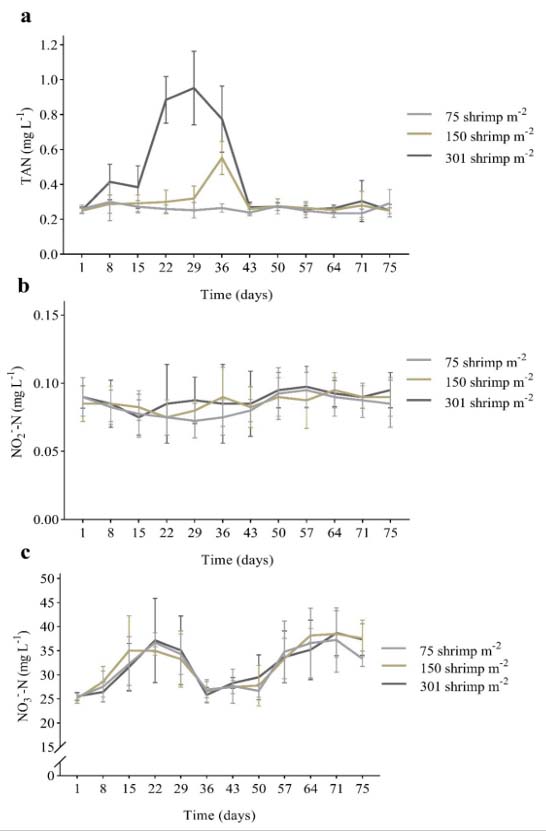
Figure 2.
Total ammonia nitrogen (TAN, a), nitrite nitrogen (NO2−-N, b), and nitrate nitrogen (NO3−-N, c) variation during a Penaeus vannamei post-larvae cultured under different stocking densities (75, 150, and 301 shrimp m−2) in a low salinity biofloc system in winter in northeastern Brazil, with four replicates
Nitrite nitrogen did not differ significantly among treatments (Table 1), ranging from 0.05 to 0.12 mg L−1 (Figure 2 b). Similarly, no significant differences were observed for nitrate nitrogen (Table 1), showing an accumulation during the first four weeks across all treatments, followed by a decrease in the 5th week and, and then rose again for the remainder of the study. Nitrate ranged from 24.08 to 45.70 mg L−1 across all densities (Figure 2 c). No statistical differences (P>0.05) were found for orthophosphate (Table 1).
Concerning the solids, no statistical differences (P>0.05) were found in mean total suspended solids (Table 1). However, during the 2nd, 3rd, and 4th weeks, total suspended solids accumulated, exceeding 800 mg L−1 across all treatments. Afterward, values stabilized around 600 mg L−1 (Figure 3 a). For settleable solids, the densities of 150 and 301 shrimp m−2 resulted in significantly higher mean values (P <0.05) than the density of 75 shrimp m−2 (Table 1). During the 2nd and 3rd weeks, density of 301 shrimp m−2 resulted in higher settleable solids (P <0.05) than density of 75 shrimp m−2, while the density of 150 shrimp m−2 showed similar values to the others. After the 5th week, no statistical differences (P>0.05) were observed, although higher densities tended to have higher values than the lowest density (Figure 3 b).
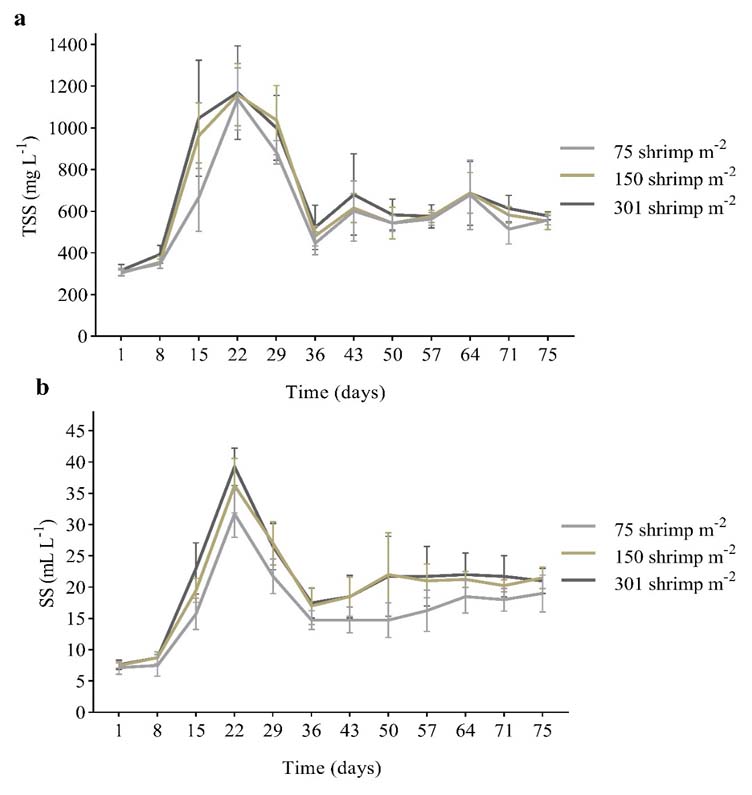
Figure 3.
Total suspended solids (TSS, a) and settleable solids (SS, b) variation during a Penaeus vannamei post-larvae cultured under different stocking densities (75, 150, and 301 shrimp m−2) in a low salinity biofloc system in winter in northeastern Brazil, with four replicates
Shrimp growth performance
The mean growth performance values are summarized in Table 2. Shrimp cultured under the lowest density (75 shrimp m−2) showed significantly higher (P <0.05) final mean weight, weekly growth, and specific growth rate, which progressively significantly declined as the density increased, with the lowest value found for the highest density (301 shrimp m−2). The treatment with 301 shrimp m−2 presented significantly higher (P <0.05) final biomass than those in the other densities, demonstrating the higher total number of animals despite the lower final mean weight. The feed conversion ratio for shrimp cultured under density of 75 shrimp m−2 was significantly lower (P <0.05) than those observed for densities of 150 and 301 shrimp m−2, which did not significantly differ (P>0.05) from each other. Shrimp cultured under 75 shrimp m−2 showed survival of 82.81±6.12%, which was significantly higher (P <0.05) than 59.57±7.50% and 57.52±10.08% for densities of 150 and 301 shrimp m−2, respectively, with no significant differences (P>0.05) between these two densities.
Table 2.
Mean ± standard deviation of growth performance for 75 days of study with Penaeus vannamei post-larvae cultured in a low salinity biofloc system under different stocking densities (75, 150, and 301 shrimp m−2) during winter in northeastern Brazil, with four replicates
| 75 shrimp m−2 | 150 shrimp m−2 | 301 shrimp m−2 | |
|---|---|---|---|
| Initial mean weight (g) | 0.04±0.08 | 0.04±0.08 | 0.04±0.08 |
| Final mean weight (g) | 2.46±0.22 a | 1.90±0.21 b | 1.54±0.13 c |
| Weekly growth (g week−1) | 0.23±0.02 a | 0.17±0.01 b | 0.14±0.01 c |
| Specific growth rate (% day−1) | 5.55±0.12 a | 5.21±0.15 b | 4.93±0.11 c |
| Final biomass (g) | 129.72±9.34 b | 143.43±4.23 b | 225.78±37.36 a |
| Feed conversion ratio | 1.32±0.10 b | 1.81±0.20 a | 1.81±0.33 a |
| Survival (%) | 82.81±6.12 a | 59.57±7.50 b | 57.52±10.08 b |
Discussion
The growth performance results illustrated that the treatment with 75 shrimp m−2 was more effective in producing P. vannamei juveniles in a low salinity BFT system during winter. This treatment achieved a survival rate above 82%, higher growth rate and higher final weight compared to those with 150 and 301 shrimp m−2, providing an economic advantage to farmers at harvest. Additionally, the lower feed conversion ratio at the lowest density indicates more efficient feed use, reducing feed cost, which is the most expensive item in shrimp farming (Gonçalves Junior et al., 2025). Despite this, a cost-benefit analysis is recommended in future studies to quantify profitability at different densities.
The progressive decline in growth observed among treatments in this study indicates a negative impact in growth performance as the stocking density increased. These findings are consistent with previous studies showing similar effects of overcrowding on P. vannamei performance (Araneda et al., 2008, 2020; Roy et al., 2020; Said et al., 2024). The observed differential growth with increasing stocking density in this study may be attributed to increased energy expenditure due to the intensified competition for space and essential resources such as feed (Araneda et al., 2008; Liu et al., 2017; Bardera et al., 2021). Larger shrimp tend to dominate smaller ones during feeding, which can contribute to the uneven growth as reported by Araneda et al. (2008) and Bardera et al. (2021). Furthermore, the lower feed conversion ratio recorded at the lowest density supports the feed use efficiency decline as stocking density increases, affecting overall profitability. This is because competition can raise stress levels, which, in turn, suppress feed use, consequently reducing growth rates and increasing susceptibility to disease and mortality (Araneda et al., 2008; Liu et al., 2017; Bardera et al., 2021).
Moreover, stress due to overcrowding may lead to water quality deterioration by promoting accumulation of organic waste and nitrogenous compounds, which further compromises shrimp health and performance (Liu et al., 2017). In our study, nitrogenous compounds mean values were within the estimated safe range for shrimp at the salinity used, where TAN should be below 0.81 mg L−1, NO2−-N below 0.25 mg L−1, and NO3−-N below 38.70 mg L−1 (Valencia-Castañeda et al., 2018; Prates et al., 2024). However, TAN spikes observed in the 3rd (0.89±0.13 mg L−1) and 4th (0.95±0.21 mg L−1) weeks at density of 301 shrimp m−2 exceeded safe levels and probably contributed to the reduced shrimp growth and survival, as reported by Romano and Zeng (2013). Thus, when using low salinity conditions, close monitoring of nitrogenous compounds is crucial to avoid production losses.
Despite the high number of heterotrophic bacteria that convert ammonia directly to bacterial biomass, the low NO2−-N levels and corresponding increase in NO3−-N during the first four weeks across all treatments suggest that the inoculum effectively promoted the presence of nitrite-oxidizing bacteria, which oxidize NO2−-N to NO3−-N (Robles-Porchas et al., 2020; Abakari et al., 2021). However, a decline in NO3−-N levels in the 5th week indicates that the water exchange, applied to control solids, may have contributed to this reduction, implying the solids influence NO3−-N levels. The decline might also be linked to heterotrophic denitrification, and subsequent increase observed in later weeks may reflect the full establishment of the system (Robles-Porchas et al., 2020; Abakari et al., 2021).
The results obtained in our study are consistent with previous studies conducted in different salinity conditions. In freshwater, Araneda et al. (2008, 2020) observed higher growth and survival in treatment with 90 shrimp m−2 compared with 180, 230, 280, and 330 shrimp m−2. Working with a salinity similar to that in our study, Roy et al. (2020) found that shrimp cultured at 88 shrimp m−2 exhibited higher growth and survival, and lower feed conversion ratio compared to treatments at 176 and 264 shrimp m−2. Similarly, Said et al. (2024) reported that higher stocking densities negatively impacted growth performance even in a seawater BFT system. They found higher final weight, higher growth rates, slightly higher survival, lower feed conversion ratio, and higher protein efficiency ratio were achieved in the treatment with 50 shrimp m−2 compared with 200 shrimp m−2. These studies reinforce that higher densities intensify competition and stress, contributing to the differential growth observed across treatments in our study. Therefore, these findings highlight stocking density as a key factor influencing shrimp performance and optimizing it is essential to maximize overall profitability and ensure animal welfare, particularly in low salinity BFT systems.
Although the feed conversion ratio was acceptable across all treatments, overall results achieved after 75 days were disappointing compared to other studies, which suggest that biofloc technology can support hyper-intensive shrimp production without compromising survivability and growth, owing to improved water quality (Silveira et al., 2020). Additionally, biofloc microorganisms, when consumed by shrimp, can enhance feed use and digestive enzyme activity (Said et al., 2024).
Dissolved oxygen levels were within the recommended range for P. vannamei growth (Van Wyk et al., 1999). As expected, the natural oligohaline water used provided electrical conductivity values consistent with low salinity conditions (Venice System, 1958). Such waters typically exhibit high alkalinity, pH, and hardness, which are vital for inland shrimp production (Barbosa et al., 2012; Pessôa et al., 2016). In this study, the absence of significant variations in alkalinity and pH may be attributed to Ca(OH)2 supplementation (Furtado et al., 2011), which helped maintain values appropriate for P. vannamei development and microbial activity in the BFT system. Hardness remained stable, likely due to consistent salinity levels (Moura et al., 2021), staying within acceptable ranges for shrimp (Van Wyk et al., 1999).
The total suspended solids accumulated across all treatments during the first 28 days, exceeded 800 mg L−1. This accumulation is likely due to minimal water exchange, continuous feed inputs, and sugar cane supplementation, which promote heterotrophic bacterial growth to control TAN levels. The low temperature may have also contributed by increasing uneaten feed, further stimulating heterotrophic bacterial growth. All treatments required solids removal to maintain concentrations between 400 and 600 mg L−1, the recommended range for P. vannamei (Schveitzer et al., 2013). Despite the need for solids removal, Schveitzer et al. (2024) highlighted that shrimp can be produced in environments above 600 mg L−1 without compromising survival. Thus, any negative effect that this parameter might have had would have been similar in all treatments, given that no statistical differences were observed. Settleable solids followed a similar trend, increasing with stocking density. Treatments with 150 and 301 shrimp m−2 produced higher biofloc volumes compared with 75 shrimp m−2, suggesting that higher stocking densities contributed to greater organic loading and settleable solids volumes. While all treatments exceeded ideal volume (Hargreaves, 2013) for P. vannamei in the 3rd week, settleable solids remained below the maximum recommended volume of 50mLL−1, which is indicative of proper biofloc formation (Khanjani and Sharifinia, 2020).
A possible reason for the poor overall profitability in all treatments compared to other studies in biofloc could be the interaction between low salinity and the daily mean water temperatures around 22°C (minimum of 20.90°C), as noted by Kır et al. (2023) and Ponce-Palafox et al. (2019). The absence of artificial heating in this study may have contributed to these low temperatures, which likely slowed shrimp growth, consistent with prior findings showing reduced growth at temperatures below 22°C, especially at high densities under low or zero salinity (Araneda et al., 2008, 2020; Abdelrahman et al., 2019). Studies also indicate that suboptimal temperatures and prolonged low-temperature stress negatively impact shrimp behavior, reducing feed intake, feed conversion, growth, and survival (Wyban et al., 1995; Van Wyk et al., 1999; de Souza et al., 2016; Prates et al., 2023; Barajas-Sandoval et al., 2024). Additionally, Abdelrahman et al. (2019) and Wang et al. (2019) found that P. vannamei growth decreased with increasing variation in water temperature at low salinities. Van Wyk et al. (1999) and Wang et al. (2019) highlighted the physiological stress caused by temperature variations, particularly at low salinities, preventing shrimp from reaching commercial size. In this study, no physiological analyses were conducted to evaluate the impact of temperature–salinity interactions on P. vannamei. Similarly, Araneda et al. (2008) reported poor growth in freshwater at 25°C, while Souza et al. (2016) and Prates et al. (2023) observed compromised growth in seawater BFT systems at temperatures below 21 and 20°C, respectively. Despite this, Prates et al. (2023) showed that is possible to maintain shrimp at low temperatures for partial growth recovery when exposed to ideal conditions.
The findings are also supported by Huang et al. (2022), who observed minimal effects on P. vannamei growth at 23°C when cultured at higher salinity (5.0 g L−1) in a BFT system. Araneda et al. (2008, 2020) similarly reported that lower salinity combined with higher densities exacerbates negative effects on shrimp performance. Numerous studies have shown that P. vannamei grow slower at low or zero salinity compared to higher salinities (Van Wyk et al., 1999; Maicá et al., 2012; Esparza-Leal et al., 2016; Valenzuela-Madrigal et al., 2019). Factors such as age, acclimation process, and deficiencies in ionic profile may also contribute to the lower shrimp performance (McGraw et al., 2002; Esparza-Leal et al., 2010; Li et al., 2017; Jaffer et al., 2020; Pimentel et al., 2023). In this study, analysis of water ionic profile was not performed to confirm levels and ratios of ions required for ideal shrimp growth. However, P. vannamei can be successfully cultured at low salinity (up to 1.0 g L−1), showing acceptable results of growth and survival (Esparza-Leal et al., 2009, 2010, 2016; Maicá et al., 2012, 2014; Abdelrahman et al., 2019; Jaffer et al., 2020; Huang et al., 2022; Pimentel et al., 2023). The maintenance of the other water parameters and nutritional requirements must be considered to compensate for the extra energy cost of basal maintenance for a greater scope for performance of shrimp (Li et al., 2017; Sokolova, 2021). In the present study, however, any effect that low salinity, low temperature, and temperature–salinity interaction might have had would have been similar in all stocking densities since there was no statistical difference among treatments for these parameters. Further studies are needed to examine the water ionic profile and physiological change to evaluate how low temperatures can affect shrimp performance under different stocking densities in a low salinity BFT system.
Conclusion
The results of the present study demonstrate that the density of 75 shrimp m−2 was more efficient for producing P. vannamei juveniles in a low salinity biofloc system during winter, without compromising survivability and feed conversion ratio. However, the overall performance across all treatments was limited by the interaction between low salinity and low temperature. Thus, maintaining water temperature within the optimal range for P. vannamei is crucial to optimize production and minimize losses, especially in low salinity conditions.
Acknowledgements
The authors would like to thank Marcus Vinicius Lourenço de Mello, Diego de Oliveira Carvalho, José Antônio Carvalho Teixeira, and Williany Fernanda Amâncio de Moraes for their kind assistance and cooperation during the study.
Notes
[3] CRediT authorship contribution statement
I. Santos: conceptualization, methodology, data curation, formal analysis, and writing – original draft, review, and editing; M. Santos and I.S. Silva: methodology, formal analysis, and writing – review and editing; U.L. Silva: supervision, conceptualization, methodology, funding acquisition, and writing – review and editing.