
Table 1.
Major bacterial diseases, vector, influence, treatments of economically important fish Oreochromis niloticus
| Disease | Causative agents | Clinical signs | Stressor contributing to diseases | Treatments | Country | References |
|---|---|---|---|---|---|---|
| 1 | 2 | 3 | 4 | 5 | 6 | 7 |
| Motile Aeromonas septicaemia (MAS) | Aeromonas hydrophila and other related Aeromonas species | Loss of body balance; lethargic swimming; gasping at the water surface; external hemorrhage; exophthalmia; swollen abdomen; frequent high mortalities, ulcer, congestion hemorrhagic, skin darkness fin rot, stunted growth, exophthalmos, skin ulcers | Stress caused by high water temperature, water pH changes, low dissolved oxygen, high levels of ammonia and nitrites, high stocking density, parasitic infections, rough handling and transportation | Disinfectants (KMnO4 at 4–10 mg/L for 1 h or 2–4 mg/L indefinite immersion), antibiotics (oxytetracycline as feed additive at 50 mg/kg fish/d for 12–14 d, 21 d withdrawal, probiotics (Enterococcus faecium at 8 g/kg feed for 45 d) Saccharomyces cerevisiae at 5 g/kg feed for 12 weeks), and various vaccines | Egypt Malaysia | Monir et al. (2020) |
| Prabu et al. (2019) | ||||||
| Stratev and Odeyemi (2017) | ||||||
| Streptococcosis | Streptococcus spp. including S. agalactiae, S. iniae, S. dysgalactiae and Enterococcus spp. | Red discoloration of the skin; lethargic; erratic swimming; exophthalmia with corneal opacity and hemorrhage in eyes; abdominal distension; skin hemorrhaging around the anus, the base of fins and anus, around the mouth, and in operculum; enlarged and nearly black spleen; and high mortality | Introduction of contaminated water and/or fry, high stocking density, high water temperature, high ammonia, low dissolved oxygen, unsuitable pH, poor husbandry management | Antibiotic in feed: erythromycin at 50 mg/kg fish/d for 12 d; oxytetracycline at 75–100 mg/kg fish/d for 14 days. Various commercial vaccines | Colombia | Prabu et al. (2019), Zamri-Saad et al. (2014) |
| Thailand | ||||||
| Egypt | ||||||
| Malaysia | ||||||
| Columnaris | Flavobacterium columnare | Fin rot; necrotic lesions on skin and gills; irregular whitish to grey patches on the skin and/or fins; high mortality rates | Poor environmental conditions, high stocking densities, high organic load, and high-water temperature | KMnO4 to the water at 2 mg/L; 20 min bath in CuSO4 at 37 mg/L or depending on alkalinity, indefinite immersion with CuSO4 at 0.5–3 mg/L | Brazil | Declercq et al. (2013); Prabu et al. (2019) |
| Vibriosis | Vibrio spp. | Septicemia; lethargy; anorexia; hemorrhages along the external body surface and the base of the fins; and high mortality | Caused by stress, poor water quality, low water temperature, and bad management practices | Dietary inclusion of antibiotic | Egypt | Prabu et al. (2019) |
| Edwardsiellosis | Edwardsiella ictaluri, E. tarda | Abnormal swimming; hemorrhages at the base of fins, operculum, belly, mouth, and vent; exophthalmia; bloody fluid in body cavity; swollen, dark red spleen; pale, mottled liver; and swollen, soft kidney | Imbalanced environmental conditions, such as high temperature, high organic load, and poor water quality | Dietary inclusion of antibiotic | United States, | El-Yazeed and Ibrahem (2009); Nhinh et al. (2022); Park et al. (2012) |
| Venezuela, | ||||||
| Taiwan and | ||||||
| Japan, | ||||||
| Norway | ||||||
| Yersiniosis | Y. ruckeri | Focal hyperplasia, desquamation in the secondary lamellae and hemorrhages in the gill arch, skin injuries, acute or chronic enterosepticemia and hemorrhagic zones | Overcrowding of fish and water quality | Antimicrobial drugs, pesticides, probiotics phytogenic agents, yeast products, Omega 3-chitosan nanoparticles and antiseptics | Egypt | Kumar et al. (2015); Aly et al. (2012); Rutherfurd-Markwick and Gill (2004); Selim and Reda (2015); Alemayehu et al. (2018); Eissa et al. (2020) |
| Francisellosis | Francisella noatunensis and subsp. orientalis | Splenomegaly and granulomas, bleeding around the pectoral fins, anorexia, erratic swimming and exophthalmos | Poor management of pond and high stocking densities | Autogenous whole cell-adjuvanted intravenous vaccine | United | Shahin et al. (2019); Pulpipat et al. (2019) |
| Kingdom and Taiwan | ||||||
| Summer syndrome | Citrobacter freundii | Hyperplasia, desquamation in the secondary lamellae and hemorrhages in the gill arch, pale liver, distended abdomen, watery kidney, focal hyperplasia, desquamation in the secondary lamellae and hemorrhages in the gill arch | Contaminated water and high stocking densities | Bacteriophage therapy | India and Brazil | El Asely et al. (2020); Jia et al. (2020) |
| Pseudomonad septicemia | Pseudomonas fluorescens and Pseudomonas aeruginosa | Exophthalmia, red spot on skin | Overpopulation, low temperature and injuries | Yucca extract (feed additive) | Egypt | Hal and Manal (2020); Osman et al. (2021); El-Keredy and Naena (2020) |
| Piscirickettsiosis (salmonid-septicemic disease) | Piscirickeittsia salmonis | Necropsy, occasional cutaneous hemorrhage, exophthalmia, enlarged spleens with multiple white granulomas, gills epithelial hyperplasia and loss of interlamellar spaces, anorexia, lethargy, respiratory distress, skin darkening and surface swimming | Water temperature fluctuations and strong storms | Tetracycline, and clarithromycin | Taiwan | Toranzo et al. (2005); Mauel et al. (2003) |
| Staphylococcosis | Staphylococcus aureus | Red spots on the skin | Water temperature fluctuations and pH of water | Phytogenic feed additives and Boswellia serrata resin extract (BSRE) supplementation | Pakistan | Montaser et al. (2021); Fatima (2014); Pridgeon and Klesius (2012) |
| Kenya | ||||||
| Flexibacteriosis | Flavobacterium columnare | Necrosis | Overpopulation, splenomegaly infected fish tissue, skin, gills and fins | Centella asiatica aqueous extract and β-glucan | Egypt | El-Tawab et al. (2020);Amphan et al. (2019) |
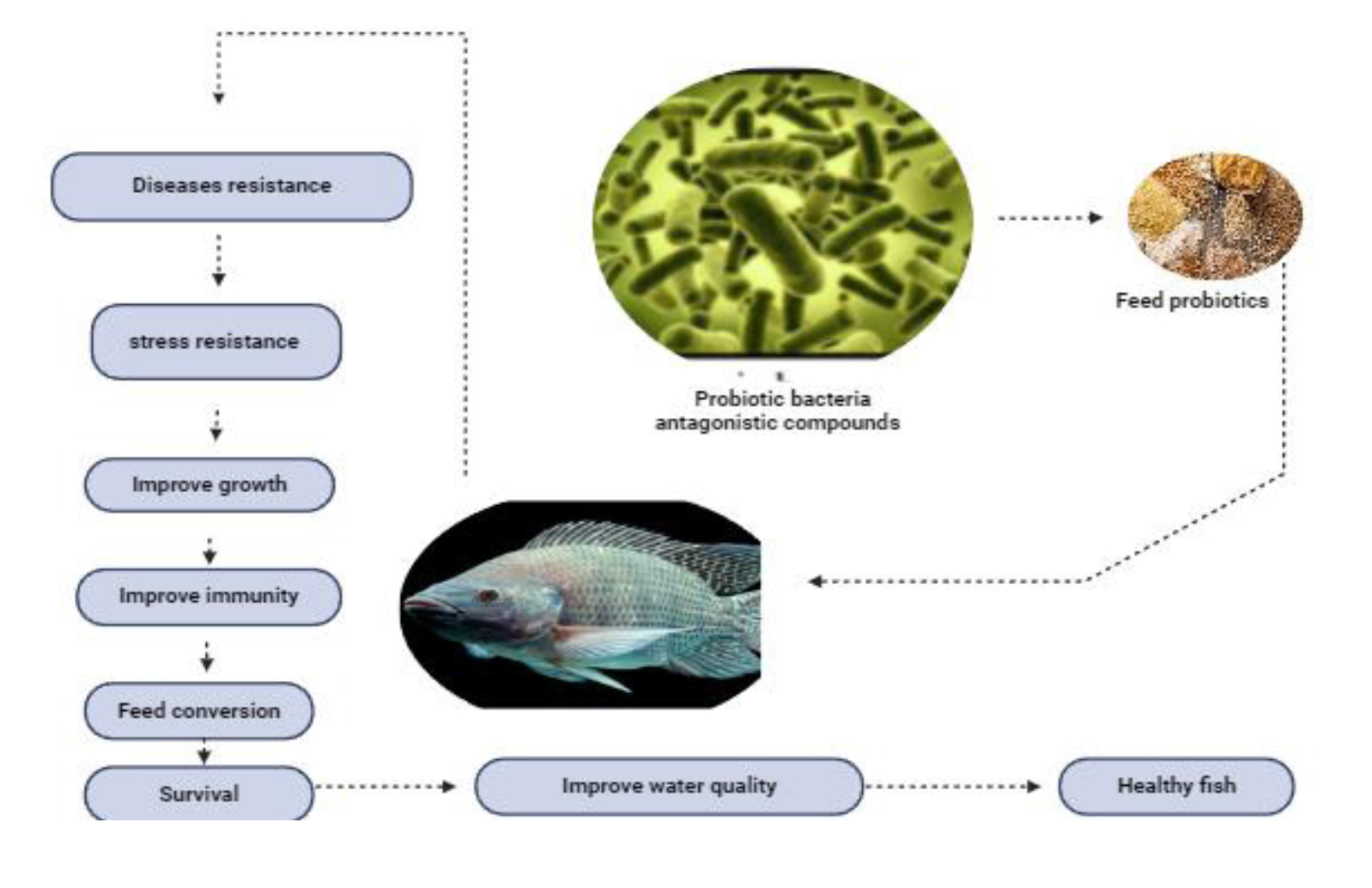
Figure 1.
Dietary supplementation of probiotics live microorganisms used against different bacterial diseases
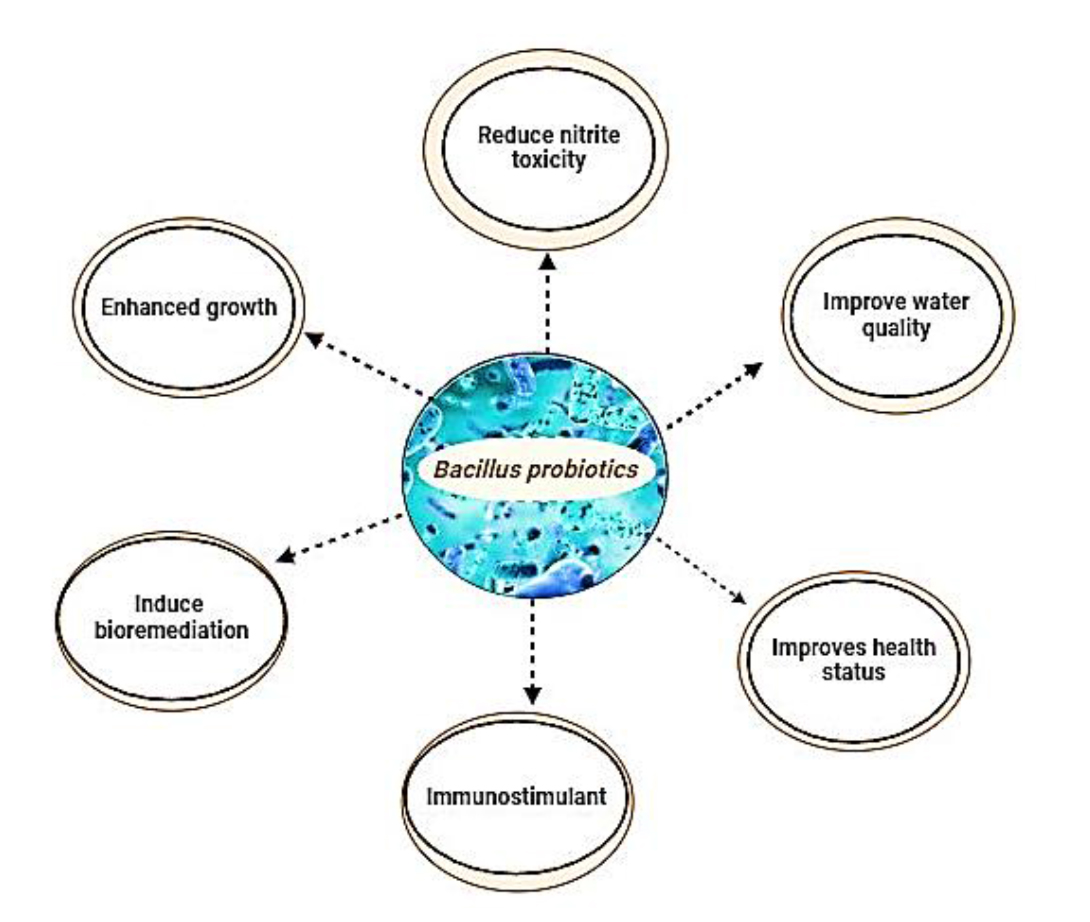
Figure 2.
Use of Bacillus as a probiotic against pathogenic bacteria in fish
Table 2.
Pathogenic bacteria, key characteristics and recent control in Nile tilapia
| Pathogenic bacteria | Key characteristics | Control | References |
|---|---|---|---|
| Aeromonas hydrophila | Gram-negative, rod-shaped, motile. Causes ulcers, hemorrhages, and fin rot. | Antibiotic treatments, probiotics, immunization. | Rivas et al. (2023); Hassanin et al. (2024) |
| Streptococcus iniae | Gram-positive, cocci, causes systemic infections and lesions in muscle. | Vaccination, early detection, and hygiene practices. | Wang et al. (2021) |
| Edwardsiella ictaluri | Gram-negative, facultative anaerobe, causes septicemia. | Vaccination, environmental control, antibiotics. | Abu-Zahra et al. (2024); Ghani et al. (2024) |
| Vibrio alginolyticus | Gram-negative, halophilic, associated with skin lesions and fin rot. | Salt baths, antimicrobial treatments, biosecurity. | Abotaleb et al. (2024) |
| Flavobacterium columnare | Gram-negative, filamentous, causes columnaris disease (skin ulceration). | Immunostimulants, bacteriophage therapy, water quality management. | Zahran and Risha (2013) |
| Yersinia ruckeri | Gram-negative, motile, associated with red mouth disease in fish. | Antibiotics, vaccination, good water quality management. | Alemayehu et al. (2018) |
| Pseudomonas fluorescens | Gram-negative, motile, causes gill disease and systemic infections. | Antibiotic treatment, improving water quality, and biosecurity. | Moharam et al. (2024) |
| Vibrio vulnificus | Gram-negative, halophilic, associated with wound infections. | Saltwater baths, antibiotics, and early detection. | Cai et al. (2024) |
| Francisella spp. | Gram-negative coccobacillus, causes francisellosis | Live-attenuated or DNA vaccines | Meyer et al. (2025) |
| Staphylococcus aureus | Gram-positive, causes staphylococcosis | Boswellia serrata resin extract (BSRE) supplementation | Montaser et al. (2021) |
| Lactococcus garvieae | Gram-positive, causes piscine lactococcosis | Adjuvant, inactive whole cell vaccine | Bwalya et al. (2020) |