In this article, we discuss measurable functions. The following is the usual definition of convexity.
Definition 1.
Let I be an interval in ℝ. Then f : I → ℝ is said to be convex if for all x, y ∈ I and λ ∈ [0, 1],
f\left( {\lambda x + \left( {1 - \lambda } \right)y} \right) \le \lambda f\left( x \right) + \left( {1 - \lambda } \right)f\left( y \right).
The Jensen inequality [21] and other inequalities [12], [27], [32], as well as other good properties [5], [20] hold for convex functions, so it is natural for researchers to consider extensions for the definition of convexity. To date, there have been many different or generalized definitions for convex functions [10], [18], [24], [32]. A recent generalization [1] unifies several varieties of convexity. For the quasi-convex function
f\left( {\lambda x + \left( {1 - \lambda } \right)y} \right) \le \max \left\{ {f\left( x \right),f\left( y \right)} \right\}
definition and some inequalities, see [11], [13], [18], [29], [32].
However, in some theoretical (like f (x) = x4 − x2) and practical situations [19], some functions may not be convex (or quasi-convex) at all, which means, for some x, y ∈ I, a reverse inequality
f\left( {\lambda x + \left( {1 - \lambda } \right)y} \right) > \max \left\{ {f\left( x \right),f\left( y \right)} \right\}
holds, thus different convexities or quasi-convexity cannot cover this situation. If we still want to have similar Jensen type inequalities as for convex functions, there might be two main approaches.
The first main approach is based on the idea of “adding” some part to offset the non-convexity, to make the function convex or Jensen inequality valid.
1.1.
One way is the so-called ε-convex function [15], [25]:
(1.1)f\left( {\lambda x + \left( {1 - \lambda } \right)y} \right) \le \lambda f\left( x \right) + \left( {1 - \lambda } \right)f\left( y \right) + \varepsilon .
See further discussions [7], [8], [23] and applications [4], [19].
1.2.
Another way is to construct a new convex function
{f_1}\left( x \right) = {1 \over 2}M{x^2} - f\left( x \right),
or
{f_2}\left( x \right) = f\left( x \right) - {1 \over 2}m{x^2},
where M = max f″, m = min f″. See p.5 in Chapter 1.4 in [9] and [27, p. 4] as well as the references cited therein.
The second main approach is to keep the original function and original version of Jensen inequality, but to “select” proper x, y ∈ I to avoid the reverse inequality situation.
2.1
A non-convex function f : I → ℝ might be a discrete convex function f : E → ℝ defined on a discrete set E ⊂ I for divided difference. Thus Jensen type inequality holds for xi ∈ E. For discrete convex function, see [17, p. 42], [30], [31], [33].
2.2
If we still want to keep the original interval I, we may consider like this: if x, y are separated enough, then the “small” non-convex part of the function may not influence the whole inequality due to the “overall” convexity. Based on this idea, we first need to define such kind of functions.
Definition 2.
Let I be an interval in ℝ. Then f : I → ℝ is said to be l-gap convex if for all x, (x + l) ∈ I and λ ∈ [0, 1],
(1.2)f\left( {\lambda x + \left( {1 - \lambda } \right)\left( {x + l} \right)} \right) \le \lambda f\left( x \right) + \left( {1 - \lambda } \right)f\left( {x + l} \right),
where l is a fixed positive real number and l ≤ |I|.
The geometric interpretation is that, each secant between (x, f (x)), (x + l, f (x + l)) lies above the graph of the function; while traditional convexity requires that each secant between (x, f (x)), (y, f (y)) lies above, for any x, y ∈ I.
It is easy to see that a convex function on I must be l-gap convex, but some l-gap convex functions may not be convex. For example, the function f (x) = x4 − x2 is 2.22475-gap convex on ℝ, but it is not convex on ℝ (see Figure 1). The constant 2.22475 is not “the best possible” (see explanations later).
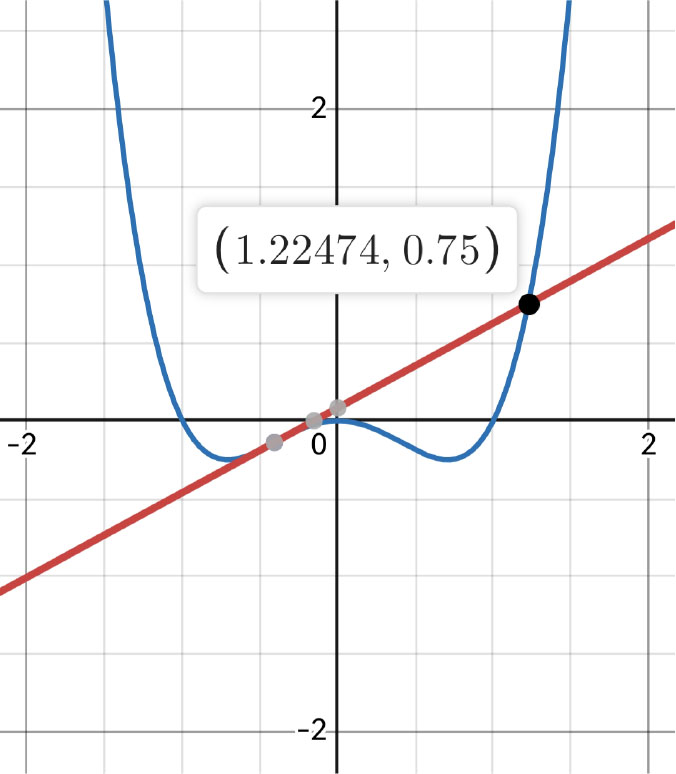
Figure 1.
A graph of an l-gap function
In this paper, we explore some basic properties of l-gap convex functions as well as some special cases (which are not convex functions in the usual sense). A Jensen type inequality is established and the majorization theorem also holds for l-gap convex functions as a generalization. Further, a Hermite-Hadamard type inequality is established.
2.
Basic result
In this section, we explore some basic properties of l-gap convex functions as well as some examples.
Before the main theorem, some preliminary results need to be proved.
Lemma 1.
Let I be an interval in ℝ. If f : I → ℝ is l-gap convex, then f is also l′-gap convex for l < l′ < 2l and l′ ≤ |I|.
Proof
For any l′ : l < l′ < 2l and a certain λ, we have
(2.1)\left( {\lambda x + \left( {1 - \lambda } \right)\left( {x + l'\;} \right)} \right) < x + l
for
\lambda \in \left( {{{l' - l} \over {l'}},1} \right)
, or
(2.2)\left( {\lambda x + \left( {1 - \lambda } \right)\left( {x + l'} \right)} \right)\; > \left( {x + l'} \right) - l
for
\lambda \in \left( {0,{l \over {l'}}} \right)
.
We first prove the case (2.2) below.
\matrix{ {\lambda f\left( x \right) + \left( {1 - \lambda } \right)f\left( {x + l'} \right)} \hfill \cr {\;\;\;\;\;\; = \lambda f\left( x \right) + \lambda \cdot {{l' - l} \over {2l - l'}}f\left( {x + l} \right) + \left( {1 - \lambda } \right)f\left( {x + l'} \right) - \lambda \cdot {{l' - l} \over {2l - l'}}f\left( {x + l} \right)} \hfill \cr }
as x and (x + l) is l-gap, we can utilise (1.2) to get
\ge \lambda \cdot {l \over {2l - l'}}f\left( {x + l' - l} \right) + \left( {1 - \lambda } \right)f\left( {x + l'} \right) - \lambda \cdot {{l' - l} \over {2l - l'}}f\left( {x + l} \right)
as (x + l′ − l) and (x + l′) is l-gap and
x + l = {{2l - l'} \over l}\left( {x + l'} \right) + {{l' - l} \over l}\left( {x + l' - l} \right)
, we can use (1.2) to get
\matrix{ { \ge \lambda \cdot {l \over {2l - l'}}f\left( {x + l' - l} \right) + \left( {1 - \lambda } \right)f\left( {x + l'} \right)} \hfill \cr {\;\;\; - \lambda \cdot {{l' - l} \over {2l - l'}}\left( {{{2l - l'} \over l}f\left( {x + l'} \right) + {{l' - l} \over l}f\left( {x + l' - l} \right)} \right)} \hfill \cr { = \lambda \cdot {{l'} \over l}f\left( {x + l' - l} \right) + \left( {1 - \lambda \cdot {{l'} \over l}} \right)f\left( {x + l'} \right)} \hfill \cr }
as (x + l′ − l) and (x + l′) is l-gap, we can apply (1.2) to get
\ge f\left( {\lambda x + \left( {1 - \lambda } \right)\left( {x + l'} \right)} \right).
Situation (2.2) is proved.
We then prove the case (2.1) below.
\matrix{ {\lambda f\left( x \right) + \left( {1 - \lambda } \right)f\left( {x + l'} \right)} \hfill \cr {\;\;\;\;\;\;\; = \lambda f\left( x \right) + \left( {1 - \lambda } \right)f\left( {x + l'} \right) + \left( {1 - \lambda } \right){{l' - l} \over {2l - l'}}f\left( {x + l' - l} \right)} \hfill \cr {\;\;\;\;\;\;\;\;\;\;\; - \left( {1 - \lambda } \right){{l' - l} \over {2l - l'}}f\left( {x + l' - l} \right)} \hfill \cr }
as (x + l′) and (x + l′ − l) is l-gap, we can use (1.2) to get
\ge \lambda f\left( x \right) + \left( {1 - \lambda } \right){l \over {2l - l'}}f\left( {x + l} \right) - \left( {1 - \lambda } \right){{l' - l} \over {2l - l'}}f\left( {x + l' - l} \right)
as x and (x + l) is l-gap, we can apply (1.2) to get
\matrix{ { \ge \lambda f\left( x \right) + \left( {1 - \lambda } \right){l \over {2l - l'}}f\left( {x + l} \right)} \hfill \cr {\;\;\;\; - \left( {1 - \lambda } \right){{l' - l} \over {2l - l'}}\left( {{{2l - l'} \over l}f\left( x \right) + {{l' - l} \over l}f\left( {x + l} \right)} \right)} \hfill \cr { = \left( {1 - {{l'} \over l} + \lambda {{l'} \over l}} \right)f\left( x \right) + \left( {1 - \lambda } \right){{l'} \over l}f\left( {x + l} \right)} \hfill \cr }
as x and (x + l) is l-gap, we can utilise (1.2) to get
\ge f\left( {\lambda x + \left( {1 - \lambda } \right)\left( {x + l'} \right)} \right).
Thus, f is also l′-gap convex.
We use Lemma 1 to prove the following important property for l-gap convex functions.
Proposition 1.
Let I be an interval in ℝ. If f : I → ℝ is l-gap convex, then f is also L-gap convex for l ≤ L ≤ |I|.
Proof
The situation l ≤ L < 2l has been proved. Suppose 2l ≤ L ≤ |I|, then
L = l \cdot {r_1} \cdot {r_2} \cdot \ldots \cdot {r_s},
where 1 < ri< 2. From Lemma 1 we have
l{\text{-gap}}\;{\rm{convex}} \Rightarrow l{r_1}{\text{-gap}}\;{\rm{convex}} \Rightarrow l{r_1}{r_2}{\text{-gap}}\;{\rm{convex}} \Rightarrow \ldots \Rightarrow L{\text{-gap}}\;{\rm{convex}}.
From Proposition 1 we conclude that for a certain l-gap convex function f, if we can find smaller l, it would be better. For the 2.22475-gap convex function f (x) = x4 −x2, as we can find smaller l than 2.22475 (but it’s hard to calculate the best one), the gap 2.22475 is not the best possible.
Let f : I → ℝ be an l-gap convex function on I ⊆ ℝ. For ak ∈ I and pk> 0, (k = 1, . . . , n), if mini≠j|ai −aj| ≥ l; i, j ∈ (1, . . . , n), then(2.3){{{p_1}f\left( {{a_1}} \right) + \ldots + {p_n}f\left( {{a_n}} \right)} \over {{p_1} + \ldots + {p_n}}} \ge f\left( {{{{p_1}{a_1} + \ldots + {p_n}{a_n}} \over {{p_1} + \ldots + {p_n}}}} \right).
Proof
From Proposition 1 we predict that f is L-convex for l ≤ L ≤ |I|. Without loss of generality, suppose that
{a_1} < {a_2} < \ldots < {a_n},
then we have
{a_{k + 1}} - {{{p_1}{a_1} + \ldots + {p_k}{a_k}} \over {{p_1} + \ldots + {p_k}}} \ge l,\left( {k = 1, \ldots ,\left( {n - 1} \right)} \right).
Thus we can utilise definition (1.2) for all L ≥ l:
\matrix{ {{p_1}f\left( {{a_1}} \right) + {p_2}f\left( {{a_2}} \right) + {p_3}f\left( {{a_3}} \right) + \ldots + {p_n}f\left( {{a_n}} \right)} \hfill \cr {\;\;\;\;\;\;\;\;\; \ge \left( {{p_1} + {p_2}} \right)f\left( {{{{p_1}{a_1} + {p_2}{a_2}} \over {{p_1} + {p_2}}}} \right) + {p_3}f\left( {{a_3}} \right) + \ldots + {p_n}f\left( {{a_n}} \right)} \hfill \cr {\;\;\;\;\;\;\;\;\; \ge \left( {{p_1} + {p_2} + {p_3}} \right)f\left( {{{{p_1}{a_1} + {p_2}{a_2} + {p_3}{a_3}} \over {{p_1} + {p_2} + {p_3}}}} \right) + \ldots + {p_n}f\left( {{a_n}} \right)} \hfill \cr {\;\;\;\;\;\;\;\;\; \ge \ldots } \hfill \cr {\;\;\;\;\;\;\;\;\; \ge \left( {{p_1} + \ldots + {p_n}} \right)f\left( {{{{p_1}{a_1} + \ldots + {p_n}{a_n}} \over {{p_1} + \ldots + {p_n}}}} \right).} \hfill \cr }
Remark 1.
By letting l → 0 in Theorem 1, we get the original Jensen inequality, as there is no restriction for mini≠j|ai − aj|.
Now we give an example of l-gap convex functions.
Example 1.
The function f (x) = axp − bxq is
{\left( {{b \over a}} \right)^{{1 \over {p - q}}}}
-gap convex on ℝ+ for a, b > 0, p > q > 1, see Figure 2.
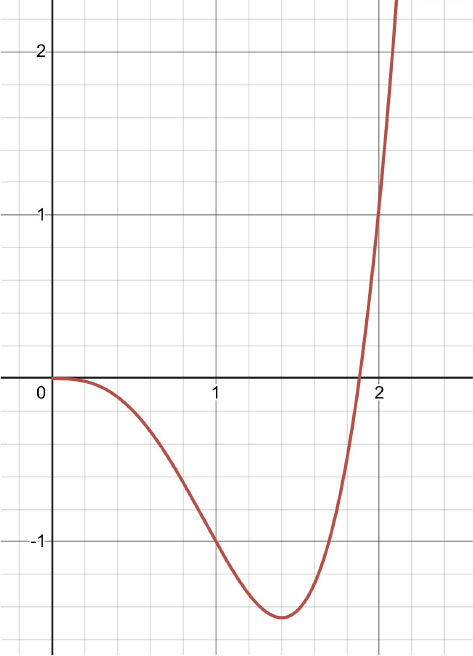
Figure 2.
An example
Proof
Since f″(x) = ap(p − 1)xp−2 − bq(q − 1)xq−2, we affirm that f is concave in [0, θ] and convex in [θ, ∞). Here
\theta = {\left( {{{bq\left( {q - 1} \right)} \over {ap\left( {p - 1} \right)}}} \right)^{{1 \over {p - q}}}}.
Just consider the tangent lines of each point of f (x) in [0, θ], and each two intersection points of f (x) and the tangent line. The farthest situation of two intersection points regarding x, is the tangent line of (0+, f (0+)), which is (0, 0) and
\left( {{{\left( {{b \over a}} \right)}^{{1 \over {p - q}}}},0} \right)
.
Now we give a refinement of the power mean inequality.
In Theorem 1, let f (x) = xp − bxq and pi = 1, according to (2.3) and Example 1, the left side of (2.4) is proven. The right side can be directly proven by power mean inequality
{{\sum\nolimits_{i = 1}^n {a_i^q} } \over n} \ge {\left( {{{\sum\nolimits_{i = 1}^n {{a_i}} } \over n}} \right)^q}.
Remark 2.
By letting b → 0 in (2.4), we get the original power mean inequality, as there is no restriction for mini≠j |ai − aj|.
To explore more examples than Example 1, we need the following lemma.
Lemma 2.
If the function fiis li-gap convex on ℝ+, i = 1, . . . , n, thenf = \sum\nolimits_{i = 1}^n {{f_i}} is l-gap convex on ℝ+for l = max(l1, . . . , ln).
Proof
According to Proposition 1, we predict that each fi is l-gap convex. Thus,
f = \sum\nolimits_{i = 1}^n {{f_i}}
is l-gap convex.
Proposition 2.
Let ai ≠ 0, i = 1, . . . , n and p1> . . . > pn> 1. The functionf\left( x \right) = {a_1}{x^{{p_1}}} + \ldots + {a_n}{x^{{p_n}}}is l-gap convex on ℝ+for some l < ∞, if a1> 0.
Proof
Note that
f\left( x \right) = \sum\limits_{i = 2}^n {\left( {{{{a_1}} \over {n - 1}}{x^{{p_1}}} + {a_i}{x^{{p_i}}}} \right)} = \sum\limits_{i = 2}^n {{f_i}\left( x \right)}
If ai> 0, then fi(x) is a convex function, or we say 0-gap convex. If ai< 0, according to Example 1, fi(x) is
{\left( {{{\left( {n - 1} \right)\left| {{a_i}} \right|} \over {{a_1}}}} \right)^{{1 \over {{p_1} - {p_i}}}}}
-gap convex. From Lemma 2, we can choose
l = \max \left\{ {{{\left( {{{\left( {n - 1} \right)\left| {{a_i}} \right|} \over {{a_1}}}} \right)}^{{1 \over {{p_1} - {p_i}}}}};i = 2, \ldots n} \right\}.
It might not be the best possible l.
From Proposition 2 we observe that l-gap convexity allows a much wider range of functions than convexity.
We compare now the advantage of ε-convex in (1.1) and l-gap convex in (1.2).
Proposition 3.
Let f : I → ℝ be an l-gap convex function on I ⊆ ℝ, then cf is also a l-gap convex function on I ⊆ ℝ for c > 0.
Sometimes when c is large, e.g., c = 10000 and cf (x) = 10000x4 −10000x2, it is also a 2.22475-gap convex function. But if we try to use ε-convex to describe, ε would be very large. Sometimes ε-convex is better. The function f (x) = ||x| − 1| is not a l-gap convex function for any positive l, but it is a ε-convex function for ε = 1. In all, ε-convex function and l-gap convex function are more general than convex function and are useful in certain circumstances.
Remark 3.
Some properties of l-gap convex functions are very different from convex functions. The 2-gap convex function in Figure 3 defined on [0, 3] is not continuous in (0, 3). We can even define such function on [1, 2] as the Dirichlet function, with the definitions on the other two intervals unchanged. Then the function is nowhere continuous on [1, 2].
However, for l-gap convex functions defined on I(|I| ≥ 2l), I have not found such example yet.
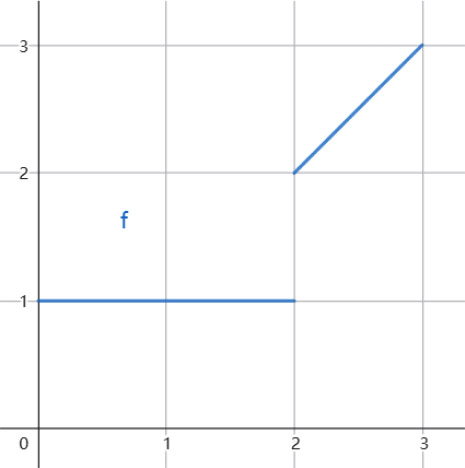
Figure 3.
An example of a 2-gap convex function
3.
Majorization for l-gap convex functions
As an application and generalization of Theorem 1, in this section, we prove that the majorization theorem also holds for l-gap convex functions.
The concept “majorization” for two sequences was first introduced in the 1900s in Economics to measure the difference of incomes or wealth, then it was used for convex functions to establish inequalities. In the 1930s, it had been systematically discussed as in [14]. In the 20th century, there were a large number of appearances of majorization in many different fields of applications [20, Chapter 7–Chapter 13]. For different concepts related to majorization, variants of majorization and its enormous applications in pure and applied mathematics, see in [20], [26], [3], [32], [28], [22], [16], [2] and [6, Chapter 2].
Recall the basic definition of majorization.
Definition 3.
Let x = (x1, . . . , xn), y = (y1, . . . , yn) denote two n-tuples and
\matrix{ {{x_{\left[ 1 \right]}} \ge \ldots \ge {x_{\left[ n \right]}},{y_{\left[ 1 \right]}} \ge \ldots \ge {y_{\left[ n \right]}},} \hfill \cr {{x_{\left( 1 \right)}} \le \ldots \le {x_{\left( n \right)}},{y_{\left( 1 \right)}} \le \ldots \le {y_{\left( n \right)}}} \hfill \cr }
be their decreasing and increasing ordered components. A vector y is said to majorize x (or x is said to be majorized by y), in symbols, y ≻ x, if
\sum\limits_{i = 1}^k {{x_{\left[ i \right]}}} \le \sum\limits_{i = 1}^k {{y_{\left[ i \right]}}} ,\left( {k = 1, \ldots ,n - 1} \right)\;\;\;{\rm{and}}\,\;\sum\limits_{i = 1}^k {{x_i}} = \sum\limits_{i = 1}^k {{y_i}} .
Then we have the celebrated majorization theorem, see [14], [20, p. 156] and [27, p. 320].
Theorem 2.
Let I be an interval in ℝ, and x, y be two n-tuples such that xi, yi ∈ I, (i = 1, . . . , n). Then\sum\limits_{i = 1}^n {f\left( {{x_i}} \right)} \le \sum\limits_{i = 1}^n {f\left( {{y_i}} \right)} holds for every continuous and convex function f, if and only if y ≻ x.
We will extend this theorem to l-gap convex functions. Before that, the following concepts [20, Chapter 2] are needed in our proof.
And the following lemma is essential to bridge the majorization and doubly stochastic matrix, see in [20, Chapter 2], [14].
Lemma 3.
A necessary and sufficient condition that x ≺ y is that there exists a doubly stochastic matrix A such that x = yA.
Theorem 3.
Let I be an interval in ℝ, and x, y be two n-tuples such that xi, yi ∈ I, (i = 1, . . . , n) and y ≻ x. If mini≠j |yi − yj| ≥ l; i, j ∈ (1, . . . , n), then(3.1)\sum\limits_{i = 1}^n {f\left( {{x_i}} \right)} \le \sum\limits_{i = 1}^n {f\left( {{y_i}} \right)} holds for every l-gap convex function f : I → ℝ.
Proof
As y ≻ x, from Lemma 3 we conclude that there exists a doubly stochastic matrix A = (αij) such that
(3.2)\sum\limits_{i = 1}^n {f\left( {{x_i}} \right)} = \sum\limits_{i = 1}^n {f\left( {\sum\limits_{j = 1}^n {{\alpha _{ij}}{y_j}} } \right).}
Use Theorem 1 for each
f\left( {\sum\nolimits_{j = 1}^n {{\alpha _{ij}}{y_j}} } \right)
, where aj = yj,
{{{p_j}} \over {\Sigma p}} = {\alpha _{ij}}
, and ignore those αij = 0, we have
(3.3)\sum\limits_{i = 1}^n {f\left( {\sum\limits_{j = 1}^n {{\alpha _{ij}}{y_j}} } \right)} \le \sum\limits_{i = 1}^n {\sum\limits_{j = 1}^n {{\alpha _{ij}}f\left( {{y_j}} \right)} } = \sum\limits_{j = 1}^n {f\left( {{y_j}} \right)} .
Combine (3.2) and (3.3), we get (3.1).
Remark 4.
By letting l → 0, we get the original inequality in the majorization theorem. And Theorem 3 is also a generalization for the un-weighted version of Theorem 1, as
y \succ \bar y
, where
\bar y = \left( {{{\Sigma _{i = 1}^n{y_i}} \over n}, \ldots ,{{\Sigma _{i = 1}^n{y_i}} \over n}} \right)
.
4.
Hermite-Hadamard type inequality for l-gap convex functions
In this section, we establish Hermite-Hadamard type inequalities for l-gap convex functions.
Theorem 4.
For [a, b] ⊂ ℝ with b − a > l, let f : [a, b] → ℝ be an l-gap convex function such that all the integrals below exist, then we have(4.1)\matrix{ {{{f\left( a \right) + f\left( b \right)} \over 2}} \hfill \cr { \ge {1 \over {b - a - l}}\left( {\int_a^{{{b + a - l} \over 2}} {f\left( x \right)dx} + \int_{{{b + a + l} \over 2}}^b {f\left( x \right)dx} } \right) \ge {1 \over {b - a}}\int_a^b {f\left( x \right)dx} ,} \hfill \cr } and(4.2)\matrix{ {{1 \over {b - a - l}}\left( {\int_a^{{{b + a - l} \over 2}} {f\left( x \right)dx} + \int_{{{b + a + l} \over 2}}^b {f\left( x \right)dx} } \right)} \hfill \cr {\;\;\;\;\;\;\;\;\;\;\;\;\;\;\;\;\;\;\;\;\;\; \ge {1 \over 2}\left( {f\left( {{{b + a - l} \over 2}} \right) + f\left( {{{b + a + l} \over 2}} \right)} \right) \ge f\left( {{{a + b} \over 2}} \right).} \hfill \cr }
Proof
For the first inequality in (4.2):
\matrix{ {{1 \over {b - a - l}}\left( {\int_a^{{{b + a - l} \over 2}} {f\left( x \right)dx} + \int_{{{b + a + l} \over 2}}^b {f\left( x \right)dx} } \right)} \hfill \cr {\;\;\;\;\;\;\;\;\;\;\;\;\;\;\;\;\;\;\;\;\;\;\;\;\;\;\;\;\;\;\;\;\;\;\;\; = {1 \over {b - a - l}}\int_a^{{{b + a - l} \over 2}} {\left( {f\left( x \right) + f\left( {a + b - x} \right)} \right)dx} ,} \hfill \cr }
noticing (a + b − x) − x ≥ l and
\left( {x,a + b - x} \right) \succ \left( {{{b + a - l} \over 2},{{b + a + l} \over 2}} \right)
, we can use Theorem 3 to get
\matrix{ {{1 \over {b - a - l}}\int_a^{{{b + a - l} \over 2}} {\left( {f\left( x \right) + f\left( {a + b - x} \right)} \right)dx} } \hfill \cr {\;\;\;\;\;\;\;\;\;\;\;\; \ge {1 \over {b - a - l}}\int_a^{{{b + a - l} \over 2}} {\left( {f\left( {{{b + a - l} \over 2}} \right) + f\left( {{{b + a + l} \over 2}} \right)} \right)dx} } \hfill \cr {\;\;\;\;\;\;\;\;\;\;\;\;\;\;\;\;\;\;\;\;\;\;\;\;\;\;\;\;\;\;\;\;\;\;\;\;\;\;\;\;\; = {1 \over 2}\left( {f\left( {{{b + a - l} \over 2}} \right) + f\left( {{{b + a + l} \over 2}} \right)} \right).} \hfill \cr }
For the second inequality in (4.2), it is obvious from the definition of l-gap convex function.
For the first inequality in (4.1):
\matrix{ {{1 \over {b - a - l}}\left( {\int_a^{{{b + a - l} \over 2}} {f\left( x \right)dx} + \int_{{{b + a + l} \over 2}}^b {f\left( x \right)dx} } \right)} \hfill \cr {\;\;\;\;\;\;\;\;\;\;\;\;\;\;\;\;\;\;\;\;\;\;\;\;\;\;\;\;\;\;\;\;\;\;\; = {1 \over {b - a - l}}\int_a^{{{b + a - l} \over 2}} {\left( {f\left( x \right) + f\left( {a + b - x} \right)} \right)dx} ,} \hfill \cr }
noticing b − a ≥ l and (a, b) ≻ (x, a + b − x), we can use Theorem 3 to get
\matrix{ {{1 \over {b - a - l}}\int_a^{{{b + a - l} \over 2}} {\left( {f\left( x \right) + f\left( {a + b - x} \right)} \right)dx} } \hfill \cr {\;\;\;\;\;\;\;\;\;\;\;\;\;\;\;\;\;\;\;\;\;\;\;\;\;\;\;\;\;\; \le {1 \over {b - a - l}}\int_a^{{{b + a - l} \over 2}} {\left( {f\left( a \right) + f\left( b \right)} \right)dx} = {{f\left( a \right) + f\left( b \right)} \over 2}.} \hfill \cr }
For the second inequality in (4.1):
\matrix{ {\left( {b - a} \right)\left( {\int_a^{{{b + a - l} \over 2}} {f\left( x \right)dx} + \int_{{{b + a + l} \over 2}}^b {f\left( x \right)dx} } \right) - \left( {b - a - l} \right)\int_a^b {f\left( x \right)dx} } \hfill \cr {\;\;\;\;\;\;\; = l\left( {\int_a^{{{b + a - l} \over 2}} {f\left( x \right)dx} + \int_{{{b + a + l} \over 2}}^b {f\left( x \right)dx} } \right) - \left( {b - a - l} \right)\int_{{{b + a - l} \over 2}}^{{{b + a + l} \over 2}} {f\left( x \right)dx} ,} \hfill \cr }
in which, we use the first inequality in (4.2) to get
\matrix{ {\int_a^{{{b + a - l} \over 2}} {f\left( x \right)dx} + \int_{{{b + a + l} \over 2}}^b {f\left( x \right)dx} } \hfill \cr {\;\;\;\;\;\;\;\;\;\;\;\;\;\;\;\;\;\;\;\;\;\;\;\;\;\;\;\;\;\;\;\;\;\; \ge {{b - a - l} \over 2}\left( {f\left( {{{b + a - l} \over 2}} \right) + f\left( {{{b + a + l} \over 2}} \right)} \right),} \hfill \cr }
while
\matrix{ {\int_{{{b + a - l} \over 2}}^{{{b + a + l} \over 2}} {f\left( x \right)dx} = \int_{{{b + a - l} \over 2}}^{{{b + a} \over 2}} {\left( {f\left( x \right) + f\left( {a + b - x} \right)} \right)dx} } \hfill \cr {\;\;\;\;\;\;\;\;\;\;\;\;\;\;\;\;\;\; \le \int_{{{b + a - l} \over 2}}^{{{b + a} \over 2}} {\left( {f\left( {{{b + a - l} \over 2}} \right) + f\left( {{{b + a + l} \over 2}} \right)} \right)dx} } \hfill \cr {\;\;\;\;\;\;\;\;\;\;\;\;\;\;\;\;\;\;\;\;\;\;\;\;\;\;\;\;\;\;\;\;\;\;\;\;\;\;\;\;\;\;\;\; = {l \over 2}\left( {f\left( {{{b + a - l} \over 2}} \right) + f\left( {{{b + a + l} \over 2}} \right)} \right),} \hfill \cr }
combine two inequalities above, we prove the second inequality of (4.1).
Remark 5.
By letting l → 0, we get the original Hermite-Hadamard inequality.