
1. INTRODUCTION
Direct torque control (DTC) strategies have been offering high efficiency in AC drive applications [1]–[5]. The DTC integrated pulse width modulation (PWM) was employed to enhance the energy production for a wind turbine drive application using synchronous generator [1]. The PWM-DTC IM drive that contained start process, was presented to ensure favorable transient and constant switching frequency [2]. The DTC with only one PI speed controller and without calculations of sector and rotating frame, was proposed to increase computational speed [3]. The virtual vectors were deployed to lower the torque ripple in a wide speed range [4]. In order to decrease fluctuations flux and torque and to increase the drive stability, the twelve-sector DTC were combined with IM parameter estimation based on model reference adaptive system (MRAS) [5]. Methods of sensorless control and supervision for induction motor (IM) have been interesting topics [6]–[7]. In sensorless drives, MRAS techniques have been widely utilized [8]–[19]. Rotor-fluxbased MRAS (RF-MRAS) and stator-current-based MRAS (SC-MRAS) were compared in cases of simultaneous uncertainties of IM parameters [8]. The MRAS was utilized to estimate parameters in sensorless permanent magnet synchronous motor (PMSM) drive [9]. The speed of synchronous reluctance motor (SRM) was estimated by reactive-power-based MRAS [10]. Stator-flux based MRAS was integrated into phase opposition disposition based five-level inverter to increase the parameter estimation accuracy and the IM drive performance [11]. The MRAS was modified to maximize power control and eliminate sensors for PMSM solar pump system [12]. The MRAS estimator was adjusted to observe the flux linkage of an interior PMSM drive system [13].
In case of deterministic observers, various techniques such as fuzzy logic, sliding mode (SM), artificial neural network (ANN), were integrated into the MRAS to obtain higher drive performances [14][19]. The MRAS was integrated the fuzzy logic into its adaptation mechanism for sensorless permanent magnet synchronous generator (PMSG) drive [14]. The ANN and particle swarm optimization were combined to improve the performance of the MRAS for sensorless control of an induction generator [15]. The RF-MRAS was enhanced by the integral SM control for sensorless IM drive [16]. In order to increase robustness and performance of sensorless IM drive, discrete SM observer was integrated into the MRAS [17]. The SM observer combined with the MRAS one, provided three types of observers that were enhanced by the sliding mode DTC for the high-performance IM control [18]. The ANN was employed with a variant of the Q-MRAS for sensorless IM drive [19]. For stochastic systems, Kalman filters (KFs) were deployed [20]–[30].
Various industrial applications such as health monitoring, robotics, sensorless control, generation systems were analysed briefly [20]. The KF increased GPS accuracy and reduced magnetometer measurement noise for estimation of position and orientation [21]. Stator currents and their derivatives were smoothed by the KF for sensorless vector controlled IM drive using back-electromotiveforce-based MRAS [22]. The extended KF (EKF) provided estimated feedback signal for suspension control system with spiral springs and magnetorheological dampers [23]. Rotor speed, rotor position and machine parameters of the SRM were estimated by the KF [24]. Speed and rotor flux were computed by the EKF that approximated covariance matrices of noise process and measurement vectors using genetic algorithm [25]. Noise covariance matrices were also adapted for sensorless drive using the EKF that integrated the maximum likelihood criterion and weighting algorithm [26]. An ANN-based observer was trained by the KF to improve the speed response [27]. The EKF was combined with intelligent magnetic model for SRM drive [28]. An iterated EKF that used two IM models was utilized to obtain estimations of IM resistances and speed [29]. The current noise was compensated by the EKF to improve the performance of sensorless PMSM drive using the MRAS [30]. Discretization methods were analyzed and selected for increasing precision of the flux and speed estimations for induction generator [31]. The extended KF that used the suboptimal principle enhanced the robustness in combination with the MRAS for sensorless bearingless IM control [32]. Next section, in order to reduce influence of Gaussian noises of stator currents on sensorless PWM-DTC IM drive using the RF-MRAS and simultaneously improve its estimation accuracy at medium and low speed areas [8], [16], the EKF that utilizes the IM model to obtain smoothed stator currents is presented. The filtered currents are employed for computations of both estimated speed and important quantities of the DTC. The third section is simulations and discussions. Conclusions are carried out in final section.
2. PROPOSED SENSORLESS CONTROL
Figure 1 shows the sensorless DTC IM drive using EKF-based MRAS. Input quantities for the DTC drive are computed according to Eqs. (1)–(5):
where, usα, usβ: stator voltages; ψsα,est & ψsβ,est: estimated stator fluxes; γest: estimated orienting angle; Te,est: estimated motor torque; Rs: stator resistance; np: number of pole pairs; isα,KF & isβ,KF: stator currents filtered by Extended Kalman Filtering block. Discrete state-space IM model that is distorted by zero-mean, Gaussian process & measurement noise vectors v & w, is described by Eqs. (6)–(7): where td: discretization period; isα & isβ: stator currents; ψrα & ψrβ: rotor fluxes; Ls & Lm: stator & magnetizing inductances; Rr & Lr: rotor resistance & rotor inductance.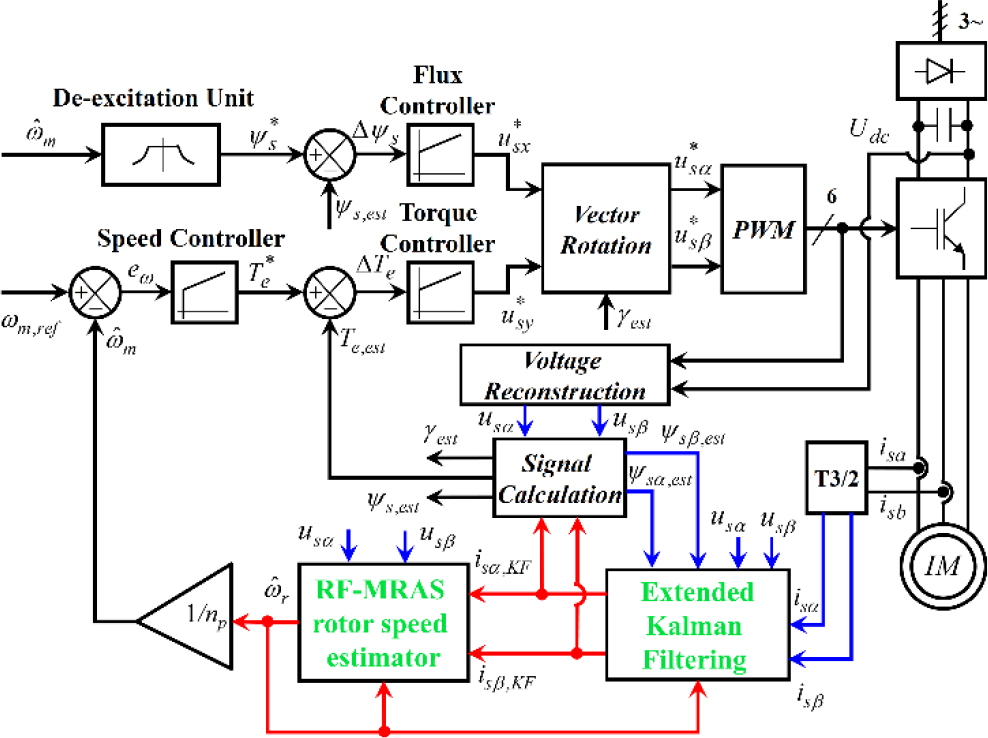
Fig. 1.
Sensorless DTC IM drive using KF-based RF-MRAS
The EKF block estimates state vector XKF that contains currents isα,KF and isβ,KF according to Eqs. (19)–(25):
whereBecause rotor fluxes in vector Xm are not measured, they are calculated according to Eqs. (29)–(30) [1]:
Symbol ~ represents predicted quantities; letters “KF” denote for ones estimated using KF; Q & R– covariance matrices of v & w with, the matrix R is assumed to be known; P – state vector covariance matrix; K – Kalman gain.
For reference model or voltage model [8], rotor fluxes are computed according to Eqs. (31)–(32):
In case of adaptive model or current model that contains estimated rotor speed , rotor fluxes are calculated by Eqs. (33)–(34):
Thanks to Popov’s theorem for minimizing adaptive signal ξ [16], the estimated rotor speed is obtained by Eqs. (35)–(36):
where, ψrα,r & ψrβ,r: rotor fluxes of the reference model; ψrα,a & ψrβ,a: rotor fluxes of the adaptive model; Kp & Ki: proportional & integral gains.3. SIMULATIONS AND DISCUSSIONS
Parameters of the IM are given in Table 1. Simulations of two sensorless RF-MRAS-based DTC IM drives: the first one is without extended Kalman filtering and the second one is with extended Kalman filtering (abbreviated as NK and KF in the rest of the text), are implemented at variances of Gaussian system and measurement noises of stator currents δp2 = {0.12, 0.52, 1.02} and δm2 = {0.12, 0.52, 1.02}. Proportional gains and integral time constants of the speed, flux, torque controllers & the rotor speed estimator are {1.5, 100, 5 & 500} and {0.05s, 0.01s, 0.05s & 0.002s}. Diagram of load torque is identical to the one, and reference speed course is similar to one ωm,ref = {5π/3 rad/s, 10π rad/s} [16]. The utilized PWM technique is space vector one with switching frequency of 20kHz, inverter DC link of 540Vdc. Normalized integral of time multiply by absolute value of speed difference (ITAEn) [16] is used to assess two sensorless drives according to Eq. (37):
Tab. 1.
Induction motor parameters
| Symbol | Quantity | Value |
|---|---|---|
| Rs | Stator resistance | 3.179Ω |
| np | Number of pole pairs | 2 |
| Ls = Lr | Stator & rotor inductances | 0.209H |
| Lm | Magnetizing inductance | 0.192H |
| Rr | Rotor resistance | 2.118Ω |
| Pn | Rated power | 2200W |
| ωm,n | Rated speed | 142π/3 rad/s |
| Te,n | Rated torque | 14.8N·m |
| Jm | Moment of inertia | 0.0047kg·m2 |
Figures 2–4, 5–7 respectively show motor speed responses in cases of δp2 = δm2 at ωm,ref = 5π/3 rad/s, ωm,ref = 10π rad/s. The figures indicate that as the variance increases, the performance of the speed response is improved more. Tables 2 and 3 list the ITAEn at ωm,ref = 5π/3 rad/s and ωm,ref = 10π rad/s in all cases of variances. The tables show that the ratio (ITAEn,KF/ITAEn,NF) is smallest when the ratio (δm2/δp2) is largest, and vice versa (see Figs. 8–9). The ratios (ITAEn,KF/ITAEn,NF) are in ranges of [24.2%; 98.9%], [24.6%; 99.0%] for ωm,ref = 5π/3 rad/s, ωm,ref = 10π rad/s, respectively.
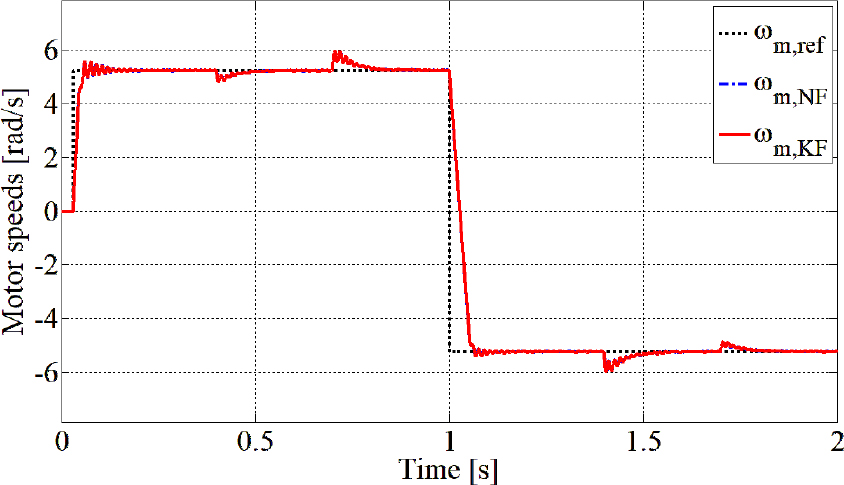
Fig. 2.
Motor speeds at ωm,ref = 5π/3 rad/s, δp2=δm2=0.12.
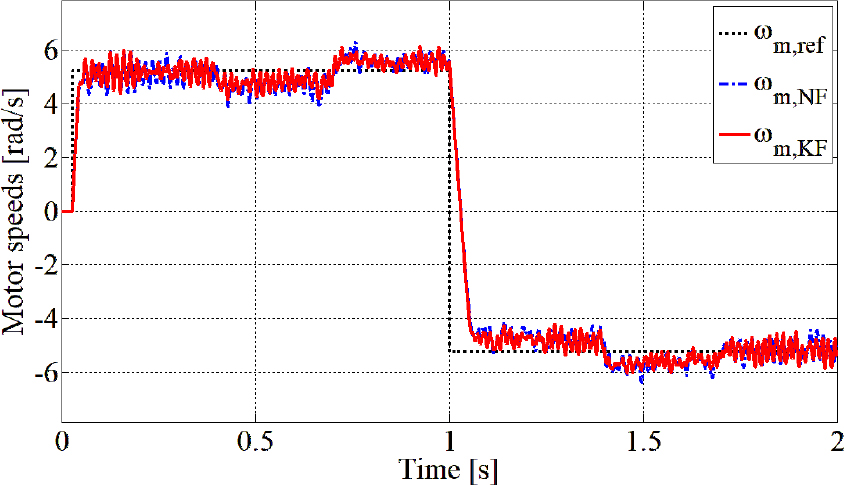
Fig. 3.
Motor speeds at ωm,ref = 5π/3 rad/s, δp2=δm2=0.52
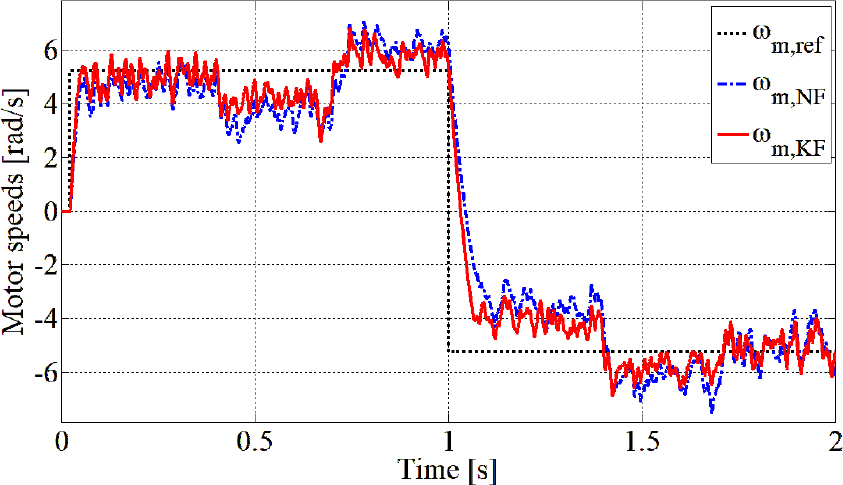
Fig. 4.
Motor speeds at ωm,ref = 5π/3 rad/s, δp2=δm2=12
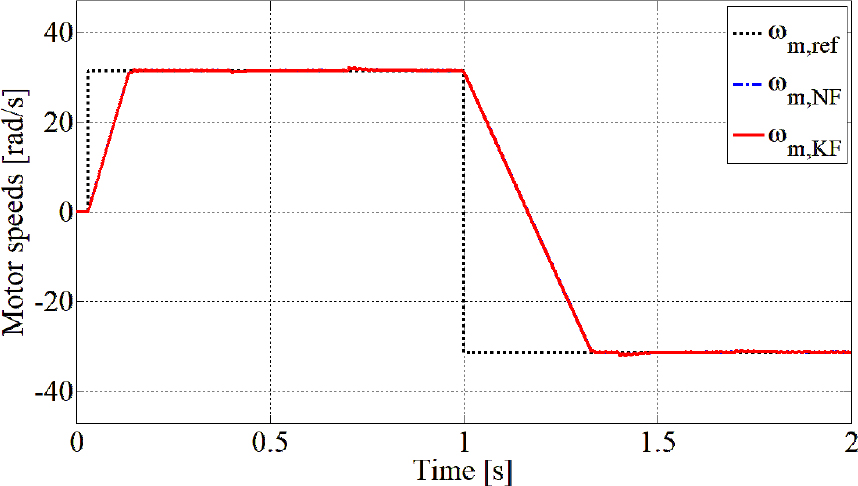
Fig. 5.
Motor speeds at ωm,ref = 10π rad/s, δp2=δm2=0.12
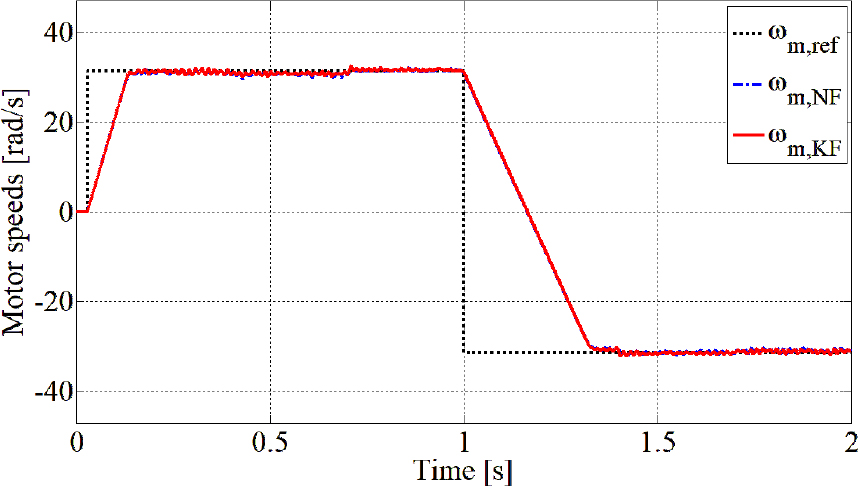
Fig. 6.
Motor speeds at ωm,ref = 10π rad/s, δp2=δm2=0.52
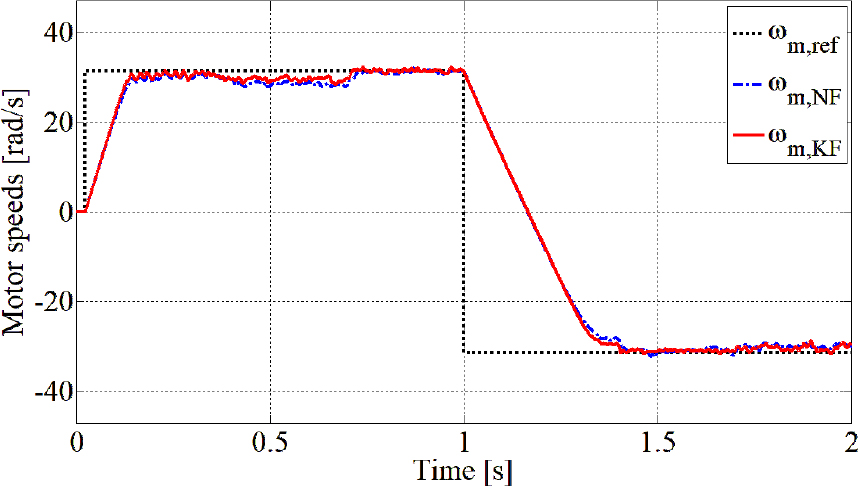
Fig. 7.
Motor speeds at ωm,ref = 10π rad/s, δp2=δm2=12
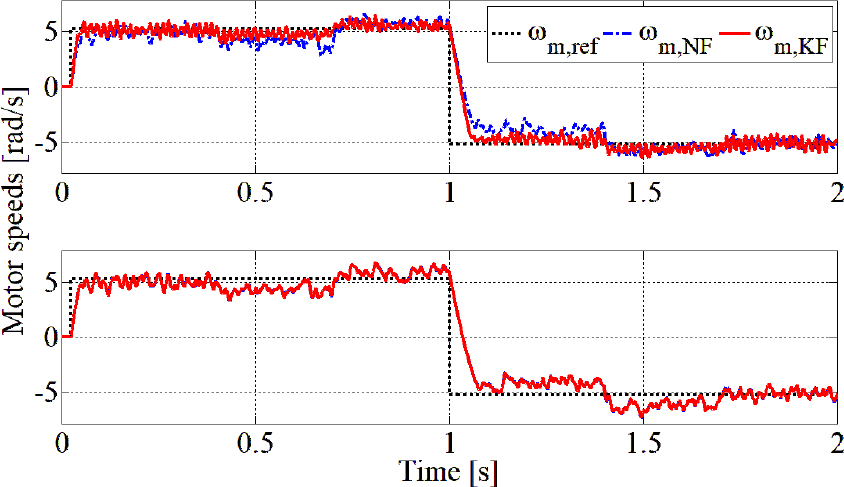
Fig. 8.
Motor speeds at ωm,ref = 5π/3 rad/s: case 1 (upper): δp2=0.12, δm2=12 and case 2 (lower): δp2=12, δm2=0.12
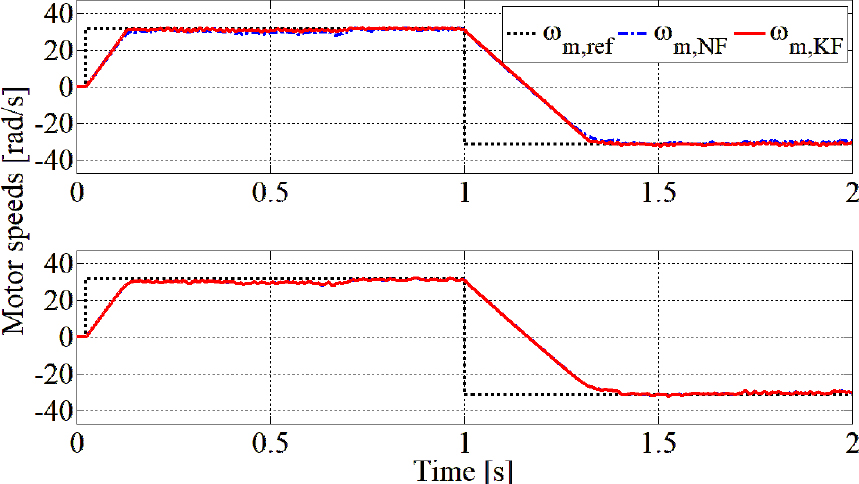
Fig. 9.
Motor speeds at ωm,ref = 10π rad/s: case 1 (upper): δp2=0.12, δm2=12 and case 2 (lower): δp2=12, δm2=0.12
Tab. 2.
ITAEn × 10−2 [s2] at ωm,ref = 5π/3 rad/s
| δp2 | δm2 = 0.12 | δm2 = 0.52 | δm2 = 1.02 | |||
|---|---|---|---|---|---|---|
| NF | KF | NF | KF | NF | KF | |
| 0.12 | 3.13 | 2.46 | 47.0 | 16.0 | 185 | 44.7 |
| 0.52 | 47.1 | 45.4 | 65.8 | 44.8 | 191 | 94.6 |
| 1.02 | 185 | 183 | 191 | 160 | 262 | 175 |
Tab. 3.
ITAEn × 10−2 [s2] at ωm,ref = 10π rad/s
| δp2 | δm2 = 0.12 | δm2 = 0.52 | δm2 = 1.02 | |||
|---|---|---|---|---|---|---|
| NF | KF | NF | KF | NF | KF | |
| 0.12 | 0.59 | 0.49 | 7.84 | 2.78 | 30.6 | 7.53 |
| 0.52 | 7.80 | 7.53 | 10.9 | 7.41 | 31.6 | 15.6 |
| 1.02 | 30.6 | 30.3 | 31.5 | 26.5 | 43.3 | 28.9 |
Time courses of relative speed difference RSD (eωmax| ωm,ref|) for cases of the ratio (ITAEn,KF/ITAEn,NF) reach maximum & minimum at ωm,ref = 5π/3 rad/s and ωm,ref = 10π rad/s are respectively shown in Figs. 10 and 11. Diagrams of stator currents are displayed in Figs. 12–13 and 14–15 for ωm,ref = 5π/3 rad/s and ωm,ref = 10π rad/s, respectively. The reason why the proposed EKF-based MRAS speed estimator is more efficient in the cases of larger ratio (δm2/δp2), is because the matrix R is assumed to be known. The covariance matrices Q and R can be estimated according to the methods in [25]–[26]. Quantities including stator fluxes, rotor fluxes of reference model, rotor fluxes of adaptive model, and adaptive signal at ωm,ref = 5π/3 rad/s & ωm,ref = 10π rad/s, δp2=0.12, δm2=12 are respectively presented in Figs. 16–17, 18–19, 20–21, and 22–23. Figures 22–23 indicate that ripple of the adaptive signal for the KF is much smaller than that for the NF. This results in significantly lower RSD for the KF. Tables 4–5 show maximum value of absolute of relative speed difference (MARSD) at ωm,ref = 5π/3 rad/s & ωm,ref = 10π rad/s for all variances. The MARSD is reduced by 80% and 77% at most, corresponding to δp2=0.12, δm2=12, for ωm,ref = 5π/3 rad/s and ωm,ref = 10π rad/s, respectively.
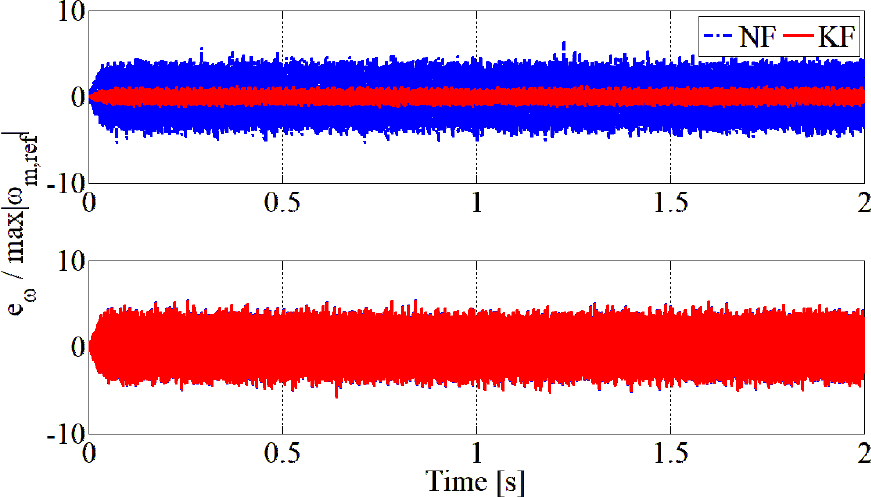
Fig. 10.
RSD at ωm,ref = 5π/3 rad/s: case 1 (upper): δp2=0.12, δm2=12 and case 2 (lower): δp2=12, δm2=0.12
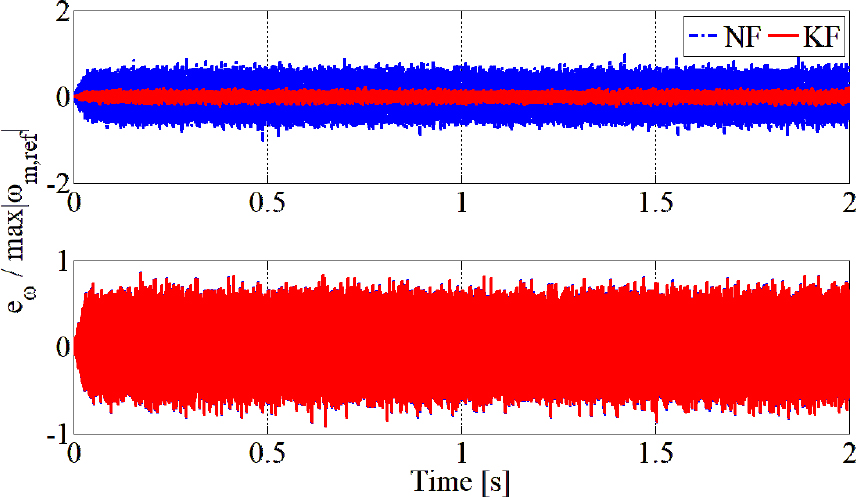
Fig. 11.
RSD at ωm,ref = 10π rad/s: case 1 (upper): δp2=0.12, δm2=12 and case 2 (lower): δp2=12, δm2=0.12
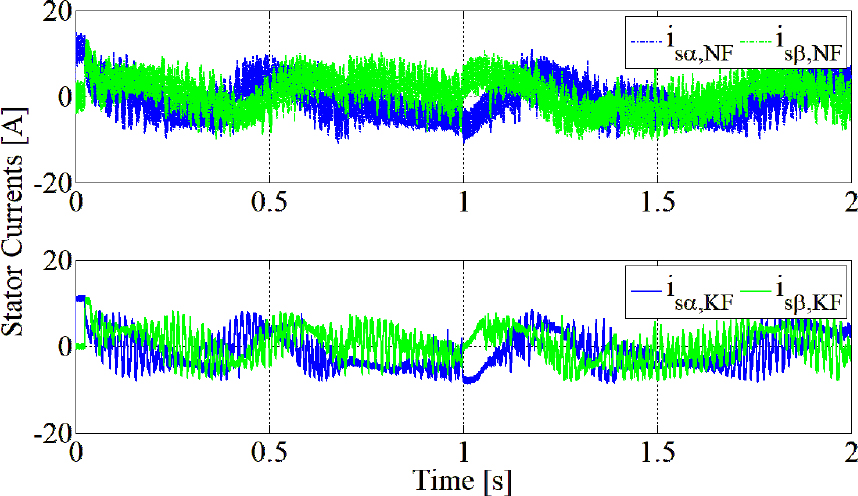
Fig. 12.
Stator currents at ωm,ref = 5π/3 rad/s, δp2=0.12, δm2=12
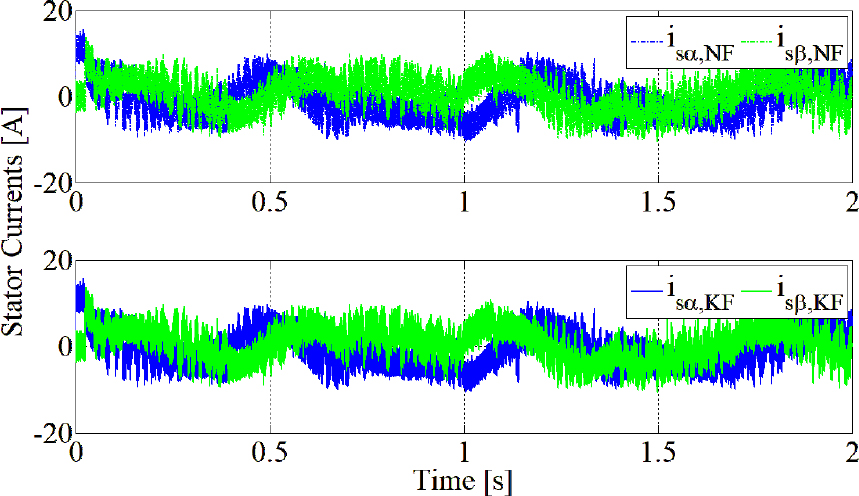
Fig. 13.
Stator currents at ωm,ref = 5π/3 rad/s, δp2=12, δm2=0.12
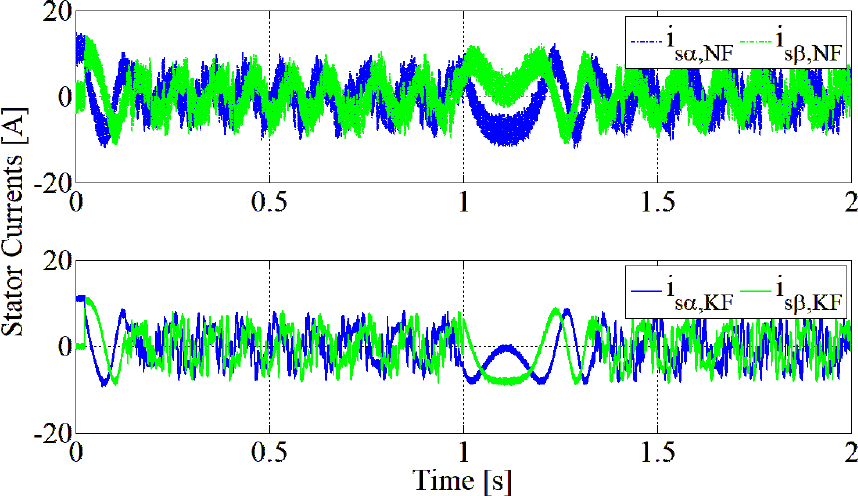
Fig. 14.
Stator currents at ωm,ref = 10π rad/s, δp2=12, δm2=12
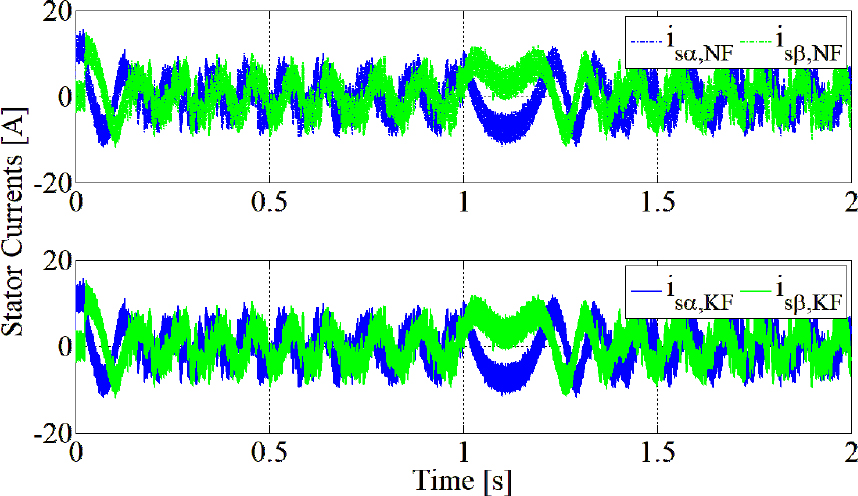
Fig. 15.
Stator currents at ωm,ref = 10π rad/s, δp2=12, δm2=0.12
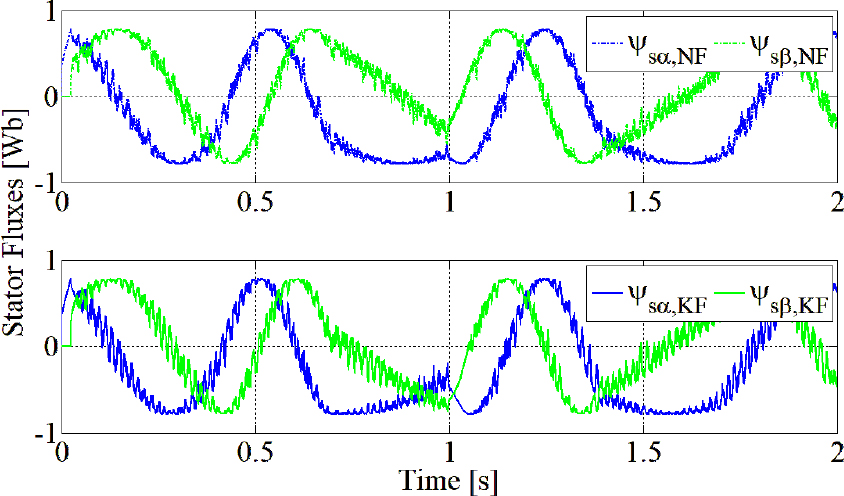
Fig. 16.
Stator fluxes at ωm,ref = 5π/3 rad/s, δp2=0.12, δm2=12
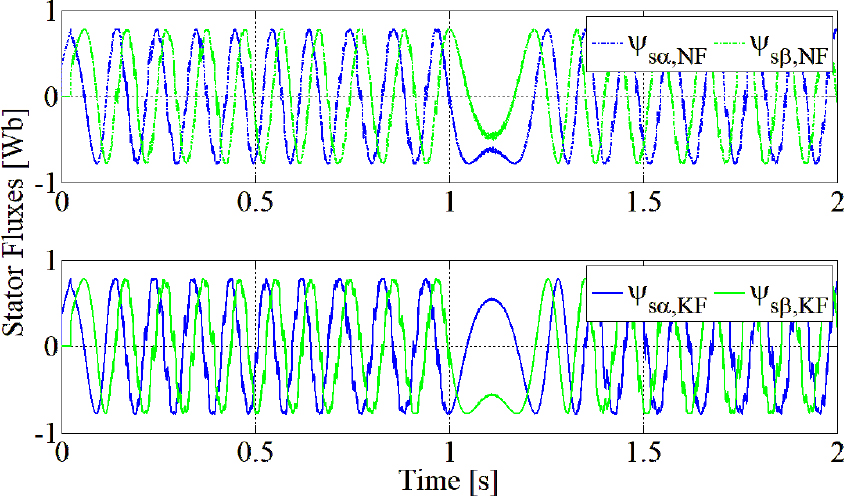
Fig. 17.
Stator fluxes at ωm,ref = 10π rad/s, δp2=0.12, δm2=12
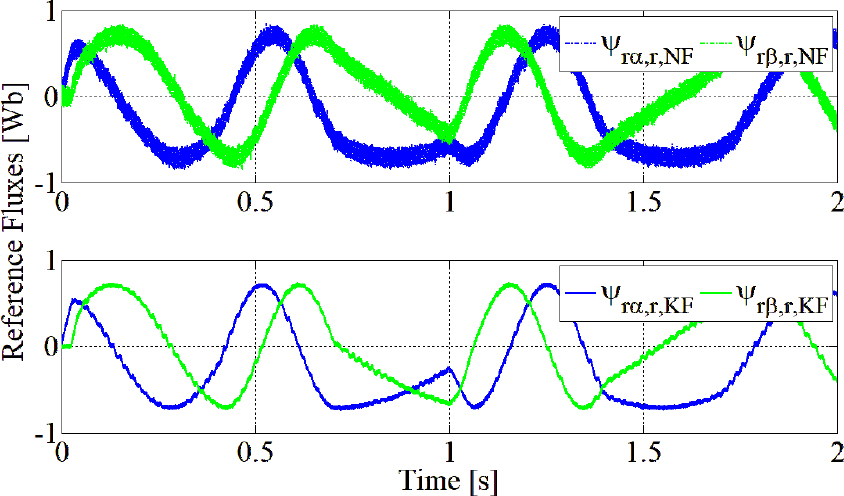
Fig. 18.
Rotor fluxes of reference model at ωm,ref = 5π/3 rad/s, δp2=0.12, δm 2=12
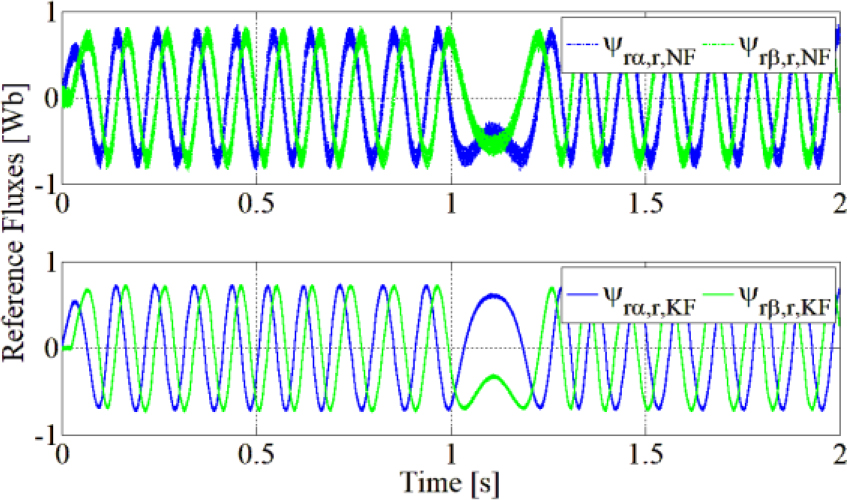
Fig. 19.
Rotor fluxes of reference model at ωm,ref = 10π rad/s, δp2=0.12, δm2=12
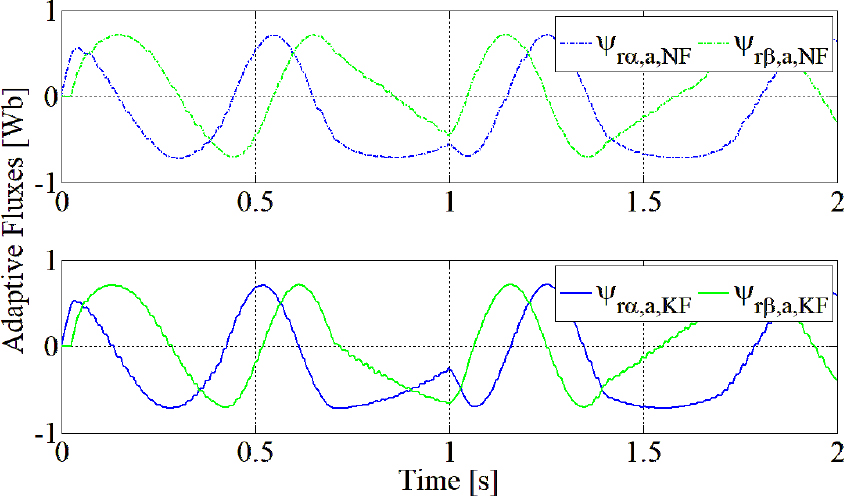
Fig. 20.
Rotor fluxes of the adaptive model at ωm,ref = 5π/3 rad/s, δp2=0.12, δm2=12
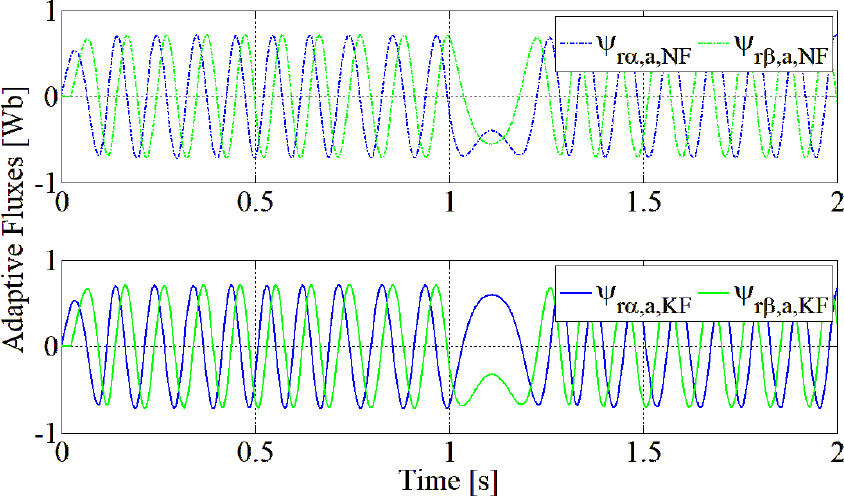
Fig. 21.
Rotor fluxes of the adaptive model at ωm,ref = 10π rad/s, δp2=0.12, δm2=12
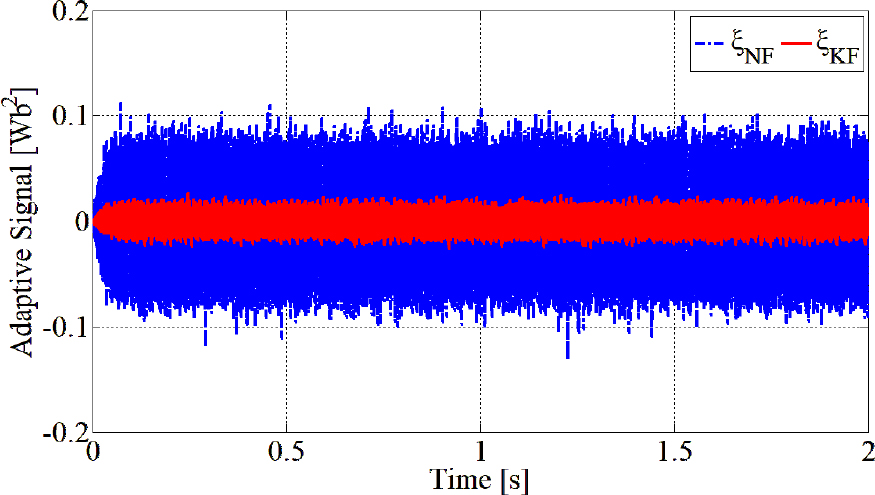
Fig. 22.
Adaptive sginal at ωm,ref = 5π/3 rad/s, δp2=0.12, δm2=12
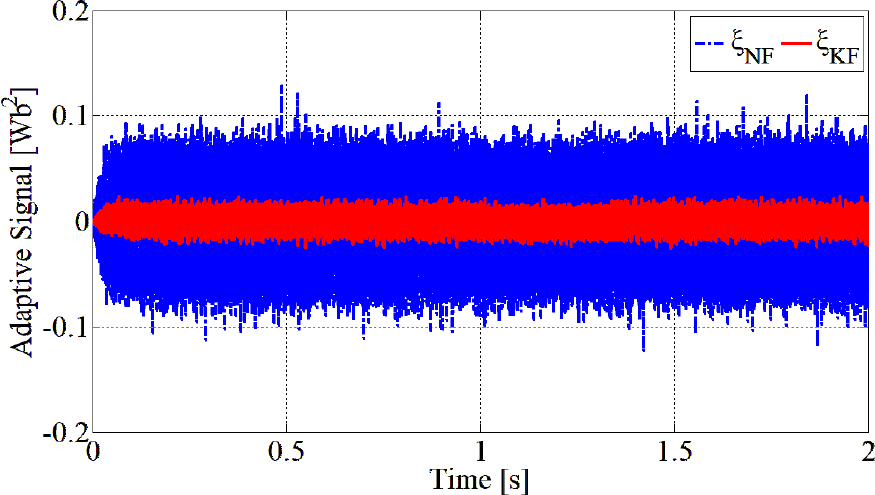
Fig. 23.
Adaptive sginal at ωm,ref = 10π rad/s, δp2=0.12, δm2=12
4. CONCLUSIONS
Sensorless RF-MRAS drives without EKF and with EKF were presented and simulated in cases of process and measurement noises of stator currents. The sensorless drive utilizing the EKF, reduces the ITAEn and MARSD compared to the one without using EKF, especially up to 75% and 80% in cases where the ratio between measurement noise variance and process noise variances is maximum at simulated lower reference speed. In case of the stochastic systems, the method can be employed for other MRAS-based speed estimators that use stator current as inputs. For the SM-based MRASs such as [16]–[18], it can be integrated to estimate components of stator flux and rotor flux vectors at the low and medium speed ranges of the time courses. Because the proposed sensorless control uses the full IM model in the EKF block, the calculation process is slow. Other Kalman Filter versions or estimation techniques of covariance matrices can be deployed to enhance the sensorless drive performance and increase computation speed.