
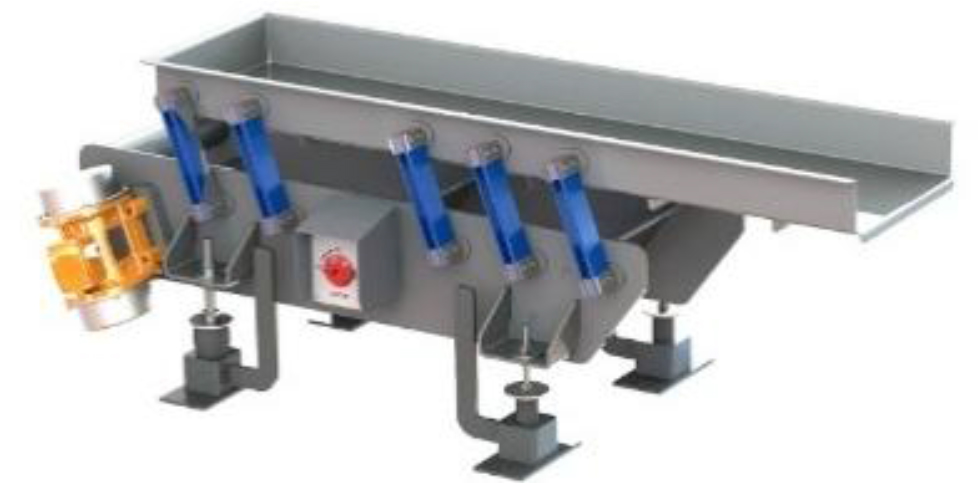
Fig. 1.
VIBRAflex II Sanitary Antiresonant Vibratory Conveyor – PFI, which dynamic and discret model is presented in Fig. 2
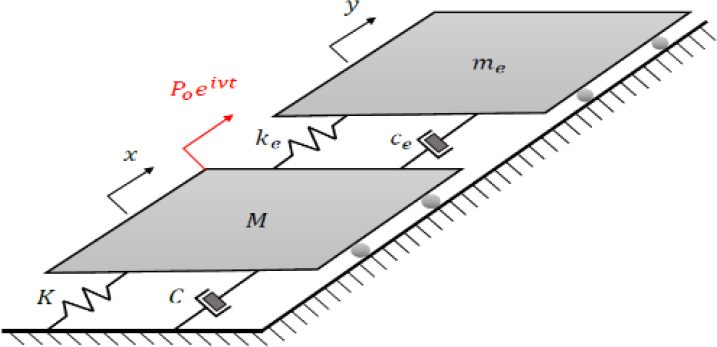
Fig. 2.
Diagram of the dynamic vibration eliminator: M – protected mass, me – eliminator mass, K, C – constants of elasticity and damping of support elements of protected mass, ke, ce – constants of elasticity and damping of elastic elements of the eliminator, Poeivt – harmonic excitation force
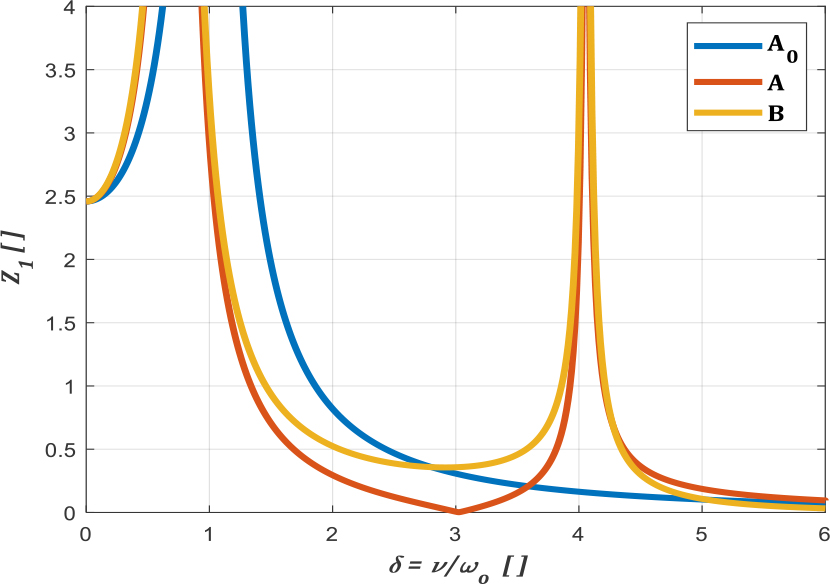
Fig. 3.
Plot of dimensionless amplitudes z1 for absolute displacements of the protected system A, the vibration eliminator B, and the system without the eliminator Ao, as a function of the ratio δ for the excitation frequency ν to the partial frequency of the eliminator ωn, equal to the antiresonant frequency (10) of the system, where z1 – the ratio of amplitudes to the value of static deflection of the protected mass
Tab. 1.
Parameters of the dynamic model from Fig. 2
| Parameter | Value | Unit |
|---|---|---|
| M | 600 | kg |
| me | 450 | kg |
| K | 719.387 | N/m |
| ke | 4.963.770 | N/m |
| C | 142 | Ns/m |
| ce | 298 | Ns/m |
| P | 14.450 | N |
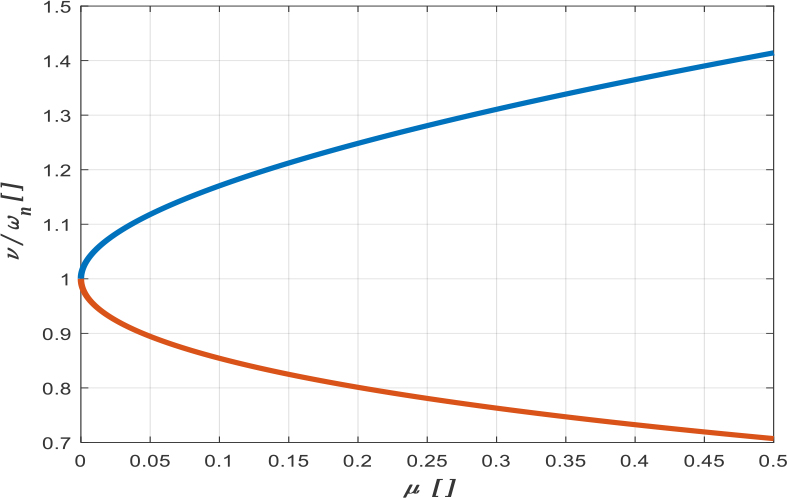
Fig. 4.
Graph showing the ratio of the resonance frequencies to the antiresonance frequency v/ωn of the analysed system, compared to the ratio of masses me/M = μ in the equality of partial frequencies of the protected and eliminator masses
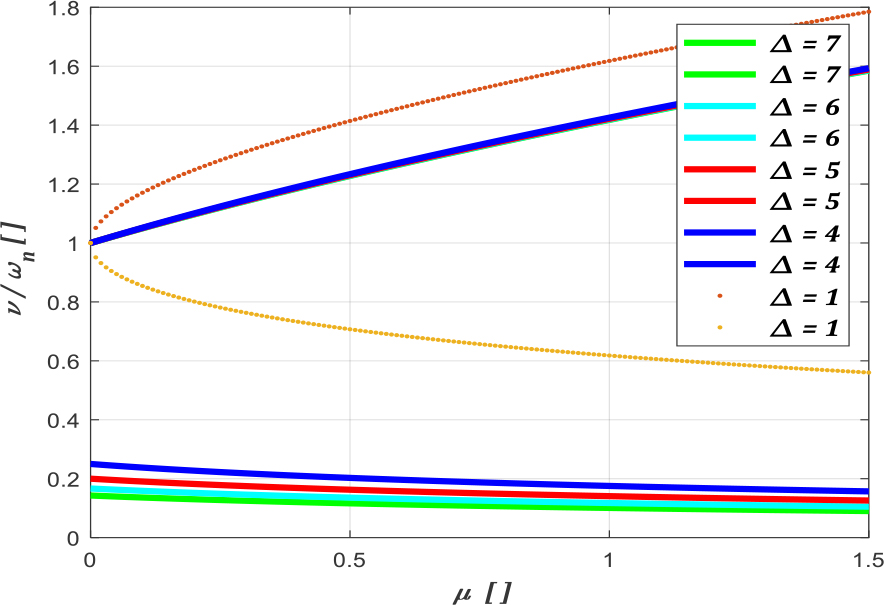
Fig. 5.
Graphs showing the ratio of the upper and lower resonance frequency to ωn as a function of the mass ratio μ, depending on the value of the parameter Δ. Note: upper frequency graphs for Δ>>1 values (Δ = 4 to 7) coincide approximately on the graph
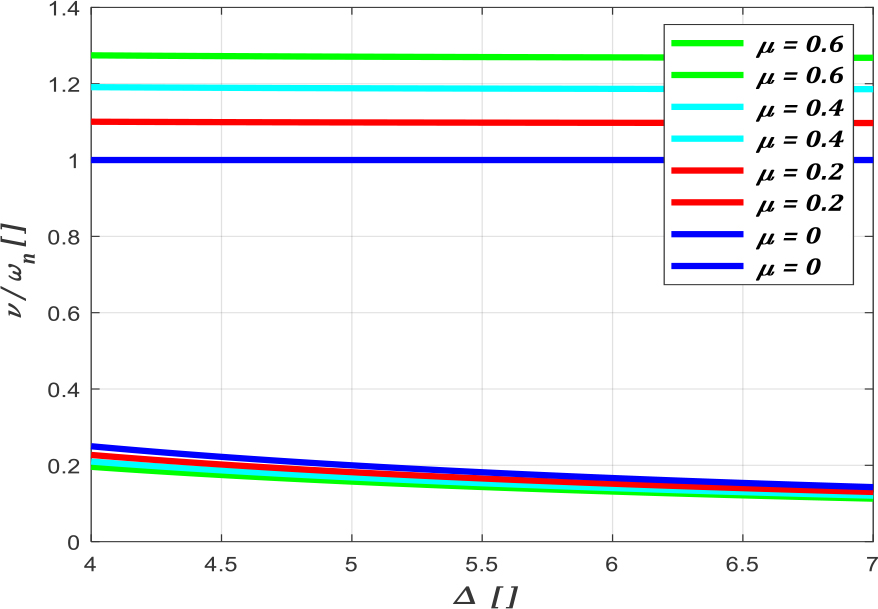
Fig. 6.
Plots of the ratios of the upper and lower frequency of the system to the antiresonance frequency ωn as a function of Δ
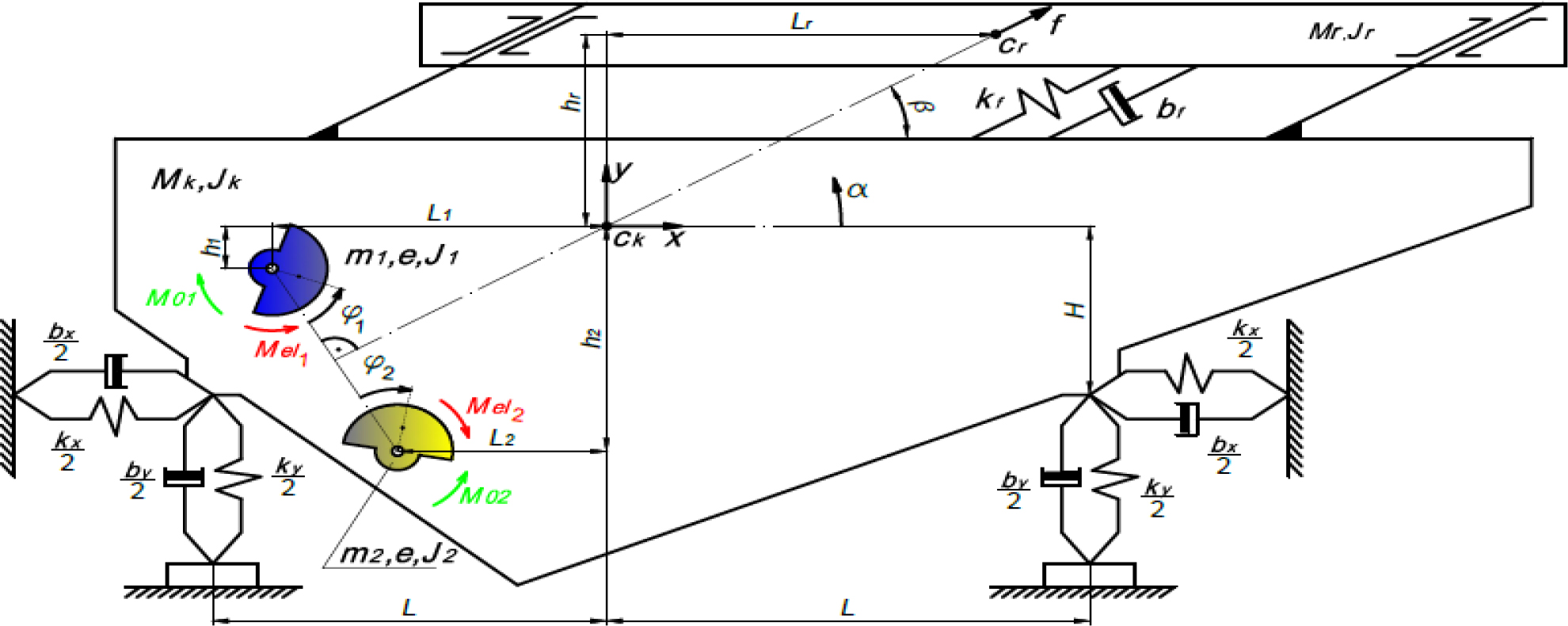
Fig. 7.
Discrete model of an antiresonant vibratory conveyor shown in Fig. 2
Tab. 2.
Parameters of the dynamic model from Fig. 7
| Parameter | Value | Unit |
|---|---|---|
| Mr | 1000 | kg |
| Mk | 2500 | kg |
| Jk | 12200 | kgm2 |
| Jr | 5000 | kgm2 |
| ky | 2328000 | N/m |
| kx | 1164000 | N/m |
| kf | 10962000 | N/m |
| by | 0 * | Ns/m |
| bx | 0 * | Ns/m |
| bf | 0 * | Ns/m |
| L | 2 | m |
| Lr | 1.92 | m |
| H | 0.48 | m |
| hr | 1.1 | m |
| β | 30 | deg |
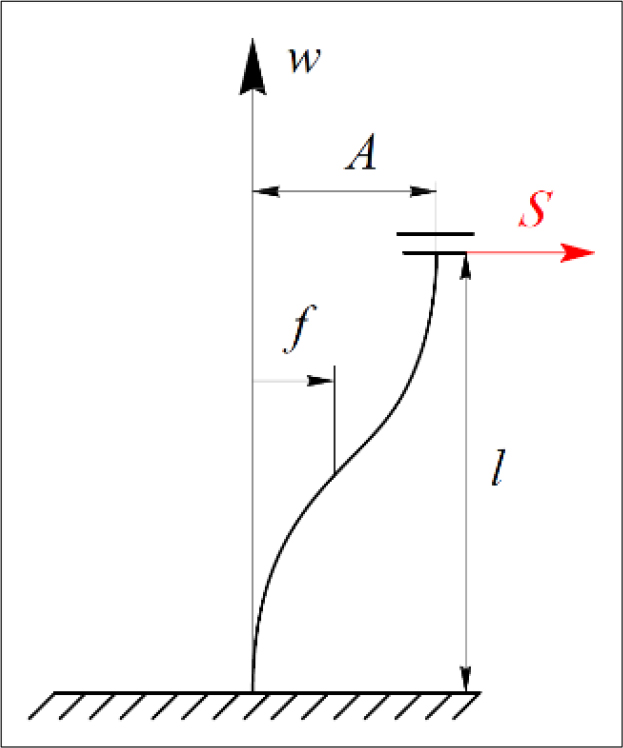
Fig. 8.
Continuous spring model (flat spring during deformation)
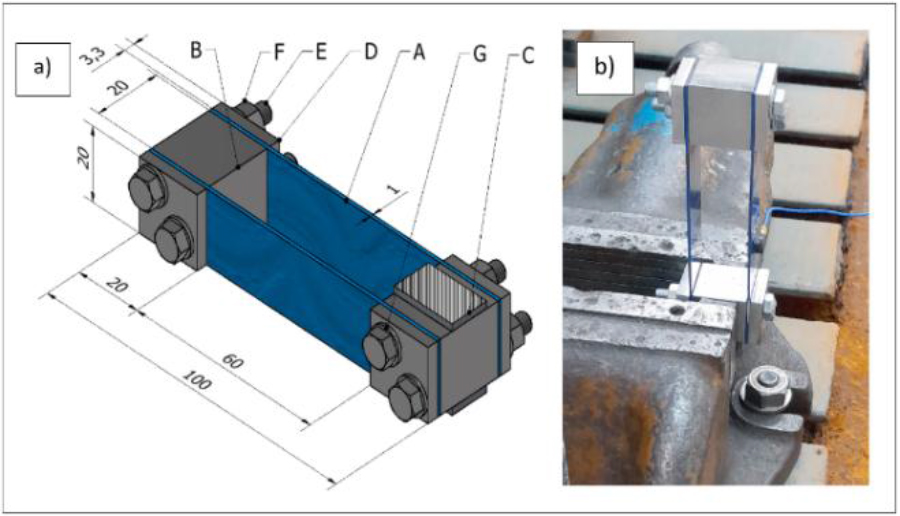
Fig. 9.
Scheme of the elastic support system, (a) A – flat spring, B – distancing mass, C – mounting washers in the vice jaws, D – pressure plates, E – screws M5x40, F – nuts, G – washers; (b) the system attached to the foundation with a vice
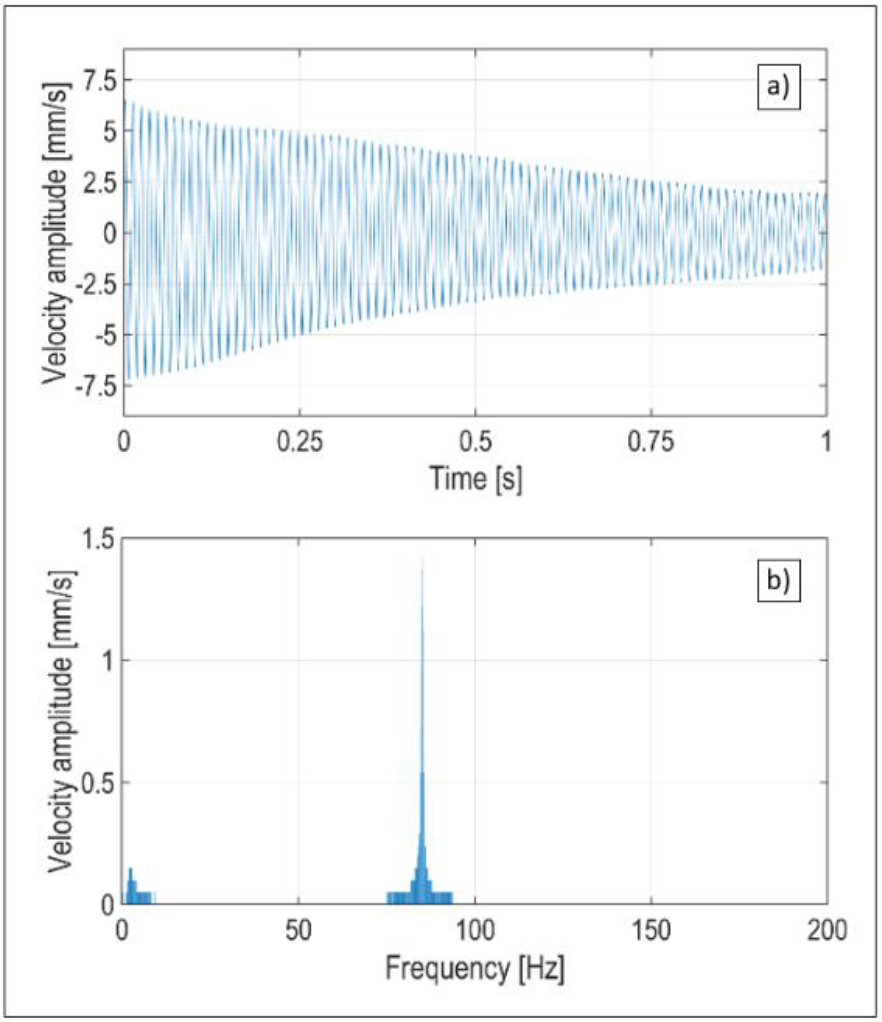
Fig. 10.
Time course of vibration velocity (a), FFT analysis results (b)
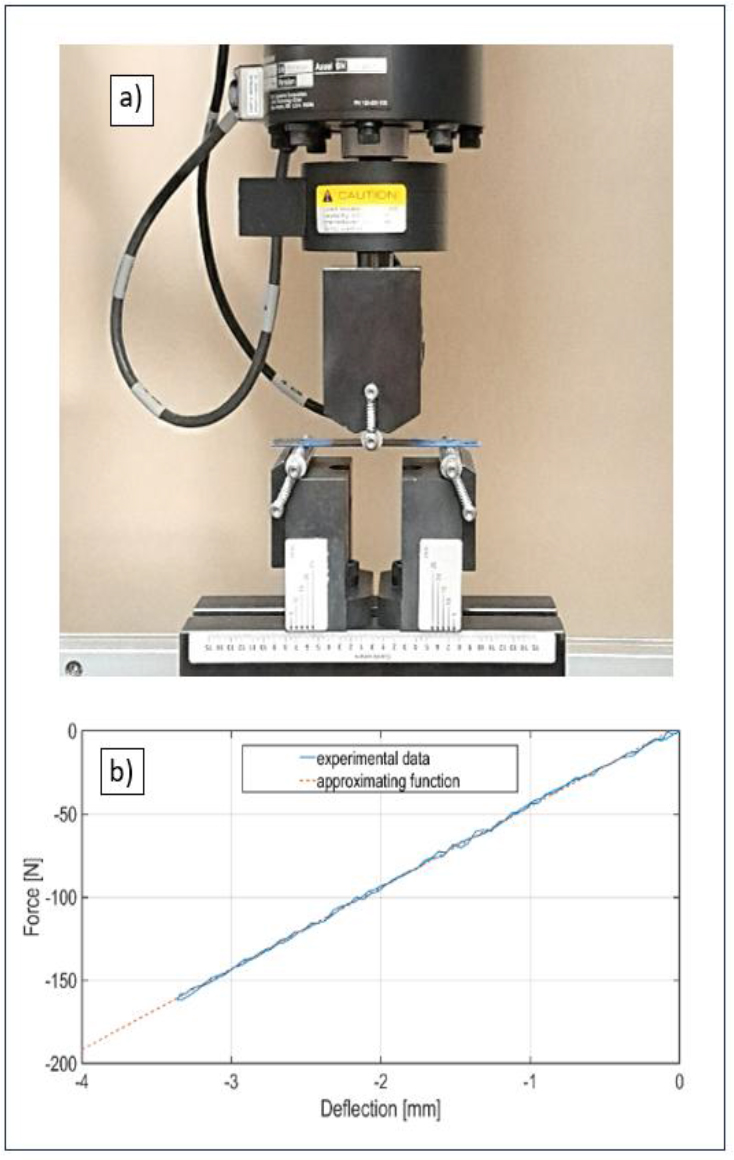
Fig. 11.
An experimental determination of the transverse stiffness of flat springs: (a) view of the station, (b) force-displacement diagram for one of the spring
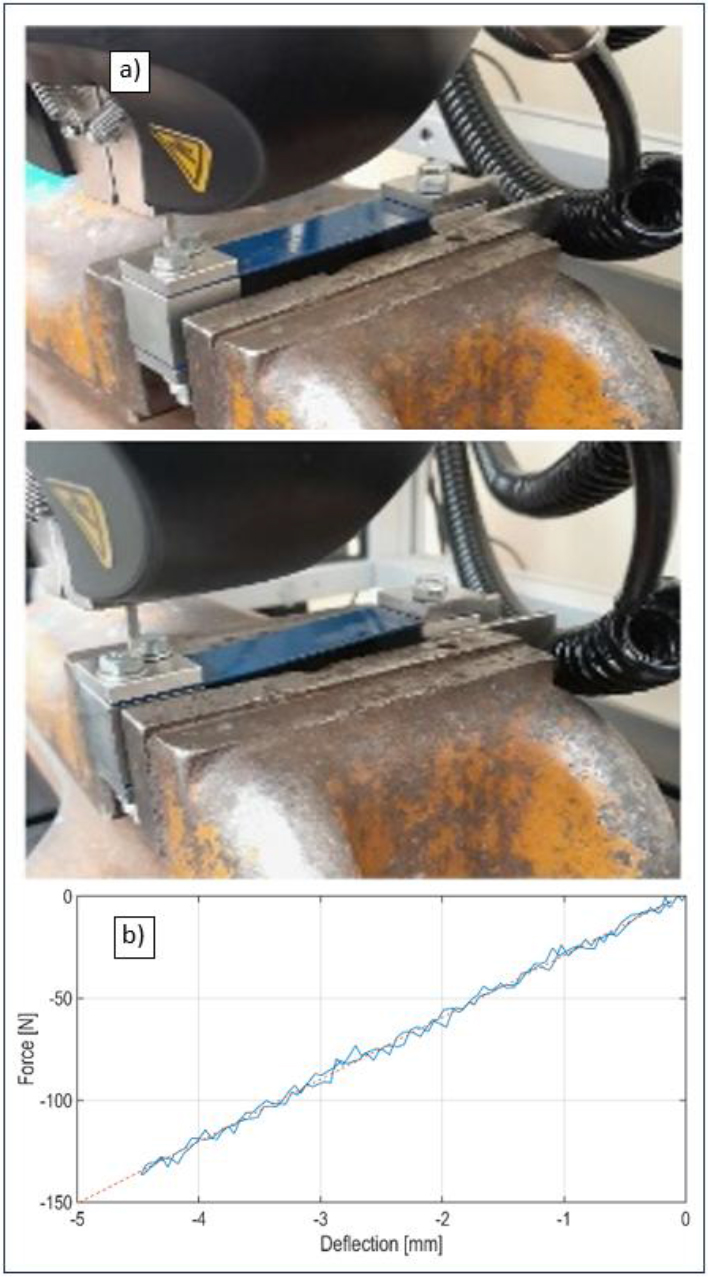
Fig. 12.
Experimental determination of the stiffness of the entire system (a) before and after the load, (b) the relationship between the transverse force and the stiffness kf of the system
Tab. 4.
Geometric and physical parameters of flat springs and other components of the test system (Fig. 9) - mass values are given with an accuracy of 0.01 g
| Parameter | Value | Unit | Meaning |
|---|---|---|---|
| lc = | 0.1 | m | total length of the spring |
| l = | 0.06 | m | active length of the spring |
| b = | 0.02 | m | spring width |
| h = | 0.001 | m | spring thickness |
| mr = | 0.00948 | kg | mass of the active part of a single spring |
| mzr = | 0.00352 | kg | reduced mass of a single spring (45) |
| md = | 0.09609 | kg | vibrating mass B + D + E |
| mz = | 0.10314 | kg | total weight reduced |
| EJs1 = | 348058 | Nmm2 | spring stiffness no. 1 |
| EJs2 = | 346149 | Nmm2 | spring stiffness no. 2 |
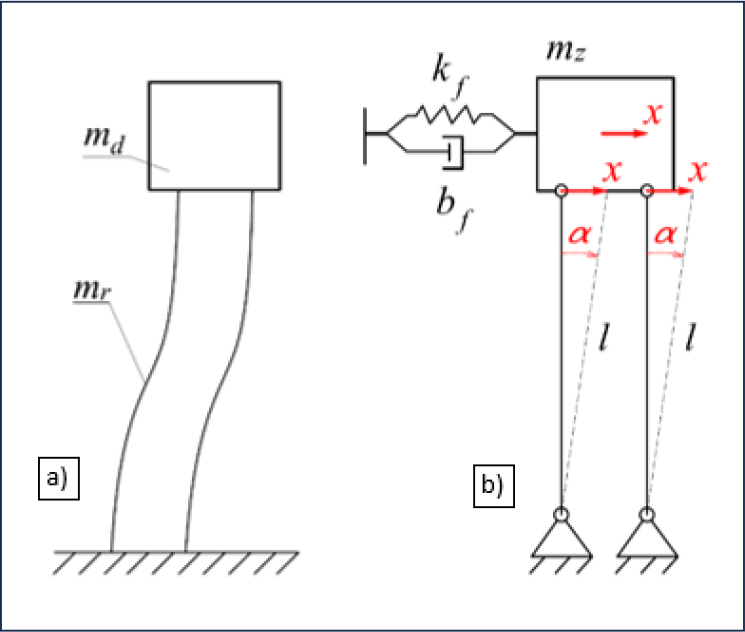
Fig. 13.
Continuous model of the tested system showing the first natural frequency (a), discrete equivalent model of the tested system for the first natural frequency (b)
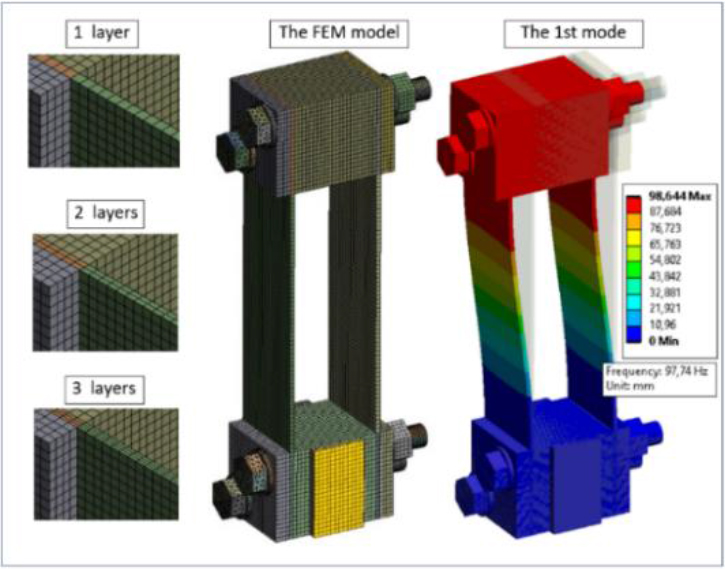
Fig. 14.
The results of the modal analysis performed in the ANSYS environment - the first form of vibration from Fig. 8 and 9 - the simulation result is 97,74 Hz (Tab.4) for three finite element layers on flat springs
Tab. 5.
Parameters of modal analysis
| Number of layers in thickness h | 1 | 2 | 3 |
|---|---|---|---|
| Total number of nodes / number of nodes of one spring | 379514/15629 | 397475/24586 | 415436/33543 |
| Average Skewness parameter | 0.24776 | 0.23940 | 0.23175 |
| Average Orthogonal Quality | 0.87048 | 0.87567 | 0.88043 |
| The 1st natural frequency | 98.01 Hz | 97.80 Hz | 97.74 Hz |
Tab. 6.
Comparison of the frequency results of the first form of bending vibrations
| A type of modal analysis | f [Hz] | ε[%] * |
|---|---|---|
| theoretical without taking into account the mass of flat springs | 100.83 | 18.21 |
| theoretical taking into account the mass of flat springs | 97.33 | 14.10 |
| numerical | 97.74 | 14.58 |
| experimental | 85.30 | 0 |