
Tab. 1.
BSC weaknesses and strengths of DEA [1]
| Weaknesses of BSC |
| One of the challenges in BSC is having the baseline which performance is measured against. Evaluation is impossible without a benchmark. First, a baseline for evaluation should be determined and then we should do the evaluation against the baseline. However, baselines and benchmarks are hard to determine and can be ambiguous. As DEA is based on relative comparison, the DMUs are evaluated against each other. By combining the BSC with DEA we can answer this important challenge of BSC. |
| BSC confronts managers with an extraordinarily complex optimization problem because of BSC has complexity and the interrelated indicators. This complexity also rises from the large number of variables. Big companies, which should try to track hundreds of measures in BSC, state that BSC lacks a single complex index to summarize the interaction between these measures of performance. |
| Lack of a common scale of measurement causes more complexity. Moreover, in BSC, we may have dimensionless ratios and index numbers. |
| Strengths of DEA |
| DEA permits to analyze multiple inputs and output factors simultaneously. This ability is very helpful in real-world management situations because there are usually multiple, multidimensional inputs and outputs. From this perspective, DEA is better in comparison with traditional approaches that can only deal with multiple inputs and a single output. Managers can use the results of DEA to improve and increase corporate performance, efficiency and competitiveness. |
| DEA solves an optimization problem and gains its weights result. Hence, DEA is only dependent on the empirical observations. This fact gives the DEA a great advantage over usual optimization procedures. |
| DEA is a non-parametric approach so it does not need to have an explicit functional form to relate inputs to outputs. |
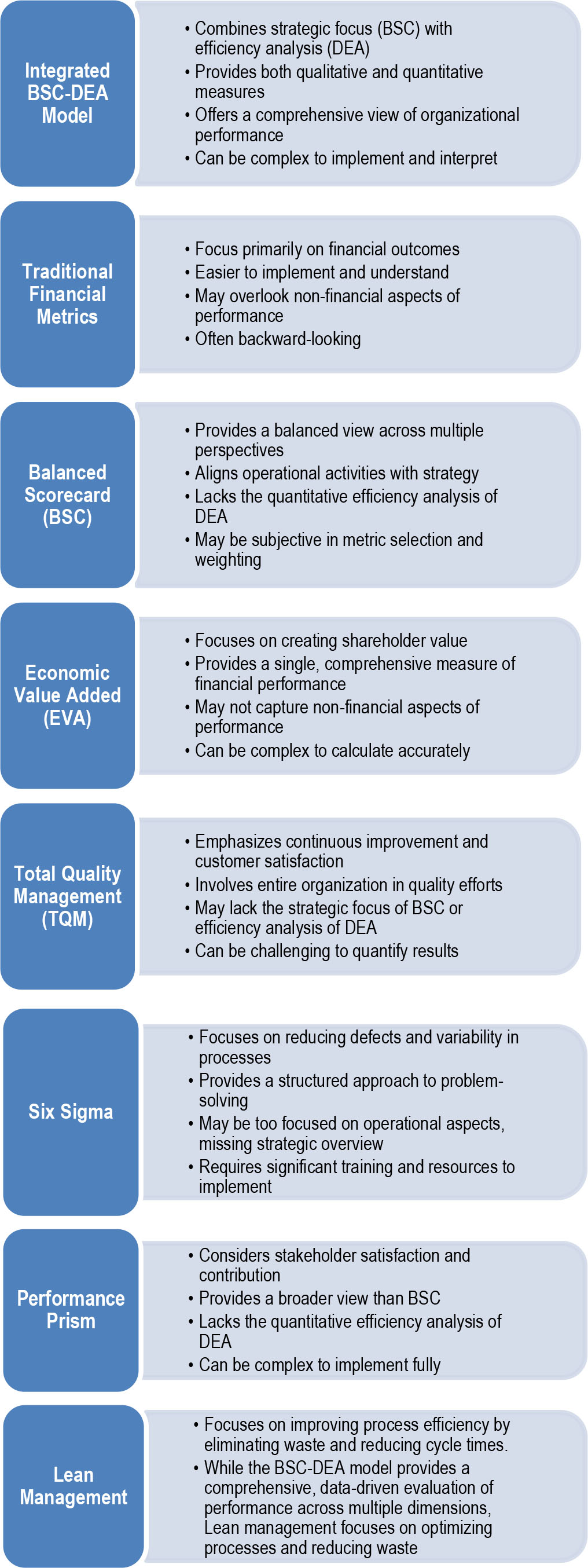
Fig. 1.
Comparison BSC-DEA model with other systems [2]
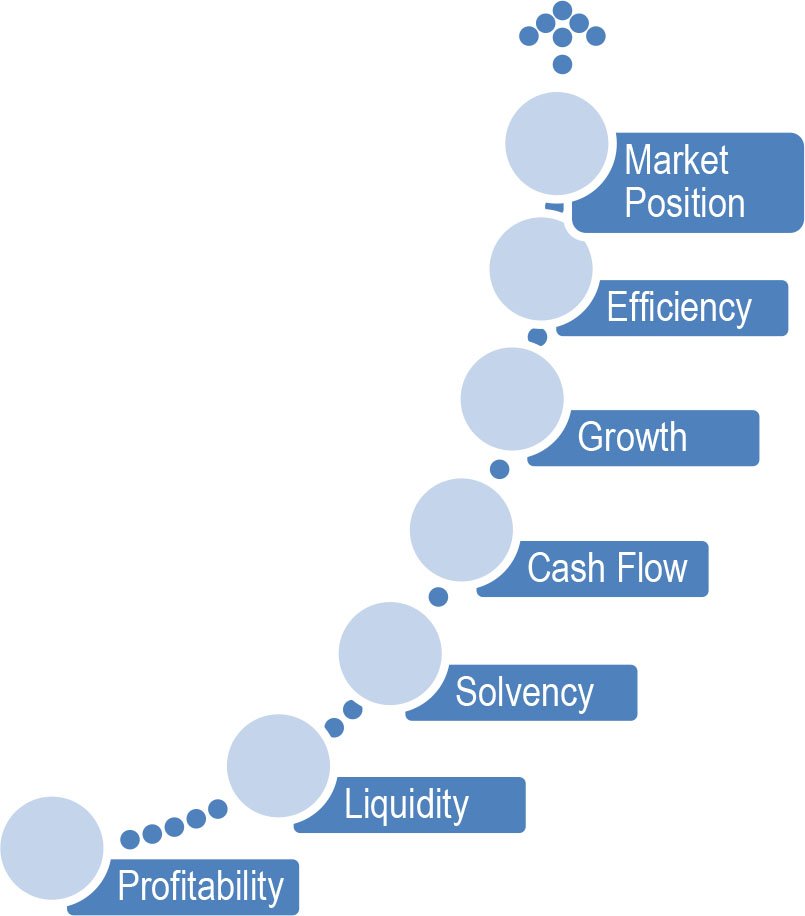
Fig. 2.
Key aspects of a company's financial health
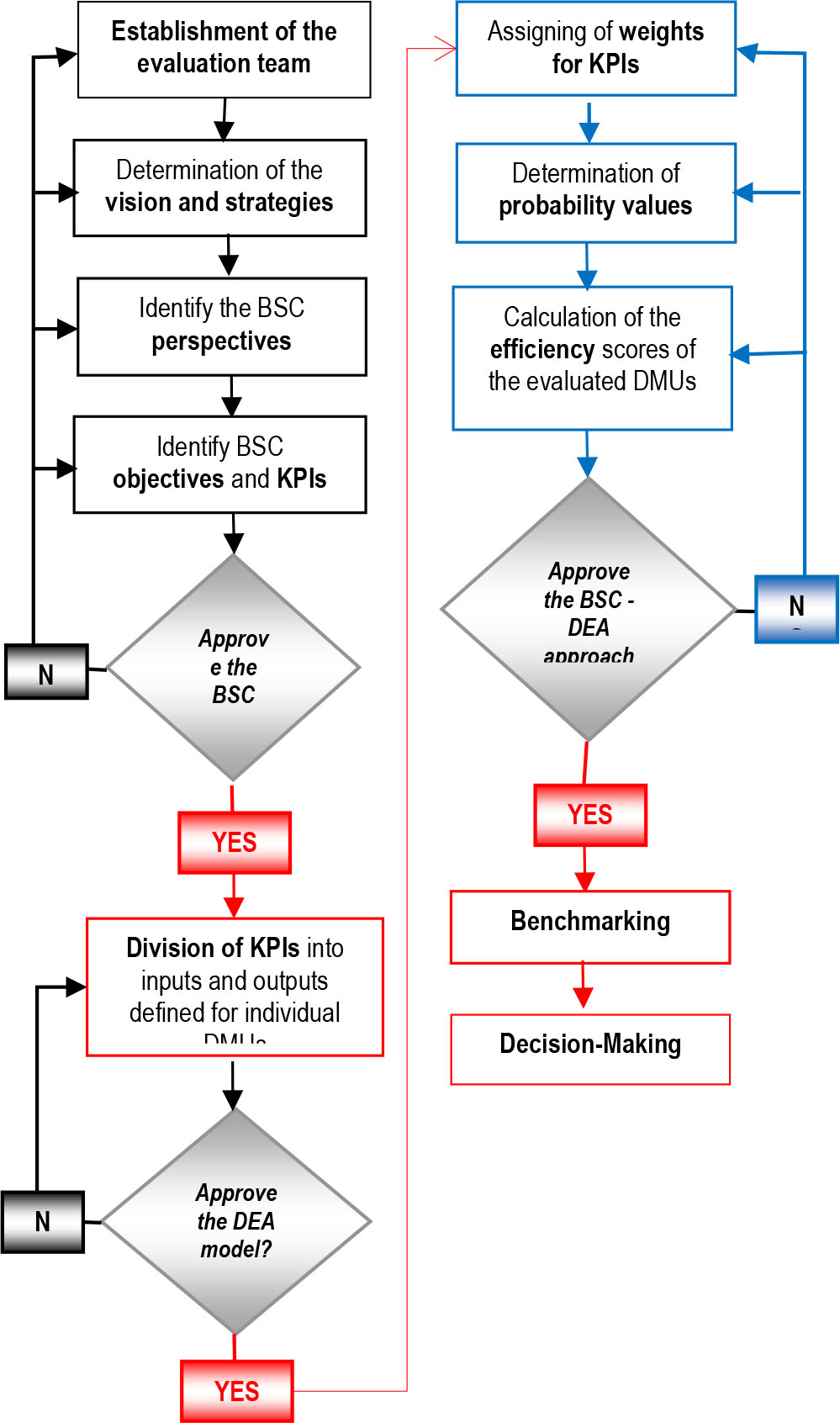
Fig. 3.
Decision – making process of BSC - DEA model
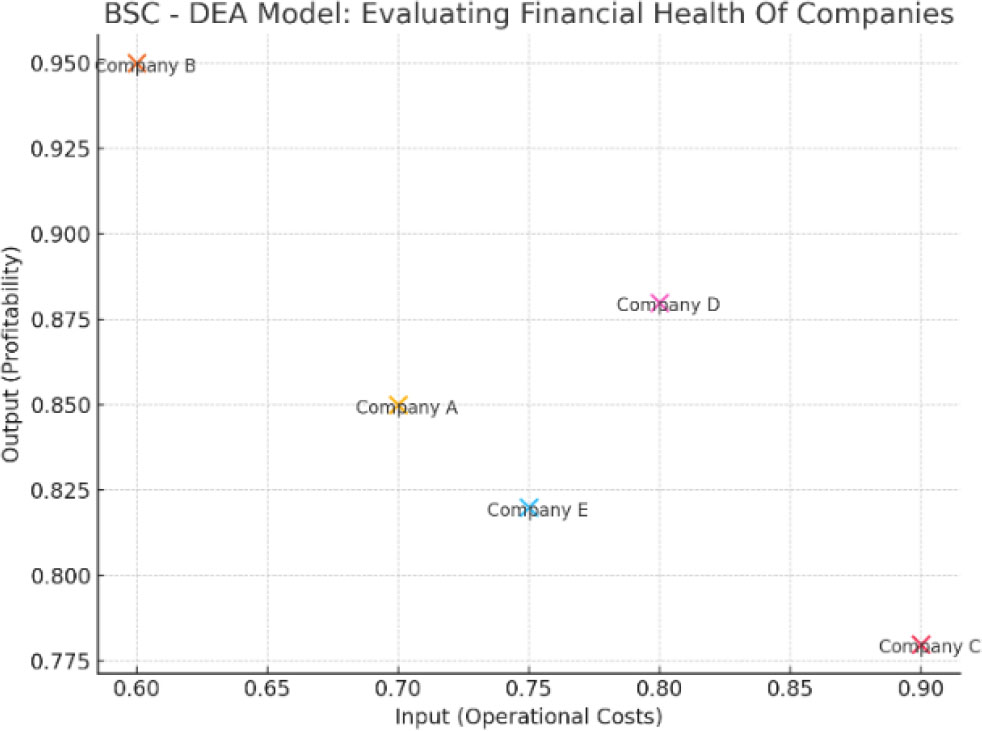
Fig. 4.
Visualization of efficiency scores in BSC-Dea model
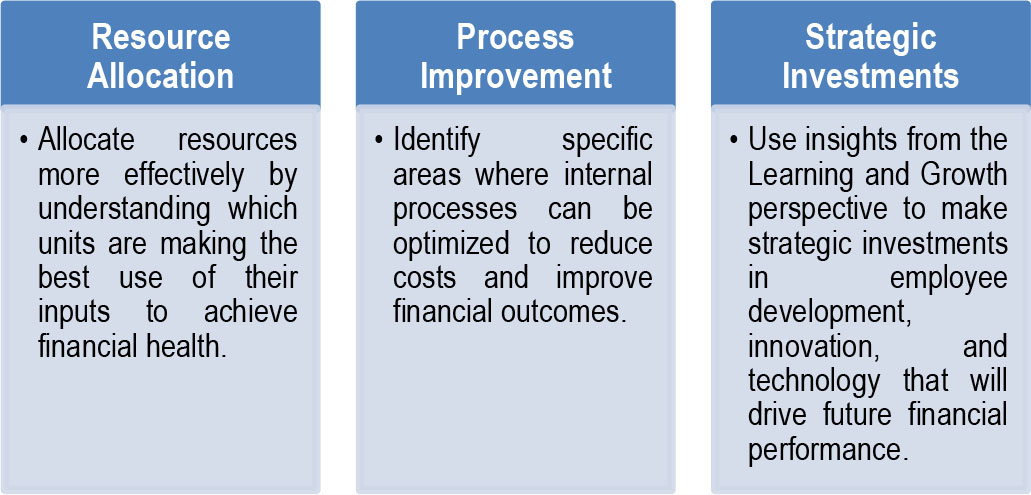
Fig. 5.
Strategic Insights of BSC-DEA mdoel
Tab. 2.
Comparing different DEA models [6]
| Model | Scale Assumption | Efficiency Focus | Applicability | Key Advantage |
|---|---|---|---|---|
| CCR | Constant Returns | Overall Technical | Standardized processes | Simple and widely applicable |
| BCC | Variable Returns | Pure Technical | Units of varying sizes | Handles scale effects |
| Additive | Non-radial | Slack-based | Input-output balance critical | Measures input and output inefficiency |
| Malmquist Index | Time-based | Productivity Change | Longitudinal performance studies | Measures efficiency over time |
| Super-Efficiency | Constant/ Variable Returns | Ranking Efficient Units | Competitive benchmarking | Ranks DMUs beyond efficiency frontier |
| Network DEA | Multi-stage Process | Process-based | Complex operations (e.g., supply chains) | Evaluates internal processes separately |
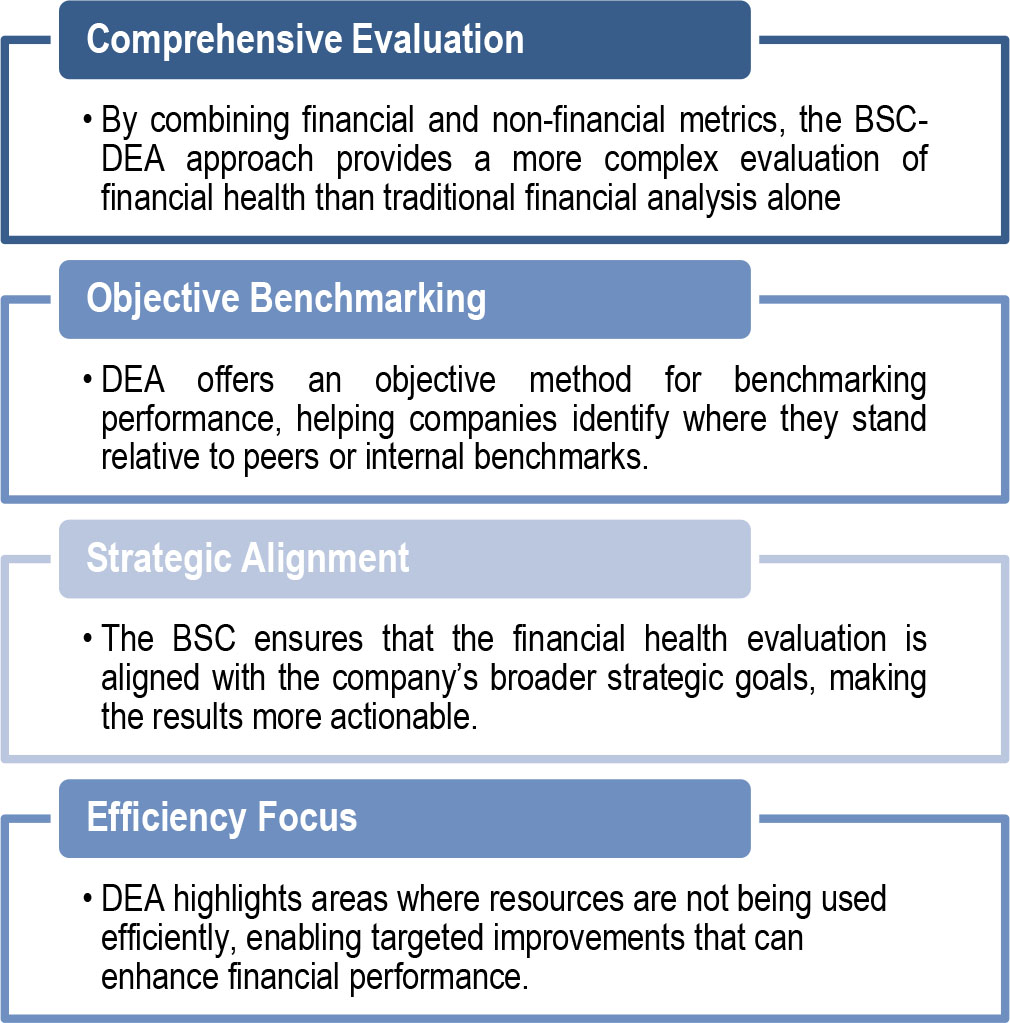
Fig. 6.
Benefits of the Integrated Approach
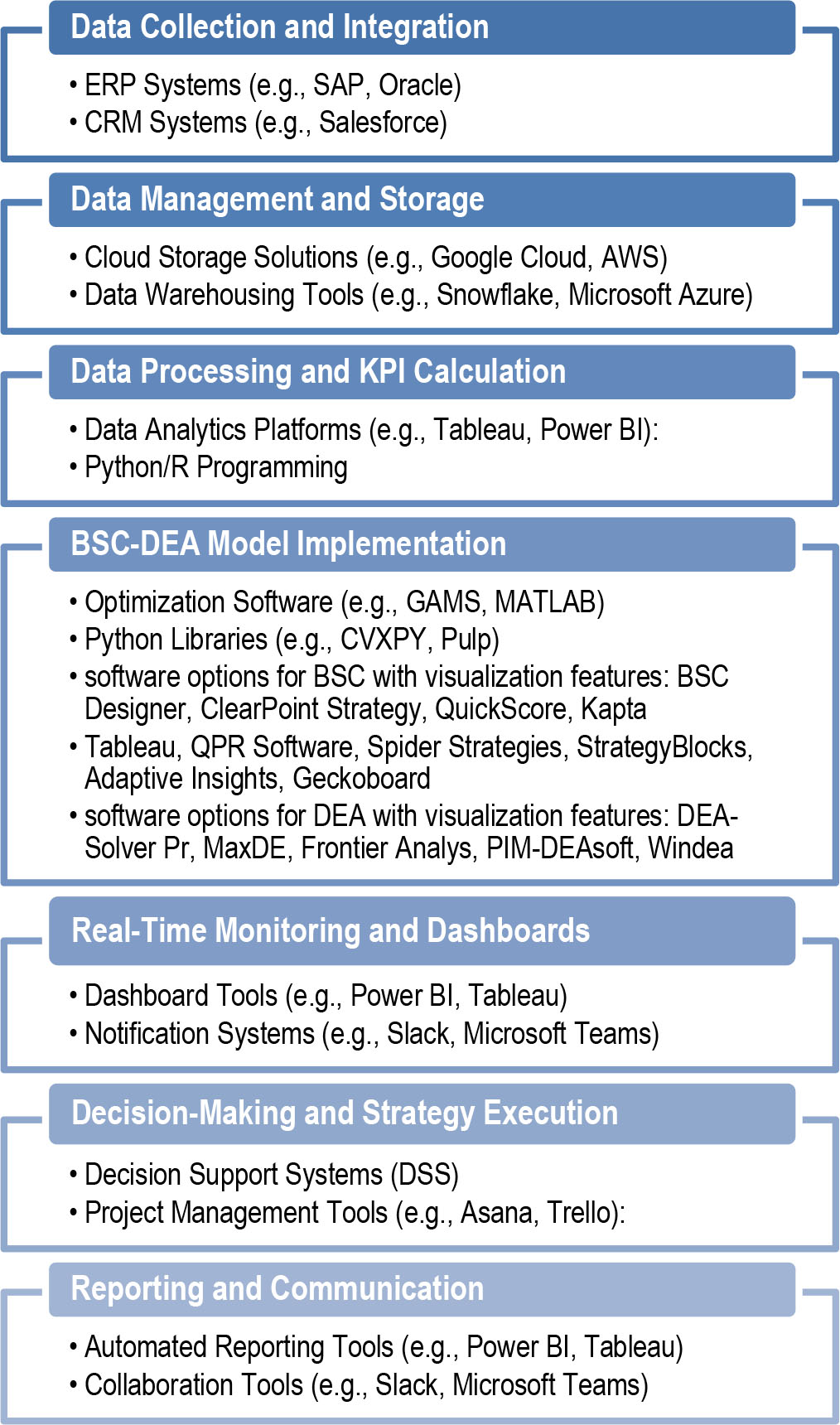
Fig. 7.
Digitization tools for BSC-DEA model
Tab. 3.
Software options suitable for BSC-DEA digitalization [6]
| Software | Best For | Strengths | Limitations |
|---|---|---|---|
| BSC Designer | BSC implementation with strategy maps and KPI tracking | User-friendly, good visualization for BSC | May lack advanced DEA functionaliti es |
| ClearPoint Strategy | Comprehensive strategy management with reporting and visualization | Strong BSC features, extensive reporting | May not provide detailed DEA analysis |
| MaxDEA | Dedicated DEA analysis with advanced models | Specialized in DEA, strong visualization | Lacks BSC functionaliti es |
| DEA-Solver Pro | Advanced DEA modeling with a focus on efficiency analysis | Highly regarded for DEA, advanced modeling | Requires expertise, not focused on BSC |
| PIM-DEAsoft | Intuitive DEA tool with solid visualization features | Good for DEA, intuitive interface | Doesn’t focus on BSC |
| QPR Software | Integrated performance management across BSC and other methodologies | Versatile, strong BSC features | May not have the same depth in DEA |
| Tableau (customized for BSC-DEA) | Customizable and advanced data visualization | Powerful visualization, customizable | Requires manual setup for DEA |
| R with Benchmarking Package | Users comfortable with programming and customization | Flexible, advanced analysis | Requires coding skills |
| MATLAB with DEA Toolbox | Advanced users needing custom DEA solutions | Powerful analytics, customizable | Requires significant expertise |
| Frontier Analyst | Performance benchmarking with DEA | Strong DEA focus, good visualization | Limited BSC functionality |