
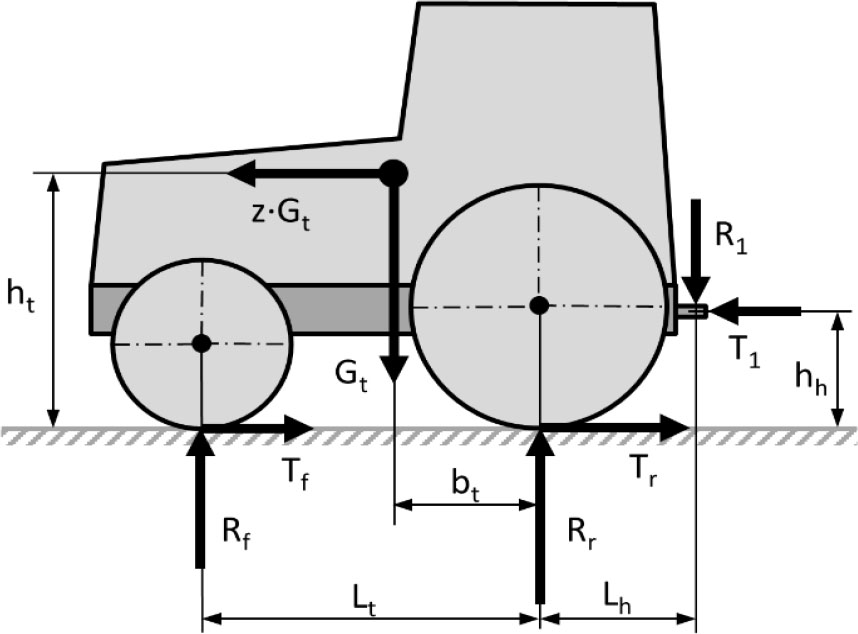
Fig. 1.
Forces acting on a farm tractor (ISO coordinate system [35])
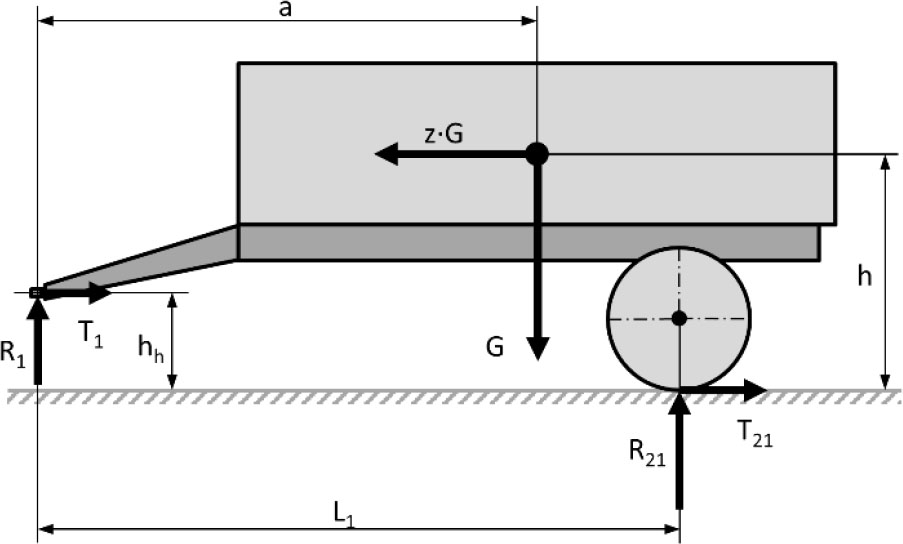
Fig. 2.
Forces acting on a single-axle semi-trailer
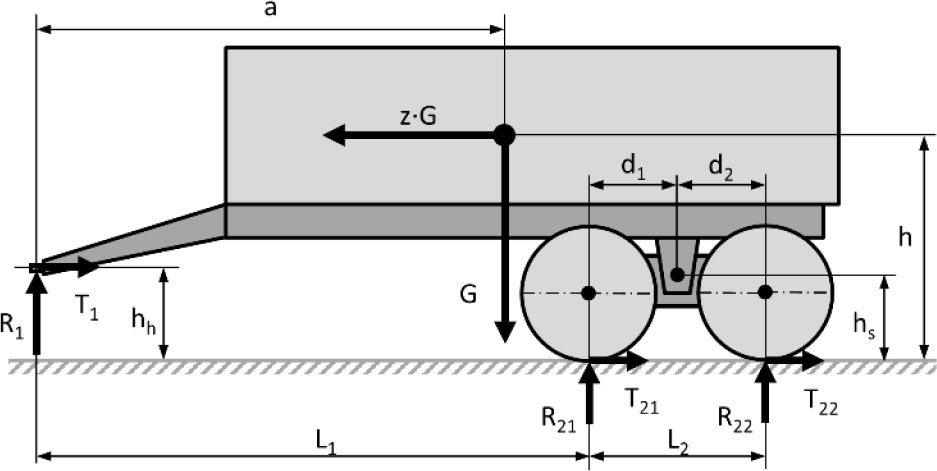
Fig. 3.
Forces acting on a tandem-axle semi-trailer
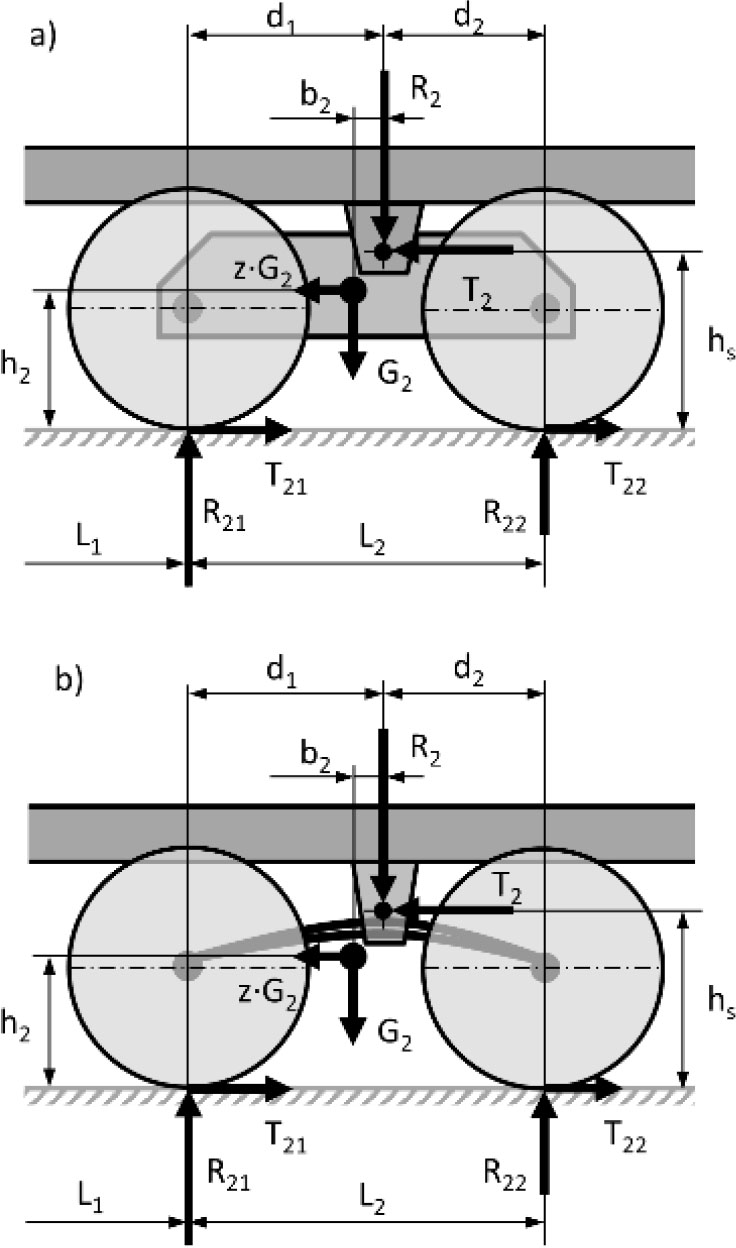
Fig. 4.
Forces acting on a walking beam (a) and bogie suspension (b)
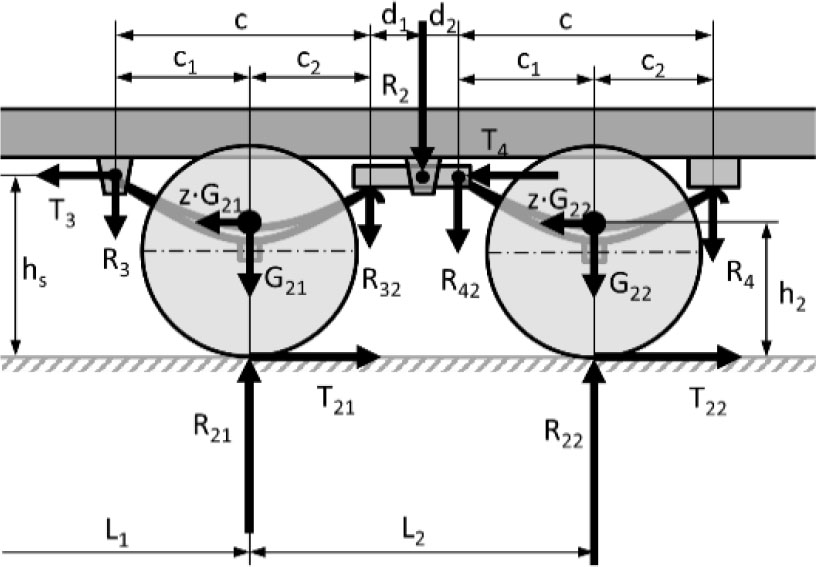
Fig. 5.
Forces acting on a two leaf spring suspension
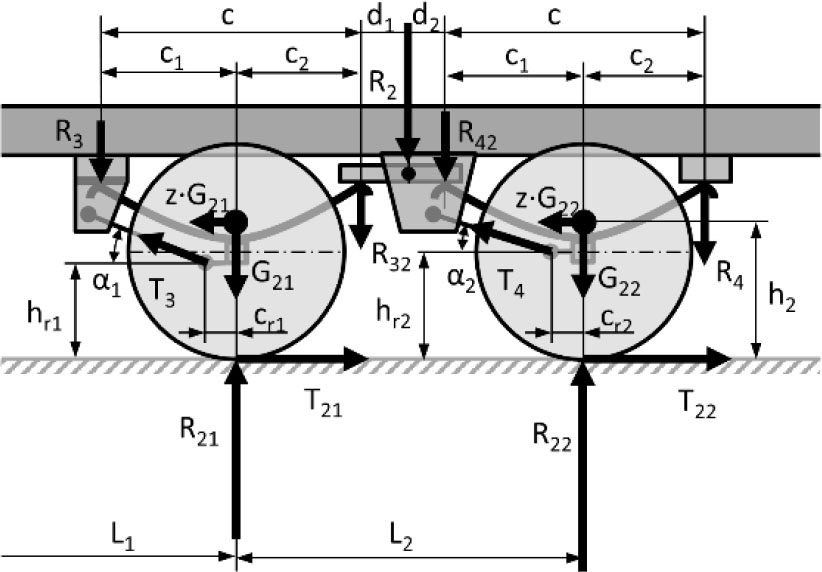
Fig. 6.
Forces acting on a two leaf-two rod suspension
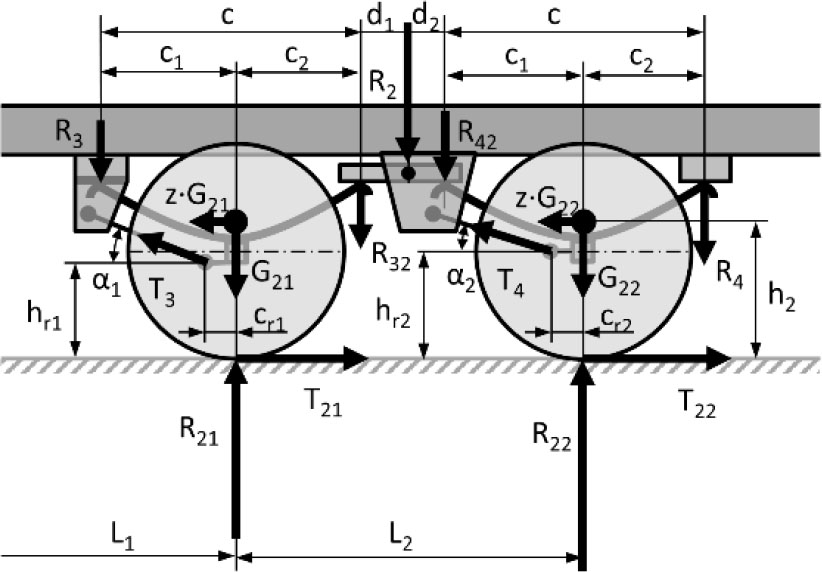
Fig. 7.
Forces acting on two leaf spring suspension with equalization
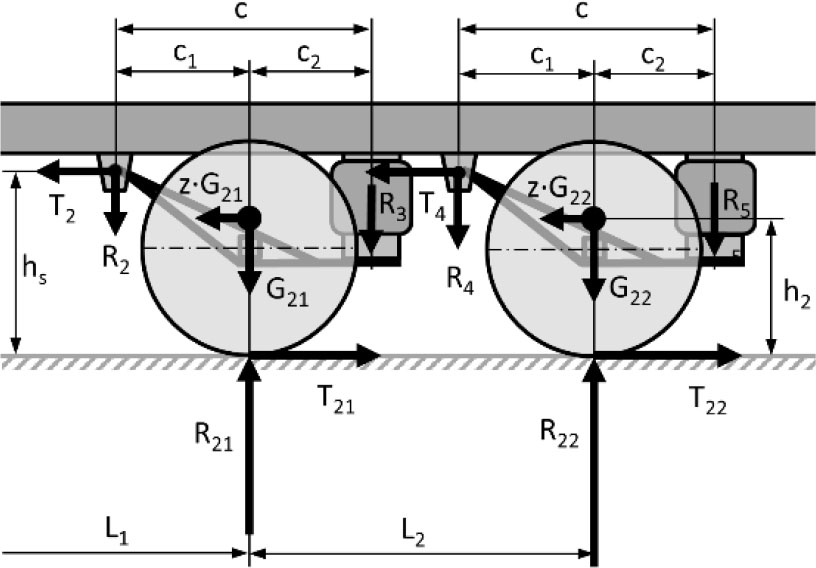
Fig. 8.
Forces acting on air tandem suspension
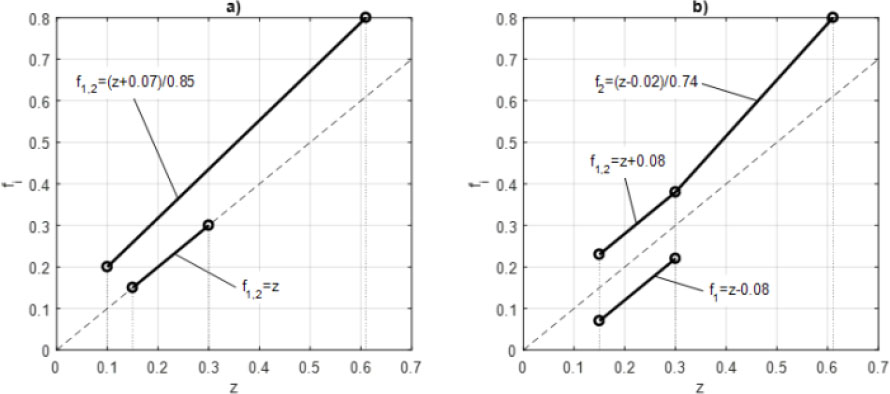
Fig. 9.
Limits of adhesion utilization in accordance with Commission Delegated Regulation (EU) 2015/68 [8]: a – first solution, b – second solution
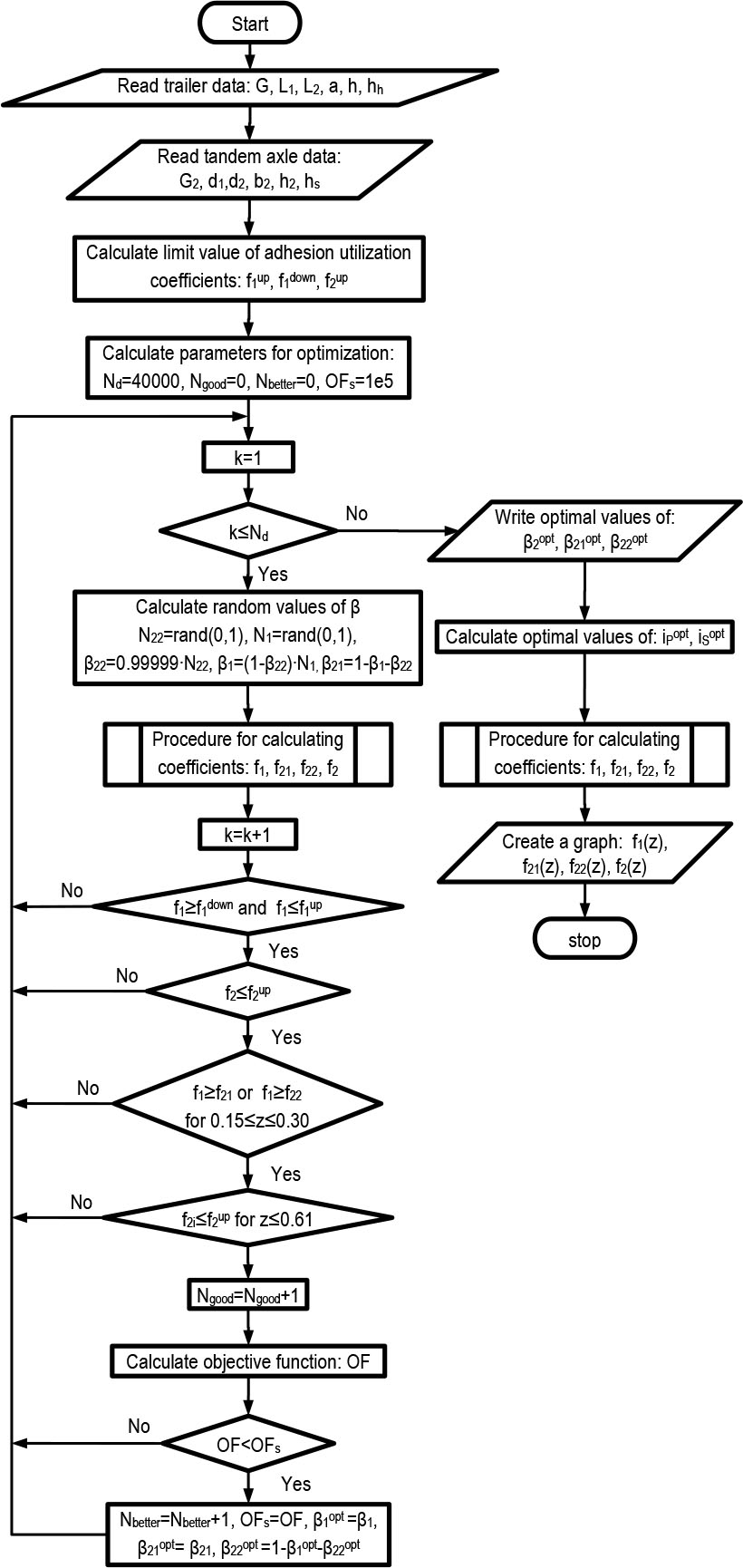
Fig. 10.
A block diagram of an algorithm for the optimization of brake forces of a semi-trailer with tandem suspension using the Monte Carlo method (OFs ‒ initial value of the objective function, Nd ‒ number of draws, Ngood – number of good solutions, meeting inequality constraints, Nbetter ‒ number of better solutions, reducing the value of the objective function)
Tab. 1.
The technical data and results of the optimization of brake force distribution in single axle semi-trailer: L1=4.45 m, hh=0.7 m (L ‒ laden, U ‒ unladen, I, II – first and second solution)
| m kg] | a [m] | h [m] | OF | β1 | iP | |
|---|---|---|---|---|---|---|
| UI-UII | 2250 | 3.895 | 0.98 | 0.0947–0.0947 | 0.2079–0.2079 | 3.8097–3.8097 |
| LI - LII | 7250 | 3.840 | 1.25 | 0.1272–0.1272 | 0.2445–0.2445 | 3.0901–3.0901 |
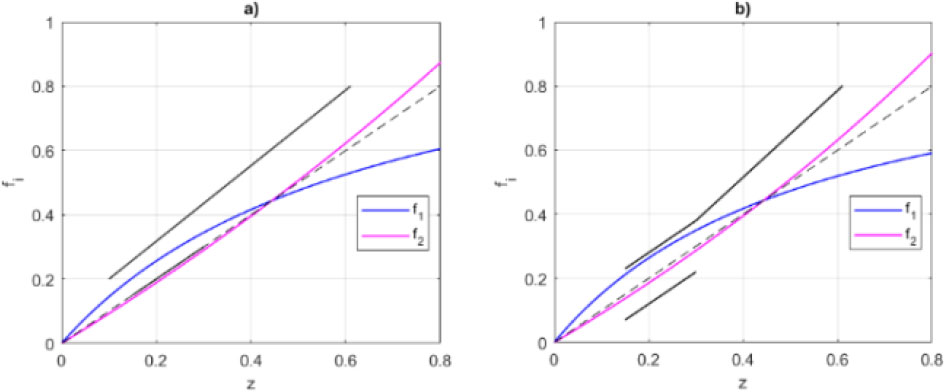
Fig. 11.
Adhesion utilization curves fi(z) for an optimal distribution of brake forces in a single axle semi-trailer: a – an unladen trailer (I solution), b – a laden trailer (II solution)
Tab. 2.
| Semi-trailer with tandem axle | Tandem suspension | |||||
|---|---|---|---|---|---|---|
| unladen | laden | bogie (3.1) | 2 leaf spring (3.2) | 2 leaf 2 rod (3.3) | 2 leaf equal. (3.4) | air susp. (3.5) |
| m=3900 kg | m=19800 kg | d1=0.705 m | c1=0.454 m | c1=0.497 m | c1=0.454 m | c1=0.5 m |
| L1=3.94 m | L1=3.94 m | d2=0.645 m | c=0.93 m | c=0.97 m | c=0.93 m | c=0.88 m |
| L2=1.35 m | L2=1.35 m | hs=0.567 m | hs=0.717 m | hr1=hr1=0.467 m | hs=0.717 m | hs=0.717 m |
| a=4.26 m | a=4.055 m | h2=0.547 m | h2=0.567 m | h2=0.567 m | h2=0.567 m | h2=0.567 m |
| h=1.19 m | h=1.62 m | b2=0.03 m | d1=d2=0.21m | d1=d2=0.19 m | d1=d2=0.675 m | |
| hh=0.59 m | hh=0.59 m | α1= α2=15º | ||||
Tab. 3.
The results of the optimization of brake force distribution in a tandem axle semi-trailer (L ‒laden, U ‒ unladen, Lw, Uw – laden and unladen with weight of suspension)
| Suspension | OF | β1 | β21 | β22 | iP | iS | |
|---|---|---|---|---|---|---|---|
| Bogie (3.1) | U-Uw | 0.3040–0.3115 | 0.1629–0.1588 | 0.5740–0.5793 | 0.2631–0.2619 | 5.1402–5.2971 | 0.4583–0.4521 |
| I and II solution | L-Lw | 0.3006–0.3015 | 0.2301–0.2301 | 0.5286–0.5286 | 0.2412–0.2412 | 3.3456–3.3456 | 0.4564–0.4564 |
| 2 leaf 2 rod (3.3) | U-Uw | 0.6716–0.8831 | 0.2313–0.2307 | 0.1803–0.1527 | 0.5884–0.6166 | 3.3239–3.3354 | 3.2635–4.0377 |
| I solution | L-Lw | 0.5841–0.6991 | 0.3117–0.3267 | 0.1674–0.1644 | 0.5209–0.5189 | 2.2086–2.1574 | 3.1116–3.1573 |
| II solution | U-Uw | 0.9446–1.2169 | 0.2075–0.2065 | 0.1705–0.1444 | 0.6220–0.6490 | 3.8198–3.8417 | 3.6483–4.4935 |
| L-Lw | 0.7531–0.7893 | 0.2806–0.2818 | 0.1577–0.1525 | 0.5617–0.5657 | 2.5635–2.5490 | 3.5631–3.7096 | |
| 2 leaf equal. (3.4) | U-Uw | 0.2512–0.2512 | 0.1951–0.1951 | 0.4031–0.4031 | 0.4018–0.4018 | 4.1265–4.1265 | 0.9969–0.9969 |
| I solution | L-Lw | 0.2099–0.2099 | 0.2605–0.2605 | 0.3710–0.3710 | 0.3685–0.3685 | 2.8388–2.8388 | 0.9935–0.9935 |
| II solution | U-Uw | 0.3002–0.3002 | 0.1803–0.1803 | 0.4040–0.4040 | 0.4156–0.4156 | 4.5449–4.5449 | 1.0288–1.0288 |
| L-Lw | 0.2117–0.2117 | 0.2561–0.2561 | 0.3721–0.3721 | 0.3717–0.3717 | 2.9046–2.9046 | 0.9989–0.9989 | |
| air susp. (3.5) | U-Uw | 0.2511–0.2511 | 0.1951–0.1951 | 0.4031–0.4031 | 0.4018–0.4018 | 4.1265–4.1265 | 0.9969–0.9969 |
| I solution | L-Lw | 0.2098–0.2098 | 0.2605–0.2605 | 0.3710–0.3710 | 0.3685–0.3685 | 2.8388–2.8388 | 0.9935–0.9935 |
| II solution | U-Uw | 0.3003–0.3003 | 0.1803–0.1803 | 0.4040–0.4040 | 0.4156–0.4156 | 4.5449–4.5449 | 1.0288–1.0288 |
| L-Lw | 0.2117–0.2117 | 0.2561–0.2561 | 0.3721–0.3721 | 0.3717–0.3717 | 2.9046–2.9046 | 0.9989–0.9989 | |
| 2 leaf (3.2) only | U-Uw | 5.3013–3.5221 | 0.2271–0.2337 | 0.0017–0.0218 | 0.7712–0.7446 | 3.4025–3.2798 | 458.23–34.199 |
| I solution | L-Lw | 4.6761–4.5855 | 0.3230–0.3202 | 0.0018–0.0030 | 0.6752–0.6768 | 2.0957–2.1233 | 376.30–222.04 |
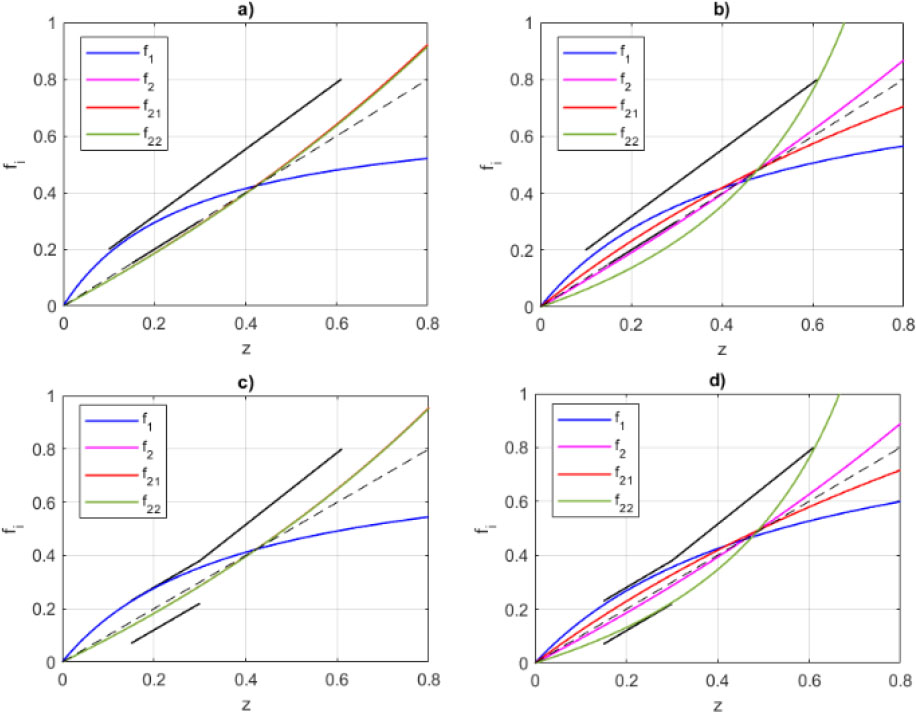
Fig. 12.
Adhesion utilization curves fi(z) for an optimal distribution of brake forces in a tandem semi-trailer (considering the weight of the tandem suspension): a – an unladen trailer with air suspension (I solution), c – a laden trailer with air suspension (II solution), b – an unladen trailer with bogie suspension (I solution), d – a laden trailer with bogie suspension (II solution)
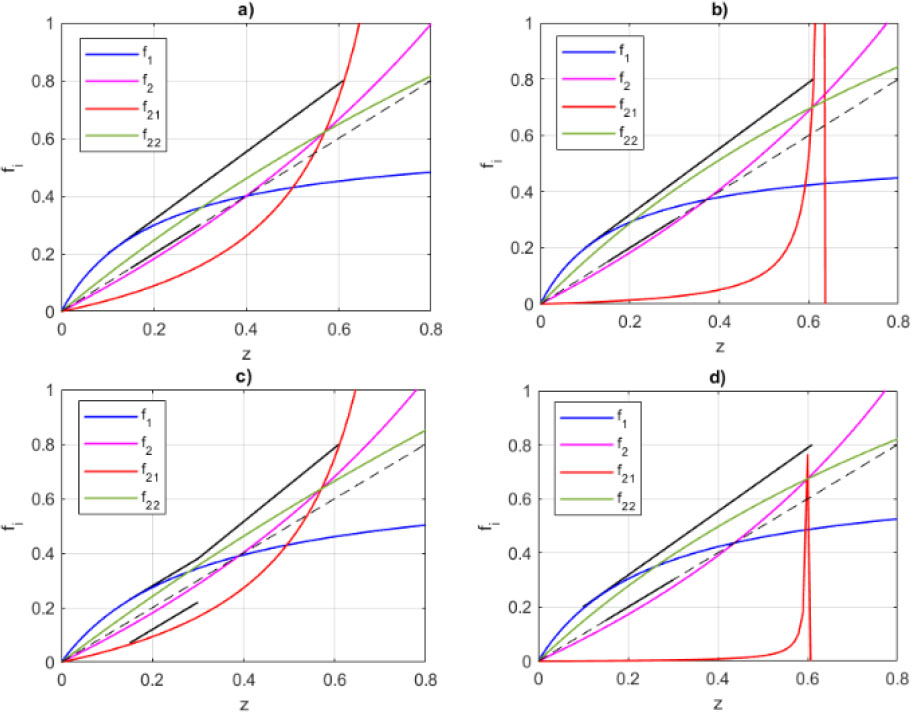
Fig. 13.
Adhesion utilization curves fi(z) for an optimal distribution of brake forces in a tandem axle semi-trailer (considering the weight of the tandem suspension): a – an unladen trailer with two leaf-two rod suspension (I solution), c – a laden trailer with two leaf-two rod suspension (II solution), b – an unladen trailer with two leaf suspension (I solution), d – a laden trailer with two leaf suspension (I solution)