
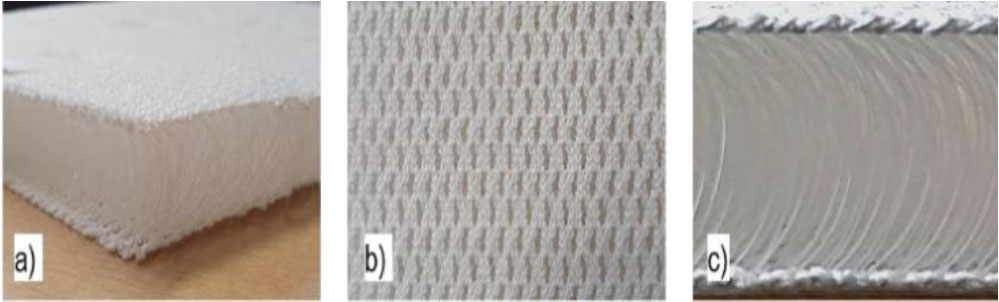
Fig. 1.
Principal construction of spacer fabrics – a) 3D-structure, b) front and back side, c) spacer area
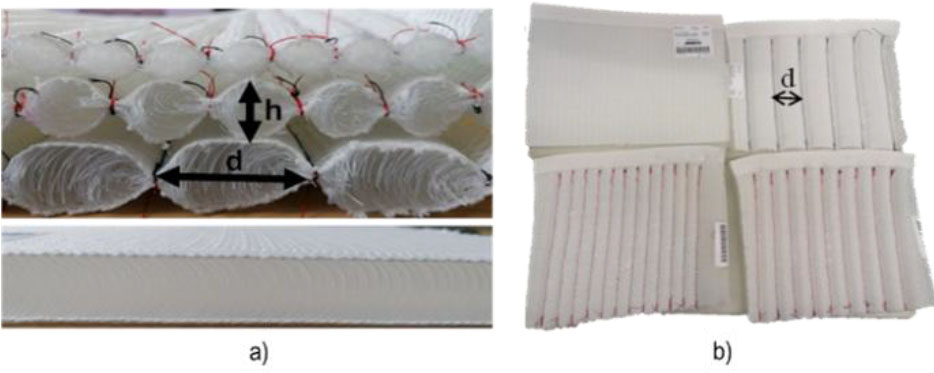
Fig. 2
Spacer fabric variations for experimental testing: (a) cross view, (b) top view; h cushion heigt, d seam distance
Tab. 1.
Technical data of the spacer fabric specimen
| Spacer fabric variation | Parameter | Value |
|---|---|---|
| Initial spacer fabric | Manufacturer | Essedea GmbH/D |
| Density | 2.349 g/mm3 | |
| Material (knitting threads) | Top/Back side: PES- multifilament | |
| Space: PES monofiles | ||
| All sewn specimen | Sewing machine | Delta Machine “M-Type (Dürkopp Adler, D) |
| Stitch | Douple lock stitch 301 | |
| Stitch length | 4 mm | |
| Tension needle thread | 40 % | |
| Foot strocke | 9 mm | |
| Sewing foot pressure | 1 (intern machine parameter without unit) | |
| Sewing threads | Amann Rasant Nm75 (PES)/D | |
| Spacer fabric 18 | Seam distance d | 18 mm |
| Spacer fabric 24 | 24 mm | |
| Spacer fabric 43 | 43 mm | |
| Without seams | Cushion height h | 20 mm (overall height/thickness) |
| Spacer fabric 18 | 8 mm | |
| Spacer fabric 24 | 15 mm | |
| Spacer fabric 43 | 20 mm |
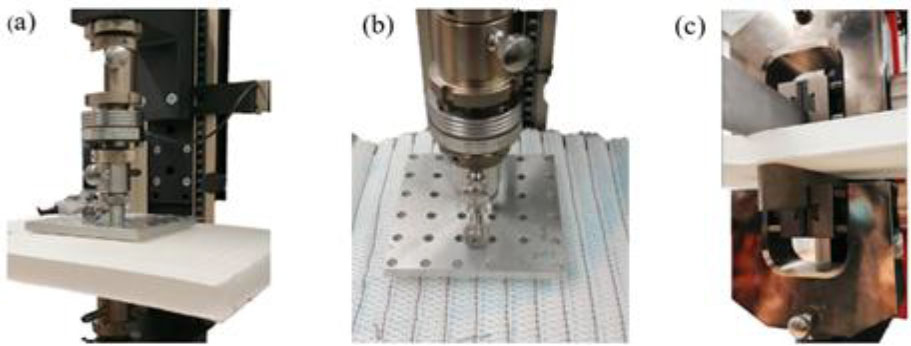
Fig. 3.
Test setup for various compression tests (a) spacer fabric without seams, (b) spacer fabric with seams, (c) Edge-force-test to a spacer fabric without seams
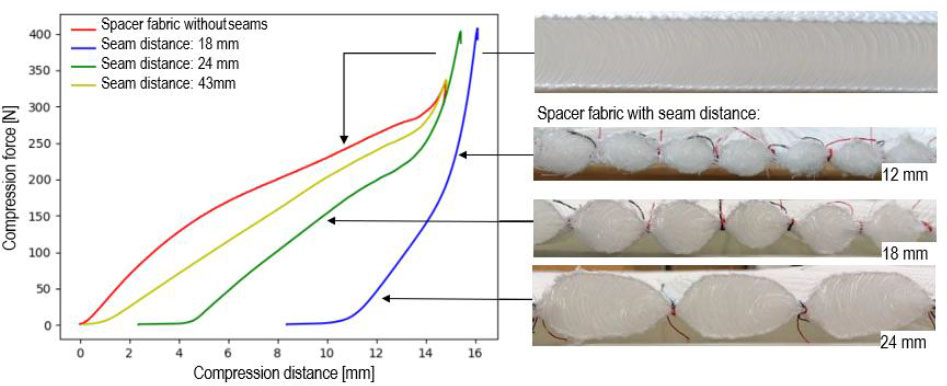
Fig. 4
Experimental results of compression tests of spacer fabrics with a various seam distances
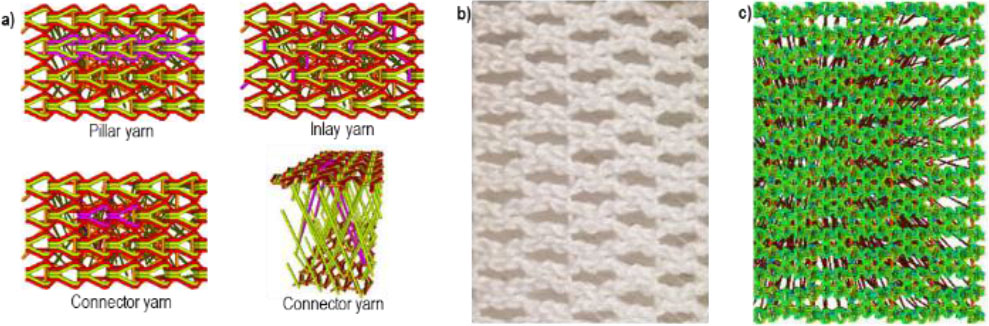
Fig. 5.
(a) Individual yarn types highlighted in purple, (b) + (c) the virtual spacer fabric sample on the right, compared to the physical sample in the middle
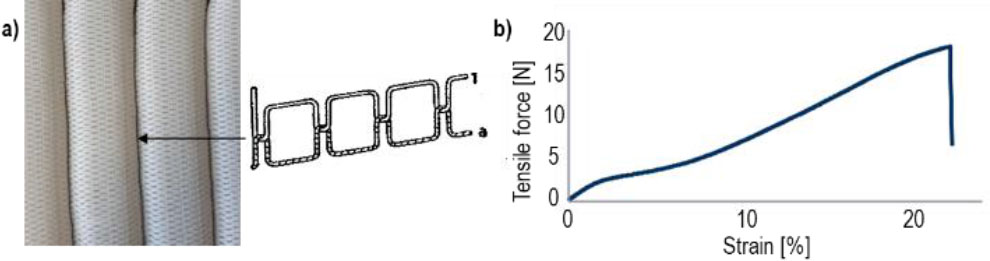
Fig. 6.
(a) Schematic representation of the double lock stitch, (b) measured force-strain curve for the yarn material
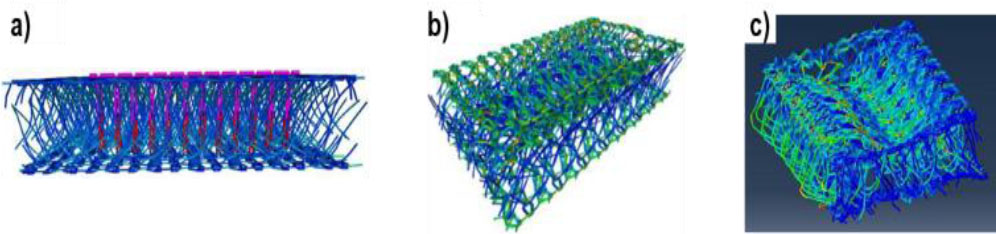
Fig. 7.
Axial stresses in the pre-stressed seams and yarns of the spacer fabric simulated with (a) + (b) TexMath- tool and (c) Abaqus - Colours indicate local stresses.
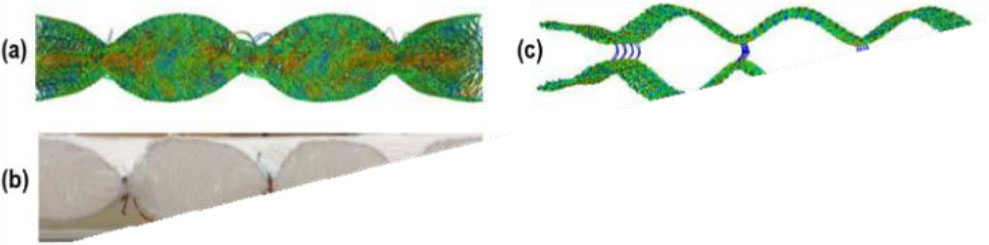
Fig. 8.
Visual comparison of the spacer fabric with 43 mm seam distance (a) simulated and (b) experimental manufactured and simulated spacer fabrics with (c) 24 mm seam distance and (d) 18 mm seam distance
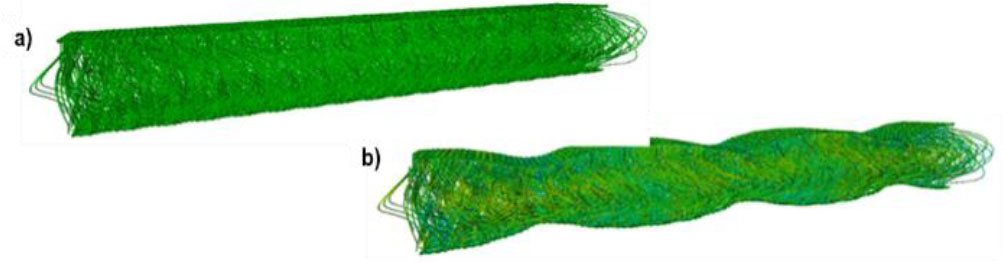
Fig. 9.
Spacer fabric with seam distance of 43 mm before and after applying the pre-stress to the stich yarn

Fig. 10.
Qualitative comparison of compression profiles at increasing compression levels for unstitched spacer fabric sample
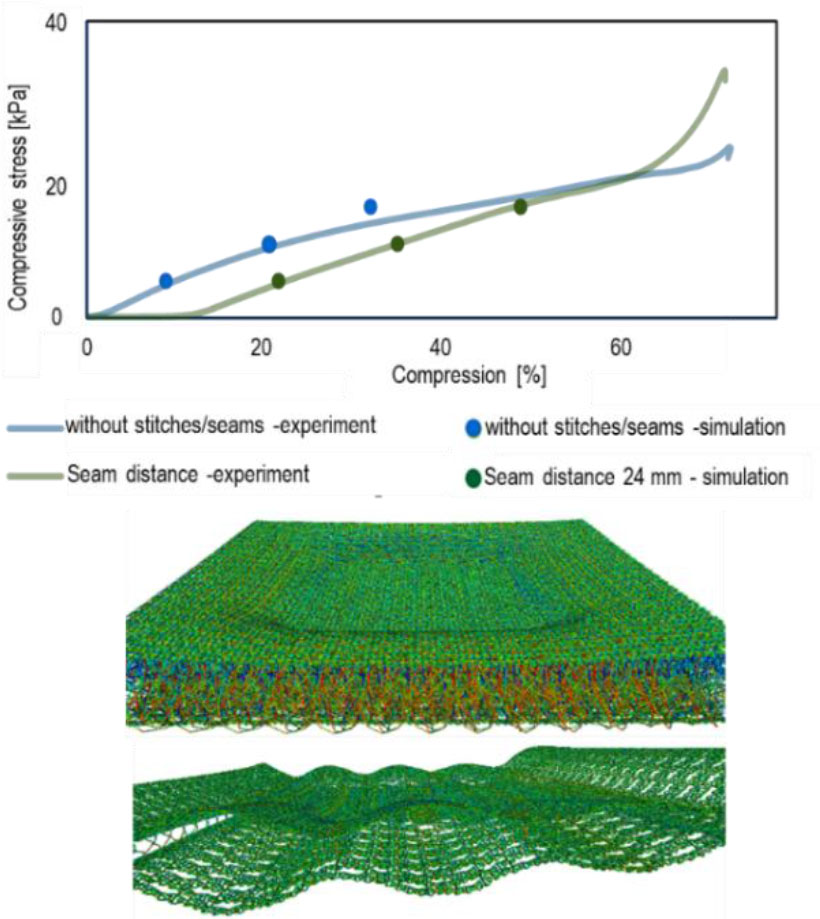
Fig. 11.
Simulative and experimentally attained compression values for unstitched spacer fabric and sample with seam distance of 24 mm. Visualization of compressed samples below

Fig. 12.
Critical area of contact search for the compression of stitched spacer fabric samples
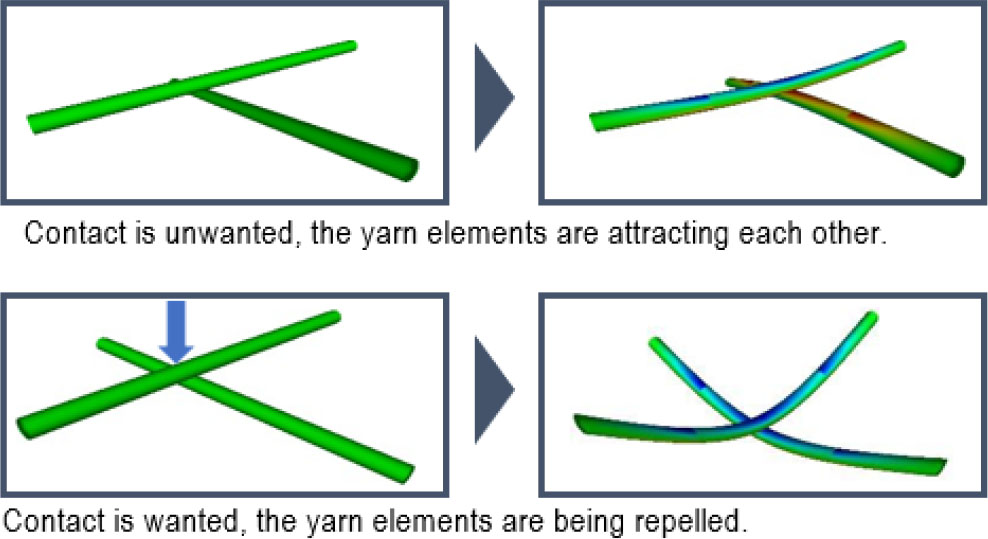
Fig. 13.
Visualization of attracting (top) and repulsing (bottom) contacts.
The simulation setup is the same, apart from an additional right-hand side force applied on the crossing centre at the bottom, indicated by the blue arrow
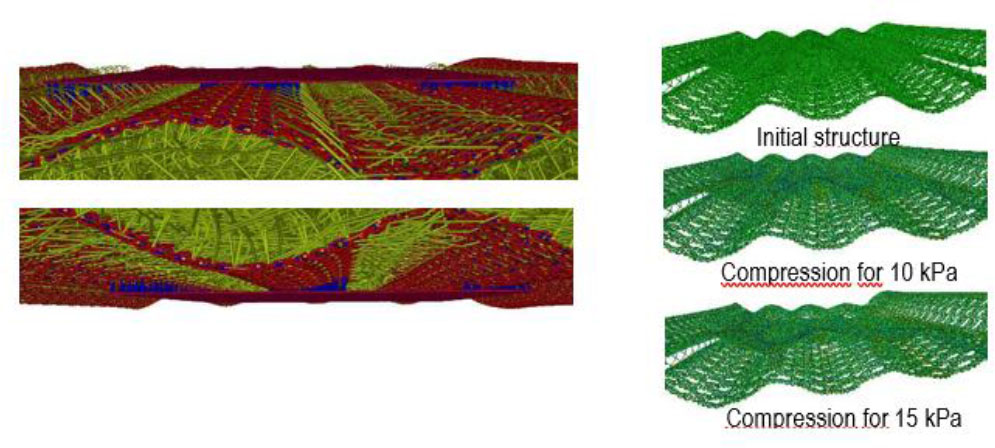
Fig. 14.
Found contacts after the final iteration of the removal algorithm and stitched fabric under different compressive loads