
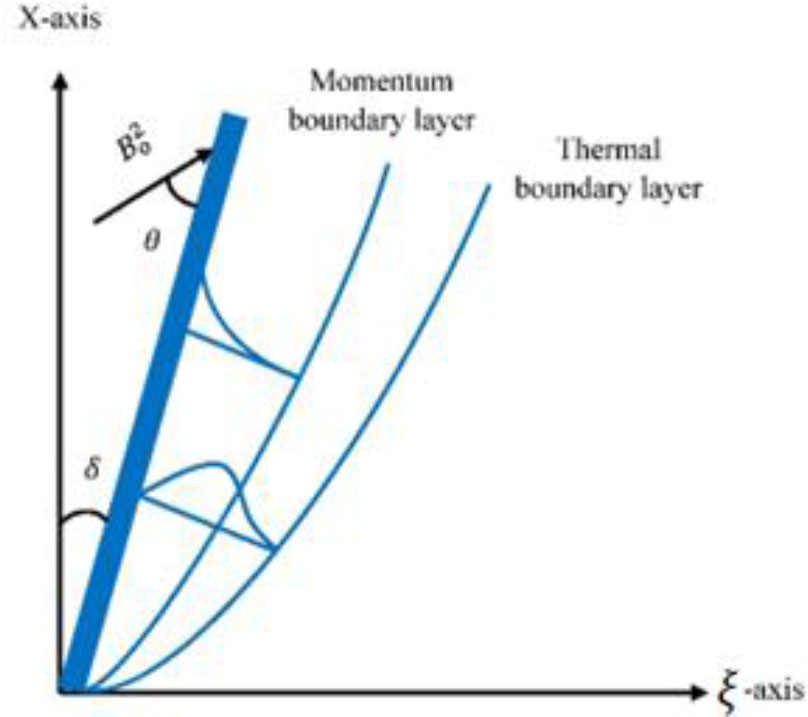
Fig 1.
Geometry of the problem
Tab. 1.
| Material | H2O | Blood | Al2O3 | TiO2 |
|---|---|---|---|---|
| ρ(kgm−3) | 997.1 | 1053 | 1600 | 4250 |
| Cp(kg−1k−1) | 0.4179 | 3594 | 796 | 686.2 |
| K(Wm−1k−1) | 0.613 | 0.492 | 3000 | 8.9528 |
| BT×10−5(k−1) | 21 | 0.18 | 44 | 0.90 |
Tab. 2.
A comparison of solutions with two diverse approaches
| ξ | Temperature by Stehfest | Temperature by Tzou | Velocity by Stehfest | Velocity by Tzou |
|---|---|---|---|---|
| 0.1 | 0.9471 | 0.9471 | 0.7001 | 0.6999 |
| 0.2 | 0.8971 | 0.8971 | 0.7856 | 0.7854 |
| 0.3 | 0.8496 | 0.8496 | 0.8532 | 0.8530 |
| 0.4 | 0.8046 | 0.8046 | 0.9053 | 0.9051 |
| 0.5 | 0.7619 | 0.7619 | 0.9438 | 0.9436 |
| 0.6 | 0.7215 | 0.7215 | 0.9707 | 0.9705 |
| 0.7 | 0.6831 | 0.6831 | 0.9875 | 0.9872 |
| 0.8 | 0.6468 | 0.6468 | 0.9956 | 0.9954 |
| 0.9 | 0.6123 | 0.6123 | 0.9964 | 0.9961 |
Tab. 3.
Numerical analysis of Nusselt number as well as skin friction for CF and AB derivatives
| α, β | Nu by CF | Nu by AB | Cf by AB | Cf by CF |
|---|---|---|---|---|
| 0.1 | 0.5352 | 0.5309 | 0.1836 | 0.1824 |
| 0.2 | 0.5276 | 0.5204 | 0.1751 | 0.1553 |
| 0.3 | 0.5151 | 0.5053 | 0.1611 | 0.1335 |
| 0.4 | 0.4972 | 0.4842 | 0.1423 | 0.1127 |
| 0.5 | 0.4730 | 0.4558 | 0.1203 | 0.0934 |
| 0.6 | 0.4411 | 0.4193 | 0.0965 | 0.0777 |
| 0.7 | 0.4000 | 0.3761 | 0.0728 | 0.0677 |
| 0.8 | 0.3502 | 0.3326 | 0.0513 | 0.0637 |
| 0.9 | 0.2965 | 0.2996 | 0.0359 | 0.0654 |
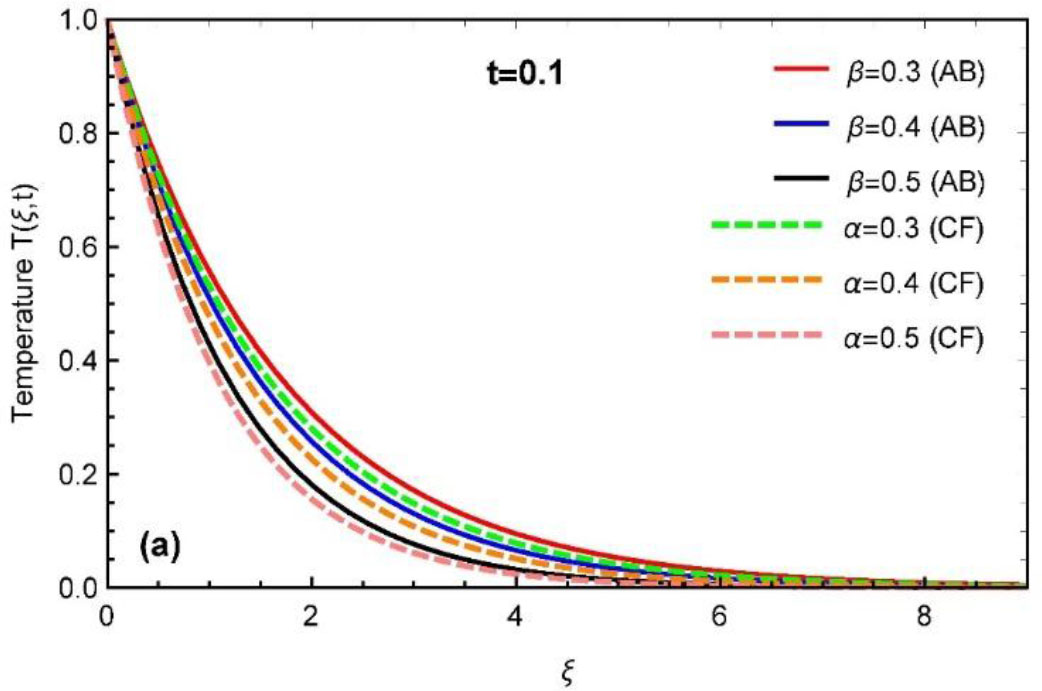
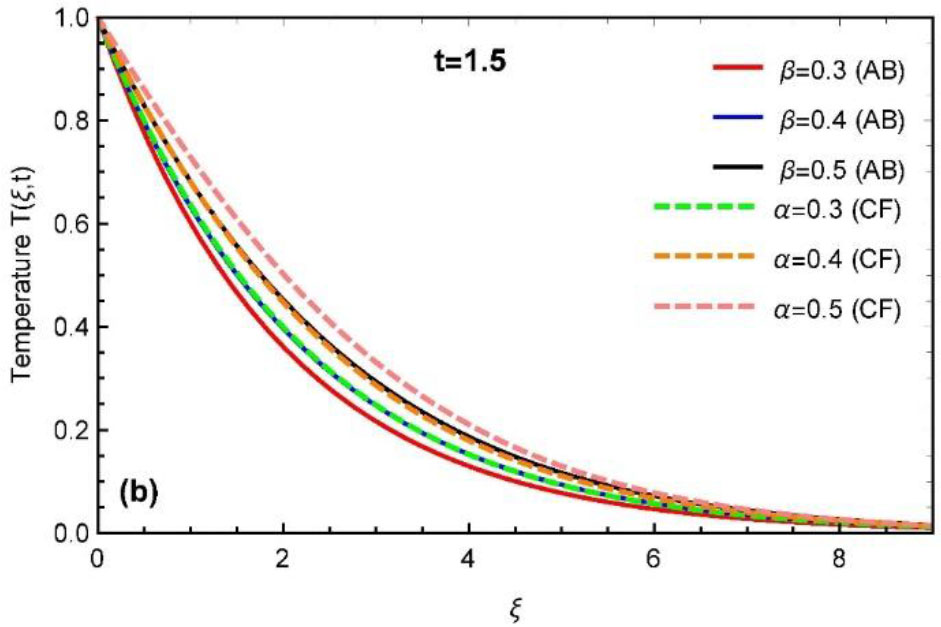
Fig. 2.
Plot of temperature field for both fractional models when Pr = 0.3, φ = 0.01 with (a): t = 0.1 and (b): t = 1.5
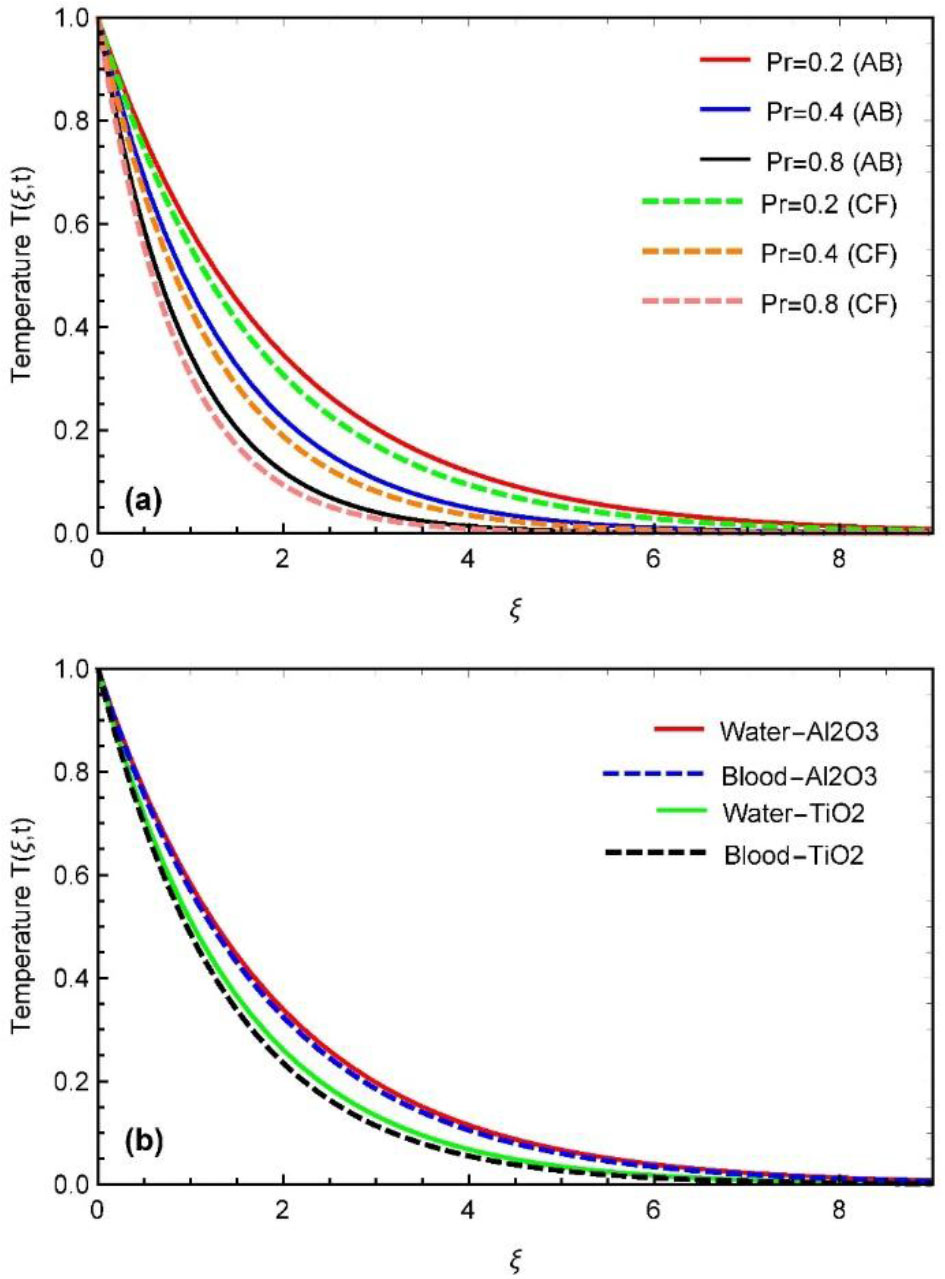
Fig. 3.
Temperature field for diverse values of (a): Prandtl number and (b): nanofluid with α, β = 0.5, φ = 0.01, and t = 0.1
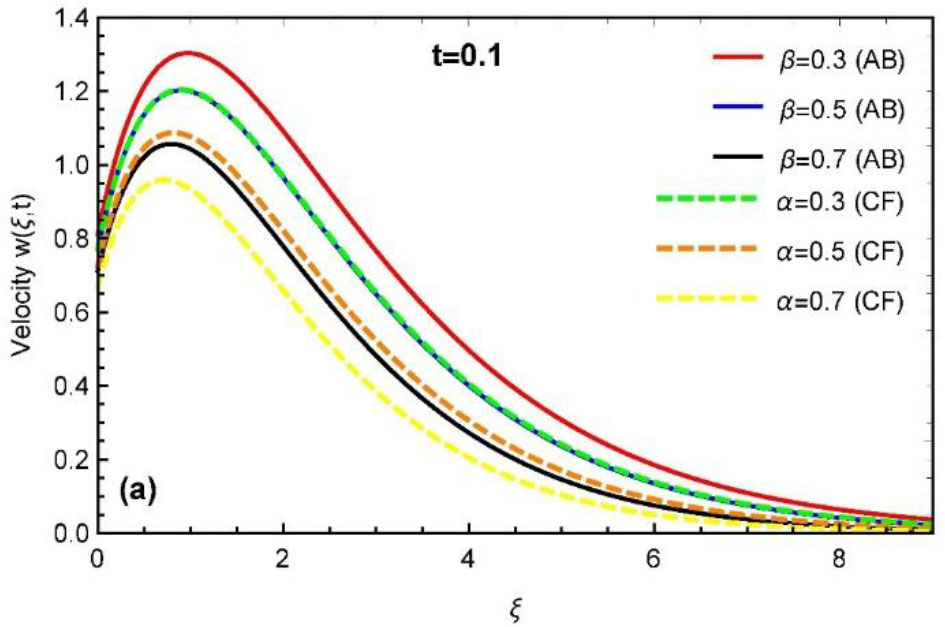
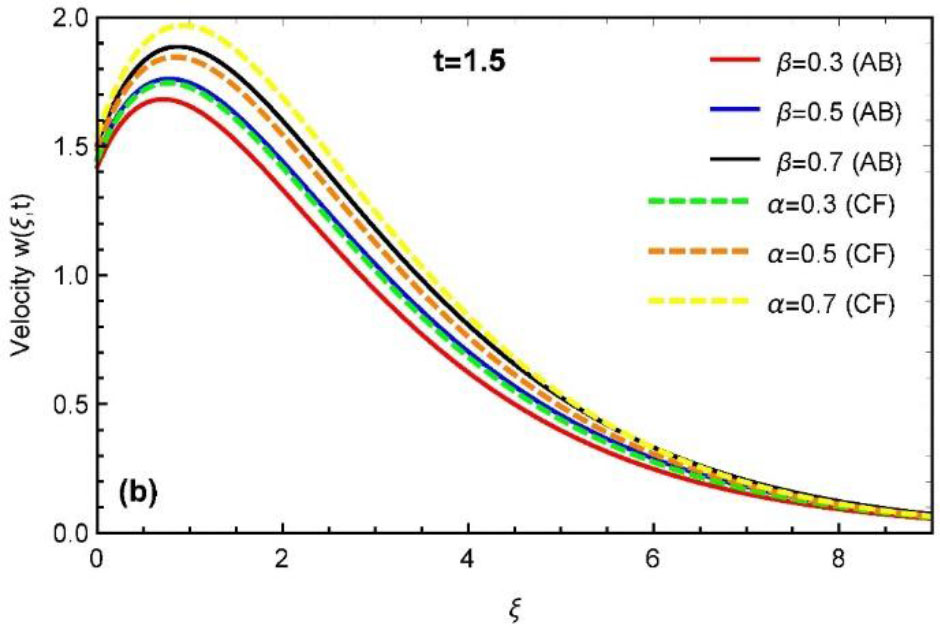
Fig. 4.
Effect of (α, β) on velocity for Pr = 0.3, M = 0.5, Gr = 4, , w = 0.9, b = 0.5, and (a): t = 0.1 (b): t = 1.5
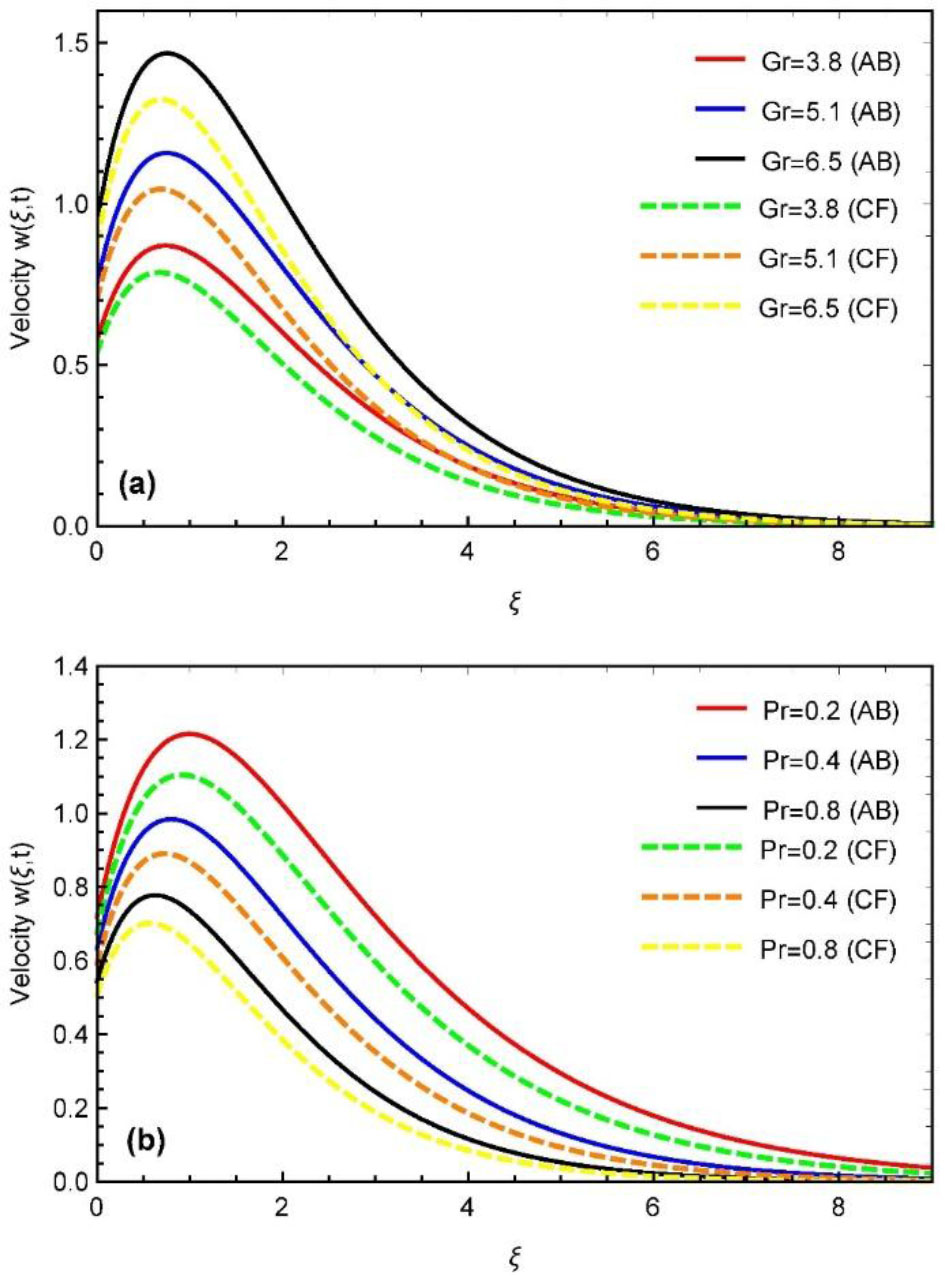
Fig. 5.
The effect of (a): Grashof number (b): Pr on velocity when α, β = 0.5, M = 0.5, , w = 0.9, b = 0.5, , t = 0.1
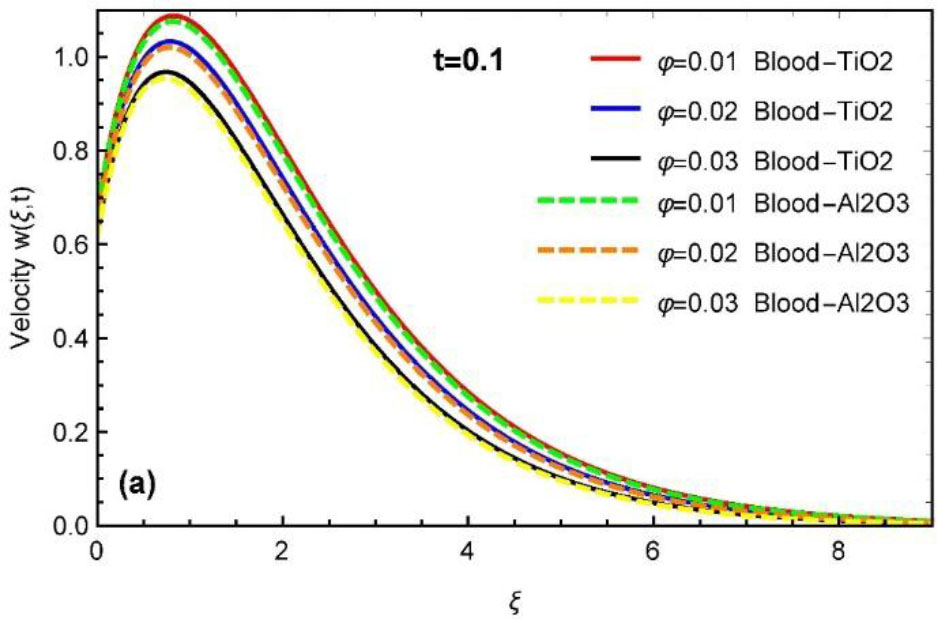
Fig. 6.
Effect of volume fraction φ on velocity for α, β = 0.5, Pr = 0.3, M = 0.5, Gr = 4, , w = 0.9, b = 0.5,
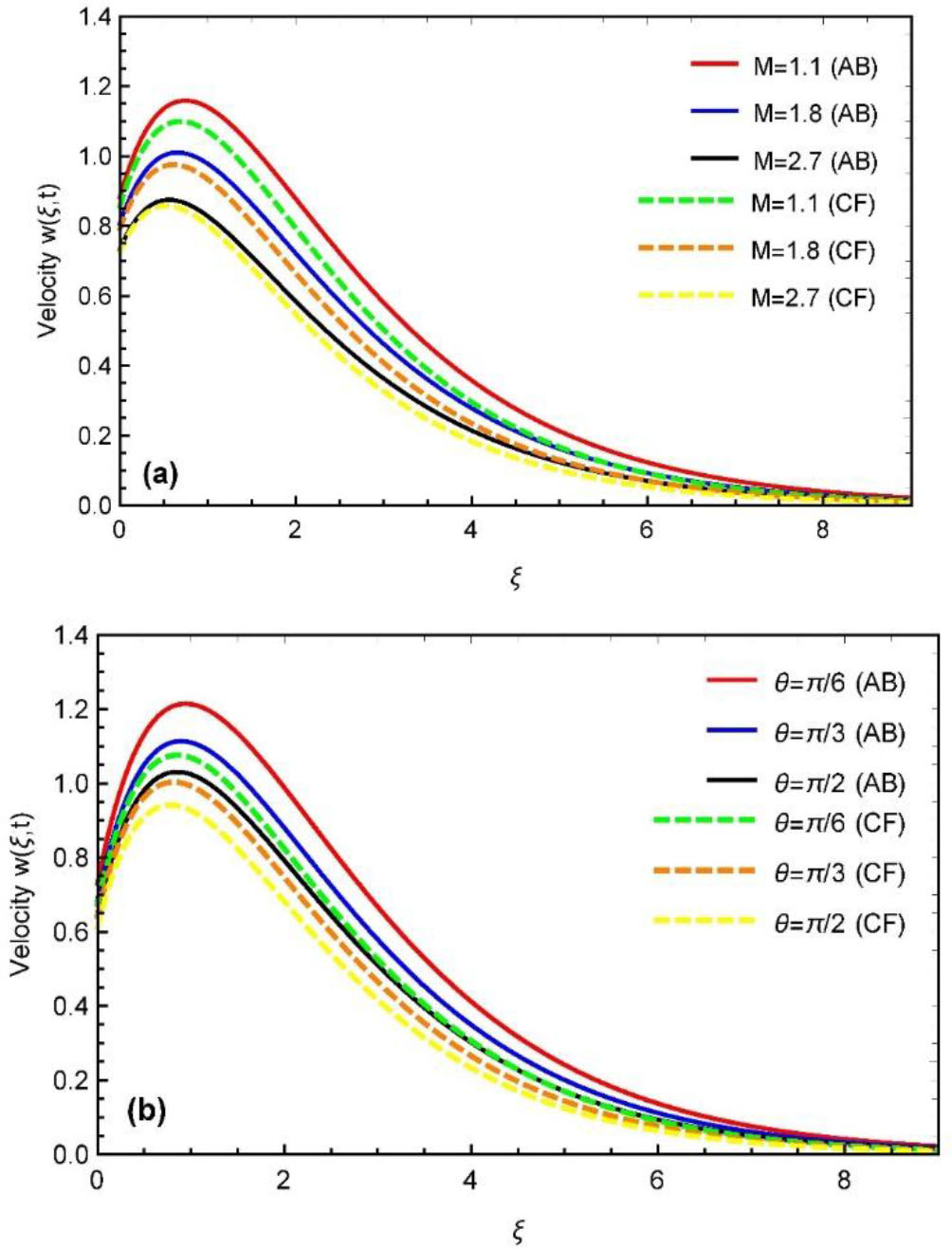
Fig. 7.
Variation in (a): magnetic parameter and (b): the inclination of magnetic field for velocity field with α, β = 0.5, Pr = 0.3, Gr = 4, w = 0.9, b = 0.5, , t = 0.1
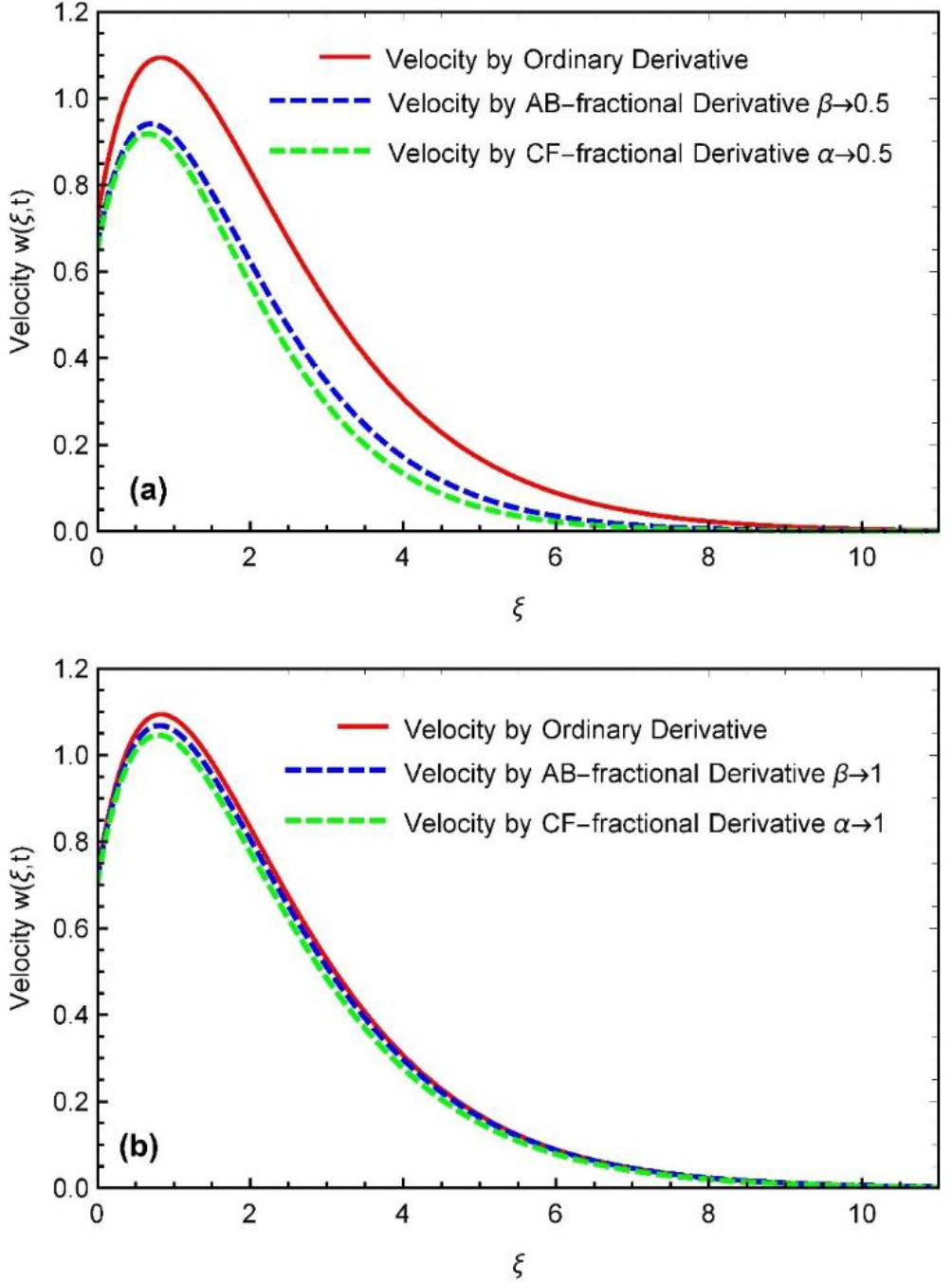
Fig. 8.
Comparison of ordinary and fractional velocity when (a): α, β → 0.5 and (b): α, β → 1
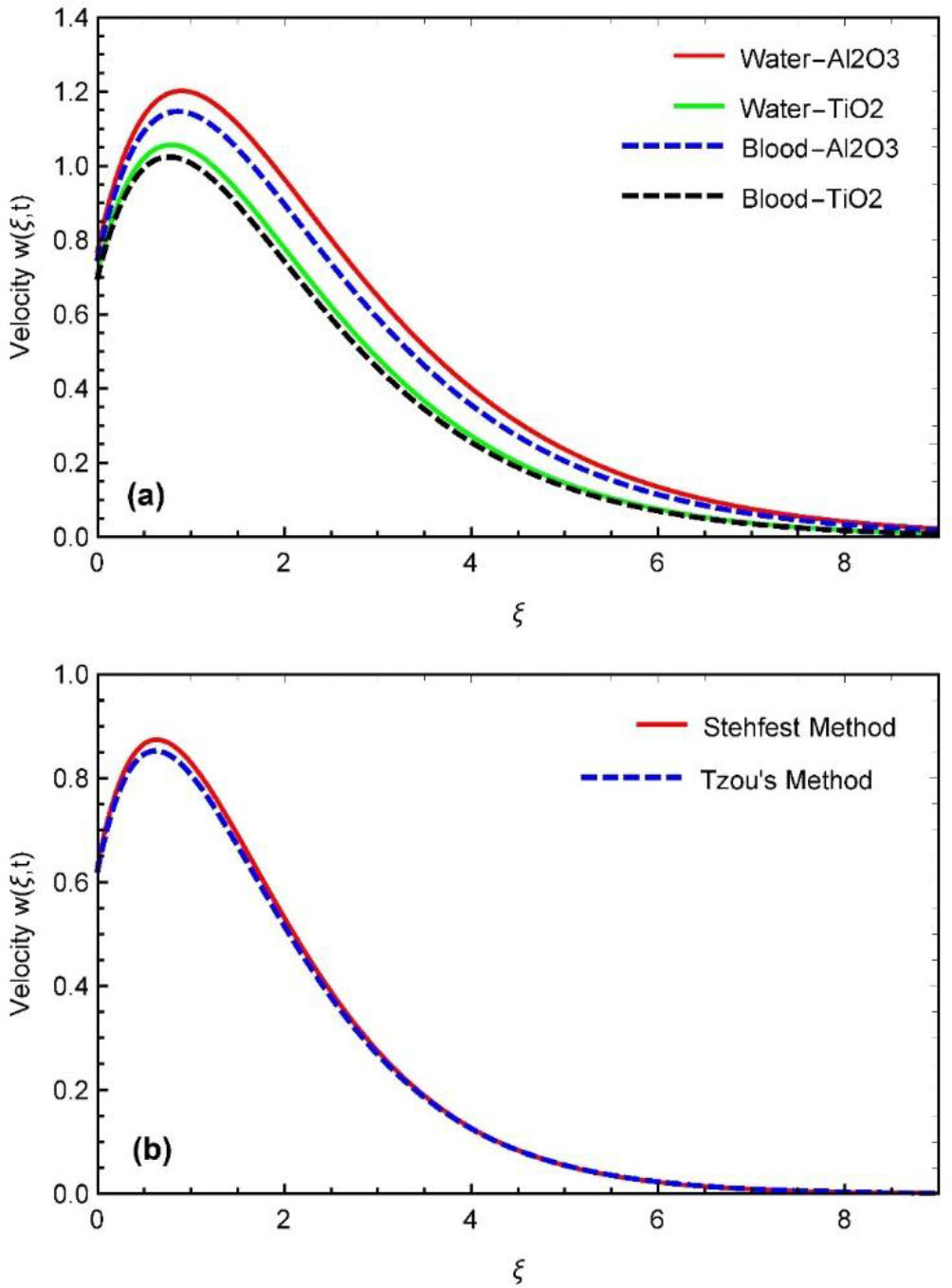
Fig. 9.
Comparison of (a): nanofluids and (b): numerical techniques for the velocity field
| Symbol | Quantity | Unit |
|---|---|---|
| w | Velocity | (m/s) |
| t | Time | (s) |
| T | Temperature | (K) |
| knf | Thermal conductivity of nanofluid | (W/mk) |
| T | Temperature | (K) |
| T∞ | Ambient temperature | (K) |
| Gr | Grashof number | (−) |
| M | Dimensionless magnetic parameter | (−) |
| Pr | Prandtl number | (−) |
| q | Laplace transform variable | (−) |
| Bo | Strength of magnetic field | (kg/s2) |
| Cp | Specific heat at constant pressure | (J/kgK) |
| b | Slip parameter | (−) |
| Cf | Skin friction | (−) |
| Nu | Nusselt number | (−) |
| μnf | Dynamic viscosity | (Pa-s) |
| α, β | Fractional parameters | (−) |
| α1 | Second-grade parameter | (−) |
| βT | Volumetric coefficient of expansion | (−) |
| ρnf | Density of nanofluid | (kg/m3) |
| θ | The angle of magnetic inclination | (−) |
| δ | The inclination angle of the plate | (mol/m3) |
| βT | Volumetric coefficient of expansion | (−) |
| σnf | Electrical conductivity of nanofluid | (−) |
| ρf | Density of fluid | (kg/m3) |
| ρs | Density of solid | (kg/m3) |
| φ | The volume fraction of nanofluid | (−) |