
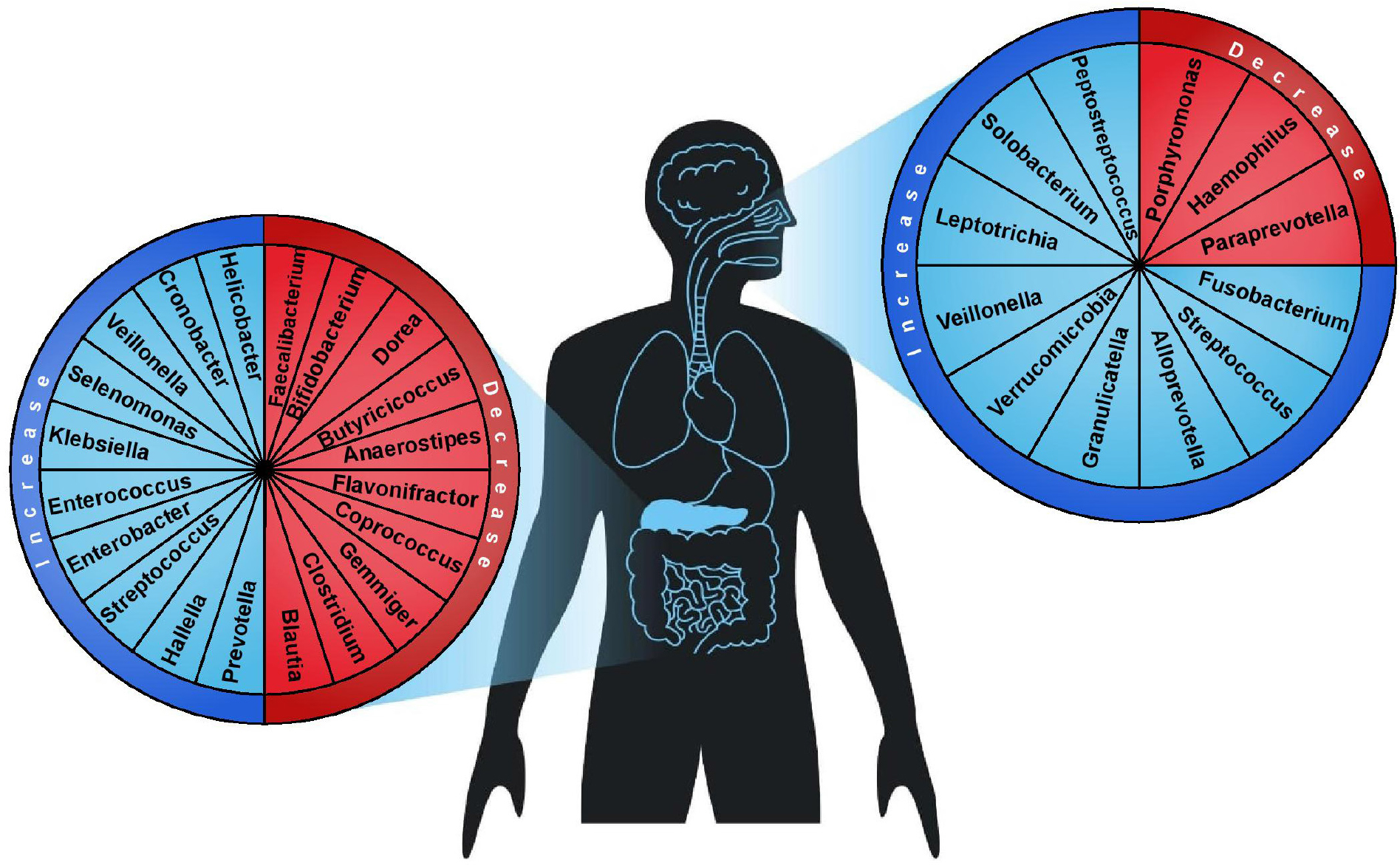
Figure 1.
Occurrence of taxonomic groups of bacteria in the oral and intestinal microbiome of patients with pancreatic cancer compared to the population of healthy people. Red fields in the pie chart - a decrease in the number of bacteria, blue fields in the pie chart - an increase in the number of bacteria. Original graphic.
Tab. 1
Summary of key research articles on the associations between the microbiome and pancreatic cancer.
Legend: CP - Chronic Pancreatitis, PC - Pancreatic Cancer, PDAC – Pancreatic Ductal Adenocarcinoma, NK – Natural Killer Cells, Th – T helper cells, PHC – Pancreatic Head Carcinoma, IM – Intestinal Microbiota, EPI – Exocrine Pancreatic Insufficiency, SI – surgical intervention, CPS – Chronic Pancreatitis Syndrome, IBS – Irritable Bowel Syndrome, PA – Pancreatic Adenocarcinoma, LTS – Long-Term Survival, PFS – progression-free survival, OS – overall survival, GI – gastrointestinal
| References | Type of research | Materials and methods | Conclusions |
|---|---|---|---|
| Fan et al. 2016 | Case-control study | Adenocarcinomaa of pancreas patients (n=361), 16S rRNA sequencing of mouthwash samples | Carriage of oral pathogens, P. gingivalis and A. actinomycetemcomitans were associated with higher risk of pancreatic cancer |
| Wei et al. 2020 | Prospective study | Pancreatic cancer patients (n=41), healthy individuals (n=69); 16S rRNA sequencing of saliva | Carriage of Streptococcus spp. and Leptotrichia spp. (z-score) was associated with a higher risk of PDAC |
| Chen et al. 2023 | Multisite analysis | pancreatic cancer patients (n=40), chronic pancreatitis patients (n-15), healthy controls (n=39); 16S rRNA sequencing of saliva | The chronic pancreatitis group exhibited the lowest microbial diversity, while no significant difference was found between the pancreatic cancer and healthy controls groups |
| Lu et al. 2019 | Clinical study/analysis | patients with pancreatic head carcinoma (n=30), healthy individuals (n=25); 16S rRNA sequencing of the tongue coating samples | The microbiota dysbiosis of the tongue coat in PHC patients and provide insight into the association between the human microbiome and pancreatic cancer |
| Pietzner et al. 2021 | Study population/analysis | 16S rRNA sequencing of fecal samples (n=2226) | The effect of exocrine pancreatic function on intestinal microbiota composition alters the availability of microbial-derived metabolites in the blood and thus directly contributes to the host metabolic changes associated with exocrine pancreatic dysfunction |
| Zhou et al. 2020 | Correlation analysis | healthy controls (n=69), chronic pancreatitis (n=71); 16S rRNA sequencing of fecal samples | Patients with chronic pancreatitis have gut microbiota dysbiosis that is partly affected by pancreatic exocrine function |
| Maev et al.. 2023 | Comparative analysis | patients (n=85) including pancreatitis without extrinsic pancreatic insufficiency (EPI, n=16), with chronic pancreatitis and mild EPI (n=11), with severe pancreatitis and EPI (n=17); 16S rRNA sequencing of fecal samples | The IM of all groups showed the dominance of phyla Firmicutes with the lowest representation in the severe EPI group, both with SI and CP, and the growth of the phyla of Actinobacteria, Verrucomicrobiota and Fusobacteria |
| Nii et al., 2023 | Experimental study | Bacterial strains (n=13) isolated from the feces of patients and healthy controls; in vitro stimulation of bone marrow-derived dendritic cells, genome sequencing of Prevotella copri | Stimulation experiments have shown up-regulation of IL-17 and Th17-related cytokines (IL-6, IL-23) of Prevotella copri, which contributes to causing rheumatoid arthritis, the same pathway may contribute to pancreatic cancer through Th17 activation |
| Maekawa et al. 2018 | Metagenomic analysis | 16S rRNA sequencing of pancreatic juice from pancreatic cancer patients (n=20) and duodenal cancer patients (n=16) | E. faecalis was frequently detected in pancreatic tissue from patients with CP and PC, and antibody titers against E. faecalis capsular polysaccharide were elevated in E. faecalis-positive patients compared to healthy donors |
| Stein-Thoeringer et al. 2024 | Prospective study | non-cancer participants (n=38), pancreatic cancers patients (n= 63); 16S rRNA sequencing of samples collected from various sites of the GI tract and surgical sites, microbial culturing | The presence of Enterococcus spp. in bile ducts of PDAC patients undergoing pancreatic surgery represents a significant risk factor for perioperative infections and, thereby, elevated postoperative and long-term mortality |
| Ren et al. 2017 | Prospective study | pancreatic cancer patients (n=85), healthy controls (n=57); 16S rRNA sequencing of fecal samples | The gut microbial profile was unique in PC, providing a microbial marker for non-invasive PC diagnosis |
| Risch et al. 2014 | Case-control study | pancreatic cancer patients (n=761), random controls (n=794); venipuncture specimens, antibody seropositivity for H. pylori and its virulence protein CagA was assessed using commercial enzyme-linked immunosorbent IgG assays. | H. pylori colonization may have diverse effects on cancer risk, depending on the organism strain type as well as on the cancer site. |
| Wang et al. 2014 | Meta-analysis | cases of H. pylori infection on pancreatic cancer (n=2049), control group (n= 2861); databases analysis | Hp+ and CagA+ infections are associated with a decreased risk of pancreatic cancer in Eastern populations but have no significant associations in Western countries. |
| Xu et al. 2022 | Meta-analysis | case-control studies (n=8), nested case-control studies (n=5), cohort studies (n=4); databases analysis | H. pylori infection can increase the incidence of pancreatic cancer in general. CagA/VacA-positive H. pylori infection is not associated with the incidence of pancreatic cancer |
| Half et al. 2019 | Comparative study | pancreatic adenocarcinoma patients (n=30), pre-cancerous lesions patients (n=6), healthy individuals (n=13), non-alcoholic fatty liver disease patients (n=16); 16S rRNA sequencing of fecal samples | Find a distinct PC-associated gut microbiome signature in an Israeli cohort, manifesting primarily as an under-representation in several bacterial families prevalent in the healthy gut |
| Edogawa et al. 2020 | Prospective study | patients with IBS (n=39), healthy volunteers (n=25), 16S rRNA sequencing of fecal samples | A subset of patients with IBS, especially in PI-IBS, has substantially high fecal PA, greater symptoms, impaired barrier and reduced microbial diversity. |
| Ubachs et al. 2021 | Clinical study | Pancreatic cancer patients (n=107), household partners (n=76); 16S rRNA sequencing of fecal samples | There were no significant differences in the composition of the bacteriobiota, although cachexia prevalence was highest in pancreatic cancer (66.7%). Faecal calprotectin levels were positively correlated with the abundance of Peptococcus, Enterobacteriaceae, and Veillonella. |
| Riquelme et al. 2019 | Clinical study | surgically resected PDAC tumor samples (n=68; 36 of LTS and 32 of STS); 16S rRNA sequencing of surgically resected PDAC tumors, PCR flow cytometry | The tumor microbiome unique to LTS may contribute towards shaping a favorable tumor microenvironment. |
| Yu et al. 2022 | Cohort study | Mice model; NK cell depletion, bacterial manipulation | The gut microbiota mediates PDAC progression through NK cell modulation and that gut microbiota-derived supernatant can modulate anti-tumor NK cell activity |