
Introduction
Parkinson’s disease
Parkinson’s disease (PD) is a complex neurodegenerative condition with no cure. The condition worsens over time, reducing a person’s quality of life and well-being (World Health Organization 2023). PD causes visible symptoms of tremors, slowness of movement, rigidity when walking and difficulties with balance. These symptoms are preceded by a variety of invisible symptoms, including sleep disorders, constipation, and anxiety and depression (Waller, Williams et al. 2021). Knowledge of these symptoms assists with early diagnosis and treatment (Waller, Williams et al. 2021). The prevalence of PD in Australia is comparable with other diseases identified as national health priorities, such as cancer (Parkinson’s NSW 2024) and cardiovascular disease (Fealy, Logan et al. 2023).
According to the World Health Organization (2023), more than 8.5 million people worldwide were living with Parkinson’s disease in 2019, with its prevalence doubling over the past 25 years, making it the fastest-growing neurological disorder in terms of disability and mortality.
In Australia, the disease disproportionately affects older adults, with 1,185 deaths recorded among those aged 75 and over, and 460 deaths among those aged 55–74 in 2019 (World Health Organization 2023). It was estimated that in 2019, around 212,000 people were living with PD across Australia, with a higher prevalence in rural and regional areas compared to urban areas, associated with environmental factors such as exposure to pesticides and other chemicals (Ayton, Ayton et al. 2019). People with PD living in rural and regional areas generally have poorer access to specialist services than people in urban areas (Australian Government 2017). This often results in delayed diagnosis, limited access to supportive treatment and rehabilitation, with marked impacts on quality of life, placing a greater burden on those with PD, their caregivers and families (Fealy, Logan et al. 2023, Micalos, Logan et al. 2024).
Parkinson’s support groups
Support groups are defined as a group of people with common experiences and concerns who provide emotional and moral support for one another (Parkinson’s NSW 2024). People living with PD, their caregivers and families may attend a support group for a range of reasons. These include increasing understanding of the disease, building social networks, connecting with others in similar circumstances, sharing stories, forming friendships, and obtaining information to help manage PD symptoms, related disabilities and the uncertainties that lie ahead as the disease progresses (Spencer, Haub et al. 2020, Carroll 2023).
International research has identified that people with PD and caregivers who participate in professional-led or peer-led support groups demonstrate a greater acceptance of PD and are better able to cope with the challenges of the disease (Aamodt, Kluger et al. 2024). Members’ ability to navigate the challenges of PD is enhanced when health professionals are involved or leading the group. This facilitates the sharing of evidence-based information, symptom management strategies and navigating the complexities of healthcare (Bush, Singh et al. 2018, Paparella 2023). In Australia, there are currently over 218 Parkinson’s support groups.
Sustainability is a common problem for Parkinson’s support groups. Wituk et al. (Wituk, Shepherd et al. 2002) discussed the importance of support from local and national organisations in maintaining a group and its sustainability. While bridging the divide between local groups, state and national organisations and healthcare services is challenging, partnerships with formal services can support group development, assist in recruiting members and provide education for leaders (Horsfall, Psychogios et al. 2020).
Research specifically focusing on leadership of Parkinson’s support groups is sparse compared to research examining support group leadership for other conditions, such as cancer, multiple sclerosis (MS) (Pomery, Schofield et al. 2016, Worrall, Schweizer et al. 2018). Most PD studies focus on the involvement of experts, health professionals and nurses in Parkinson’s support groups (Bush, Singh et al. 2018) rather than specifically exploring support group leadership as a volunteer role or position. Studies specifically focused on examining the role of Parkinson’s support group leaders in Australia are limited, particularly in rural and regional areas where there is less access to specialist services (Fealy, Logan et al. 2023).
The purpose of this study was to investigate leadership in Parkinson’s support groups across rural and regional New South Wales, Australia, specifically focusing on the skills, knowledge, and experience of the group leaders. A secondary aim was to identify factors that impact the function and sustainability of these support groups.
Methods
Setting
This study was set in rural and regional areas of New South Wales, Australia (Australian Bureau of Statistics 2016). (Figure 1).
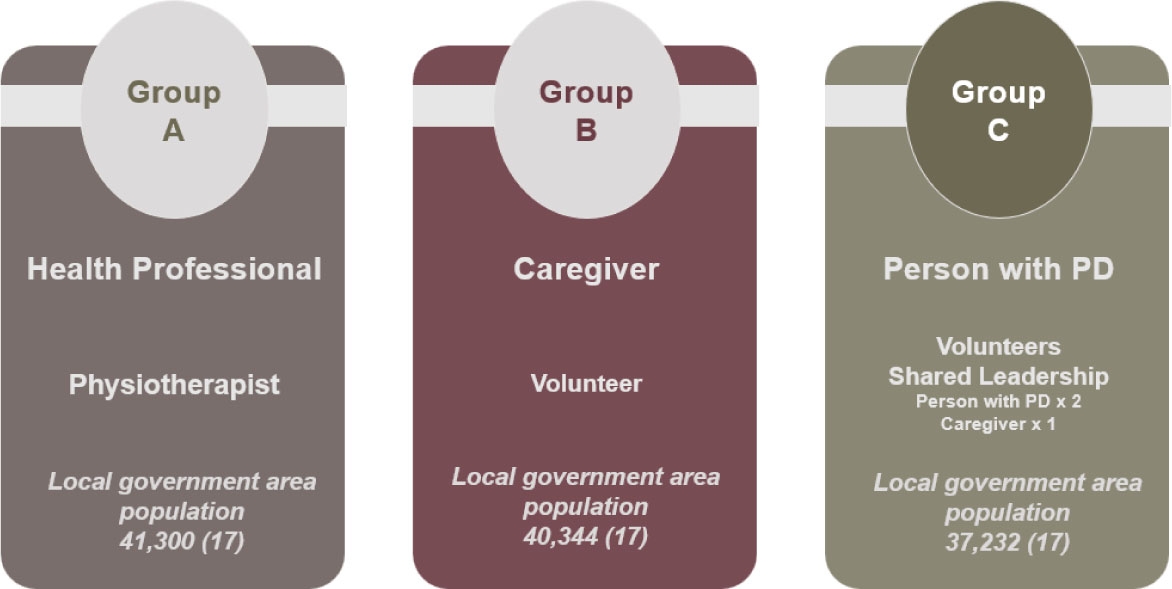
Figure 1:
Study sites
Study design
The overall study utilised a three-site case study design underpinned by an interpretivist paradigm, enabling an in-depth exploration of this complex topic. The design enabled the authors to compare the complexities of the support group leader role as enacted by each different type of leader, with a focus on their skills, knowledge, and experience (Stake 1978).
Table 1:
Participant characteristics
| Pseudonym | Gender | Age | Type of leadership | Education | Occupation | Time in role (Yrs.) |
|---|---|---|---|---|---|---|
| Deborah | Female | 51 | Health professional | Bachelor’s degree | Physiotherapist Employed | 22 |
| Keith | Male | 71 | Caregiver | Bachelor’s degree | Retired Volunteer | 6 |
| Shared leadership model | ||||||
| Elaine | Female | 71 | Person with PD (Principal) | Graduate certificate | Retired Volunteer | 6 |
| Dot | Female | 78 | Person with PD (Supporting role) | Senior secondary school | Retired Volunteer | 6 |
| Beverley | Female | 75 | Caregiver (Supporting role) | Junior secondary school | Retired Volunteer | 6 |
Recruitment
Recruitment information was posted on the Charles Sturt University and Parkinson’s NSW websites. Support group leaders interested in participating in the study were invited to contact the first author. A support group leader is identified as a person, or persons, elected or appointed to perform the role of chair or deputy chair for the support group (Parkinson’s NSW 2020). At each site, a minimum of one and a maximum of three leaders were sought for the project.
Participants
The participants recruited were people who led a Parkinson’s support group in rural and regional
New South Wales. Three support groups were recruited to ensure a spread of three different leaders: a health professional, a caregiver, and a person with PD. The person with PD led a group that uses a shared model of leadership, i.e., the main leader is a person with PD, supported by a person with PD and a caregiver. See Table 1.
Data collection
Semi-structured interviews used an interview guide developed following a comprehensive literature review on support group participation. Attention was given to ensuring the focus was on co-generation of knowledge between the researcher (first author) and participants, providing the opportunity to understand complex issues specific to Parkinson’s support groups (Stake 1978). The interview guide (Table 2) was designed to focus the discussion, enabling each participant to feel involved in the research, and to self-reveal when talking about controversial and sensitive issues. Data collection was initially to be face-to-face in each support group locality. However, the COVID-19 pandemic restrictions imposed in Australia necessitated a shift to online interviews (COTA 2023). These were conducted via Zoom, a cloud-based video conferencing service that enables people to meet virtually. All participants in the study were provided with the opportunity to participate in a follow-up interview either via Zoom or by telephone if they had further information they wished to share.
The interviews were conducted by the first author between September and December 2020. Written consent was obtained from each participant before starting their interview. Each participant was sent a copy of the transcribed interview to review and make changes if needed. Before starting data analysis, all data were de-identified.
Table 2:
Interview guide
| Interview Guide |
|---|
|
Data analysis
The data analysis used a hierarchical framework approach to identify patterns and generate themes from the data (Smith and Firth 2011). The data analysis software, NVivo, was used to support the analysis process. A coding matrix was applied to the transcripts, with categories emerging from this process. This helped identify patterns, generate themes from the data, and develop formal ideas.
Author one coded the transcripts, then met regularly with authors two and three to review and engage in reflexive discussions ensuring the analysis was accurate and reliable (Attride-Stirling 2001, Smith and Firth 2011). As the analysis progressed, codes and themes were further refined with similar codes combined into broader themes and sub-themes, then defined in thematic tables. Through this process, a comprehensive picture of the data emerged (Attride-Stirling 2001, Smith and Firth 2011). Representative quotations are used to support the analysis, and participation identification pseudonyms are outlined in Table 2.
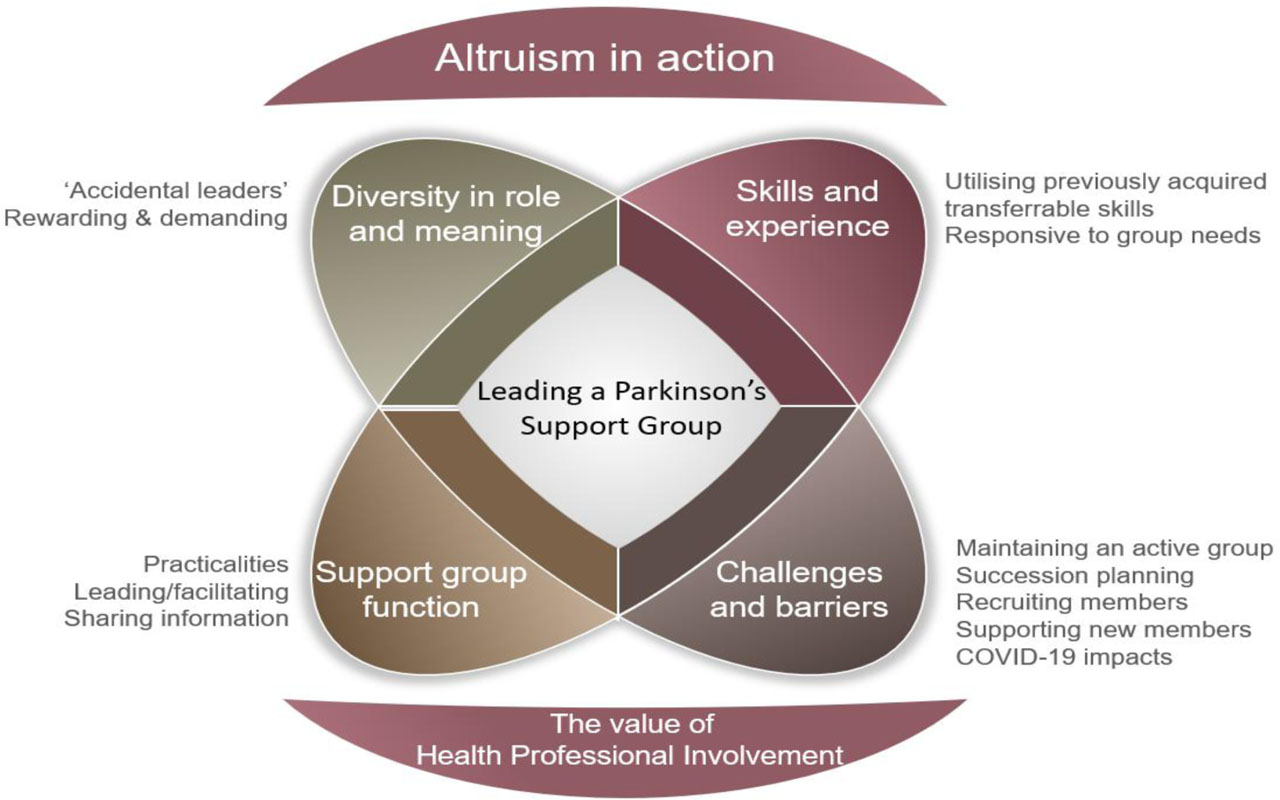
Figure 2:
Summary of themes
Ethics
The Charles Sturt University Human Research Ethics Committee provided ethics approval for this research project (20088). The study is reported against the Consolidated Criteria for Reporting Qualitative Research (Tong, Sainsbury et al. 2007).
Results
The findings are presented from the five support group leader participants, all of whom have been assigned pseudonyms to protect their identities (Table 1). They are Deborah, a physiotherapist and leader of the health professional support group; Keith, a retired university administrator and leader of the caregiver-led support group; Elaine, a retired office manager and leader of the Parkinson’s-led support group, supported by Dot, a retired public service office administrator with PD; and Beverley, a retired telephonist and a caregiver for her husband who has PD. The results are presented under two major themes – ‘altruism in action’ and ‘value of health professional involvement’ (Figure 2).
Altruism in action
Each leader promoted the well-being of their group’s participants and aimed to provide them with opportunities to be with people who shared a common bond of being connected by PD. They exhibited strong embedded personal values and ideals and motivated group participants to come together and share their experiences, learn from each other, and be rewarded by group participation. Each enacted their roles with a level of commitment and passion that demonstrated ‘altruism in action’, placing the needs of the support group members above their own.
Diversity in role and meaning
The leaders of each group found themselves in the role by default, as accidental leaders. Elaine said, “… I got involved army style, volunteered by somebody else!” Keith described becoming an accidental leader, “I just sort of slipped into the role as the leader …”. In contrast, Deborah transitioned into the role, delegated as part of her position when “the aged care team identified a need for supporting people with Parkinson’s” and the local healthcare service had established the group.
Each of the leaders identified intrinsic rewards associated with leading a group, while attributing a different meaning to the ‘demanding’ role. Deborah said, “It is rewarding at different times, though when I first started in the role, I found it really taxing”. Keith described the reward of seeing one member diagnosed with PD attend: “The group changed his life. He openly spoke about how he felt at the meetings and his wife used to tell me on the side as well”. They also described the demands of being both a caregiver and a support group leader: “You almost need to be able to run two lives”. In comparison, Elaine highlighted the personal benefit, “Being the leader helps me. It helps me because it keeps me up to date with things”.
Skills and experience
Group leaders talked about their previous occupations and how the knowledge and skills acquired during their working life transferred to their role as a group leader. Keith noted the impact of skills gained from “a degree in business and a diploma of education”, saying, “There’s no doubt that my working life and other voluntary commitments I’ve had over the years played a big role”. Likewise, Elaine spoke of transferrable skills and knowledge from prior experiences: “My husband and I were joint leaders of a family group made up of people of all different sizes, race, colour …”. In contrast, Deborah described her clinical skills as enabling her to provide an engaging and enjoyable atmosphere for the support group members, “our fortnightly exercise class, especially the blokes (men), they just love to get together and have a good chin wag (conversation)”.
Ongoing training and education were seen as an integral part of being a support group leader. Deborah described adding to her professional knowledge: “As a qualified physiotherapist and practising health professional, I have learned about Parkinson’s during the 22 years I have been the leader”. Keith spoke about his professional skills blended with his understanding of PD, having cared for his wife for over 16 years. “I’m the walking dictionary; I help compose the notes she sends out as she struggles with the technology”. Elaine spoke of her professional and personal skills, “my previous work and life history and having PD has turned me into a person who has a lot of experience with death and dying”.
Support group role and functions
Group meetings are held in partnership with local entities, at either a health service or a community club. Common goals were evident across the groups, particularly in terms of providing social interactions and opportunities for friendship.
Leading a PD support group
Keith explained, “I see my role as more as a facilitator”. Elaine described their meeting format as “semi-formal. Everybody has their own little information time”. Similarly, Deborah described their group as functioning relatively informally, “the meetings are about connecting socially, the common factor is Parkinson’s”. Keith felt that “the group works much better if you’re not too intrusive and you get everyone involved”. In comparison, Deborah focused more on personal development, “anything to do with leadership skills, managing people, being the best version of yourself is what I like doing”.
Sharing information
The leaders spoke about sharing and learning new information as integral to the effective functioning of support group meetings. Groups had a variety of guest speakers, with topics relevant to PD and other interesting subjects. Hearing from various health professionals and allied health students and access to information from credible sources were considered valuable. “People really do like having guest speakers come along” (Deborah); “the group relies on hearing from health professionals, we get together and share information” (Keith); “our members want to know detailed things, and this is where the guest speakers come into their own because they can concentrate on that one subject” (Elaine).
Challenges and barriers
Leading a group involves a range of challenges, irrespective of whether the leader had formal training and leadership qualifications. For Keith, new members were seen as important to maintaining an active group, and he described focusing on “trying to encourage more people to come along”. In comparison, Elaine focused on providing new information, especially accessing “what new research might be happening and what’s happening in Parkinson’s NSW (the peak body)”. Deborah spoke of the challenge of “trying to keep it interesting” and noted “I find the hardest [thing] to do is trying to find guest speakers”.
Succession planning
All leaders described succession planning as a major barrier to the group’s longevity. Keith observed that, “the challenge is having someone available to pass the baton on to when the time comes”. He said, “the challenge is to share the load with somebody”. Deborah was unsure what would happen in the future, “whether or not someone else staff-wise from here would step in or … step up, I honestly don’t know”. When asked about recruitment, Keith remarked, “we haven’t done anything this year”. Elaine said their group’s strategy of “recruiting new members is mostly word of mouth”. Dot reflected on a time she tried to step back from the leadership position, the response from Elaine was “No! No! No! We want to keep you. Beverley and I are here to help you”. Beverley said her initial role was that of group treasurer, “it was just handed to me … we’d like you to do this. I thought it would be for a couple of weeks, and it ended up being a long time!” Deborah’s response was consistent with the other leaders, the group was “not very good at recruiting, we don’t do a lot of advertising”.
The confronting aspect of new members seeing people with advanced stages of PD
Linked to the apparent hesitancy to actively recruit new support group members was the fear expressed by all leaders that a person newly diagnosed with PD would be confronted by seeing others with advanced stages of PD. Keith explained, “I think it’s fairly confronting when you see the advanced stage that some people are in. I felt exactly the same thing when I walked into the meeting”. A similar response was made by Elaine, who noted that “seeing somebody that’s worse off than what you are and wondering whether that’s how you’ll end up. This can be confronting for people, and I can vouch for that”. Deborah’s response also identified this challenge, “they (new people to the group) struggle with people who have higher needs, you don’t want to freak them out”. Beverley spoke of the diversity of each person’s symptoms and experiences, “All of the Parkinson’s sufferers are different. They’re not all the same. Different little things happening with them…”. Dot spoke about how their group usually follows up those who don’t return to the group. In one instance, she recounted “it is because the partner doesn’t like what they see when they get to the group”.
The COVID-19 pandemic – impacts
The widespread social restrictions and lockdowns imposed in New South Wales during the COVID-19 pandemic resulted in the cessation of all face-to-face meetings. Keith reported that, “this year has really knocked the wind out of the sails of everyone”. Elaine spoke of the impact on their group’s activities, “I do a calendar for the whole 12 months. We advertised everything on Facebook, on radio, we had it everywhere and had to cancel the whole lot, that was awful!”. Deborah also reflected on the impact of the group being unable to meet and said, “I really want to see those people, the support group was their rock and without their rock, they truly began to crumble, people noticed”.
The value of health professional involvement
The importance of health professional involvement as a support group leader emerged as an overarching theme in the data. Deborah described her inherent skills, education, leadership and lived experience as a physiotherapist: “Being in charge of a physio department, I had done some leadership management training, I also run my own small private practice, these provide me with leadership skills.” She described her extended experience with PD as providing a solid basis for “… our support group to have a strong education and social focus”.
Deborah also described her connections with the health system and how these helped in the context of support group function, “I have good contacts in the right places because I work in health. I don’t have any problem approaching different health professionals to ask to come and talk”. As a health professional, Deborah was also able to visit the members of her support group across a variety of settings outside of the support group meetings; for example, in specific exercise classes and in their homes.
The advent of COVID-19 highlighted the positive benefits of Deborah’s access to seeing people in their home environment:
“As a health professional, I’ve been able to go in and see people in their homes. I’ve had contact with people who hadn’t even been having contact with their own family, and that sense of loss and loneliness was very, very real, and so I just think yeah, that face-to-face human contact is so important”.
Health professionals as guest speakers at the support group
Each participating leader spoke about the value of having health professionals involved in the support group as guest speakers. Deborah spoke about involving the group members in selecting guest speakers and also described the importance of hearing from a pharmacist, “… because medications are so important”, and a dietitian, “… every couple of years, I think there is that need to keep revisiting certain topics”.
The leaders also spoke positively about the involvement of other health professionals; for example, Keith remarked, “when we had a Parkinson’s nurse, it was fantastic because we could get the real story behind whatever it was, rather than the layman’s interpretation”. They structured their meetings so that the first part is “… more of a get together and a bit of information sharing” and the second half is for guest health professional speakers. Elaine found the guest speakers “informative and interesting”, and she has included a range of other speakers:
“We’ve had pharmacists, [a] speech pathologist, audiologist, most people know something about their disorder, but they don’t know the nitty gritty. They want to know detailed things, and this is where the guest speaker comes into their own because they can concentrate on that one subject”.
Discussion
To our knowledge, this qualitative study is the first to investigate leadership across PD support groups in Australia and internationally. Despite the diversity in the role, the experience of the peer leaders (caregiver and person with PD) was similar, while the health professional leader was younger and still working as a physiotherapist. All participants were similar in age to other volunteers in Australia (55–74 years), consistent with Australia’s ageing population (37% retired), although only 30% of volunteers live in rural, regional and remote areas (Biddle, Boyer et al. 2022). Leaders repeatedly put aside their own needs to benefit the members of the group they lead. They demonstrated highly developed communication skills and the capacity to effectively organise, plan, and manage the multifaceted responsibilities associated with group leadership. The involvement of healthcare professionals enhanced the functioning of the support groups, with education, knowledge, and increased comprehension of PD while facilitating increased opportunities for both individual and collective support.
Support group leadership – altruism in action
Each support group leader interviewed in this study revealed an authentic leadership style. They described the level of commitment, time and energy required, along with the need for empathy, patience and understanding and acknowledged that the purpose of their role was primarily to support and promote the best interests of others (Northouse 2022). In this context, leaders, peer-led volunteers and professionals pledge their leadership altruistically for the sake of others without expecting a benefit (Sağnak and Kuruöz 2017, Mulinge 2018). Support group members perceive them as trustworthy, believable and demonstrating strong internal values and ideals (Carroll 2023). Such leaders are effective in motivating others to act in ways that encourage and benefit all group members rather than pursuing their own self-interest (Mulinge 2018, Northouse 2022).
Each leader in the study displayed ‘altruism in action’ in their commitment to nurturing and guiding the group members on their PD journey. The leaders spoke about how the group also enhanced their own personal growth and level of knowledge (Mulinge 2018, Tsai, Newstead et al. 2024). As in similar studies, the leaders found the role personally rewarding and strongly enhancing their psychological well-being (Volunteering Australia and the Settlement Council of Australia 2019). This is consistent with helper-therapy theory, where a high degree of reward is evident for leaders as they perform the helper role and benefit personally from the position (Zordan, Juraskova et al. 2010).
The group leaders in this study have a significant record of lived experience of PD, including awareness of the trajectory of PD and the visible and invisible symptoms. They understand the effects of social isolation on both caregivers and people with PD resulting from low mood, anxiety and loss of self-esteem (Tomagová, Bóriková et al. 2021, Kalampokini, Hommel et al. 2022). The health professional leader had been in the group leader position for 22 years, the leader of the caregiver-led group had provided care to his wife with PD for 18 years, and the leader of the PD-led group had been diagnosed 12 years ago. The peer leaders spoke about how their diverse lived experiences provided meaning and purpose for their group members while simultaneously understanding that both people with PD and their caregivers are on a trajectory. This approach is particularly important for new members, who may be confronted by the potential impact of seeing others further along the disease trajectory (Bush, Singh et al. 2018). This issue requires sensitivity and awareness from group leaders, including providing information to new members that would prepare them before attending their first meeting.
Compared to the health professional leader, the peer leaders described the development of their role as emergent leaders. This concept of emergence is aligned with expectation states theory, which examines how social order hierarchies develop within groups to give status and voice to individuals working together to achieve a common goal (McClean, Martin et al. 2018). As their role developed, each group leader in this study took responsibility for organising the group meetings, guest speakers and activities to raise awareness. Leaders also provided support to group members outside of the regular meetings. This finding is consistent with previous studies focused on MS, cancer and mental health that described support group leaders as shaping the success of the support group and setting the tone for meetings and gatherings. Leaders also took responsibility for the practical tasks required for group activities and the provision of genuine care and empathy to group members (Mulinge 2018, Worrall, Schweizer et al. 2018, Tsai, Newstead et al. 2024).
Health professional involvement
Jordan et al. (Jordan, Kluger et al. 2020) study explored health professional involvement in Parkinson’s support groups, focusing on the importance of providing a ‘roadmap’ approach as a guide for where a person with PD is on the disease trajectory. In this study, the health professional leader focused on the importance of visiting the person with PD and their carer in their own home. The health professional can then assess their current circumstances and suggest future planning for increased levels of care and support, either through the support group or other services. In this way, topics such as future healthcare needs and advanced care planning can be discussed while preserving a person’s dignity and acknowledging them as a person (Jordan, Kluger et al. 2020, Tomagová, Bóriková et al. 2021).
Health professionals actively engaged in Parkinson’s support groups develop a deep understanding of the person’s experience, which is incorporated into their own professional experience, improving their knowledge and practice and helping to generate research evidence (Renedo, Komporozos-Athanasiou et al. 2018). Research suggests that health professionals’ practice improves through active involvement in and exploration of the person’s knowledge of their condition. These two sources of knowledge (health professional and person) complement each other and provide a positive influence on individuals’ lives (Aagaard 2017).
Multidisciplinary and specialist health professionals also provide benefits to support groups as guest speakers. Hall et al. (Hall, Donovan et al. 2018) describe a framework in which a pharmacist and other health professionals, such as specialist nurses and doctors, are guest speakers at a support group. This facilitates self-care, including providing support and influencing healthcare decisions. In this study, the health professional leader, as a physiotherapist, achieved successful engagement by leading both the Parkinson’s support group and the PD exercise class. In this context, positive health outcomes were achieved, the support provided by the health professional being person-centred and compatible with their skills. Importantly, the role was fully integrated within existing rural and regional healthcare services and support networks, all of which were clearly defined and freely available to the PD community. Working in collaboration with multidisciplinary and specialist health professionals not only helps people with PD and their carers better manage their health, it also has the potential to support more effective models of care in rural and regional areas and reduce healthcare costs (Bramble, Wong et al. 2021).
This study supports the evidence that in rural and regional areas, models where a specialist Parkinson’s nurse with professional knowledge is involved both as a leader and guest speaker in a support group enhance the quality and credibility of the information provided to group participants (Bush, Singh et al. 2018). In contrast, research has shown that peer-led support groups can also be effective, although more likely to offer more social support compared to professional-led groups (Worrall, Schweizer et al. 2018). The pervasive difficulties highlighted in this study with succession planning could be addressed by sharing leadership roles and providing ongoing education to support the current leaders’ skills and knowledge (Zordan, Juraskova et al. 2010, Worrall, Schweizer et al. 2018).
Support group leaders and health professionals who are actively involved with peak bodies can also enhance sustainability. Peak bodies for chronic health conditions such as dementia, cancer and Parkinson’s disease provide resources to help and develop support group leaders. All three support groups in this study were aligned with the PD peak body as well as having links with local agencies where the group meetings were held (for example, in local health facilities, clubs and aged care facilities). Groups with such connections are less likely to disband because of the additional support provided by other agencies, and the relationships that have been established and strengthened through partnerships (Wituk, Shepherd et al. 2002, Horsfall, Psychogios et al. 2020).
The challenges of the COVID-19 pandemic
This study showed that engaging virtually during the COVID-19 pandemic was difficult for the peer-led groups, whereas the health professional-led group transitioned from face-to-face to virtual meetings without much difficulty. The problems encountered by leaders in this study were consistent with the literature reporting that older people use technology less than younger people, and may find technology confusing and difficult to use or understand, especially in rural and regional areas (Aslan, Mold et al. 2024).
Conclusion
The findings of this study demonstrate an authentic leadership style that supports people living with and affected by PD. The support group leaders each have a lived experience of PD and possess the skills, knowledge and experience that enable them to effectively lead, providing a supportive environment for those who attend. Each leader exhibited altruism in action, giving of their time and energy for the well-being of support group members. Active engagement with PD peak bodies can support the connection of both the person with PD and carers with their local Parkinson’s support group, new networks, and social activities, providing them with a community of support.
Significant benefits are associated with health professional involvement as a guest speaker, group leader or co-facilitating a support group, as they provide contemporary knowledge and relevant clinical information for people living with and affected by PD. Support group leaders value the contribution of health professionals regularly participating in support group meetings, empowering people to actively engage in behaviours that can maintain their quality of life. This can reduce costs to the health system while facilitating the provision of accurate information and influencing the healthcare decisions made by people with PD.
Limitations and future research
The COVID-19 pandemic presented a challenge to conducting this research, requiring interviews to be conducted virtually or by telephone. This mode of interviewing resulted in two limitations: it prevented the researcher from meeting the participants in person; and some participants had difficulty connecting because of technical issues, which might have affected the information shared. Another limitation was the focus was on rural and regional Parkinson’s support groups, and support groups in remote areas were not included. Future research that provides a greater understanding of how health professionals interact and support the leaders of Parkinson’s support groups is recommended.