
Fig 1.
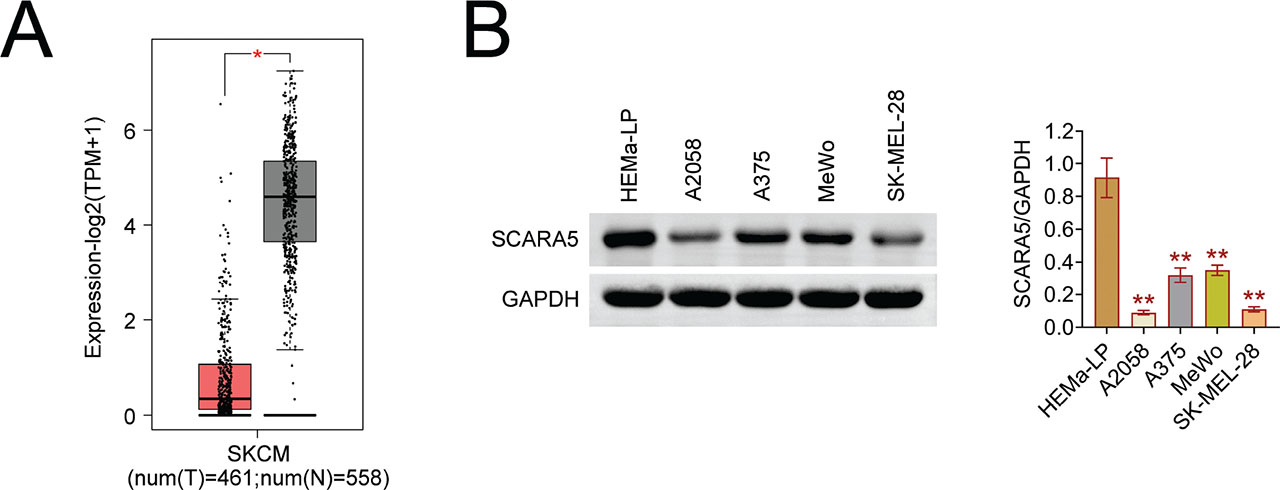
SCARA5 is downregulated in SKCM tissues and cell lines. (A) SCARA5 mRNA expression in SKCM tumor tissues (n = 461) and normal tissues (n = 558) was analyzed using the GEPIA database (TCGA-SKCM cohort). (B) SCARA5 protein levels were examined by Western blot in normal skin melanocytes (HEMa-LP) and SKCM cell lines (A2058, A375, MeWo, SK-MEL-28). GAPDH served as the loading control. Quantification of SCARA5 expression relative to GAPDH is shown on the right. Protein lysates from each replicate were analyzed separately, and representative blots are shown. Data represent mean ± SEM of three independent experiments (N = 3). P < 0.01 compared with HEMa-LP. GAPDH, Glyceraldehyde-3-Phosphate Dehydrogenase; GEPIA, gene expression profiling interactive analysis; SEM, standard error of the mean; SCARA5, scavenger receptor class A member 5; SKCM, skin cutaneous melanoma.
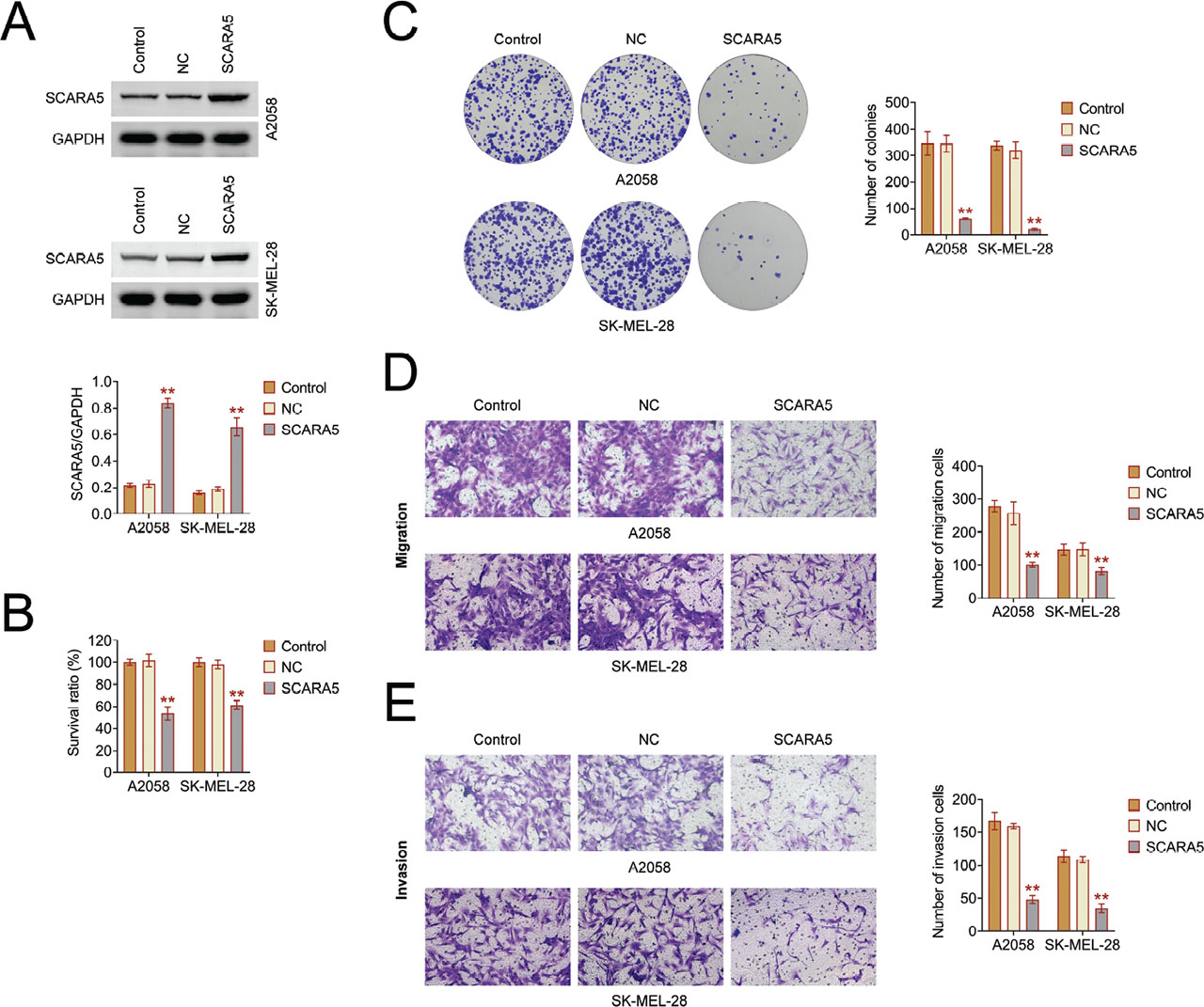
Fig 2.
Overexpression of SCARA5 inhibits the proliferation and migration of SKCM cells. (A) Western blot analysis confirmed successful overexpression of SCARA5 in A2058 and SK-MEL-28 cells. GAPDH was used as the loading control. Quantification of SCARA5 protein levels is shown below. (B) Cell viability was assessed by CCK-8 assay at 48 h post-transfection. (C) Colony formation assay showing the number of colonies formed by A2058 and SK-MEL-28 cells in each group. (D, E) Transwell assays were performed to evaluate the migration (D) and invasion (E) abilities of SCARA5-overexpressing cells compared with the Control and NC groups. Representative images and quantification are shown. Data represent mean ± SEM of three independent experiments (N = 3). P < 0.01 compared with NC group. GAPDH, Glyceraldehyde-3-Phosphate Dehydrogenase; SCARA5, scavenger receptor class A member 5; SEM, standard error of the mean; SKCM, skin cutaneous melanoma.
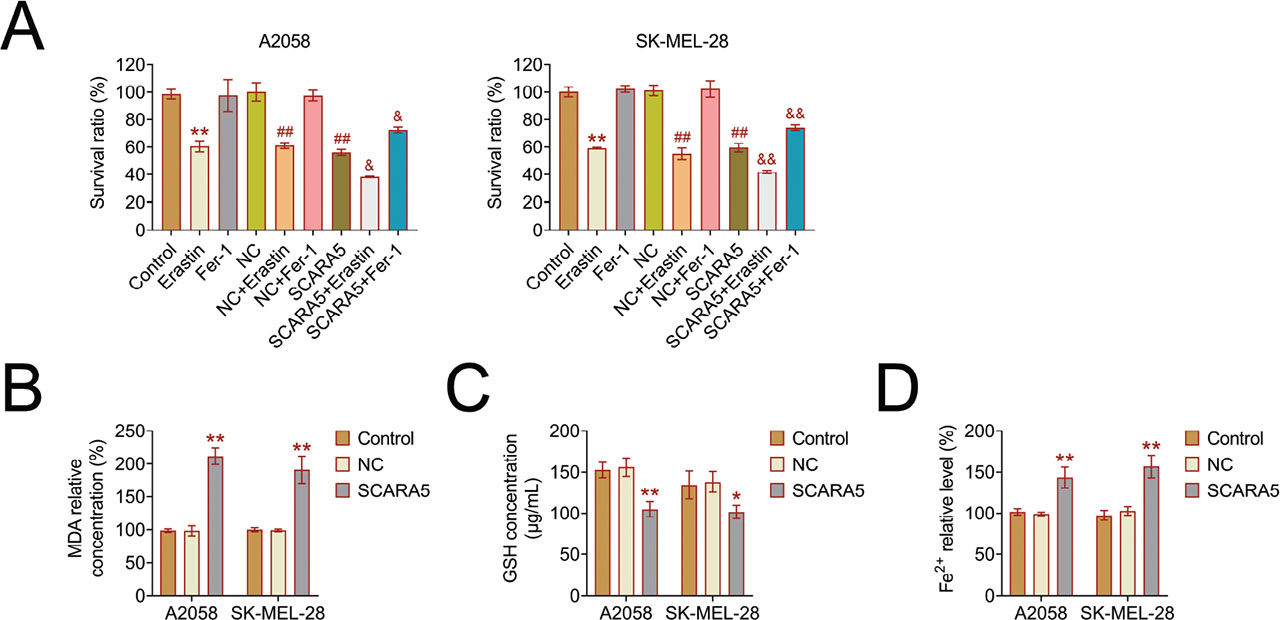
Fig 3.
Overexpression of SCARA5 induces ferroptosis in SKCM cells. (A) Cell viability was measured in A2058 and SK-MEL-28 cells treated with Erastin (ferroptosis inducer), Ferrostatin-1 (Fer-1, ferroptosis inhibitor), or SCARA5 overexpression, alone or in combination, using the CCK-8 assay. (B) MDA levels were detected in SCARA5-overexpressing or NC cells. (C) GSH concentrations were detected upon SCARA5 overexpression. (D) Intracellular ferrous iron (Fe2+) levels were detected in SCARA5-overexpressing cells. Data represent mean ± SEM of three independent experiments (N = 3). **P < 0.01, *P < 0.05 vs. NC group; ##P < 0.01 vs. NC + Erastin group; &&P < 0.01, &P < 0.05 vs. SCARA5 group. GSH, glutathione; MDA, malondialdehyde; SCARA5, scavenger receptor class A member 5; SEM, standard error of the mean; SKCM, skin cutaneous melanoma.
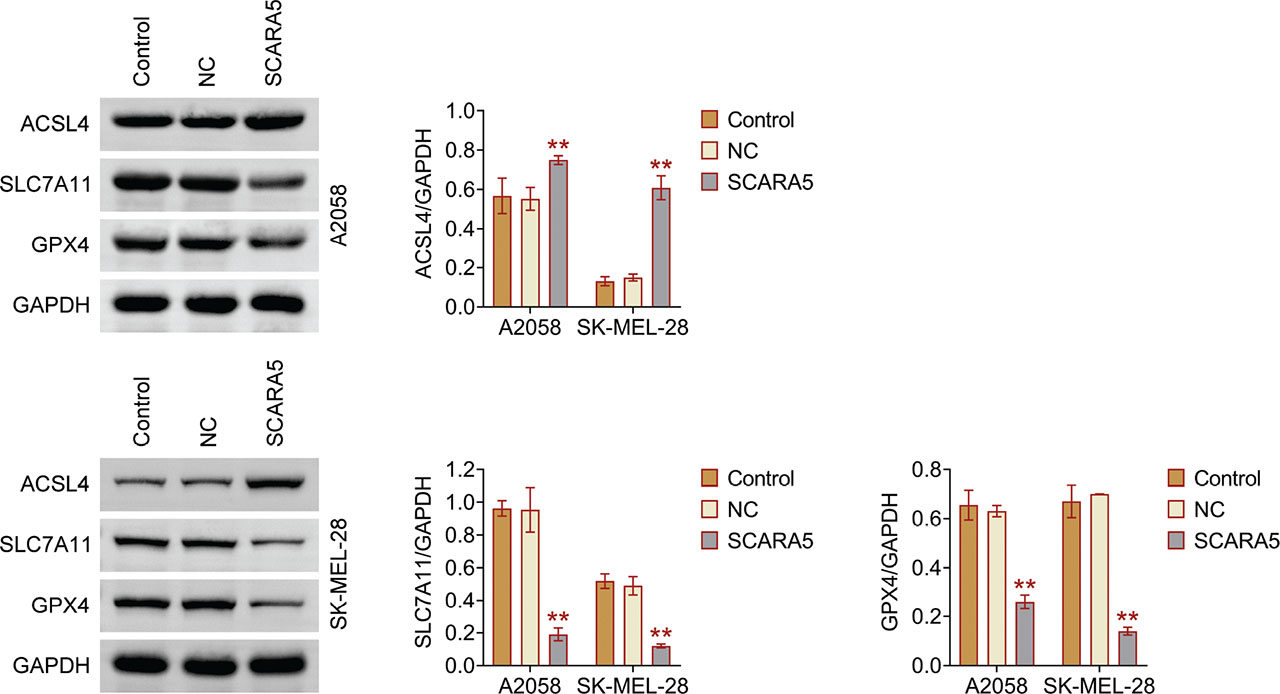
Fig 4.
SCARA5 regulates the GPX4/ACSL4 signaling pathway in SKCM cells. Western blot analysis was used to detect the expression levels of ACSL4, SLC7A11, and GPX4 in A2058 and SK-MEL-28 cells transfected with SCARA5 overexpression plasmids. GAPDH served as the loading control. Protein lysates from each replicate were analyzed separately, and representative blots are shown. Data represent mean ± SEM of three independent experiments (N = 3). P < 0.01 compared with the NC group. ACSL4, acyl-CoA synthetase long-chain family member 4; GAPDH, Glyceraldehyde-3-Phosphate Dehydrogenase; GPX4, glutathione peroxidase 4; SCARA5, scavenger receptor class A member 5; SEM, standard error of the mean; SKCM, skin cutaneous melanoma.