
Table 1
Sociodemographic and occupational characteristics of the PICU nurse cohort (N=60)
| Demographic and job-related characteristics | N (%) or Mean±SD | |
|---|---|---|
| Age (years) | 34.2±8.1 | |
| Gender | Female | 53 (88.3 %) |
| Male | 7 (11.7 %) | |
| Marital status | Married | 32 (53.3 %) |
| Single/other | 28 (46.7 %) | |
| Highest nursing qualification | Secondary nursing school | 7 (11.7 %) |
| BScN/BN | 46 (76.7 %) | |
| Master’s degree | 7 (11.7 %) | |
| Years in nursing | 10.1±7.3 | |
| Years in PICU | 7.4±4.5 | |
| Monitored shift | Day shift (07:00–19:00) | 30 (50.0 %) |
| Night shift (19:00–07:00) | 30 (50.0 %) |
Table 2
Descriptive statistics of full-shift noise-exposure measurements with personal dosimeters (N=60)
| Noise exposure | Mean±SD | Median | Min | Max | Dosimetry measurements > NIOSH REL (85 dBA/8 h) | Dosimetry measurements > WHO (35 dBA) |
|---|---|---|---|---|---|---|
| LAeq (12-hr) (dBA) | 77.0±4.2 | 77.1 | 67.6 | 84.7 | N/A | 60 |
| LAeq,8 h (dBA) | 78.5±4.2 | 78.6 | 69.1 | 86.2 | 2 | 60 |
| LCpeak (dBC) | 116.8±5.1 | 115.9 | 107.2 | 130.1 | 0 (>140 dBC) | 60 (>40 dBA L_Amax) |
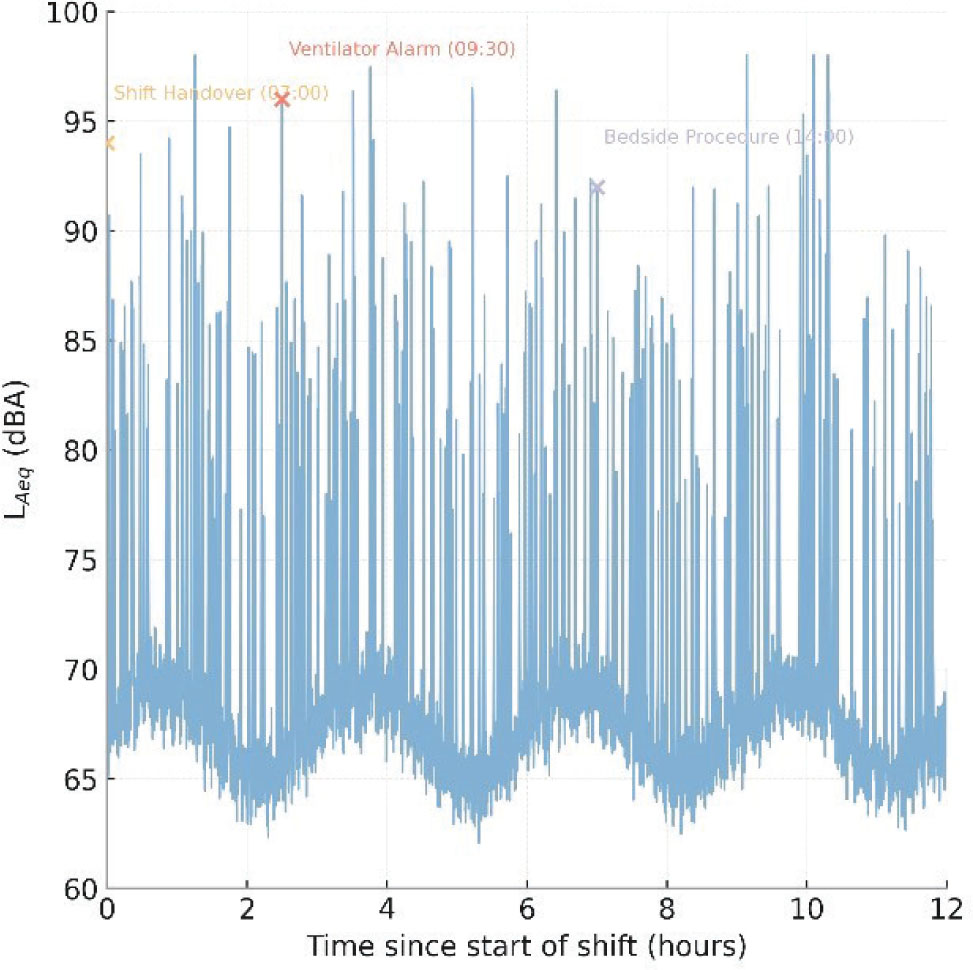
Figure 1
Time-history plot of noise exposure (LAeq) for a representative 12-hour PICU nurse shift
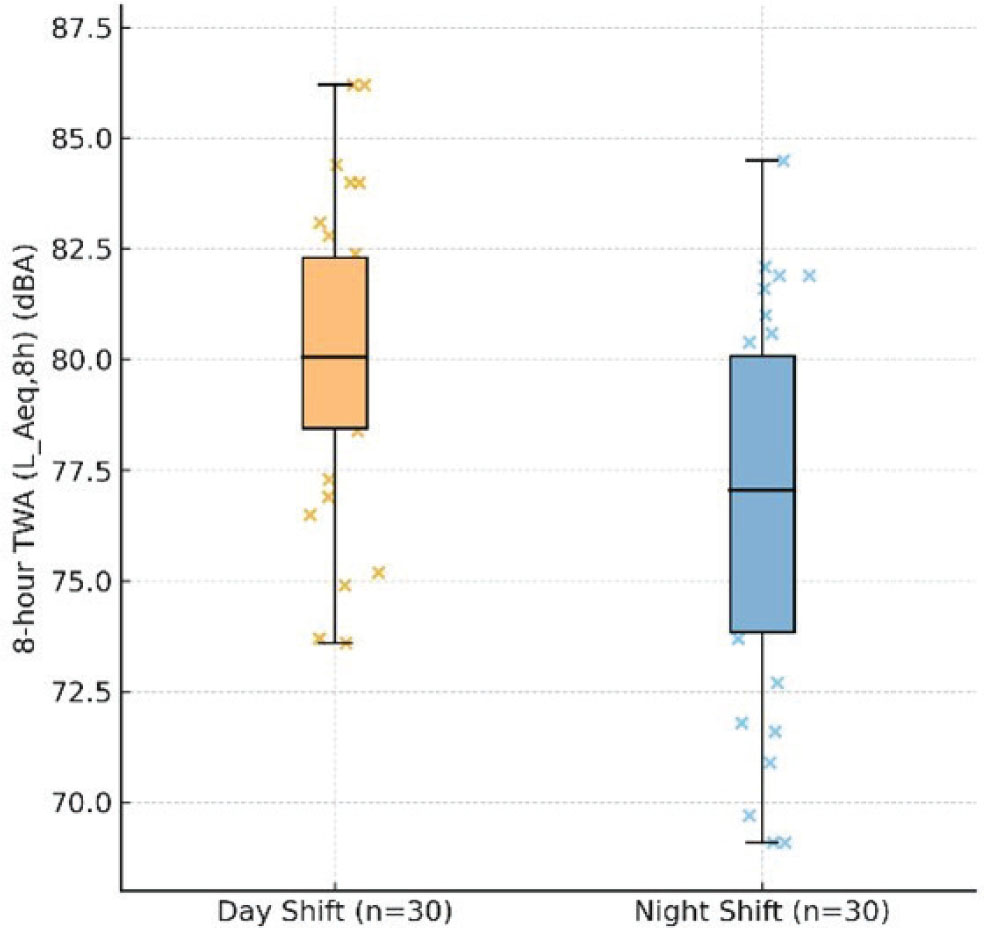
Figure 2
Distribution of 8-hour TWA noise exposure (LAeq,8 h) by shift type (day vs night); TWA – time-weighted average
Table 3
Primary identified noise sources and associated peak levels (LCpeak)
| Noise source | Location | Mean LCpeak ± SD (dBC) |
|---|---|---|
| Mechanical ventilator alarm (high priority) | Bedside | 112.4±3.1 |
| IV pump alarm | Bedside | 105.8±4.5 |
| Phone ringing (central station) | Nurse station | 94.2±2.2 |
| Staff conversation (group, 1 m) | Nurse station | 85.0±5.7 |
| Overhead paging system | Unit-wide | 88.6±3.9 |
| Equipment Cleaning (metal-on-metal) | Utility Room | 96.1±6.4 |
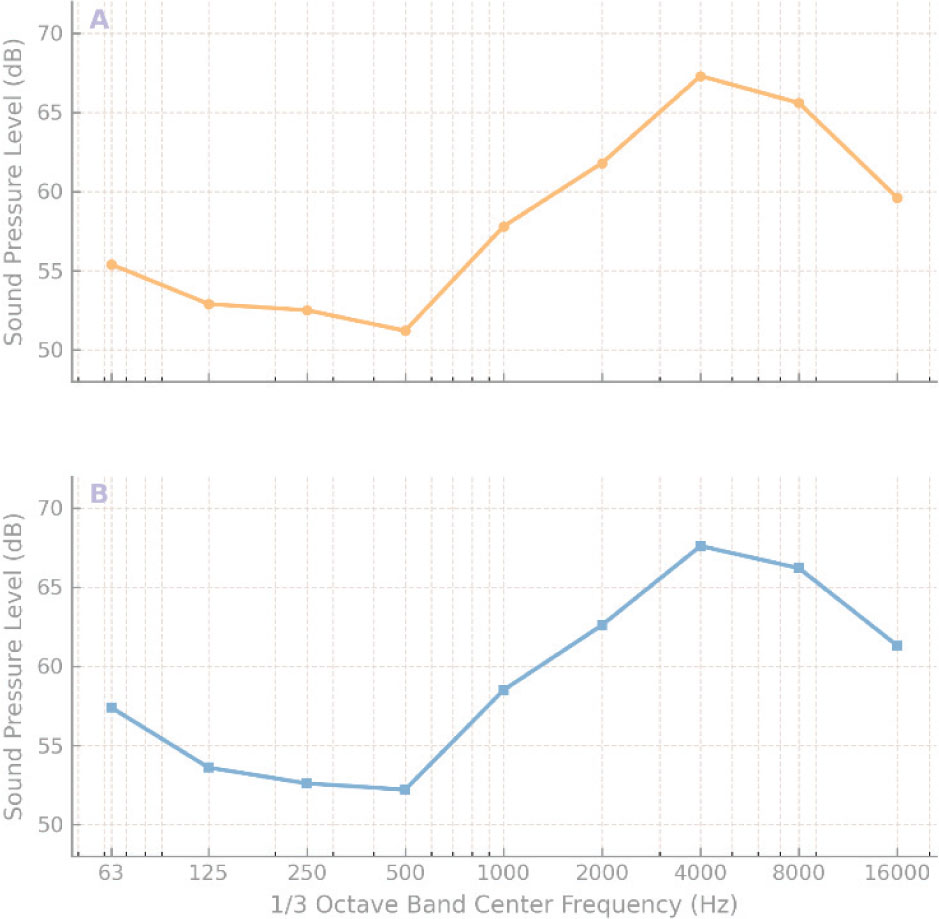
Figure 3
Acoustic characterisation of the PICU environment; A) 1/3 octave band frequency analysis at central nurse station; B) 1/3 octave band frequency analysis at patient bedside
Table 4
Descriptive statistics for health outcome variables (N=60)
| Health outcome variable | Scale | Mean ± SD | Median | Min | Max | Prevalence of poor outcome |
|---|---|---|---|---|---|---|
| Perceived stress (PSS-10) | 0–40 | 19.8±6.1 | 20.5 | 8 | 32 | N/A |
| Sleep quality (PSQI) | 0–21 | 8.4±3.3 | 8.0 | 2 | 17 | 39 of 60 (PSQI>5) |
| Hearing handicap (HHIA) | 0–100 | 12.4±10.1 | 10.0 | 0 | 44 | 7 of 60 (Score>16) |
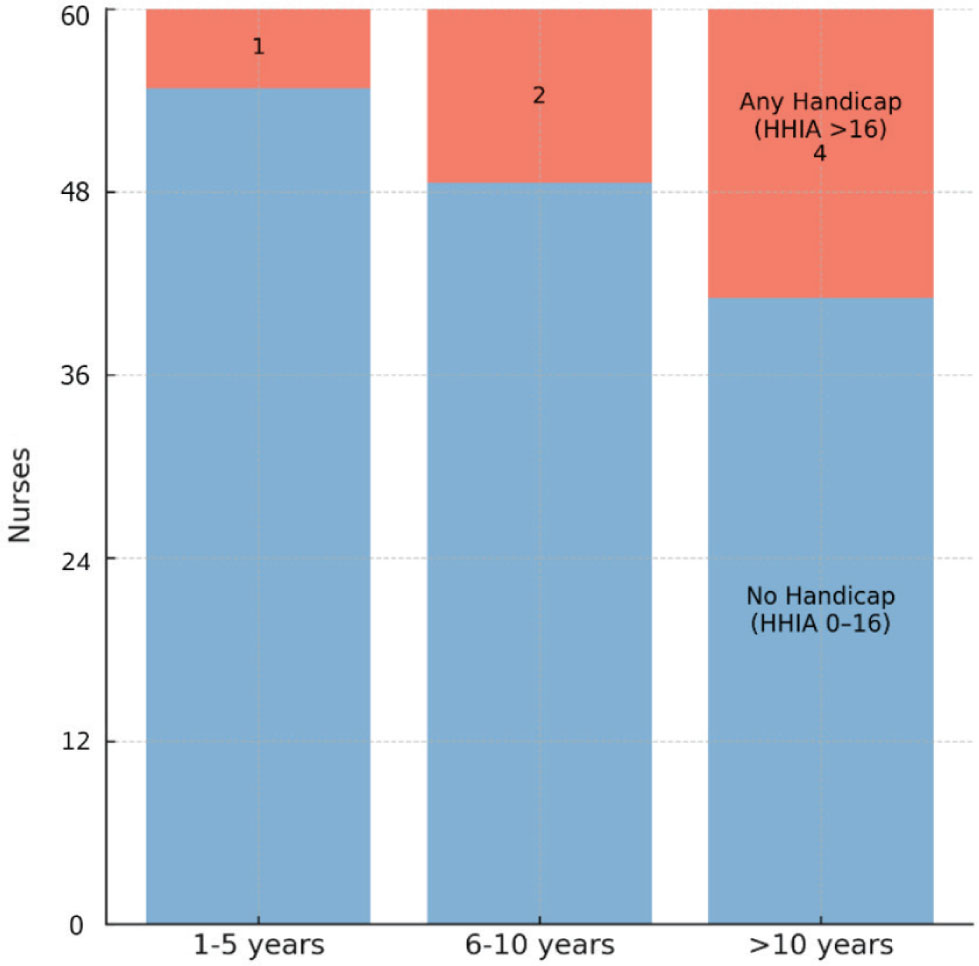
Figure 4
Prevalence of hearing handicap (HHIA categories) by years of work at the PICU
Table 5
Pearson correlation matrix for LAeq,8 h, health outcome scores, and confounders
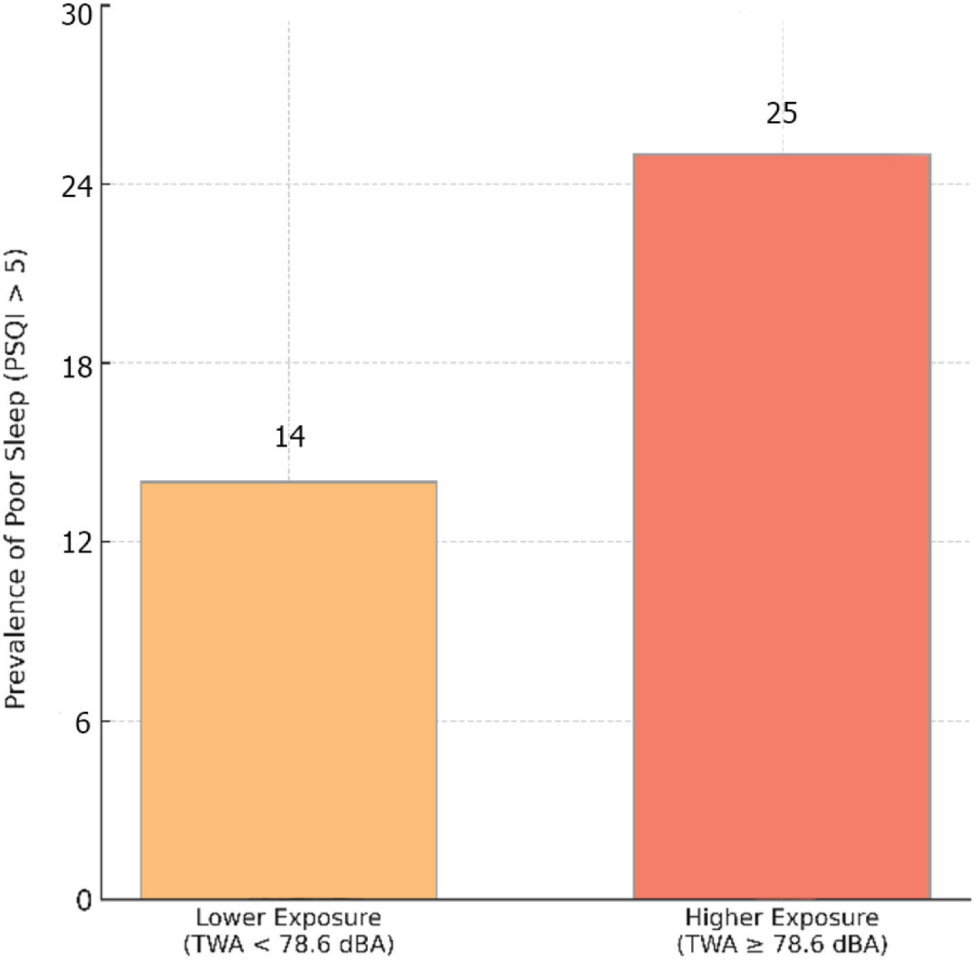
Figure 5
Prevalence of poor sleep quality (PSQI>5) stratified by noise exposure groups
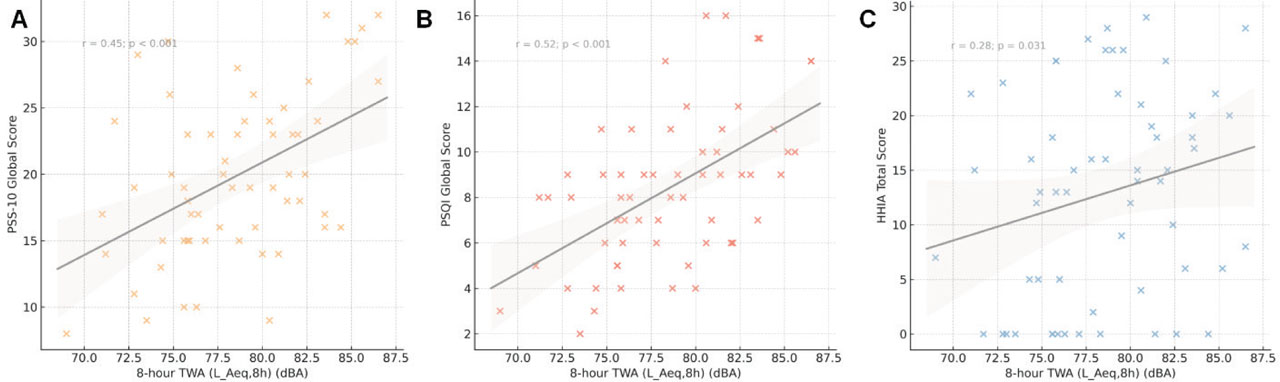
Figure 6
Scatter plots of 8-hour TWA (LAeq,8 h) vs Perceived Stress Scale (PSS-10) score(A), Pittsburgh Sleep Quality Index (PSQI) total score (B), and hearing handicap inventory (HHIA) total score (C)
Table 6
Multivariate logistic regression analysis for predictors of poor sleep quality (PSQI>5)
| Variable | Log-odds ratio with PSQI > 5 | SE | Wald | p-value | Adjusted odds ratio (OR) | 95 % CI for OR |
| LAeq,8 h (per 1 dBA) | 0.223 | 0.088 | 6.39 | 0.012* | 1.25 | 1.05–1.48 |
| PSS-10 score (per point) | 0.270 | 0.089 | 9.15 | 0.003** | 1.31 | 1.10–1.55 |
| Age (per year) | 0.041 | 0.055 | 0.56 | 0.454 | 1.04 | 0.93–1.16 |
| Years in PICU (per year) | −0.029 | 0.061 | 0.23 | 0.633 | 0.97 | 0.86–1.09 |
| Constant | −18.75 | 7.11 | 6.97 | 0.008 |
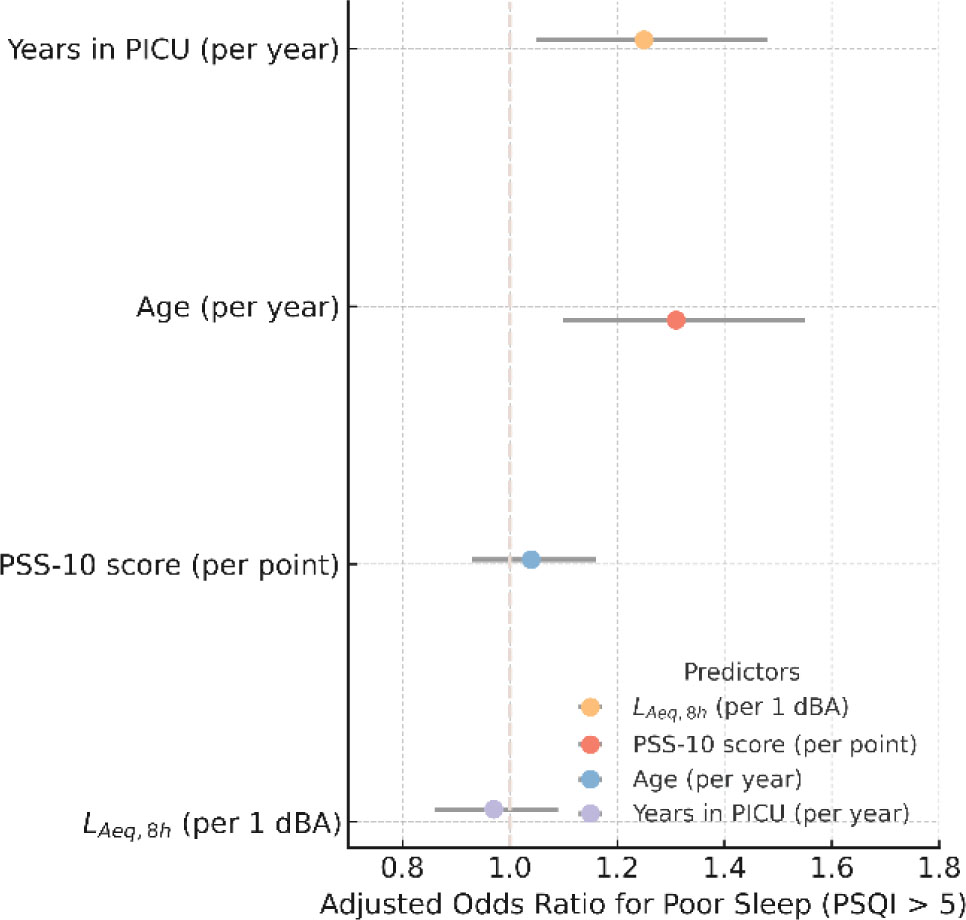
Figure 7
Forest plot of adjusted odds ratios for poor sleep quality (PSQI>5); PICU – paediatric intensive care unit; PSQI – Pittsburgh Sleep Quality Index; PSS-10 – Perceived Stress Scale
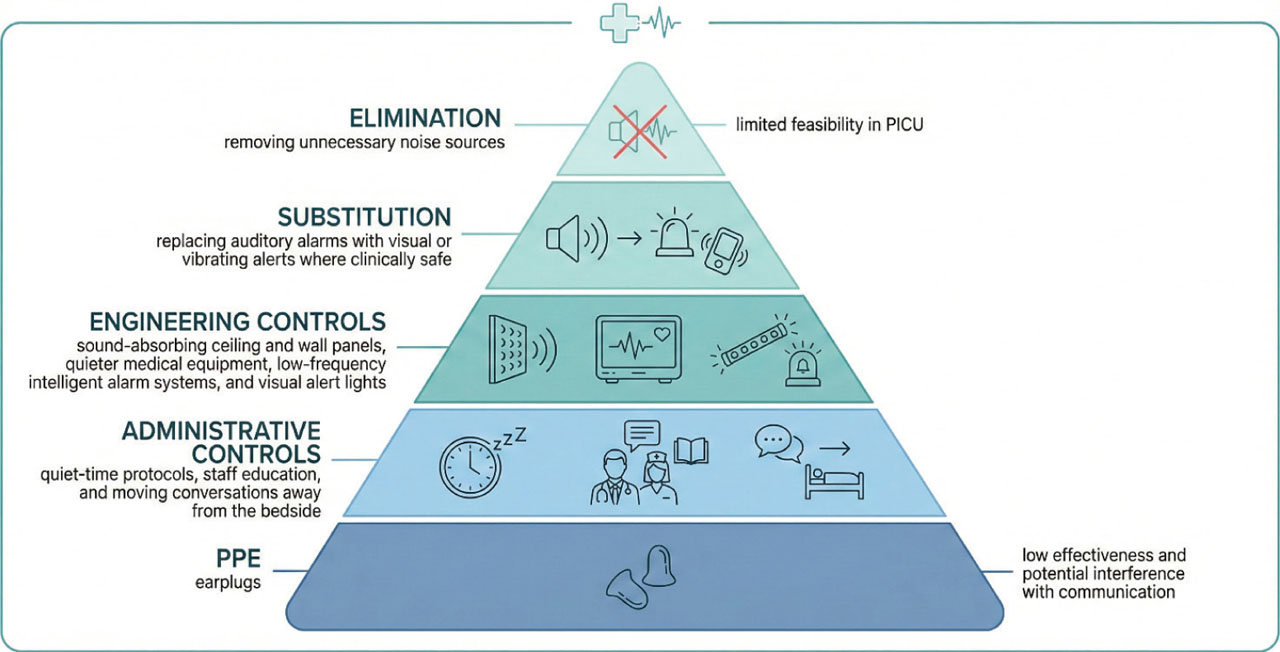
Figure 8
Conceptual model of the hierarchy of noise control adapted for paediatric intensive care units