
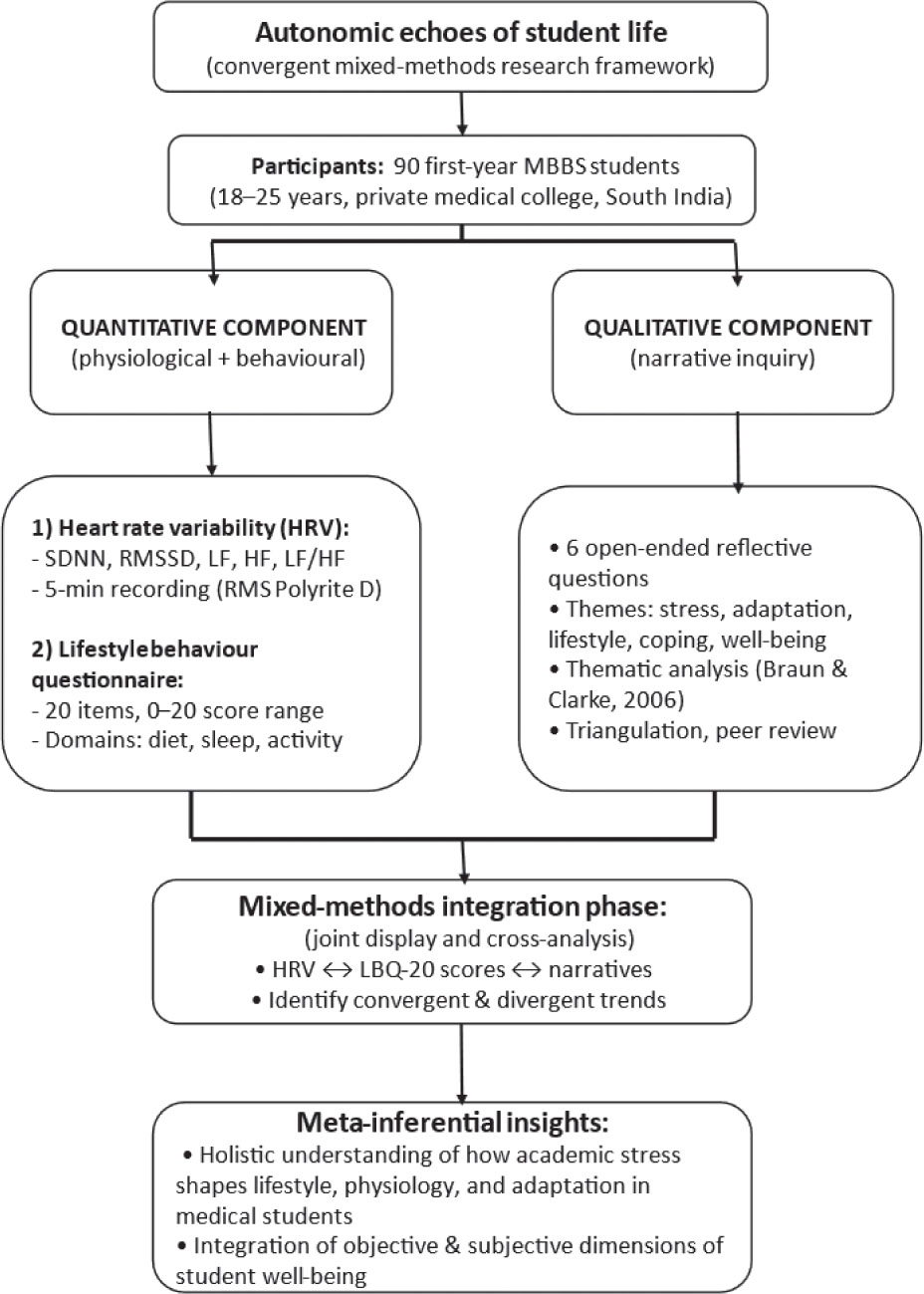
Figure 1
The flowchart of convergent mixed-method study design, illustrating parallel collection of heart rate variability measurements and lifestyle behaviour scoring, and separate qualitative data analysis and final integration
Table 1
Mean heart rate variability by variables in first-year medical students in South India
| HRV variable | Mean | SD | Range | N |
|---|---|---|---|---|
| Mean heart rate (bpm) | 91.73 | 13.11 | 63–130 | 90 |
| SDNN (ms) | 42.76 | 18.2 | 1.08–118.85 | 90 |
| RMSSD (ms) | 28.37 | 13.75 | 5.67–60.44 | 90 |
| PNN50 (%) | 13.24 | 14.87 | 0–58.9 | 90 |
| FFT LF/HF ratio | 1.85 | 0.87 | 0.23–3.96 | 90 |
| Lomb LF/HF ratio | 1.52 | 1.07 | 0.45–37.167 | 88 |
| Total power | 590.37 | 1123.37 | 8.12–10500.94 | 90 |
[i] FFT LF/HF ratio – fast Fourier transform low-to-high frequency ratio; HRV – heart rate variability; Lomb LF/HF ratio – Lomb-Scargle low-to-high frequency ratio; PNN50 – percentage of successive normal-to-normal intervals that differ by more than 50 ms; RMSSD – root mean square of successive differences; SDNN – standard deviation of normal-to-normal intervals
Table 2
Pearson correlation between LBQ-20 scores and HRV variables in first-year medical students in South India
| HRV variable | R | p-value | N |
|---|---|---|---|
| SDNN | −0.168 | 0.113 | 90 |
| RMSSD | −0.188 | 0.076 | 90 |
| FFT LF/HF ratio | −0.093 | 0.382 | 90 |
| Lomb LF/HF ratio | −0.042 | 0.698 | 88 |
| Total power | 0.149 | 0.163 | 90 |
[i] FFT LF/HF ratio – fast Fourier transform low-to-high frequency ratio; HRV – heart rate variability; LBQ-20 – 20-item Lifestyle Behaviour Questionnaire; Lomb LF/HF ratio – Lomb-Scargle low-to-high frequency ratio; RMSSD – root mean square of successive differences; SDNN – standard deviation of normal-to-normal intervals
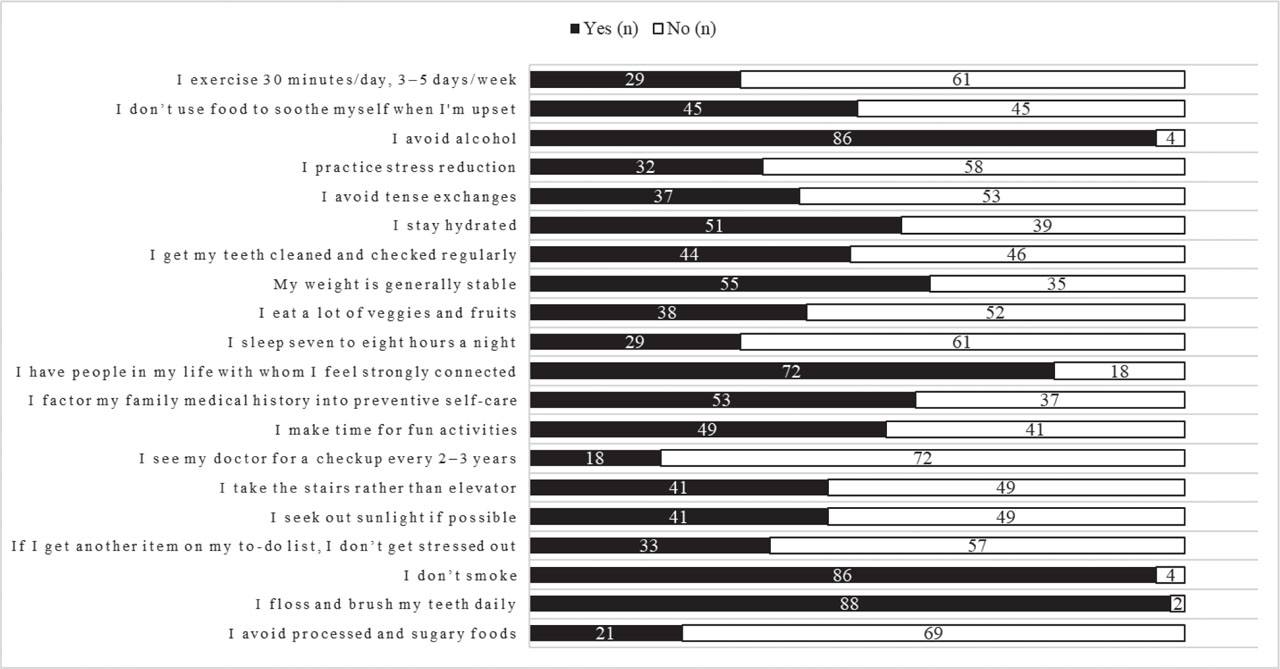
Figure 2
Prevalence of lifestyle behaviours among first-year medical students (N=90)
Table 3
HRV Differences in HRV variables between low and high LBQ-20 score groups of first-year medical students in South India (independent t-test)
| HRV Metric | Low-score group (≤10) | High-score group (>10) | t-value | p-value |
|---|---|---|---|---|
| SDNN (ms) | 45.29 | 39.87 | −1.106 | 0.272 |
| RMSSD (ms) | 30.50 | 26.16 | −1.258 | 0.212 |
| FFT LF/HF Ratio | 1.94 | 1.75 | −0.896 | 0.373 |
| Lomb LF/HF Ratio | 1.58 | 1.44 | −0.829 | 0.410 |
[i] FFT LF/HF ratio – fast Fourier transform low-to-high frequency ratio; HRV – heart rate variability; LBQ-20 – 20-item Lifestyle Behaviour Questionnaire; Lomb LF/HF ratio – Lomb-Scargle low-to-high frequency ratio; RMSSD – root mean square of successive differences; SDNN – standard deviation of normal-to-normal intervals
Table 4
Narratives on lifestyle and health perceptions among first-year medical students in South India
| Identified themes | Summary | Example quotes |
|---|---|---|
| Daily routines | Rigid and academia-driven schedules with little time left for self-care, leading to exhaustion |
|
| Influences on choices | Decisions driven by stress, social media, mood, peers, and hostel diet limitations |
|
| Balancing responsibilities | Students struggle to balance health and academic life: time and stress constraints dominate |
|
| Lifestyle supports health | Structured routines, exercise, and some social support from friends and family lead to positive habits. |
|
| Lifestyle hinders health | Academic pressure, sleep deprivation, sedentary lifestyle, junk food, and mental health issues |
|
| Lifestyle changes upon enrolment to medical school | Some students adopted healthier lifestyle behaviour, which was difficult to keep due to fatigue/stress |
|
Table 5
Joint display matrix integrating LBQ-20 scores, HRV variables, and qualitative theme analysis among first-year medical students in South India
| Quantitative component | Quantitative variable(s): LBQ-20 score / HRV metric | Qualitative theme | Integration / Interpretation |
|---|---|---|---|
| LBQ-20 score | Mean=9.46 (SD=3.16): moderate overall adherence to healthy lifestyle practices | Lifestyle supports health | Students report moderate adherence to health behaviours: hygiene and avoidance of smoking & alcohol habits are the most adhered to practices. |
| LBQ-20 high-score group (>10) | High: Maintaining oral hygiene practices (88), Avoid alcohol (86), Non-smoking (86) | Lifestyle supports health | Preventive lifestyle behaviours were evident in narratives describing gym participation and conscious self-care practices. |
| LBQ-20 low-score group (≤10) | Processed and sugary food avoidance (21), enough sleep (29), Exercise (29) | Balancing responsibilities | Students struggle to maintain health behaviours due to workload, academic stress, and time constraints. |
| Comparison between the low and high LBQ-20 score groups | No significant difference in SDNN: (45.29 vs 39.87, respectively; p=0.27) | Lifestyle changes | Despite better lifestyle scores, students show no significant improvement in HRV, indicative of persistent stress or |
| HRV variable correlations with LBQ-20 score | Weak and statistically non-significant | Lifestyle hinders health | In contrast to reported healthy behaviours, autonomic function remains largely unaffected. This suggests dominant influence of chronic stress and academic strains on autonomic function. |
| Autonomic imbalance indicator | Lomb LF/HF missing for 2 participants due to absent HF signal | Daily routines | Possibly due to extreme sympathetic activity towed to rigid schedules and inadequate recovery, reflecting physiological strain. |
| Stress prevalence | Low adherence to stress management (33) and stress reduction practices (32) | Influences on choices | Low adherence to stress management practices, reflecting student narratives of academic burden and fatigue. Stress appears to dominate lifestyle behaviours and might blunt the effect of healthy behaviours, which explains the weak correlation observed with HRV. |
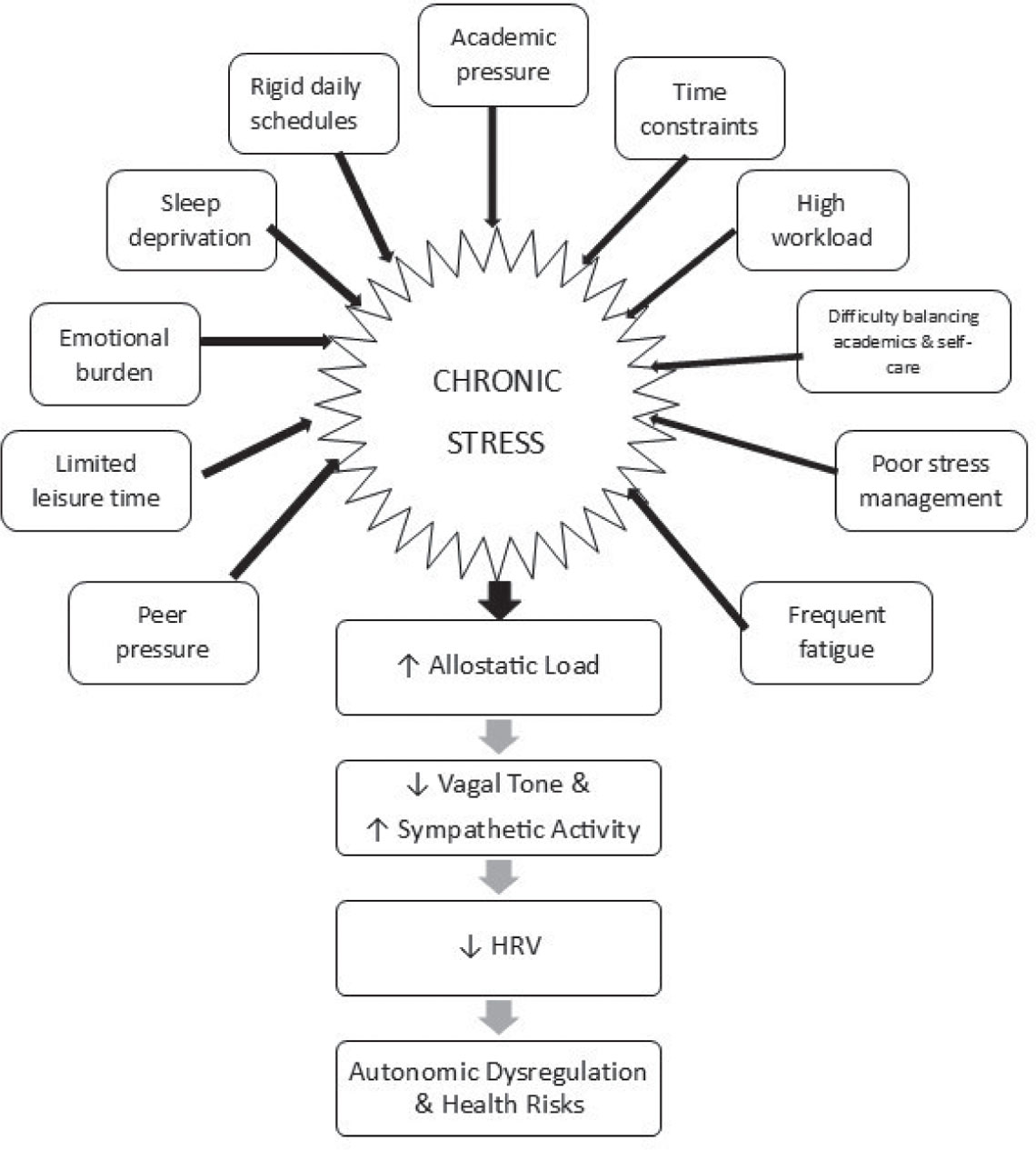
Figure 3
Pathways linking lifestyle disruptions, chronic stress, and autonomic balance based on integrated qualitative and quantitative findings