
Table 1
Quality parameters data for GC/µECD analysis of benzene derivatives
| Benzene derivative | MDL (ng/L) | PQL (ng/L) | Accuracy (%) | Precision (RSD %) |
|---|---|---|---|---|
| 1,2,3-TeCB | 3.72 | 6.41 | 98.82 | 8.81 |
| 1,2,4-TeCB | 3.33 | 5.84 | 102.2 | 7.15 |
| 1,3,5-TeCB | 3.02 | 5.36 | 104.1 | 7.22 |
| PeCB | 3.02 | 7.62 | 108.0 | 12.7 |
| HeCB | 2.18 | 5.45 | 97.70 | 11.9 |
| TFL | 3.87 | 9.67 | 100.0 | 11.7 |
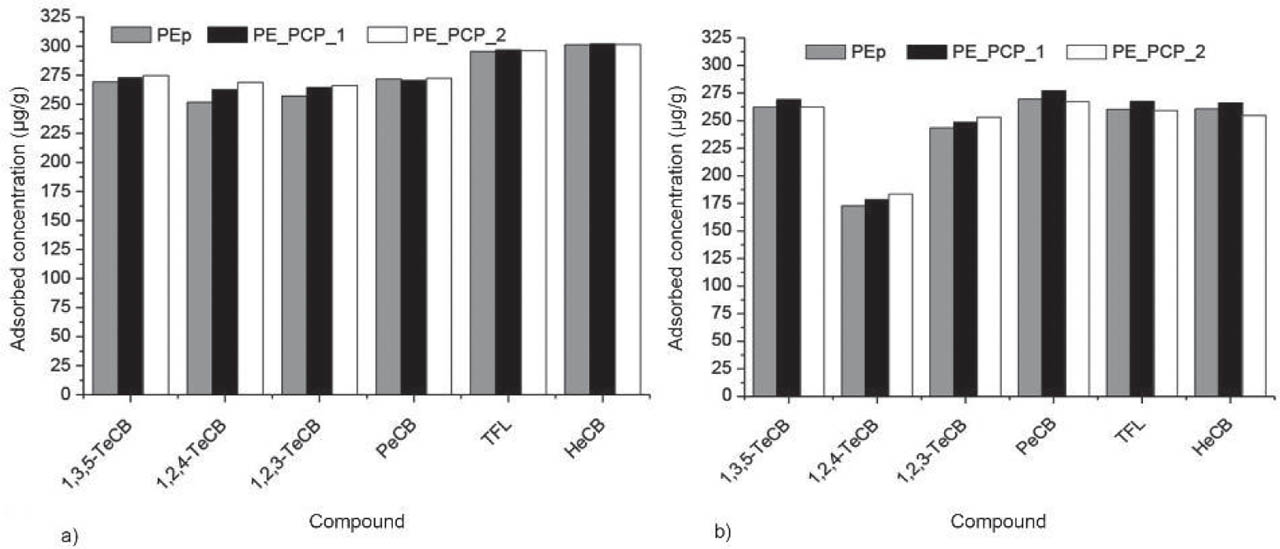
Figure 1
Mean (±SD) adsorbed benzene derivative per unit mass of adsorbent (µg/g) after 48 h of microplastics exposure: a) in individual solutions and b) in the mixture (n=3). 1,2,3-TeCB – 1,2,3-trichlorobenzene; 1,2,4-TeCB – 1,2,4-trichlorobenzene; 1,3,5-TeCB – 1,3,5-trichlorobenzene; HeCB – hexachlorobenzene; PE_PCP_1 – PE microparticles from the personal care product 1; PE_PCP_2 – PE microparticles from the personal care product 2; PeCB – pentachlorobenzene; PEp – standard PE microparticles (Thermo Fisher); TFL – trifluralin
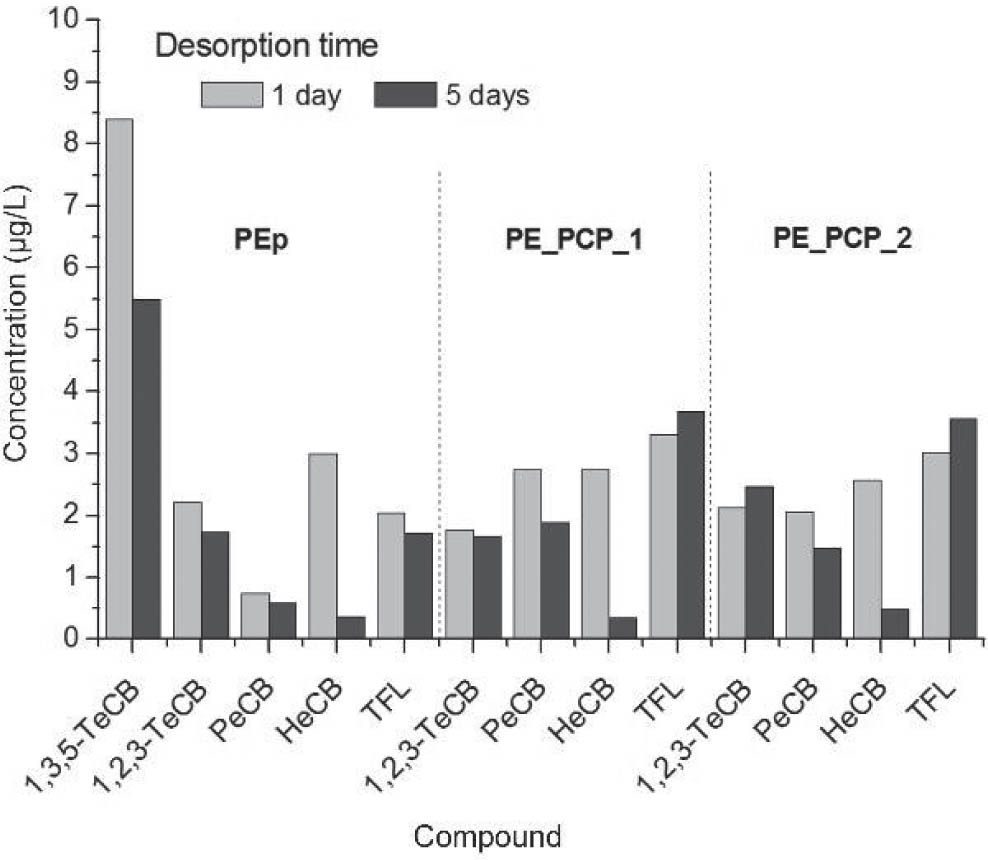
Figure 2
Mean (±SD) desorbed concentrations of benzene derivatives in aqueous medium (µg/L) after 1 and 5 days of desorption. 1,2,3-TeCB – 1,2,3-trichlorobenzene; 1,2,4-TeCB – 1,2,4-trichlorobenzene; 1,3,5-TeCB – 1,3,5-trichlorobenzene; HeCB – hexachlorobenzene; PE_PCP_1 – PE microparticles from the personal care product 1; PE_PCP_2 – PE microparticles from the personal care product 2; PeCB – pentachlorobenzene; PEp – standard PE microparticles (Thermo Fisher); TFL – trifluralin
Table 2
Presence of non-target compounds in culture medium after desorption of 1 and 5 days
| Compound | Microplastic | |||||
|---|---|---|---|---|---|---|
| PEp after 1 d | PEp after 5 d | PE_PCP_1 after 1 d | PE_PCP_1 after 5 d | PE_PCP_2 after 1 d | PE_PCP_2 after 5 d | |
| Benzaldehyde | + | + | + | + | + | + |
| 2-ethyl hexanol | + | + | + | + | + | + |
| Benzyl alcohol | + | + | + | |||
| Phenylethyl alcohol | + | + | ||||
| 1-Dodecanol | + | + | ||||
| Prophylbenzene | + | + | ||||
| Acetophenone | + | + | + | + | + | + |
| Diethyl phthalate | + | + | + | + | + | + |
| Dibutyl phthalate | + | + | + | + | ||
| Bis (2-ethylhexyl) phthalate | + | |||||
| 1,2-Benzenedicarboxylic acid | + | + | ||||
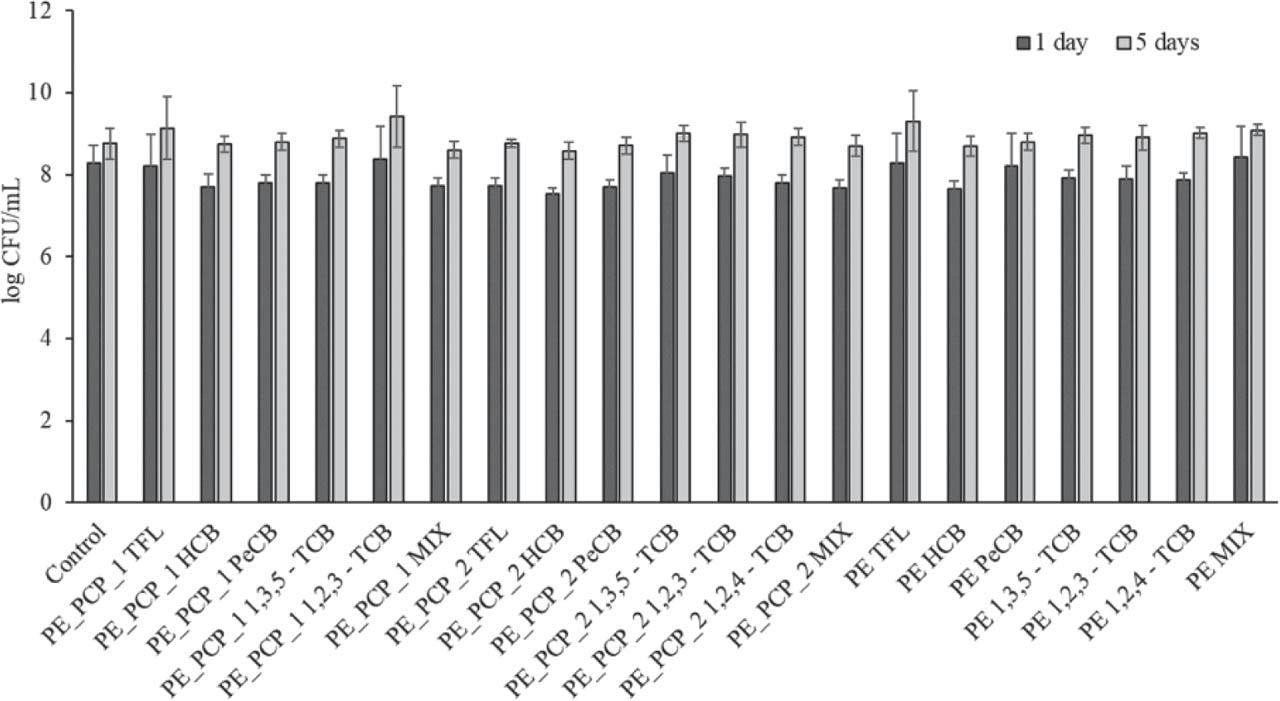
Figure 3
A. baumannii Sava 4 counts after the short- (one day) and long-term (five days) exposure to the highest concentration of microplastics (10 g/L) containing TFL; HCB; PeCB; 1,2,3-TCB; 1,2,4-TCB; 1,3,5-TCB separately and in a mixture (n=3, mean value ± SD). The starting A. baumannii Sava 4 abundance was 7.0±0.1 log CFU/mL. 1,2,3-TeCB – 1,2,3-trichlorobenzene; 1,2,4-TeCB – 1,2,4-trichlorobenzene; 1, 3, 5 - T e C B – 1,3,5-trichlorobenzene; HeCB – hexachlorobenzene; PE_PCP_1 – PE microparticles from the personal care product 1; PE_PCP_2 – PE microparticles from the personal care product 2; PeCB – pentachlorobenzene; PEp – standard PE microparticles (Thermo Fisher); TFL – trifluralin
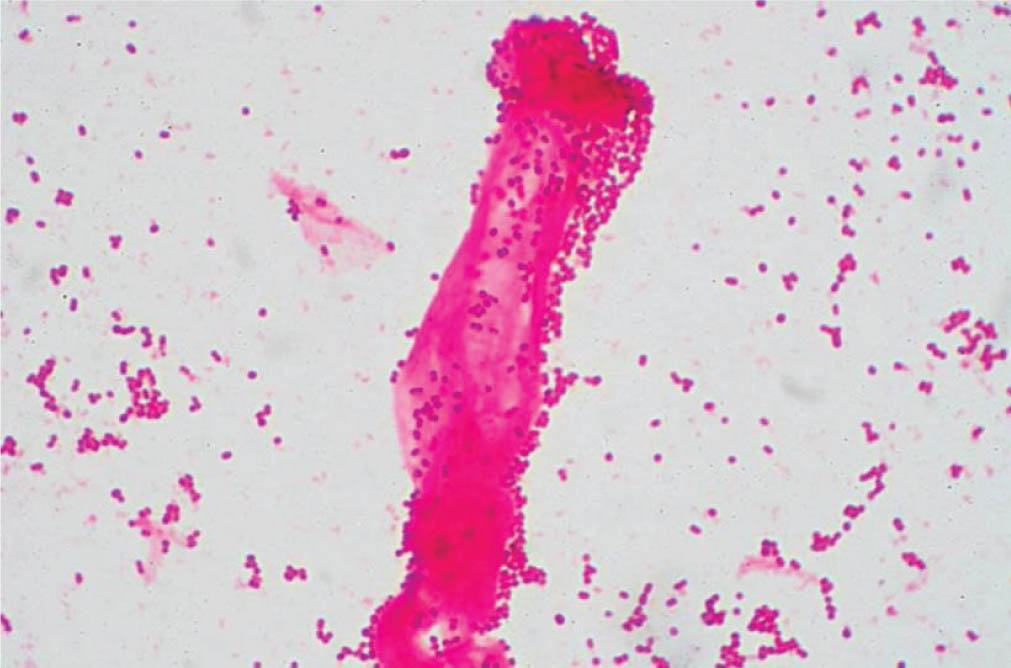
Figure 4
Immobilised cells of A. baumannii Sava 4 on the surface of microplastic particle at 1000× magnification
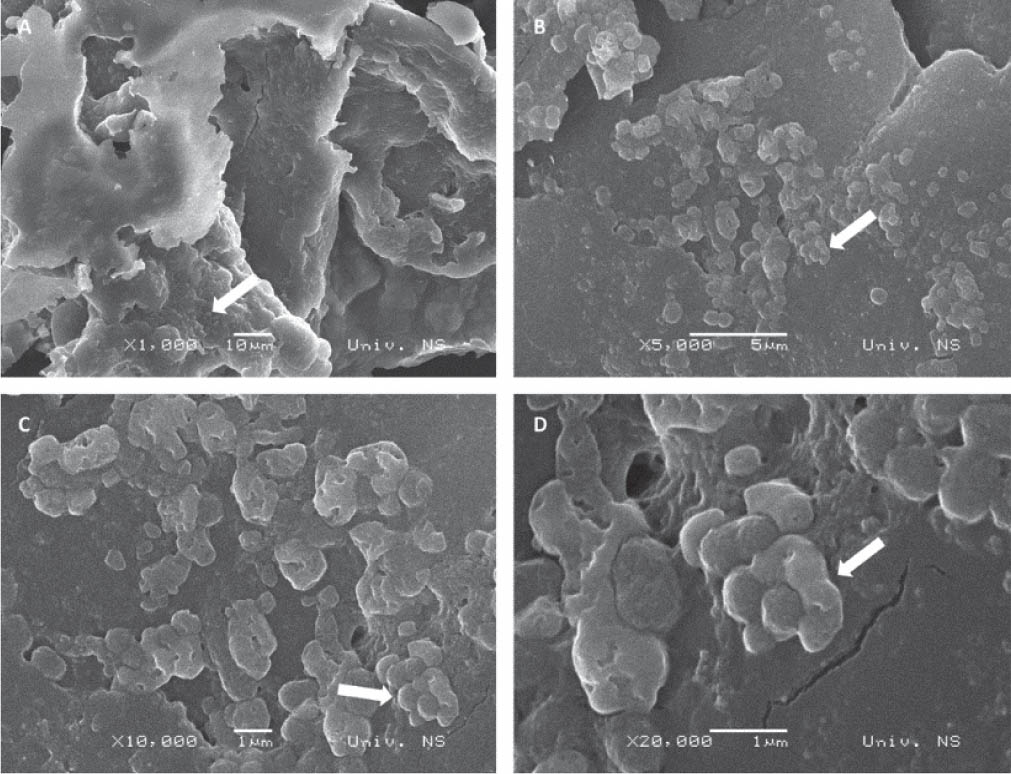
Figure 5
SEM images of PE microplastic particles after incubation with A. baumannii Sava 4 at increasing magnifications illustrating the surface morphology of the particles and the distribution of bacterial cells on microplastic surface