
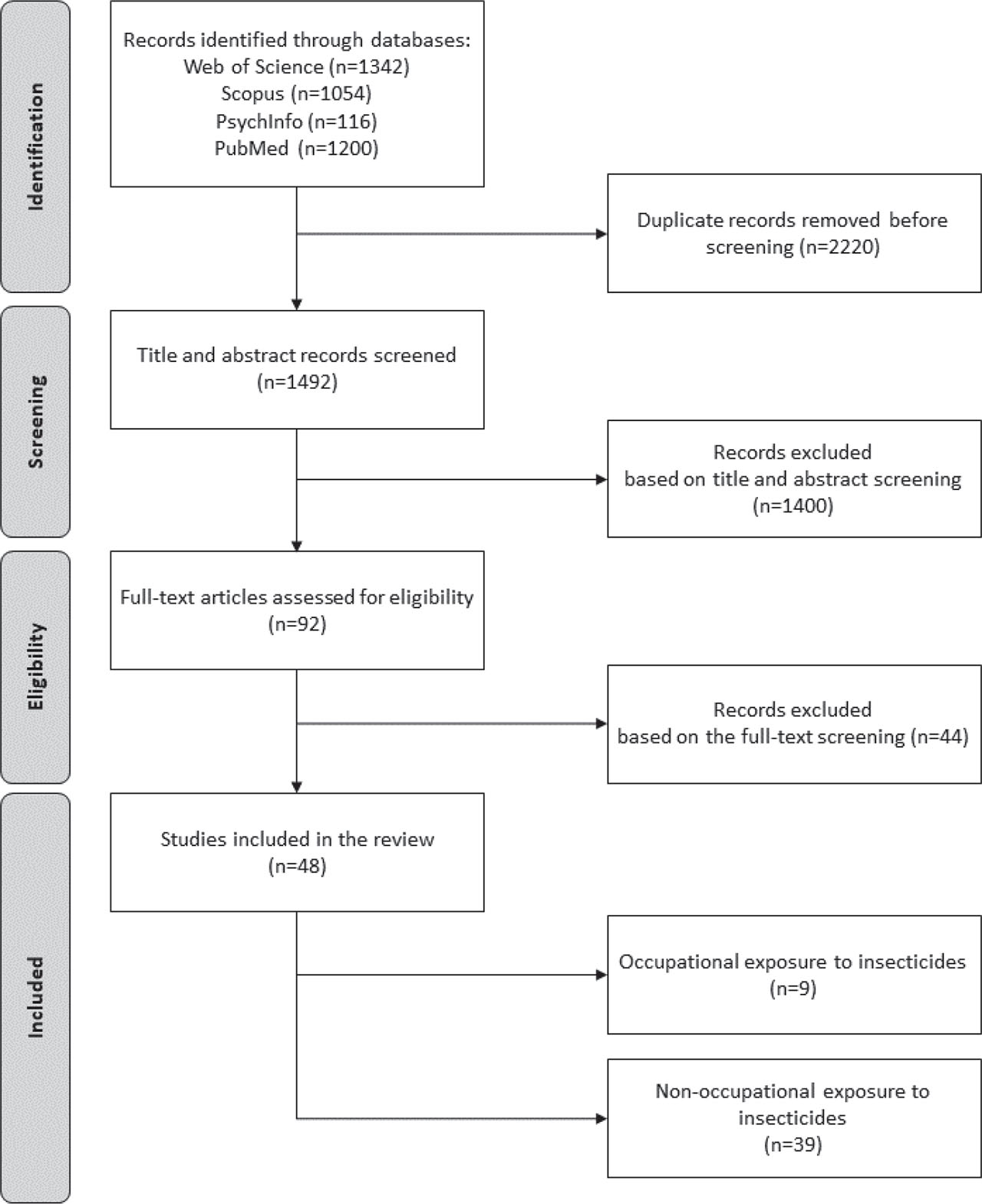
Figure 1
Flow diagram of article search and selection
Table 1
Overview of assessment tools, study counts, and reported effects across core aspects of neurobehavioural functioning in studies on sleep and neurobehavioural outcomes of insecticide exposure (only adverse and null effect are shown, others are counted)
| Core aspect of neurobehavioural functioning | Abbr. | Instruments (tests, subtests, tasks, questionnaires) | n | Adverse effects | Null effect | ||||||
|---|---|---|---|---|---|---|---|---|---|---|---|
| N | O | T | N | O | T | N | O | T | |||
| Working memory/immediate (short-term) memory | WM | Digit Span1,2, Match-To-Sample1, Letter-Number Sequencing2, Picture Span2, Arithmetic2, Immediate Memory for Faces3, Object Memory4,14, Memory for Sentences5, Digit String5, Spatial Working Memory6, Registration7, Immediate Memory Span8, Children’s Memory Scale, Benton Visual Retention Test, Sternberg working memory task | 22 | 9 | 31 | 32 % (7) | 78 % (7) | 45 % (14) | 59 % (13) | 22 % (2) | 48 % (15) |
| Long-term memory/learning (includes visual, i.e., non-verbal, and verbal memory) | LTM | Serial Digit Learning1, Reverse Learning1, Narrative Memory3, Delayed Memory for Faces3, Object Memory4,14, Copying Recall5, Paired Associate Learning6, Recall7, Delayed Recall8, Level of Learning8, Children’s Memory Scale, Benton Visual Retention Test, Rey-Osterrieth Complex Figure, Long term memory task14 | 10 | 6 | 16 | 20 % (2) | 67 % (4) | 38 % (6) | 80 % (8) | 17 % (1) | 56 % (9) |
| Visuospatial and visuomotor abilities | VSVM | Picture Completion2, Block Design2,*,14, Visual Puzzles2, Object Assembly2, Design Copying3, Geometric Puzzles3, Visual motor integration task4,14, Copying5, Rey-Osterrieth Complex Figure, Figure drawing14, Eye-Hand Coordination9 | 12 | 6 | 18 | 33 % (4) | 17 % (1) | 28 % (5) | 67 % (8) | 83 % (5) | 72 % (13) |
| Attention and inhibitory control | AIC | Continuous Performance1, 12, Selective Attention1, Divided Attention1, Statue3, Auditory Attention & Response Set3, Inhibition3, Rapid Visual Information Processing6, Attention and Calculation7, Attention Network Test, Lewis Digit Vigilance Test | 9 | 8 | 17 | 56 % (5) | 50 % (4) | 53 % (9) | 33 % (3) | 38 % (3) | 35 % (6) |
| (Other) Executive functions | EF | Progressive Ratio1, Picture Arrangement2, Mazes2, Multi-tasking6, Orientation7, Trail Making Test, Wisconsin Card Sort Test, Behavior Rating Inventory of Executive Function | 8 | 8 | 16 | 75 % (6) | 75 % (6) | 75 % (12) | 25 % (2) | 25 % (2) | 25 % (4) |
| Sensory and motor function | SMF | Visuomotor Precision3, Purdue Pegboard4, Santa Ana Form Board14, Pegboard11,14, Motor Screening6, Motor performance10, Name writing14, Finger Tapping1,14, Lanthony Desaturated D-15, Gross motor skills and balance14 | 11 | 7 | 18 | 45 % (5) | 71 % (5) | 56 % (10) | 36 % (4) | 29 % (2) | 33 % (6) |
| Processing speed/reaction time | PS | Symbol Digit1, Simple Reaction Time1, Response Reaction6, Reaction Time Test14, (Digit Symbol) Coding2, Symbol Search2, Animals2, Cancellation2 | 12 | 9 | 21 | 58 % (7) | 56 % (5) | 57 % (12) | 25 % (3) | 33 % (3) | 29 % (6) |
| Verbal ability | VA | Information2, Similarities2, Vocabulary2, Comprehension2, Comprehension of Instructions3, Speeded Naming3 | 14 | 5 | 19 | 50 % (7) | 60 % (3) | 53 % (10) | 43 % (6) | 40 % (2) | 42 % (8) |
| Fluid reasoning | FR | Figure Weights2, Block Design2, Picture Concept2, Matrix Reasoning2, Series13, Classifications13, Matrices13, Conditions (topology)13 | 6 | 0 | 6 | 50 % (3) | 0 % (0) | 50 % (3) | 50 % (3) | 0 % (0) | 50 % (3) |
| General intellectual functioning | GIF | Full scale IQ2, Total score3,10, Raven’s Colored Progressive Matrices | 14 | 0 | 14 | 57 % (8) | 0 % (0) | 57 % (8) | 43 % (6) | 0 % (0) | 43 % (6) |
| Emotional and behavioural functioning | EB | Affect Recognition3, Behavior Assessment for Children 2nd edition, Eysenck Personality Questionnaire, Strengths and Difficulties Questionnaire, Mood and Feelings Questionnaire – Child edition, Children’s Depression Inventory 2nd edition, Multidimensional Anxiety Scale for Children 2nd edition, Child Behavior Checklist, Conners’ Rating Scale – Revised Short Version, ADHD Criteria of Diagnostic and Statistical Manual of Mental Disorders 4th edition, Self-Reported Delinquency and Self-Reported Behavior14, Parent–child difficulties checklist and parental involvement14 | 14 | 1 | 15 | 57 % (8) | 100 % (1) | 60 % (9) | 14 % (2) | 0 % (0) | 13 % (2) |
| Sleep | S | Survey/questionnaire | 2 | 0 | 2 | 50 % (1) | 0 % (0) | 50 % (1) | 0 % (0) | 0 % (0) | 0 % (0) |
Table 2
Summary of studies investigating sleep and neurobehavioural effect of exposure to insecticides
| Ref. | Study design | Country, region, cohort, and start year | Sample size (% of boys) | Groups | Age range (years) | Type of insecticide | Exposure assessment | Neurobehavioural assessment | Main findings | |
|---|---|---|---|---|---|---|---|---|---|---|
| Non-occupational (residential) exposure studies | (82) | CO | China, Asia SMBCS 2009–2010 | n=1266 mother-child pairs (54 %) |
| 1–10 (within subject) | OP (chlorpyrifos, chlorpyrifos-methyl) and CARB (carbofuran) | urinary OP (TCPy) and CARB (CFP) metabolites | SDQ, Parent/caregiver assessment ADHD Criteria of Diagnostic and Statistical Manual of Mental Disorders, Fourth Edition (ADHD-DSM-IV) rating scale | Evidence of adverse effects on EB functioning in children with exposure during infancy and toddlerhood (↑OP metabolites) |
| (65) | CS | Ecuador, South America ESPINA 2008 | n=313 (51 %) | 4–9 | mixture, including OP, NEO, and PYR | residential proximity to crops (ArcGIS) | NEPSY-II (AIC, L, ML, VP) | Evidence of adverse effects on WM, LTM, AIC, VA, and GIF related to living in close proximity to greenhouse floricultural crops | ||
| (67) | CS | Ecuador, South America ESPINA 2008 | n=313 (51 %) | 4–9 | OP, CARB | AChE blood lev. (E); temporal proximity to heightened pesticide use; residential proximity to plantation (ArcGIS) | NEPSY-II (AIC, L, ML, VP, SM) | Evidence of adverse effects on VSVM, AIC, SMF, and GIF related to peak pesticide spray seasons in agricultural communities | ||
| (66) | CS | Ecuador, South America ESPINA 2008 | n=313 (52 %) | 4–9 | OP/CARB | AChE blood levels (E) | NEPSY-II (AIC, L, ML, VP, SM) | Evidence of adverse effects on LTM, AIC, and GIF related to ↓AChE activity in boys | ||
| (61) | CS-pilot | Costa Rica, North America 2007 | n=35 (NR) |
| 4–10 | OP, PYR | urinary OP (PNP, IMPy, TCPy) & PYR (3-PBA) metabolites | BARS (DST, TAP, MTS, CPT, DAT), Figure drawing, Long term memory test | Conclusion could not be drawn based on reported data | |
| (64) | mixed | Ecuador, South America ESPINA 2008 | n=309 (50 %) | T1 (2008): 4–9 years; T2&3 (2016): 11–17 years | mixture, types not specified | AChE blood levels (E); questionnaire; residential proximity to crops (ArcGIS); temporal proximity to heightened pesticide use | NEPSY-II (AIC, L, ML, VP, SP) | Evidence of adverse effects on VSVM, AIC, and VA lasting up to 90+ days after peak pesticide spray seasons | ||
| (55) | CS-pilot | Ecuador, South America | n=79 mother-child dyads (47 %) |
| 5–8 | OP | AChE blood levels (E); urinary OP metabolites (DAPs); interview | SRT, PEG-SA, DST (WISC-IV), Copying test (Stanford-Binet), FTT | Prenatal exposure important risk factor. Current OP exposure (↑OP metabolites) only predicted poorer PS | |
| (51) | CO | USA (Arizona), North America CPS 1998 | n=48 (46 %) |
| 5–9 | OP | urinary OP metabolites (DAPs) | WISC-III SF, CMS, WCST, TMT; CBCL/4–18, TRF | No strong evidence of adverse effects. Current OP exposure (↑OP metabolites) only predicted poorer EF | |
| (72) | CS | USA (Pacific Northwest), North America 2008 | n=215 parent-child pairs (54 %) |
| 5–12 | OP | pesticide concentrations (house dust samples) | CBCL/6–18 | Evidence of adverse effects on EB related to OP concentration in house dust | |
| (56) | CO | USA (Pacific Nortwest), North America 2008 | n=328 (55 %) |
| 5–12 | OP | OP residues (home carpet dust); questionnaire | BARS (DST, TAP, MTS, SDT, CPT, DAT), OMT, PEG-P, VMI, Name writing; CBCL | Evidence of adverse effects on AIC and SMF related to OP exposure in children from agricultural families. Mixed effects on WM | |
| (53) | CS | Mexico, North America 2010 | n=105 (51 %) | 5–14 | OP | urinary OP metabolites (DAPs) | WISC-IV (VIC, PRI, WMI, PSI, FSIQ) | Evidence of adverse effects on WM, PS, VA, FR, and GIF related to OP exposure (↑OP metabolites) in children living in rural area | ||
| (59) | CO | Thailand, Asia | n=54 (58 %) |
| 6–8 | OP, PYR | urinary OP (DAPs, TCPy) & PYR (3-PBA, DCCA) metabolites | (TAP, DAT, DST, SDT, MTS, CPT), PENTB (PEG-P, VMI, OMT) | Mixed effects related to OP and PYR exposure during high and low pesticide use season in aqua- and agriculture communities. ↑PYR metabolites predicted poorer PS and WM performance in certain instances, while ↑OP metabolites predicted improvement in AIC and SMF | |
| (45) | CS | Ecuador, South America | n=87 mother-child dyads (58 %) |
| 6–8 | OP | AChE blood levels (E); OP urinary metabolites (DAPs); interview | FTT, PEG-SA, K-CPT, Stanford-Binet (Copying, Copying Recall, Memory for Sentences, Digit String), DST (WISC-IV), RCPM | Prenatal exposure more harmful than current exposure. No evidence of adverse effects of current exposure | |
| (52) | CS | Costa Rica, North America 2007 | n=190 (49 %) |
| 6–9 | OP, PYR | urinary OP (TCPy) & pyrethroids (3-PBA) metabolites | WISC-IV (Block Design, Picture Concepts, Matrix Reasoning, DST, Letter Number Sequencing, Coding, Symbol Search, Cancellation); LDD-15, ROCF Copy and Delayed recall trials, CAVLT-2 (Immediate Memory Span, Delayed Recall, Level of Learning), DTVP-2, WRAVMA, RRT; CPRS-R | Evidence of adverse effects on WM (in boys), VSVM, SMF, PS (in girls), and EB functioning related to OP and PYR exposure (↑OP & PYR metabolites) in children living near plantations | |
| (47) | CS | Iran, Asia 2019 | n=128 (45 %) | 6–9 | OP | OP concentrations (ambient air samples; within a 50-meter radius from the greenhouse); residential proximity to the greenhouse (GPS) | WISC-IV (VIC, PRI, WMI, PSI, FSIQ) | Evidence of adverse effects on PS, VA, FR, and GIF related to greenhouse density | ||
| (83) | CS | Canada, North America CHMS, cycle 1 2007 | n=1081 (51 %) | 6–11 | OP, PYR | urinary OP (DAPs) & PYR metabolites (4-F-3-PBA, cis-DBCA, cis-DCCA, trans-DCCA, trans-DCCA) | SDQ | Evidence of adverse effects on EB functioning related to pesticide exposure (↑PYR metabolites; pesticide used to treat pets/head lice) | ||
| (73) | CO | UK, France, Spain, Lithuania, Norway, Greece, Europe HELIX study: BiB, EDEN, INMA, KANC, MoBa, Rhea 2013 | n=1301 mother-child dyads (55 %) | 6–11 | OP | urinary OP metabolites (DAPs) | CBCL/6–18, CPRS-R; questionnaire items (sleep duration) | Adverse effect on EB functioning related to prenatal exposure. Childhood exposure (↑OP metabolites) predicted better EB functioning | ||
| (85) | CS | UK, France, Spain, Lithuania, Norway, Greece, Europe HELIX study: BiB, EDEN, INMA, KANC, MoBa, Rhea 2013 | n=1301 mother-child pairs (55 %) | 6–11 | OP | urinary OP metabolites (DAPs) | ANT and other tests (not described) | No evidence of adverse effects | ||
| (50) | CS-pilot | Chile, South America | n=25 (56 %) |
| 6–11 | OP | urinary OP metabolites (DAPs) levels; school location (urban or rural) | WISC-III (VCI, POI, FDI, PSI, FSIQ) | No strong evidence of adverse effects. ↑OP metabolite levels only predicted poorer PS | |
| (44) | A | Spain, Europe 2009 | n=315 mother-child dyads (51 %) | 6–11 | OP | urinary OP metabolites (DAPs); questionnaire; pre- and postnatal residential proximity to crops | WISC-IV (VIC, PRI, WMI, PSI, FSIQ) | Evidence of adverse effects on GIF, VA, PS and FR related to high pesticide use season and OP exposure (↑OP metabolites), stronger in males | ||
| (69) | CS | Malaysia, Asia | n=683 (50 %) |
| 6–11 | OP | ChE blood levels | WHO-NCTB (TMT), MSCA (motor scale) | Evidence of adverse effects on SMF and EF related to ↓blood ChE levels | |
| (68) | CS | Iran, Asia 2021 | n=114 (50 %) |
| 6–13 | OP | pesticides concentration (hair samples) | TMT A & B | Evidence of adverse effects on EF related to OP concentration in hair, stronger in females | |
| (80) | CS | Malaysia, Asia | n=389 (20 %) |
| 7–8.5 | OP | ChE blood levels; residential proximity to paddy fields | MSCA | Evidence of adverse effects on GIF related to ↓ ChE levels in children living in close proximity to agricultural fields | |
| (42) | CS | Columbia, South America 2019 | n=232 parent-child dyads (50 %) | 7–10 | mixture, containing primarily OP, PYR, fungicides | questionnaire; info from stores about most bought pesticides in the area | WISC-IV (VIC, PRI, WMI, PSI, FSIQ) | Evidence of adverse effects on WM, VA, and PS (in girls) related to reported exposures at home or school | ||
| (118) | CS | Lebanon, Asia 2017 | n=464 parent-child dyads (46 %) | 7.5–13 | mixture, types not specified | questionnaire | Cattell 2 test (Series, Classification-differences, Matrices, Conditions) | No adverse effect | ||
| (43) | CS | USA (North Carolina), North America PACE5 2018–2019 | n=141 (50 %) |
| 8 | OP, PYR | passive pesticide exposure (silicone wristbands); questionnaires | WISC-V (VCI, VSI, FRI, WMI, PSI, FSIQ) | No evidence of adverse effects, except mixed effects observed on VA | |
| (79) | CS | Indonesia, Asia | n=56 (45 %) | 9–11 | OP | AChE blood levels (E); questionnaire | MMMSEC (orientation, attention, registration, recall, and language) | Evidence of adverse effects on WM, EF, and GIF related to ↓AChE activity | ||
| (41) | CS | Egypt, Africa 2017 | n=150 (0 %) |
| 9–18 | primarily OP (chlorpyrifos) | AChE blood levels (S); questionnaire | WAIS (Information, Similarities, Arithmetic, Block Design, Digit Symbol, DST), BVRT, TMT, Santa A dexterity test, Beery Visual Motor Integration Test; questionnaire | Evidence of adverse effects on WM, VSVM, EF, SMF, and VA in girls living in agricultural areas, related to para-occupational exposure, and ↓AChE levels | |
| (49) | CS-pilot | Argentina, South America | n=71 (49 %) |
| 7–10 | OP, CARB | BChE (P) and AChE (E) blood levels; residential location (agricultural or livestock-farming area) | WISC-III (DST, Digit-Symbol, Mazes), gross motor skills and balance tasks | Mixed effects. Evidence of adverse effect on EF, and positive effect on SMF related to residential exposure to pesticides. Null effect on WM and PS | |
| (81) | mixed | Ecuador, South America ESPINA 2008 | n=545 (49 %) | 11–17 | OP/CARB | AChE blood levels (E) | CDI-2, MASC-2 Child self-report | Evidence of adverse effects on EB functioning related to ↓AChE activity, especially in female and younger adolescents | ||
| (84) | CS | USA (Oklahoma), North America 2013 | n=91 parent-youth dyads (60 %) | M = 14.4 (1.7) | PYR | pesticide concentration (wipe samples from home) | Mood and Feelings Questionnaire, Child version (MFQ-C); Parent–child difficulties checklist; Parental involvement (7 items) | Evidence of adverse effects on EB functioning in adolescents related to PYR concentration in house dust | ||
| (76) | CO | Ecuador, South America ESPINA 2016 | n=554 (49 %) | 12–17 | OP/CARB | AChE blood levels (E) | CDI-2, MASC-2 Child self-report | Evidence of adverse effects on EB functioning related to ↓AChE activity, stronger in females and older adolescents | ||
| (115) | CO | USA (California), North America CHAMACOS 1999–2000 | n=537 mother-child dyads (46 %) | 14, 16, 18 (within subject) | OP | maternal and child urinary OP metabolites (DAPs) | BASC-2: Parent form & Self-Report of Personality | Evidence of adverse effects related to prenatal, but not childhood, OP exposure | ||
| (74) | CS | Spain, Europe INMA-Granada 2017 | n=151 (100 %) | 15–17 | OP, PYR, CARB | urinary OP (TCPy, IMPy, MDA, DETP, DEDTP), PYR (3-PBA, DCCA) and CARB (1-N) metabolites | CBCL/6–18 | Evidence of adverse effects on EB functioning related to exposure to a combination of insecticides (↑OP & PYR metabolites) | ||
| (54) | CO | USA (California), North America CHAMACOS 1999–2000 | n=534 mother-child dyads (46 %) | 16–17 | OP | maternal and child urinary OP metabolites (DAPs) | WISC-IV (FSIQ), BRIEF; Self-Reported Delinquency and Self-Reported Behavior scales, Conner’s ADHD Index | Limited evidence of adverse effects on EB functioning related to prenatal OP exposure only. | ||
| (116) | CO | USA (California), North America CHAMACOS 1999–2000 | n=527 mother-child dyads & additional 305 dyads (in 2009–2011) (49 %) | 16 & 18 (within subject)) | neurotoxic pesticides, including OP, PYR, NEO, CARB | residential proximity to agricultural pesticide use (within 1 km from home) | BASC-2 Parent version, BASC-2 Self-Report of Personality | Mixed evidence of adverse effects on EB functioning related to living in close proximity to agricultural pesticide use (OP, PYR, CA, NE) during both prenatal and early childhood (0–5 y) development | ||
| (75) | CS | USA (national, representative), North America NHANES 2007 | n=17551 (899) (52 %) | 16–20 | PYR | urinary PYR metabolites (3-PBA, Trans-DCCA, 4-F-3-PBA, Cis-DBCA) | Questionnaire items (sleep disorder, trouble sleeping) | Evidence of adverse effects on sleep related to PYR exposure (↑ PYR metabolites) in males | ||
| (70) | CO | USA (California), North America CHAMACOS 1999–2000 | n=537 mother-child dyads (46 %) | 18–19 | OP | OP metabolites (DAPs) | WCST, Sternberg working memory test, Pyramids and Palm Trees Task | No evidence of adverse effect related to prenatal and childhood exposure. In boys, childhood OP exposure (↑OP metabolites) only predicted worse WM | ||
| (71) | CO | USA (California), North America CHAMACOS 1999–2000 | n=537 mother-child dyads (46 %) | 18–19 | OP | maternal and child urinary OP metabolites (DAPs) | WCST; Sternberg working memory task; Pyramids and Palm Trees | No strong evidence of adverse effects related to prenatal or childhood OP exposure | ||
| (48) | CS | Argentina, South America | n=87 (NR) |
| 11–16 | OP, CARB | BChE (P) and AChE (E) blood levels; residential location (rural, in close proximity to plantations, or urban) | WISC (DST, Digit-Symbol), Lewis Digit Vigilance Test | Evidence of adverse effects on WM, AIC, and PS (in moderate exposure group) related to residential exposure to pesticides | |
| (78) | CS | South Africa, Africa CapSA 2017 | n=1001 (47 %) | 9–16 | mixture, types not specified | questionnaire | CANTAB (MS, RR, SWM, PAL, MTT, RVP) | Evidence of adverse effects on WM, LTM, EF, and SMF in children living on farms, related to eating crops and engaging in farm-related activities. Mixed effects on AIC | ||
| (40) | CS | Egypt, Africa 2005 | n=100 (100 %) |
| 9–18 | primarily OP (chlorpyrifos) | AChE blood levels (S/P); questionnaire | WAIS (Information, Similarities, Arithmetic, Block Design, Digit Symbol, DST), BVRT, TMT; EPQ | Evidence of adverse effects on WM, VSVM, EF PS, VA, and EB related to pesticide application and ↓ AChE levels | |
| (58) | CS | Brazil, South America 2001 | n=66 (55 %) |
| 10–18 | mixture, types not specified | questionnaire; residential location (rural or urban) | BARS (CPT, MTS, DST, PRT, SRT, SAT, SDL, SDT, TAP) | Evidence of adverse effects on AIC, EF, SMF, and PS related to farming activities in younger adolescents. In whole sample, rural residents performed better on LTM than urban | |
| (57) | CO | Egypt, Africa 2016 | n=242 (100 %) |
| 12–18 | OP (chlorpyrifos) | urinary OP (TCPy) metabolites over 1 year | BARS (MTS, CPT, DST, SDT, SDL, TAP, SRT), Similarities, BVRT, TMT-A & -B, VMI, PEG-SA | Evidence of adverse effects on WM, LTM, and SMF related to pesticide application (↑OP metabolites) | |
| (46) | CS | Egypt, Africa 2005 & 2009 | n=120 (100 %) |
| 12–18 | OP (primarily chlorpyrifos) | BChE blood levels (S/WB); questionnaire | BARS, BVRT, WAIS-R, TMT; Neurological assessment | No strong evidence of adverse effects. ↓ BChE activity only predicted worse performance on EF. | |
| (63) | CS | Egypt, Africa 2009 | n=41 (100 %? NR) |
| 12–18 | OP (primarily chlorpyrifos) | AChE (E) and BChE (P) blood levels; urinary OP metabolite (TCPy); questionnaire | BARS (MTS, SDL, DST, CPT, SAT, TAP, SRT, SDT), BVRT, PEG-SA, TMT, Similarities, Block Design | Evidence of adverse effects on WM, LTM, and VA in adolescent pesticide applicators | |
| (60) | CO | Egypt, Africa 2010 | n=84 (100 %? NR) |
| 12–21 | OP (primarily chlorpyrifos) | AChE and BChE blood levels; urinary OP metabolite (TCPy) | BARS (CPT, DST, SDT, TAP), PEG-SA, VMI, TMT, BVRT, Similarities, Block Design | Evidence of adverse effects on WM, AIC, EF, SMF, PS, VA in adolescent pesticide applicators related to ↑OP metabolites and ↓AChE and BChE activity | |
| (62) | CO | Egypt, Africa 2010 | n=98 (100 %) |
| 12–21 | OP (primarily chlorpyrifos) | urinary OP metabolite (TCPy); questionnaire | BARS (TAP, SAT, DST, SDL, SDT, SRT, RLT), BVRT, TMT, PEG-SA, Similarities, Block Design, VMI | Evidence of adverse effects on WM, LTM, AIC, EF, SMF, and PS in adolescents highly exposed to OP pesticides, especially during the application season |
[i] Table 2 explanation 1-N – 1-Naphthol; 3-PBA – 3-phenoxybenzoic acid; 4-F-3-PBA – 4-fluoro-3-phenoxybenzoic acid; A – ambispective study; AChE – acetylcholinesterase; ADHD – attention-deficit/hyperactivity disorder; ADHD-DSM-IV – ADHD Criteria of Diagnostic and Statistical Manual of Mental Disorders IV rating scale; AIC – attention & inhibitory control; ANT – Attention Network Test; BARS – Behavioural Assessment and Research System; BASC – Behaviour Assessment System for Children; BChE – butyrylcholinesterase; BRIEF – Behaviour Rating Inventory of Executive Function; BVRT – Benton Visual Retention Test; CANTAB – Cambridge Automated NeuroPsychological Battery; CARB – carbamate; CAVLT-2 – Children’s Auditory Verbal Learning Test; CBCL – Child Behavior Checklist; CDI-2 – Children’s Depression Inventory; CFIT – Culture Fair Intelligence Test; CFP – carbofuran phenol; ChE – plasma cholinesterase; CMS – Children’s Memory Scale; CO – cohort (longitudinal) study design; CPRS-R – Conners’ Parent Rating Scale-Revised; CPT – Continuous Performance Test; CS – cross-sectional study design; DAPs – dialkyl phosphate metabolites; DAT – Divided Attention Test; DBCA – dibromochloropropane acid; DCCA – cis-/trans-3-(2,2-dichlorovinyl)-2,2-dimethylcyclopropane carboxylic acid; DEDTP – diethyldithiophosphate; DETP – diethylthiophosphate; DST – Digit Span Test; DTVP-2 – Frostig Developmental Test of Visual Perception; E – erythrocyte; EB – emotional & behavioural functioning; EF – executive functions (other); EPQ – Eysenck Personality Questionnaire; FDI – Freedom from Distractibility Index; FR – fluid reasoning; FRI – Fluid Reasoning Index; FSIQ – Full Scale Intelligence Quotient; FTT – Finger Tapping Test; GIF – general intellectual functioning; IMPy – imidacloprid pyridine; K-CPT – Conners’s Kiddie Continuous Performance Test; L – language domain; LDD-15 – Lanthony Desaturated D-15; LTM – long-term memory/learning; MASC-2 – Multidimensional Anxiety Scale for Children; MDA – malathion dicarboxylic acid; MFQ-C – Mood and Feelings Questionnaire – Child version; ML – memory and learning domain; MMMSEC – Modified Mini – Mental State Examination for Children; MS – motor screening; MSCA – McCarthy Scale of Children’s Ability; MTS – Match-To-Sample; MTT – Multi-Tasking Test; NEO – neonicotinoid; NEPSY-II – Developmental NEuroPSYchological Assessment; OMT – Object Memory Test; OP – organophosphate; P – plasma; PAL – Paired Associates Learning; PEG-P – Purdue Pegboard; PEG-SA – Santa Ana Form Board; PENTB – Paediatric Environmental Neurobehavioural Test Battery; PNP – para-nitrophenol; POI – Perceptual Organisation Index; PRI – Perceptual Reasoning Index; PRT – Progressive Ratio Test; PS – processing speed/reaction time; PSI – Processing Speed Index; PYR – pyrethroid; RCPM – Raven’s Coloured Progressive Matrices; RLT – Reversal Learning Test; ROCF – Rey-Osterrieth Complex Figure; RR – response reaction; RRT – Rapid Response Task; RVP – Rapid Visual Information Processing; S – serum; SAT – Selective Attention Test; SDL – Serial Digit Learning; SDQ – Strengths and Difficulties Questionnaire; SDT – Symbol Digit Test; SM – Sensorimotor domain; SMF – sensory & motor function; SP – Social Perception domain; SRT – Simple Reaction Time; SWM – Spatial Working Memory; TAP – tapping; TCPy – 3,5,6-trichloro-2-pyridinol; TMT – Trail Making Test; VA – verbal ability; VCI – Verbal Comprehension Index; VMI – visual motor integration; VP – visuospatial processing domain; VSI – Visuospatial Index; VSVM – visuospatial and visuomotor abilities; WAIS – Wechsler Adult Intelligence Scale; WB – whole blood; WCST – Wisconsin Card Sorting Test; WHO-NCTB – WHO Neurobehavioural Core Test Battery; WISC – Wechsler Intelligence Scale for Children; WM – working memory/short-term (immediate) memory; WMI – Working Memory Index; WRAVMA – Wide Range Assessment of Visual Motor Ability