
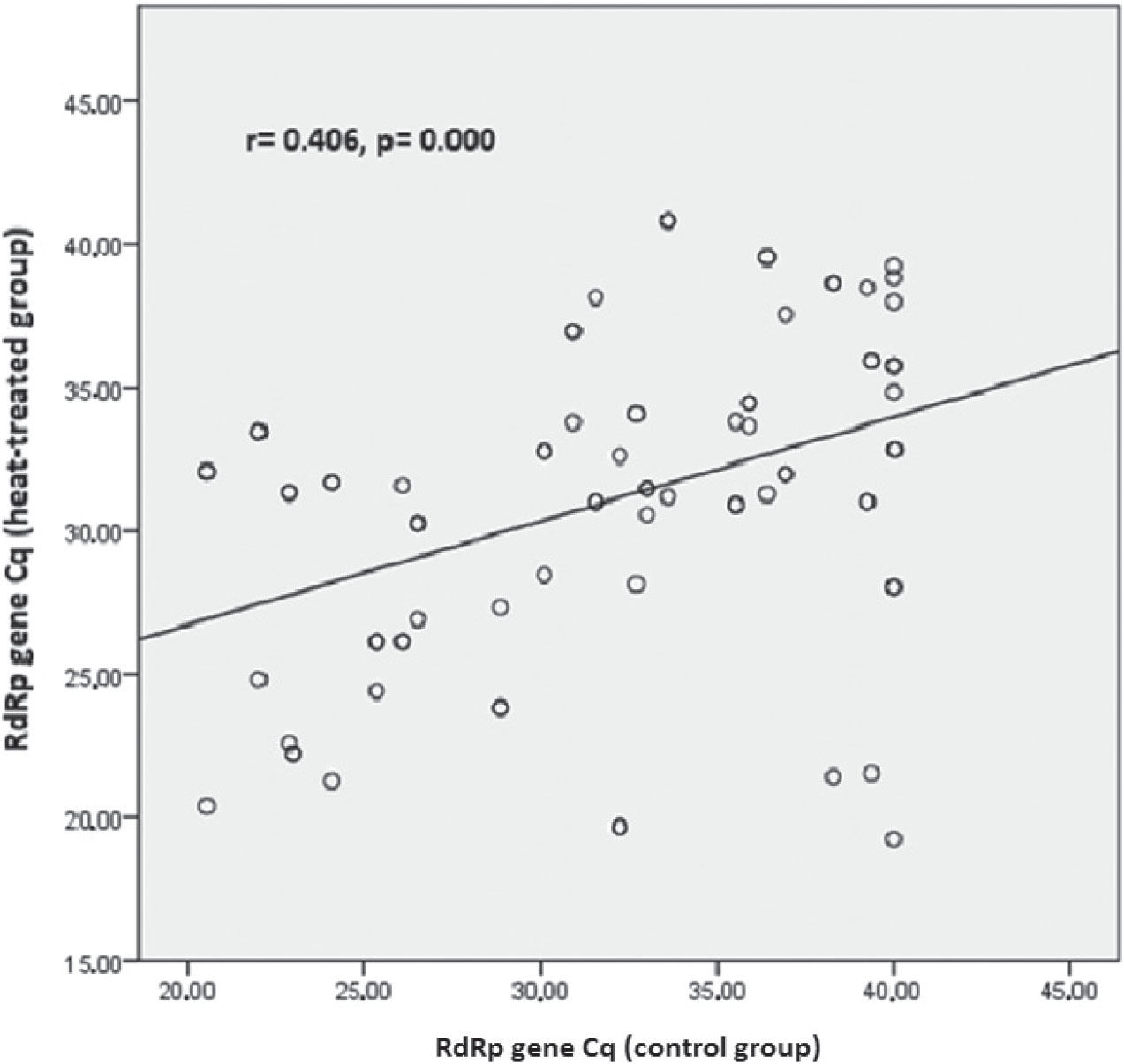
Figure 1
Correlation between the RdRp gene Cq values in the control and heat-treated strongly positive (Cq≤33) sample batch
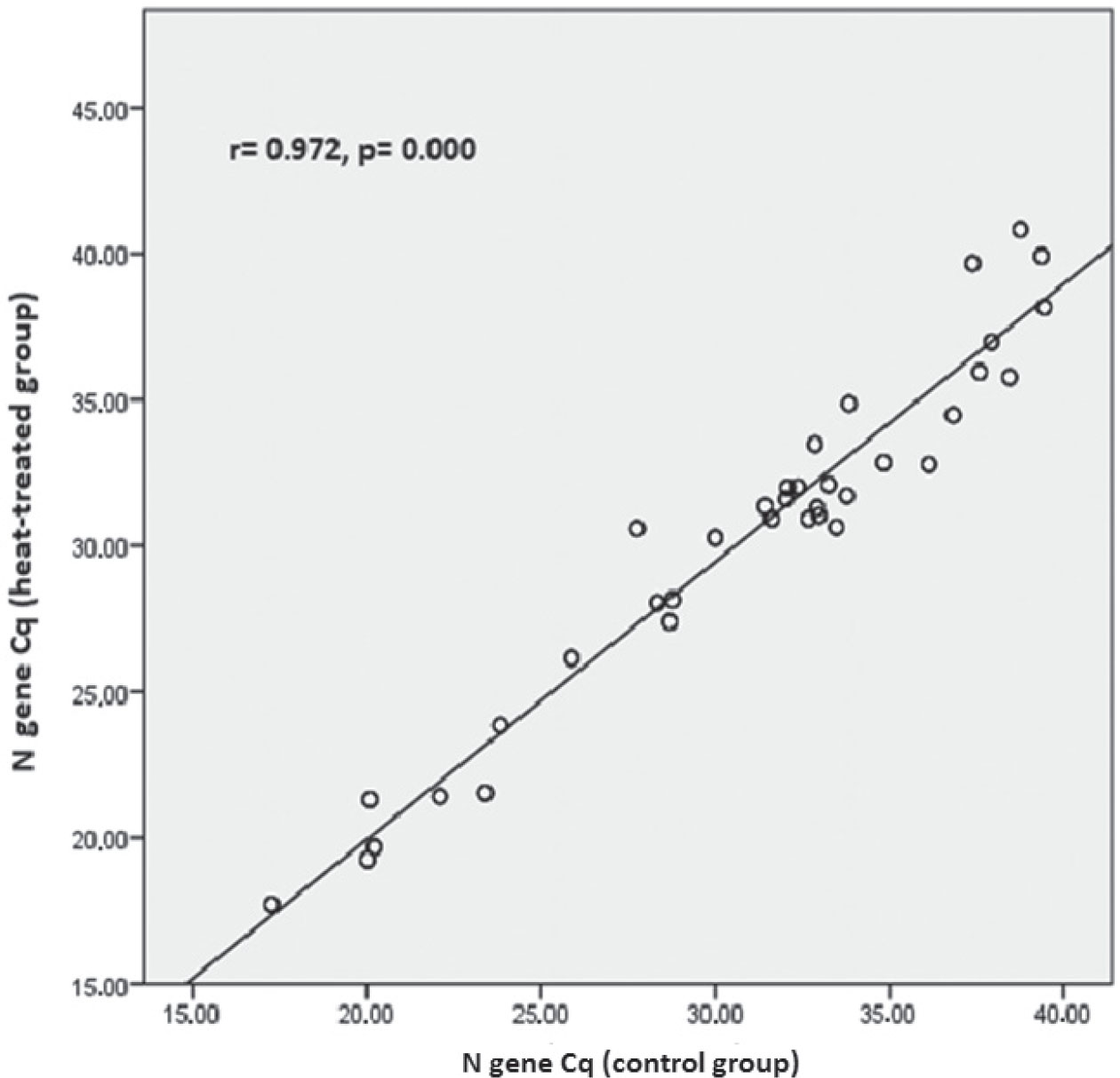
Figure 2
Correlation between the N gene Cq values in the control and heat-treated strongly positive (Cq≤33) sample batch
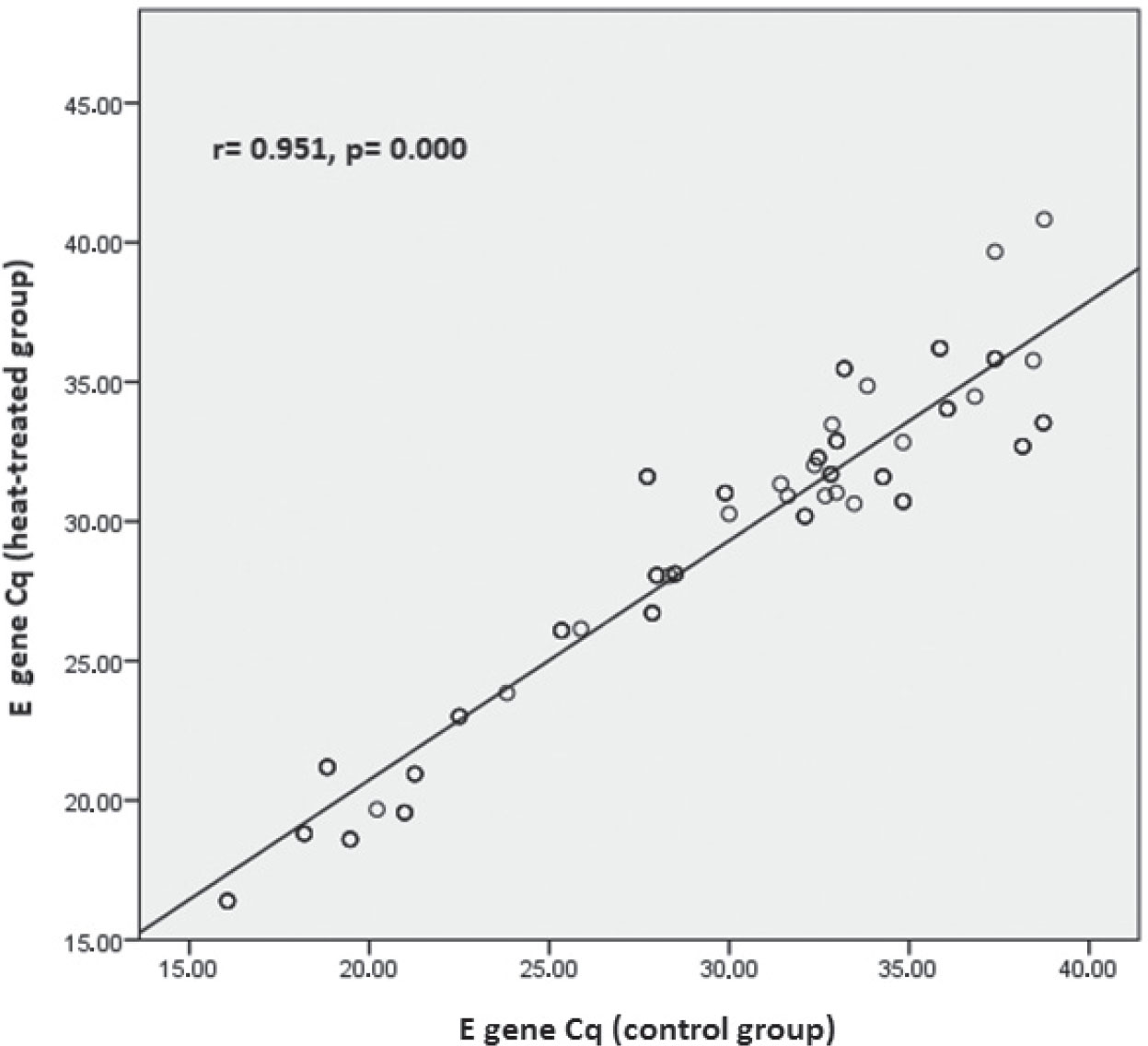
Figure 3
Correlation between the E gene Cq values in the control and heat-treated strongly positive (Cq≤33) sample batch
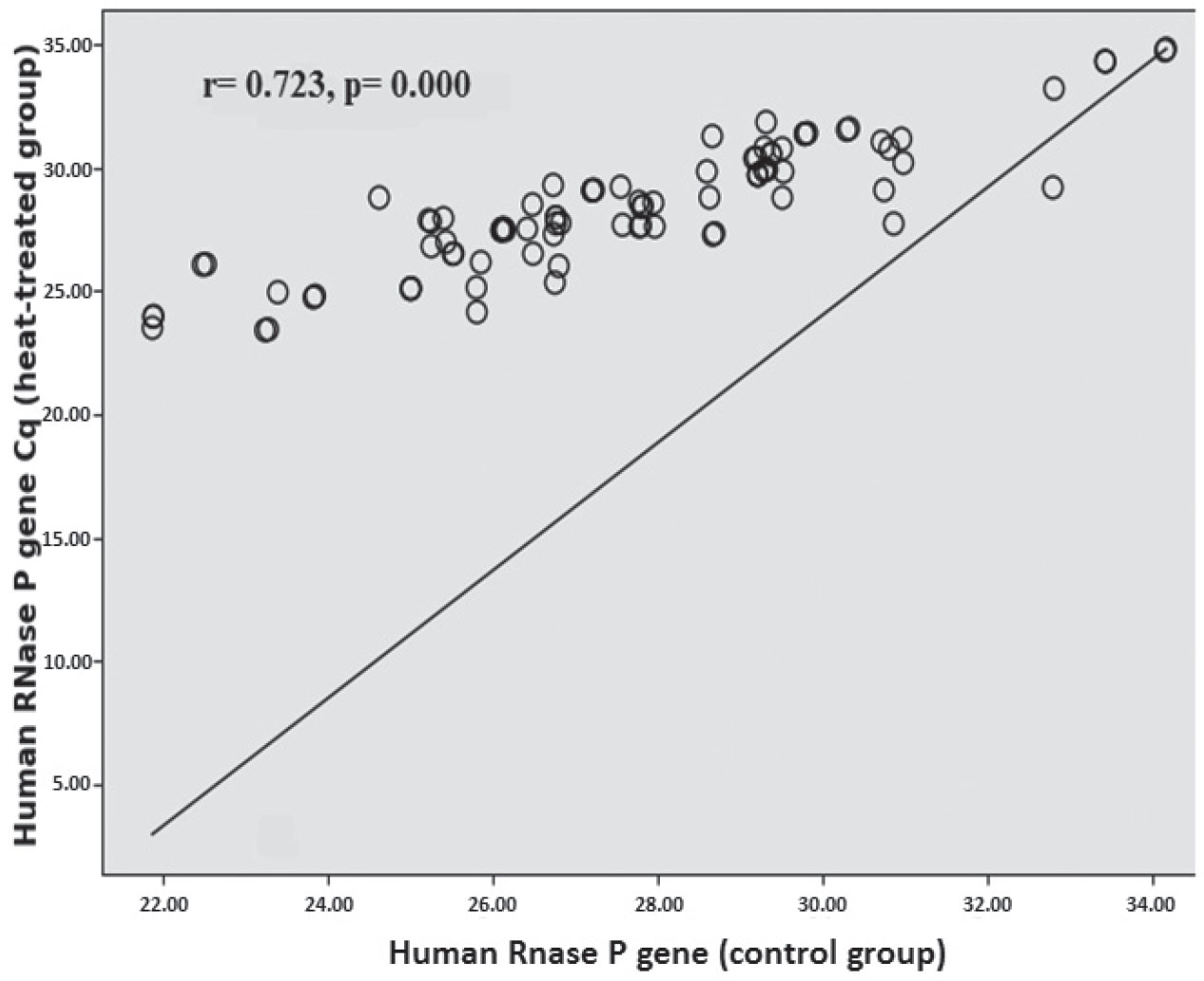
Figure 4
Correlation between the human RNase P gene Cq values in the control and heat-treated positive sample batch
Table 1
Proportion of detected target genes in SARS-CoV-2-positive control and heat-treated samples
| Groups (batches) | RdRp gene, N gene, and E gene positive n (%) | RdRp gene and N gene positive n (%) | N gene and E gene positive n (%) | N gene positive n (%) |
|---|---|---|---|---|
| Control | 66 (59.46) | 18 (16.22) | 12 (10.81) | 15 (13.51) |
| Heat-treated | 63 (57.27) | 25 (22.73) | 4 (3.64) | 18 (16.36) |
Table 2
Mismatching RT-qPCR results for control and heat-treated SARS-CoV-2-positive samples
| Sample ID | Untreated sample result (Cq value) | Heat-treated sample result (Cq value) | ||||
|---|---|---|---|---|---|---|
| RdRp gene | N gene | E gene | RdRp gene | N gene | E gene | |
| S 018 | Positive (39.37) | Positive (32.86) | Positive (35.50) | Negative | Positive (33.47) | Negative |
| S 023 | Positive (38.29) | Positive (33.25) | Positive (38.73) | Negative | Positive (32.09) | Positive (33.53) |
| S 024 | Negative | Positive (36.13) | Negative | Negative | Positive (32.78) | Positive (34.97) |
| S 028 | Positive (39.76) | Positive (34.92) | Negative | Negative | Negative | Negative |
| S 033 | Negative | Positive (32.93) | Positive (38.15) | Positive (38.00) | Positive (31.29) | Positive (32.69) |
| S 055 | Positive (39.28) | Positive (32.96) | Positive (35.05) | Negative | Positive (33.74) | Negative |
| S 056 | Positive (39.44) | Positive (33.78) | Positive (36.06) | Negative | Positive (31.71) | Positive (34.04) |
| S 060 | Positive (39.56) | Positive (33.54) | Positive (38.39) | Negative | Positive (32.35) | Positive (33.90) |
| S 061 | Positive (39.87) | Positive (34.29) | Negative | Negative | Positive (32.17) | Positive (34.65) |
| S 065 | Negative | Positive (40.0) | Positive (36.29) | Negative | Positive (40.0) | Negative |
| S 068 | Positive (38.71) | Positive (39.44) | Negative | Negative | Positive (38.16) | Negative |
| S 070 | Negative | Positive (32.26) | Positive (38.52) | Positive (37.96) | Positive (31.93) | Positive (32.91) |
| S 092 | Positive (39.63) | Positive (32.63) | Positive (35.96) | Negative | Positive (33.43) | Negative |
| S 096 | Positive (38.59) | Positive (33.73) | Positive (38.54) | Negative | Positive (32.35) | Positive (33.90) |
| S 098 | Negative | Positive (36.29) | Negative | Negative | Positive (32.65) | Positive (34.77) |
| S 102 | Positive (39.92) | Positive (34.18) | Negative | Negative | Positive (40.0) | Negative |
| S 107 | Negative | Positive (32.52) | Positive (38.26) | Positive (37.15) | Positive (31.96) | Positive (32.70) |
Table 3
Paired comparison of mean Cq values between the control and heat-treated SARS-CoV-2-positive samples
| Mean Cq value (95 % CI) | Paired t-test differences | ||
|---|---|---|---|
| Mean difference (95 % CI) | p-value* | ||
| human RNase P gene (control batch) (n=111) | 27.50 (27.12–27.88) | 0.653 (0.31–0.99) | <0.001 |
| human RNase P gene (heat-treated batch) (n=110) | 28.16 (27.66–28.65) | ||
| RdRp gene (control batch) (n=40) | 31.19 (29.88–32.50) | –1.04 (−2.17–0.27) | 0.011 |
| RdRp gene (heat-treated batch) (n=41) | 30.15 (28.76–31.54) | ||
| N gene (control batch) (n=67) | 31.02 (29.90–32.14) | 0.61 (0.33–0.88) | <0.001 |
| N gene (heat-treated batch) (n=60) | 31.22 (30.24–32.19) | ||
| E gene (control batch) (n=40) | 28.93 (27.57–30.29) | –0.65 (−0.15–1.14) | 0.010 |
| E gene (heat-treated batch) (n=41) | 28.29 (27.16–29.42) | ||
| Weakly positive samples (Cq>33) (n=252) | |||
| RdRp gene (control batch) (n=47) | 34.70 (34.09–35.31) | 0.11 (−0.60–0.83) | 0.751 |
| RdRp gene (heat-treated batch) (n=47) | 34.82 (33.91–35.73) | ||
| N gene (control batch) (n=44) | 34.44 (34.00–34.88) | 0.15 (−0.44–0.75) | 0.612 |
| N gene (heat-treated batch) (n=50) | 34.59 (33.93–35.25) | ||
| E gene control batch) (n=38) | 34.95 (34.32–35.58) | –0.93 (−1.73–0.14) | 0.020 |
| E gene (heat-treated batch) (n=26) | 34.02 (33.39–34.65) | ||