
Table 1
Differences between commute and on-duty driving (central and related concept, respectively)
| Characteristics | Commute driving | On-duty driving |
|---|---|---|
| Purpose of driving | To work and back home | For work and other purposes |
| Vehicle | Own vehicle | Employer’s vehicle |
| Passengers | Alone or with spouse or children | Alone or with colleague |
| Traffic hours | Usually peak hours | Throughout the day |
| Traffic congestion | High during peak hours | Subject to traffic hours |
| Road familiarity | Highly likely | Highly unlikely |
| GPS usage | Unlikely (except for traffic alerts) | Highly likely |
| Mode of driving | Highly “auto-mode” | More vigilant |
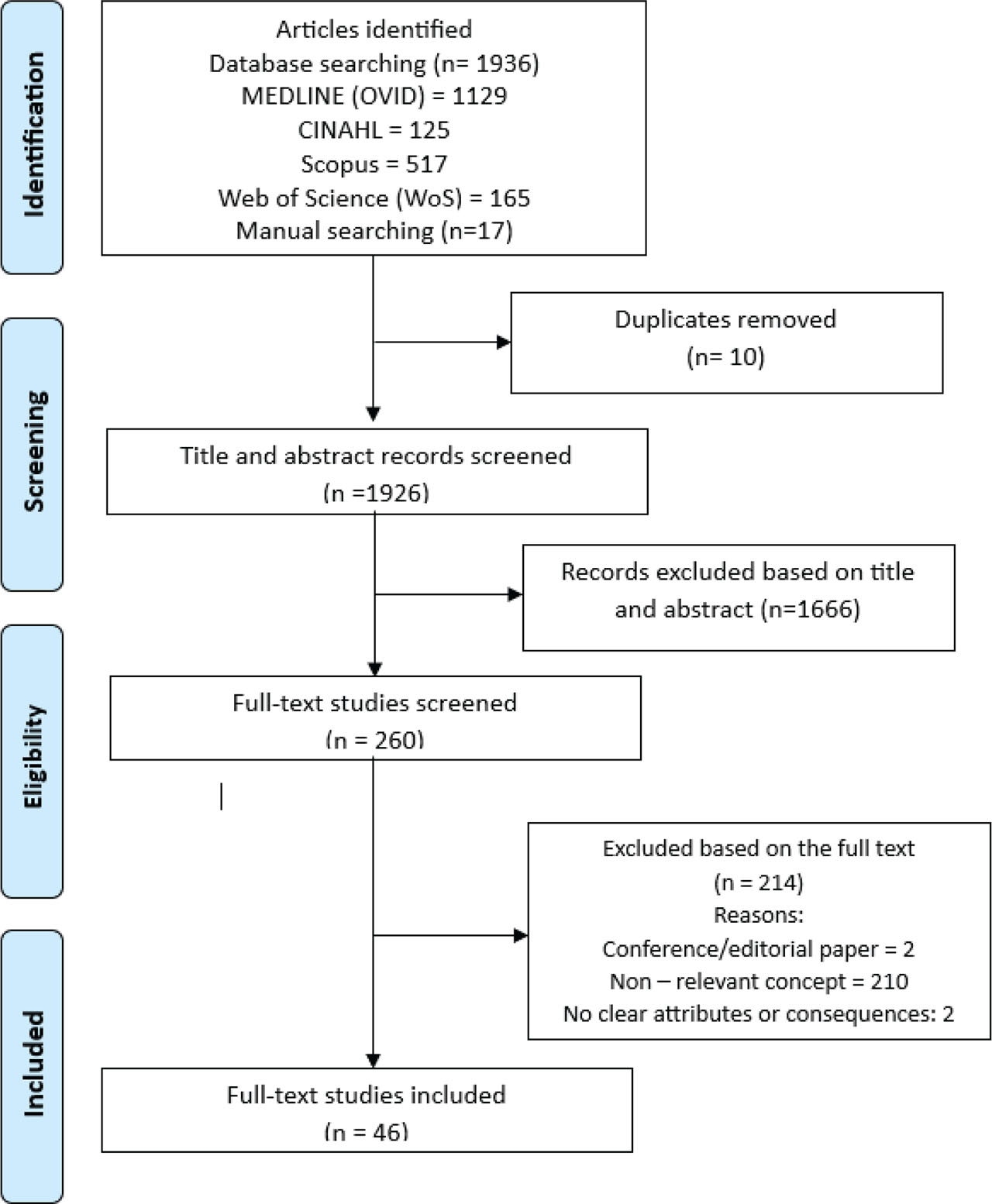
Figure 1
Article search strategy based on the PRISMA guidelines (35)
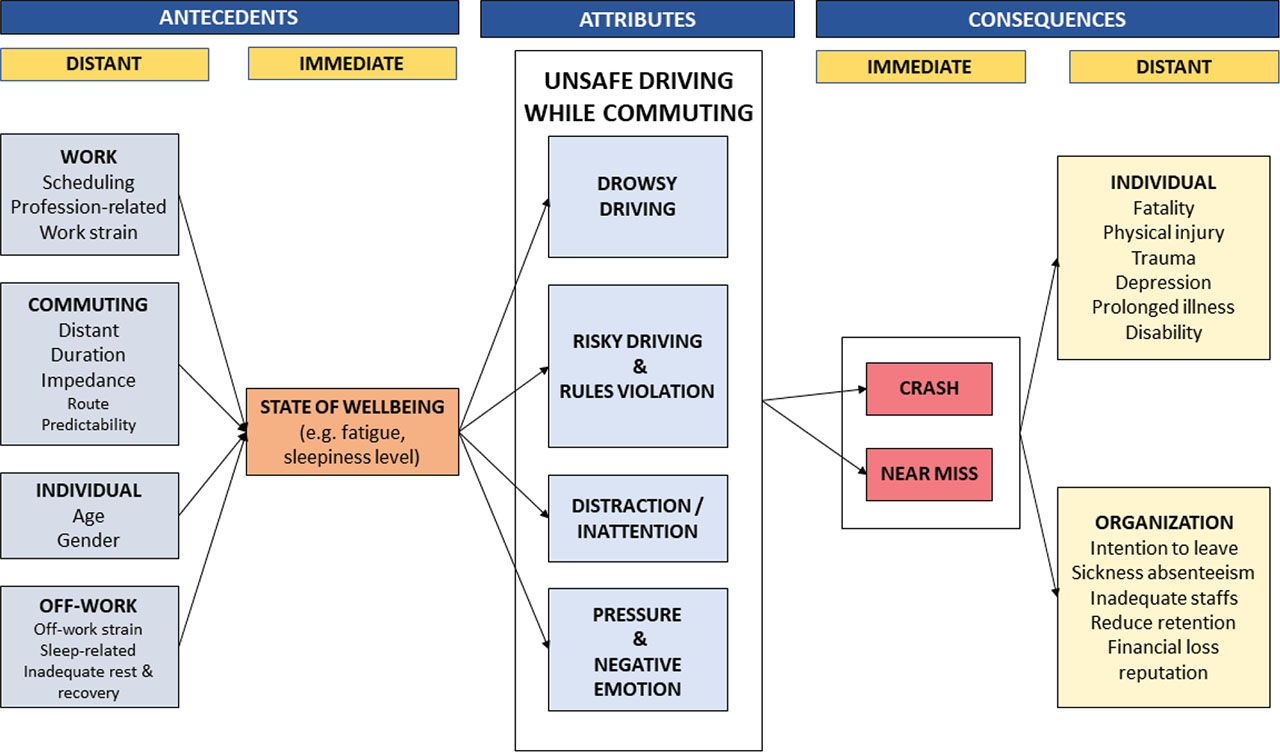
Figure 2
Factors affecting commute driving among HCWs
Table 2
Characteristics of the reviewed studies (n=46) on HCWs’ commute driving behaviour
| Type of data | Characteristics (no. of studies) |
|---|---|
| Country | Australia &/New Zealand (n=6) |
| Canada (n=1) | |
| France (n=1) | |
| Israel (n=2) | |
| Malaysia (n=2) | |
| Norway (n=1) | |
| United Kingdom (n=2) | |
| United States of America (n=30) | |
| Not stated (n=1) | |
| Year of publication | 1990–2000 (n=5) |
| 2001–2010 (n=10) | |
| 2011–2020 (n=26) | |
| 2021–2022 (n=5) | |
| Study design | Cross-sectional (n=21) |
| Case-control (n=2) | |
| Cohort/longitudinal (n=10) | |
| Quasi (pre/post) (n=7) | |
| Randomised clinical trial (n=2) | |
| Qualitative (n=4) | |
| Study population | Doctors (including residents/interns/house officers) (n=24) |
| Nurses (n=15) | |
| Mixed HCWs (n=7) | |
| Experimental studies (N=11) | Driving simulator (n=7) |
| Naturalistic observation (n=4) |
Table 3
Summary of analysed studies by attributes of unsafe driving behaviour of HCW commuters and consequences of such behaviour
| Attributes | Number of studies | References |
|---|---|---|
| Being asleep at the wheel / drowsy driving | 28 | (12, 13, 24, 37,38,39,40,41,42,43,44,45,46,47,48,49,50,51,52,53,54,55,56,57,58,59,60,61) |
| Rules violations (e.g., speeding, ticketing) | 8 | (12, 24, 53, 61,62,63,64,65) |
| Inattention / distracted driving / rumination | 7 | (24, 43, 52, 53, 61, 63, 665) |
| Stress / negative emotion | 2 | (55, 67) |
| Immediate consequences | ||
| Near crash / hazardous event | 21 | (13, 24, 37, 46,47,48, 52,53,54, 56, 57, 61, 62, 64, 68,69,70,71, 75, 77, 78,) |
| Crashes / collisions | 24 | (9,10,11,12,13, 37, 39, 40, 42,43,44, 46,47,48,49,50, 53, 59, 61, 64, 69, 70, 75, 77,) |
| Distant consequences | ||
| Individual (physical injury, emotional injury, poor quality of life, depression, burnout, fatigue) | 5 | (9, 11, 37, 44, 68) |
| Organisational (sick absenteeism, lower work performance and enjoyment, intention to work fewer hours) | 4 | (9, 37, 41, 44) |
Table 4
Antecedents influencing unsafe driving behaviours while commuting among HCWs according to themes, sub-themes, and keywords
| Groups | Antecedents | Key terms | References |
|---|---|---|---|
| Work | Scheduling | Night shift, long shift, quick return (<11 h between shifts), type of shift, extended duration of shift, on-call, post duty | (9, 13, 32,33,34, 36, 40, 41, 44, 45, 47, 49,50,51,52, 54,55,56,57,58,59,60,61,62,63,64,65,66) |
| Profession-related | Residency years, seniority, type of profession (doctor vs nurse vs paramedic, etc.), seniority, medical discipline (critical care vs emergency) | (9,10,11, 38, 39, 42, 44, 67) | |
| Pressure at work | Stress level, burnout (emotional exhaustion, personal accomplishment, depersonalisation), depression | (50, 68, 69) | |
| Commuting | Commuting | Commuting distance, commuting duration, commuting impedance, rural vs urban, time spent actively driving, highlighting inherent task demands, direction of commuting (home to work vs work to home) | (9, 10, 35, 42, 48, 51, 60, 65, 70,71,72) |
| Off-work | Pressure outside work | Off-work stress, off-work activities (care for ageing parents, continuing studies while working, second job) | (69, 72) |
| Sleep-related | Sleep duration, sleep quality, sleep deprivation, acute sleep loss, shift work sleep disorder (shift work difficulties, difficulties remaining awake at work, tendency to fall asleep, struggle to remain awake) | (12, 33, 37, 44, 47, 49, 50, 57, 58, 64, 67, 72) | |
| Individual | Individual | Age (younger), gender (male), | (11, 38, 39, 67) |
| State of wellbeing | State of wellbeing | Fatigue, sleepiness, tiredness, mean blink duration (proxy for fatigue), percentage of eye closure (proxy for fatigue) | (32, 36, 39, 41, 45, 46, 49, 52, 58, 62, 67, 68, 72, 73) |