
Table 1
Pigments contained in tattoo inks
| Colour | Pigments | Ref. |
|---|---|---|
| Black | Iron oxide (Fe3O4), iron oxide (FeO), carbon, logwood | 9, 15, 17, 18 |
| White | Titanium dioxide (TiO2), zinc (Zn), lead (Pb) | 9 |
| Brown | Ochre (an ancient pigment), iron (Fe) | 9, 11 |
| Red | Cinnabar (HgS), cadmium red (CdSe), iron oxide (Fe2O3), napthol-AS pigment (C26H22N4O4), quinacridone (C20H12N2O2), azo compounds | 9, 11 |
| Purple | Cobalt (Co), manganese (Mn) | 17, 18 |
| Orange | Disazodiarylide (C34H30Cl2N6O4) and/or disazopyrazolone (C32H24Cl2N8O2), cadmium selenide sulphide (Cd2SeS) | 17, 18, |
| Yellow | Cadmium sulphide (CdS), azo compounds, lead (Pb) | 17, 18 |
| Brown | May contain iron oxides, e.g., ochre, iron (Fe) | 17 |
| Green | Cobalt oxide (CoO) or chromium oxide (Cr2O3), phthalocyanine green (C32Cl16CuN8), a mix of cobalt chromate (CoCr2O4) and lead chromate (PbCrO4) | 17, 18 |
| Blue | Aluminium cobalt oxides (Al2Co2O5), copper phthalocyanine (C32H16CuN8), nickel (Ni) | 16, 17, 18 |
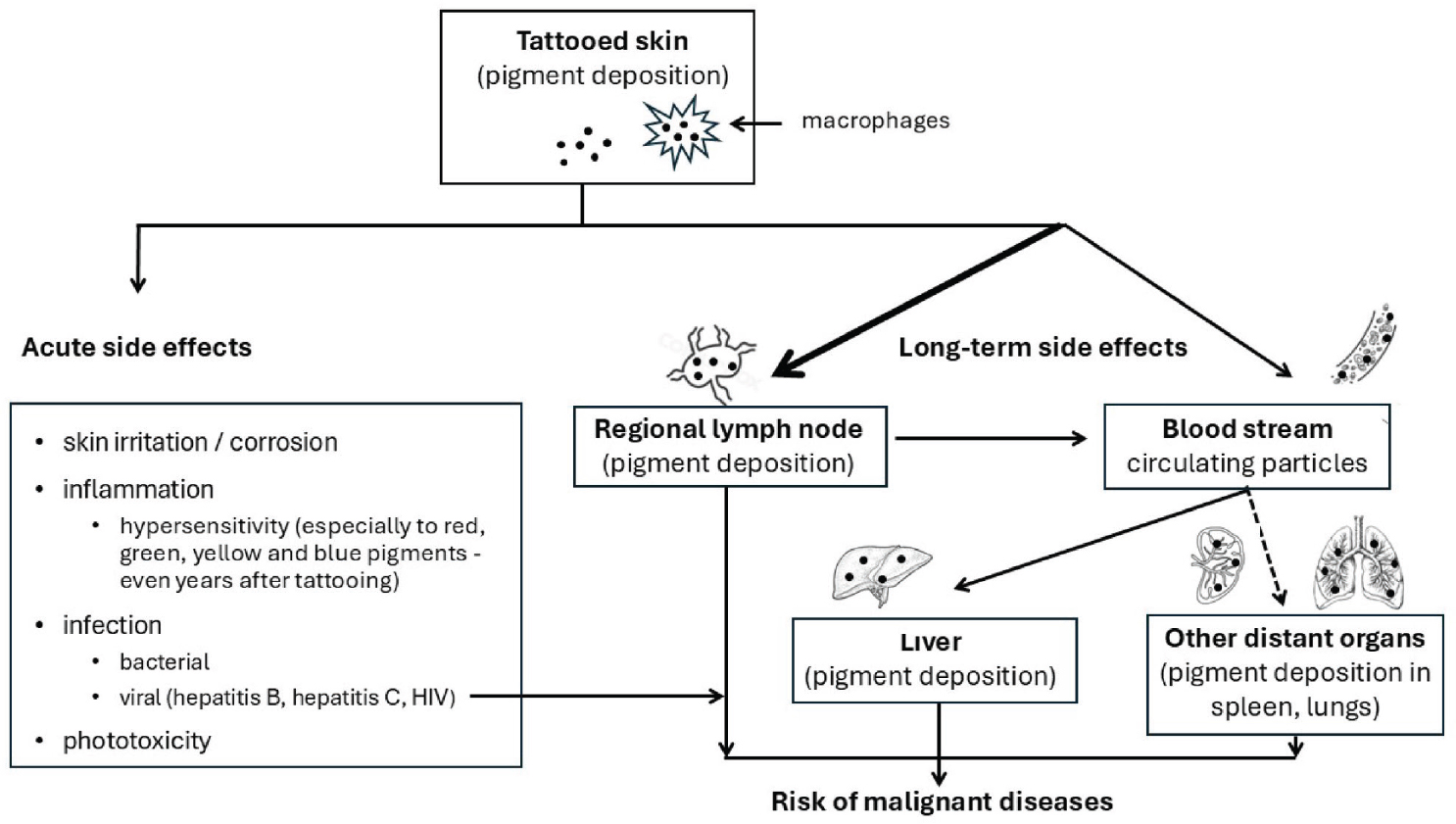
Figure 1
Distribution of tattoo pigments after injection into the skin. HIV – human immunodeficiency virus
Table 2
Immediate, delayed, and long-term adverse effects and complications of tattooing
| Adverse effects/complications | Cause/Clinical features | Onset |
|---|---|---|
| Immediate | ||
| Iritation/inflammation | Skin damage, lymphadenopathy | Shortly after tattooing |
| MRI burn | Pain, subjective sensation of burning | During MRI |
| Delayed | ||
| Infection | ||
| Bacterial | Staphylococcus, Streptococcus, Psudomonas, Clostridium species, nontuberculous mycobacteria, etc. | First few days |
| Viral | Hepatitis B, C, human immunodeficiency virus, papilloma, and herpes simplex viruses | Weeks to months |
| Mycotic | Zygomicota | After months |
| Other | ||
| Allergy | Tattoo ink ingredients (e.g., nickel) | Days/weeks/years |
| Photoallergic reaction (hives-like reaction) | Tattoo ink with cadmium sulphide; possibly ROS-mediated | After sun exposure |
| Skin disease in tattooed area | Clinical features: psoriasis, lichen planus, pseudolymphoma, pseudoepitheliomatous hyperplasia | Weeks to years |
| Long-term | ||
| Idiopathic benign accumulation of inflammatory cells | Cutaneous pseudolymphoma | Weeks to years |
| Malignant diseases | Carcinoma basocellular, melanoma, keratoacanthoma, lymphoma | Weeks to years |
Table 3
Methods for detection and identification of adverse effects of tattooing
| Test | Principle | Method |
|---|---|---|
| Ex vivo on cells | Addition of tattoo ink (component) to isolated cells (lymphocytes, macrophages) | Flow cytometry |
| Ex vivo on cell culture or reconstructed human skin models (RHS) | Application of tattoo ink (component) on RHS | Reflectance spectroscopy |
| Experiments on sacrificed animals (a year after injection of tattoo ink) | Detection of deposits of tattoo pigments in the Kupfer cells | Light microscopy and transmission electron microscopy |
| Human trials | ||
| Skin biopsy | Qualitative and quantitative analysis | histology analysis; immunohistochemistry analysis; micro-X-ray fluorescence analysis (μ-XRF); laser ablation-inductively coupled plasma-mass spectrometry (LA-ICP-MS) |
| Case reports | Description of side effects in individual patients | Clinical identification and laboratory testing |
| Epidemiological research | Description of side effects on a large number of subjects | Examining the connection between tattooing and side effects (e.g., link between ink and cancer) |
| In silico | Computer models of cellular behaviour | Computer simulation software |
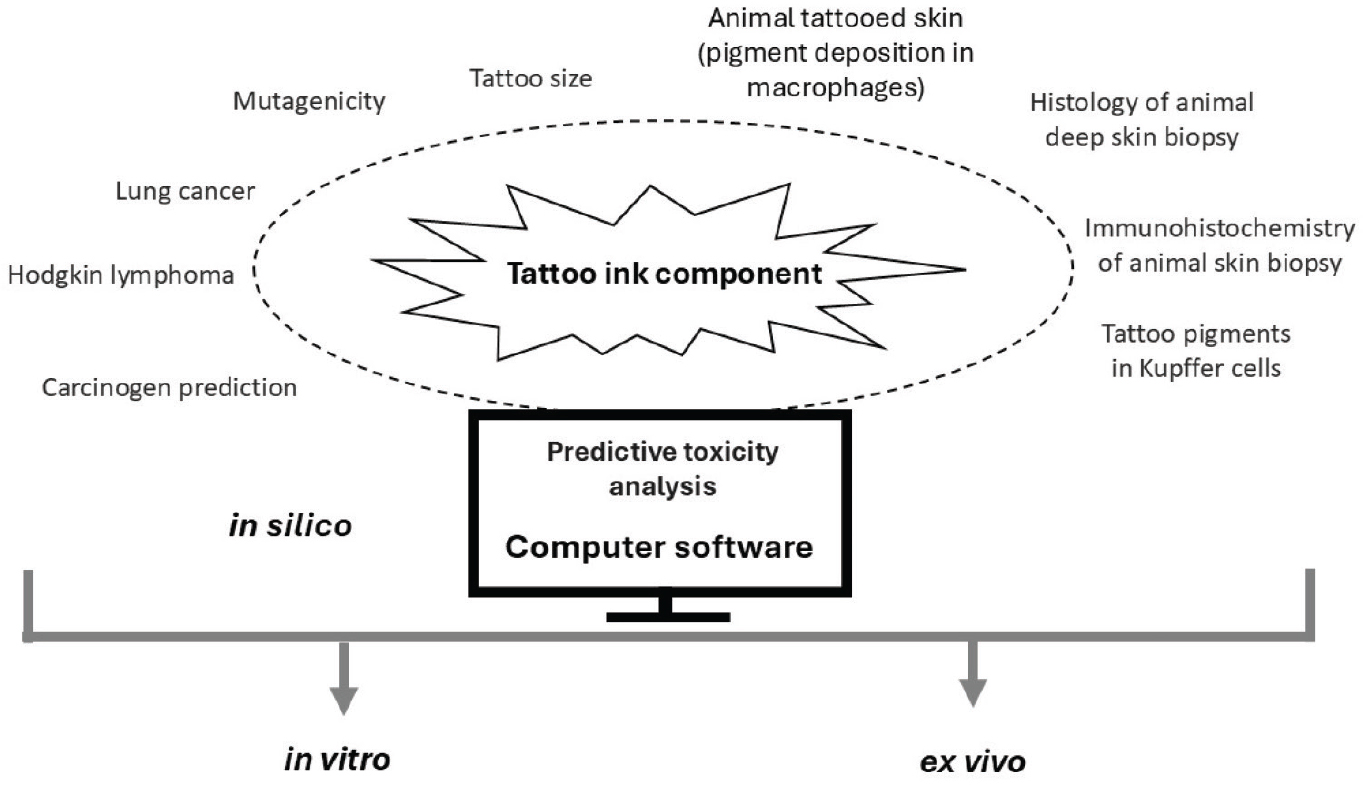
Figure 2
Possible avenues of in silico analysis to predict the adverse effects of tattoo ink components