
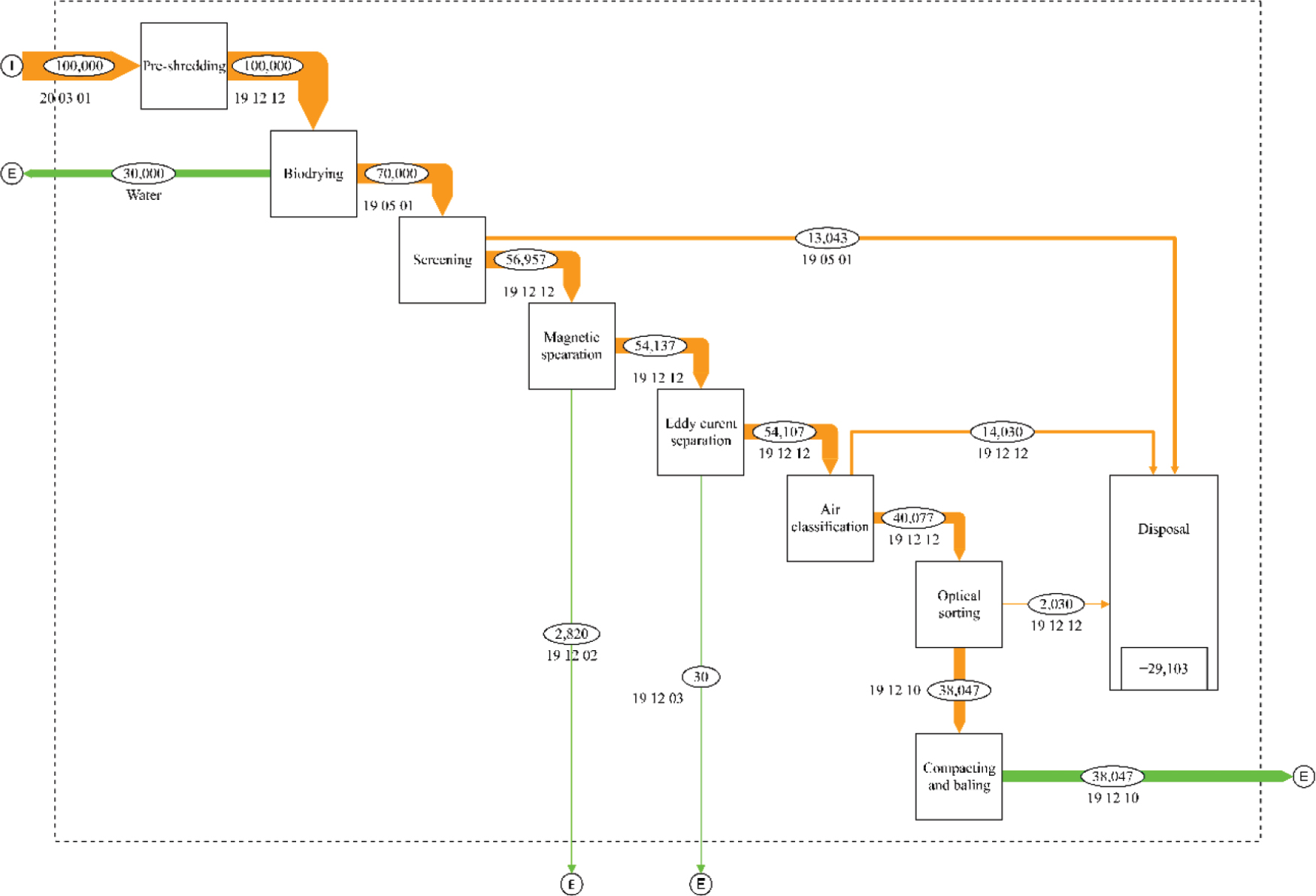
Figure 1
Material flow of residual waste in the mechanical-biological treatment plant at the WMC Marišćina, Croatia; I – import flow; E – export flow
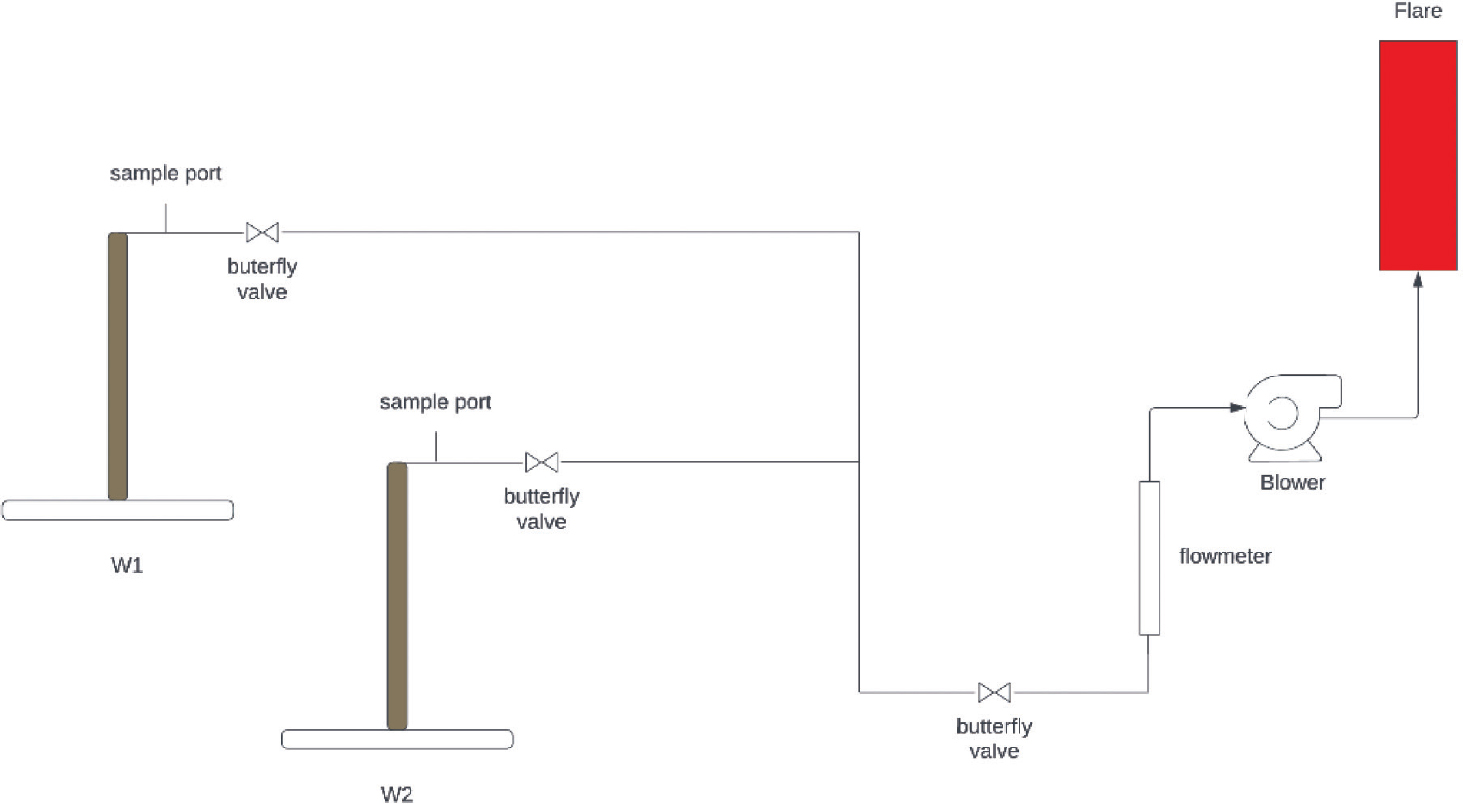
Figure 2
Active venting system schematic at the HDPE cover WMC Marišćina landfill. W1 – gas well 1; W2 – gas well 2
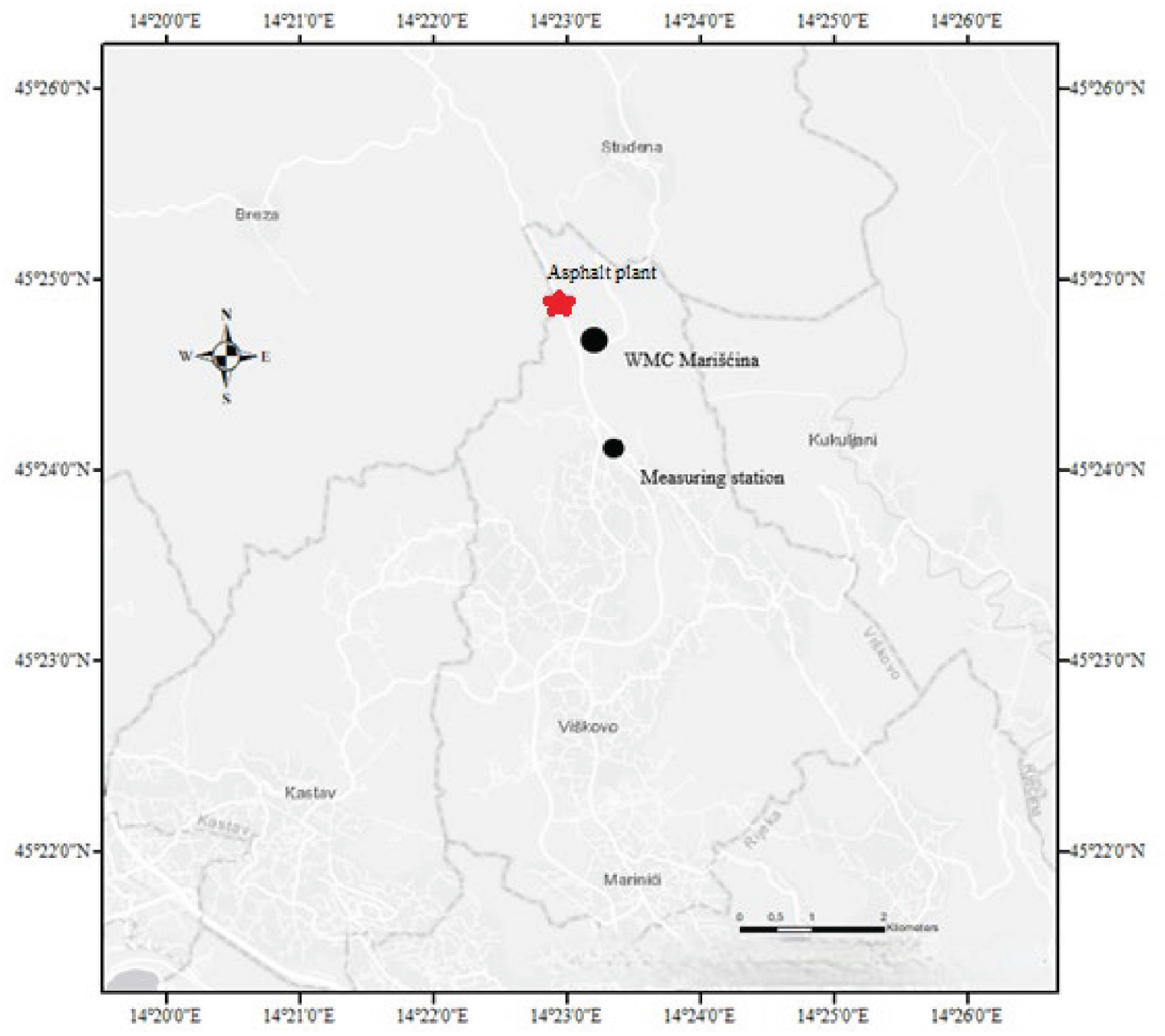
Figure 3
Locations of the WMC Marišćina, monitoring station, and the local asphalt plant (red star)
Table 1
Hydrogen sulphide (H2S), ammonia (NH3), and particulate matter (PM10) concentrations near the Marišćina Waste Management Centre in 2018 and 2021 by season
| Year | Season | Count | Mean | SD | Min | Q1 | Median | Q3 | Max |
|---|---|---|---|---|---|---|---|---|---|
| H2S (mg/m3) | |||||||||
| 2018 | Autumn | 91 | 1.33 | 1.36 | 0.20 | 0.55 | 0.90 | 1.50 | 9.70 |
| Spring | 92 | 0.83 | 0.28 | 0.40 | 0.60 | 0.80 | 1.00 | 1.70 | |
| Summer | 92 | 0.67 | 0.28 | 0.30 | 0.48 | 0.60 | 0.80 | 1.50 | |
| Winter | 90 | 1.32 | 1.27 | 0.20 | 0.70 | 0.90 | 1.18 | 7.10 | |
| 2021 | Autumn | 91 | 0.58 | 0.19 | 0.30 | 0.50 | 0.50 | 0.70 | 1.40 |
| Spring | 92 | 0.64 | 0.19 | 0.20 | 0.50 | 0.60 | 0.80 | 1.10 | |
| Summer | 92 | 0.70 | 0.19 | 0.30 | 0.60 | 0.70 | 0.80 | 1.10 | |
| Winter | 90 | 0.70 | 0.43 | 0.20 | 0.40 | 0.60 | 0.80 | 2.50 | |
| NH3 (mg/m3) | |||||||||
| 2018 | Autumn | 91 | 1.77 | 0.83 | 0.30 | 1.15 | 1.60 | 2.25 | 4.10 |
| Spring | 92 | 1.46 | 0.69 | 0.30 | 1.00 | 1.30 | 1.80 | 3.60 | |
| Summer | 92 | 1.55 | 0.91 | 0.10 | 0.90 | 1.45 | 2.10 | 4.30 | |
| Winter | 90 | 1.65 | 0.95 | 0.30 | 0.90 | 1.50 | 2.20 | 4.40 | |
| 2021 | Autumn | 91 | 1.71 | 0.59 | 0.70 | 1.30 | 1.50 | 1.90 | 4.30 |
| Spring | 92 | 2.31 | 0.92 | 0.90 | 1.70 | 2.07 | 2.70 | 5.40 | |
| Summer | 92 | 1.88 | 0.73 | 0.40 | 1.30 | 1.80 | 2.40 | 3.60 | |
| Winter | 90 | 1.85 | 0.74 | 0.70 | 1.40 | 1.70 | 2.18 | 4.30 | |
| PM10 (mg/m3) | |||||||||
| 2018 | Autumn | 91 | 20.15 | 7.08 | 8.00 | 14.57 | 19.16 | 24.51 | 40.30 |
| Spring | 92 | 22.06 | 12.17 | 7.10 | 15.55 | 19.60 | 25.90 | 108.60 | |
| Summer | 92 | 18.40 | 6.13 | 8.16 | 14.01 | 17.64 | 21.68 | 35.80 | |
| Winter | 90 | 20.43 | 8.60 | 5.70 | 14.11 | 18.23 | 26.48 | 48.40 | |
| 2021 | Autumn | 91 | 16.09 | 8.69 | 3.50 | 9.60 | 15.00 | 21.40 | 54.20 |
| Spring | 92 | 12.05 | 7.60 | 2.50 | 7.05 | 9.95 | 13.85 | 39.20 | |
| Summer | 92 | 15.73 | 10.85 | 2.40 | 9.88 | 13.45 | 17.80 | 79.80 | |
| Winter | 90 | 17.62 | 14.06 | 3.30 | 8.53 | 14.05 | 22.03 | 83.80 | |
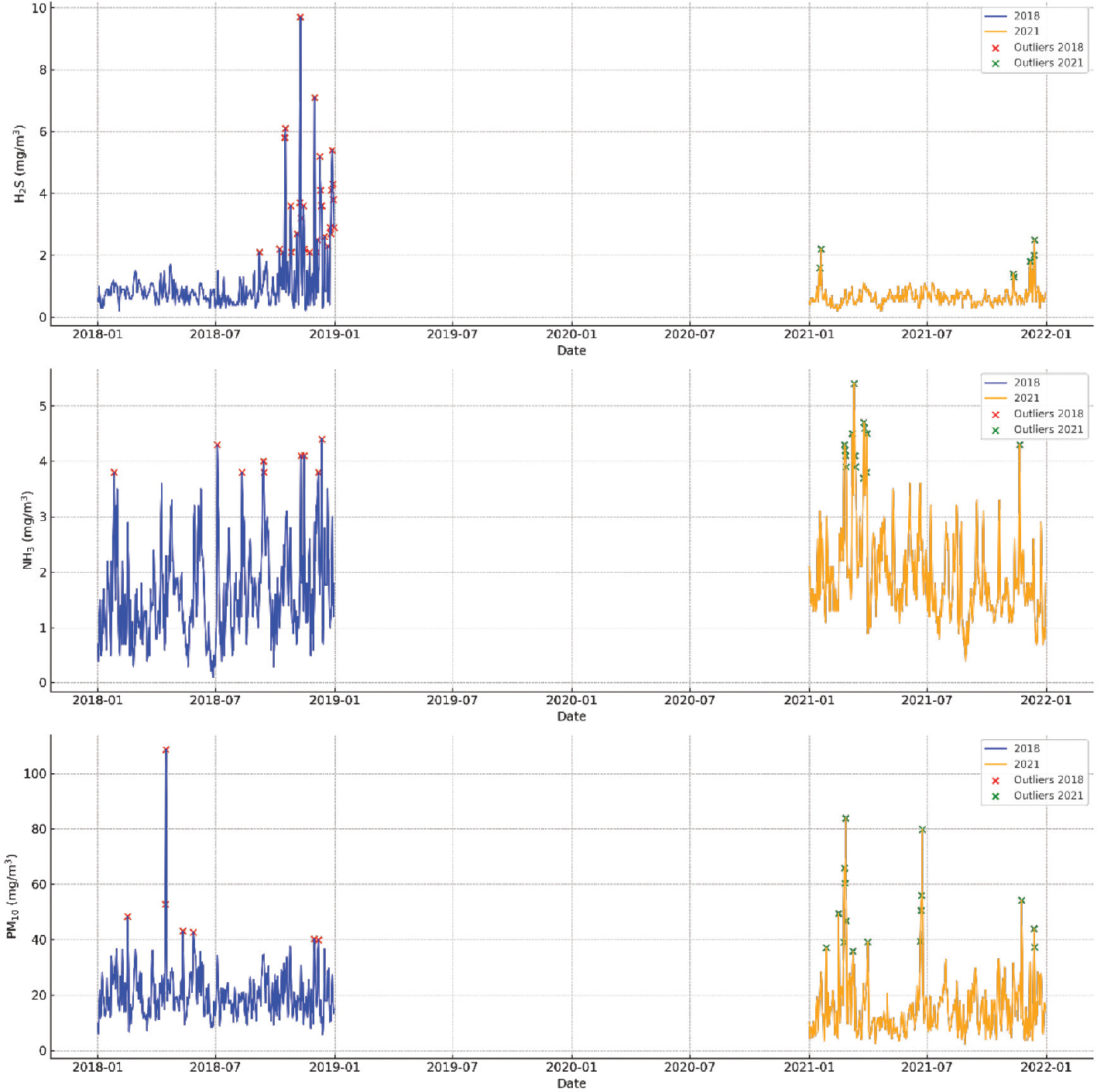
Figure 4
Time-trends of 24-hour averaged concentrations of H2S, NH3, and PM10 in 2018 (blue) and 2021 (orange). Peak air quality values are indicated by red (2018) and green (2021) crosses
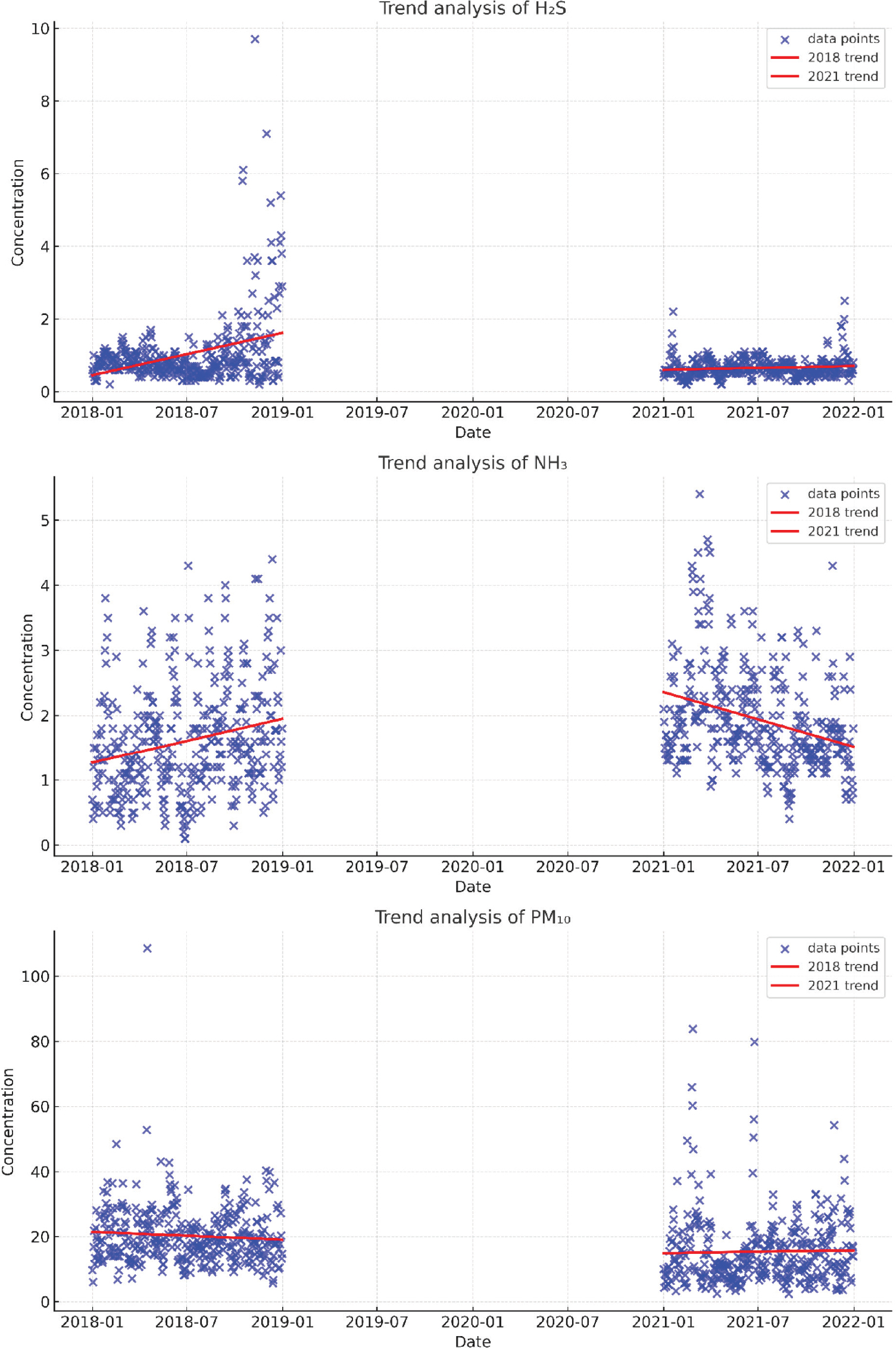
Figure 5
Linear trends in H2S, NH3, and PM10 concentrations (red line) measured near the WMC Marišćina with individual data points plotted separately for each year (blue crosses)
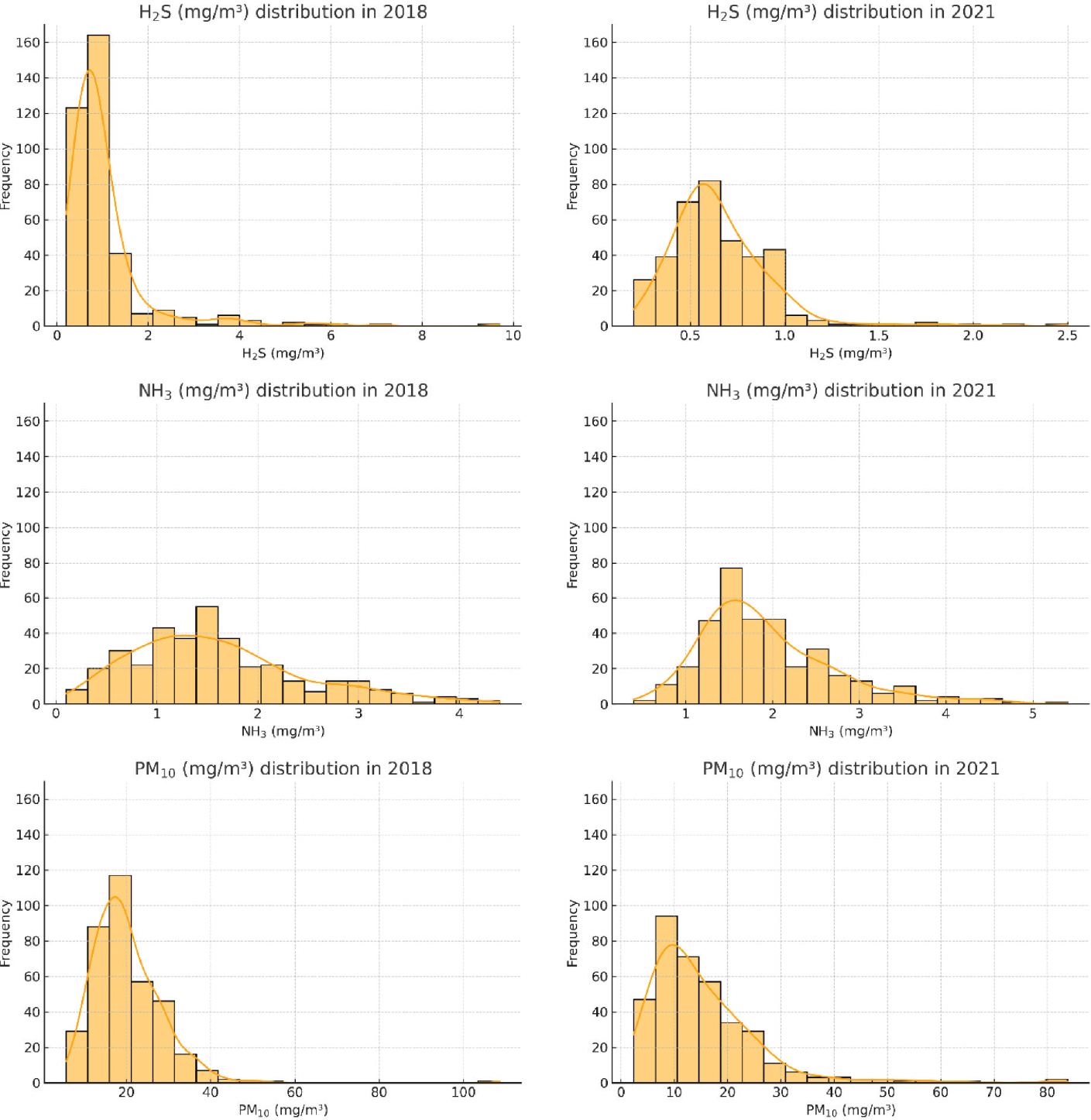
Figure 6
Distribution of H2S, NH3, and PM10 24-hour averaged levels near the WMC Marišćina and their kernel density estimates
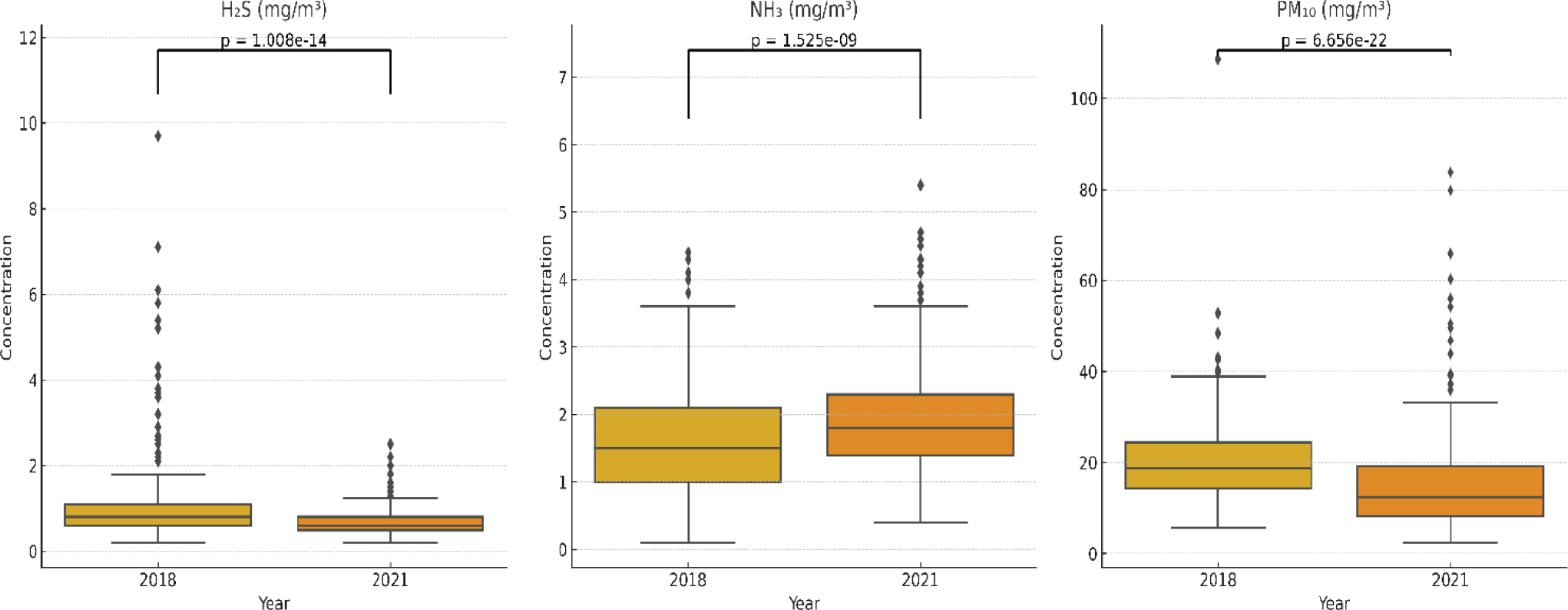
Figure 7
Comparison of 2018 and 2021 H2S, NH3, and PM10 levels measured near the WMC Marišćina. The central line within each box represents medians, while the edges of the box indicate the interquartile range (IQR). Whiskers extend to the minimum and maximum values within 1.5 times of the IQR, and any outliers are plotted as individual points
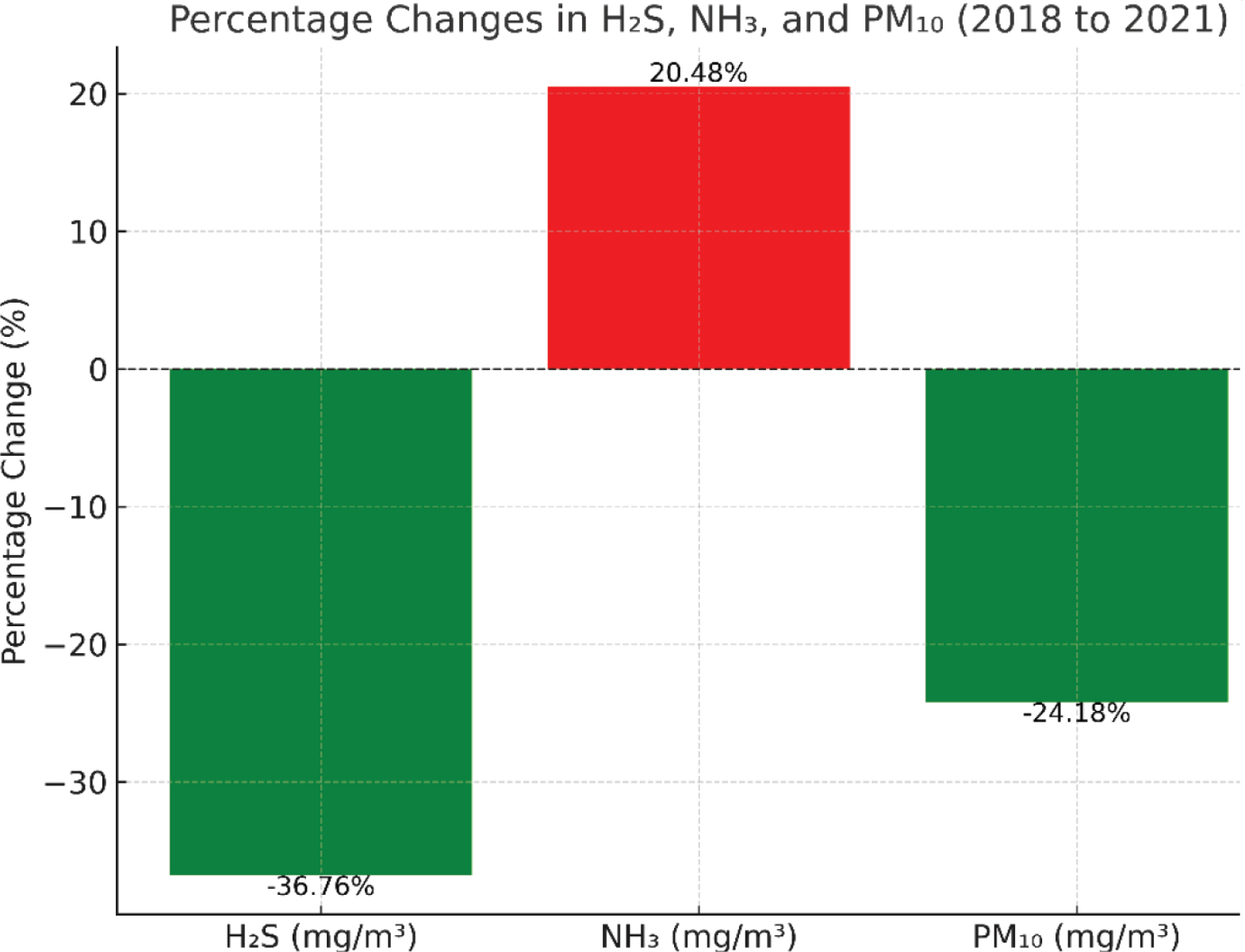
Figure 8
Changes in H2S, NH3, and PM10 measured near the WMC Marišćina from 2018 to 2021
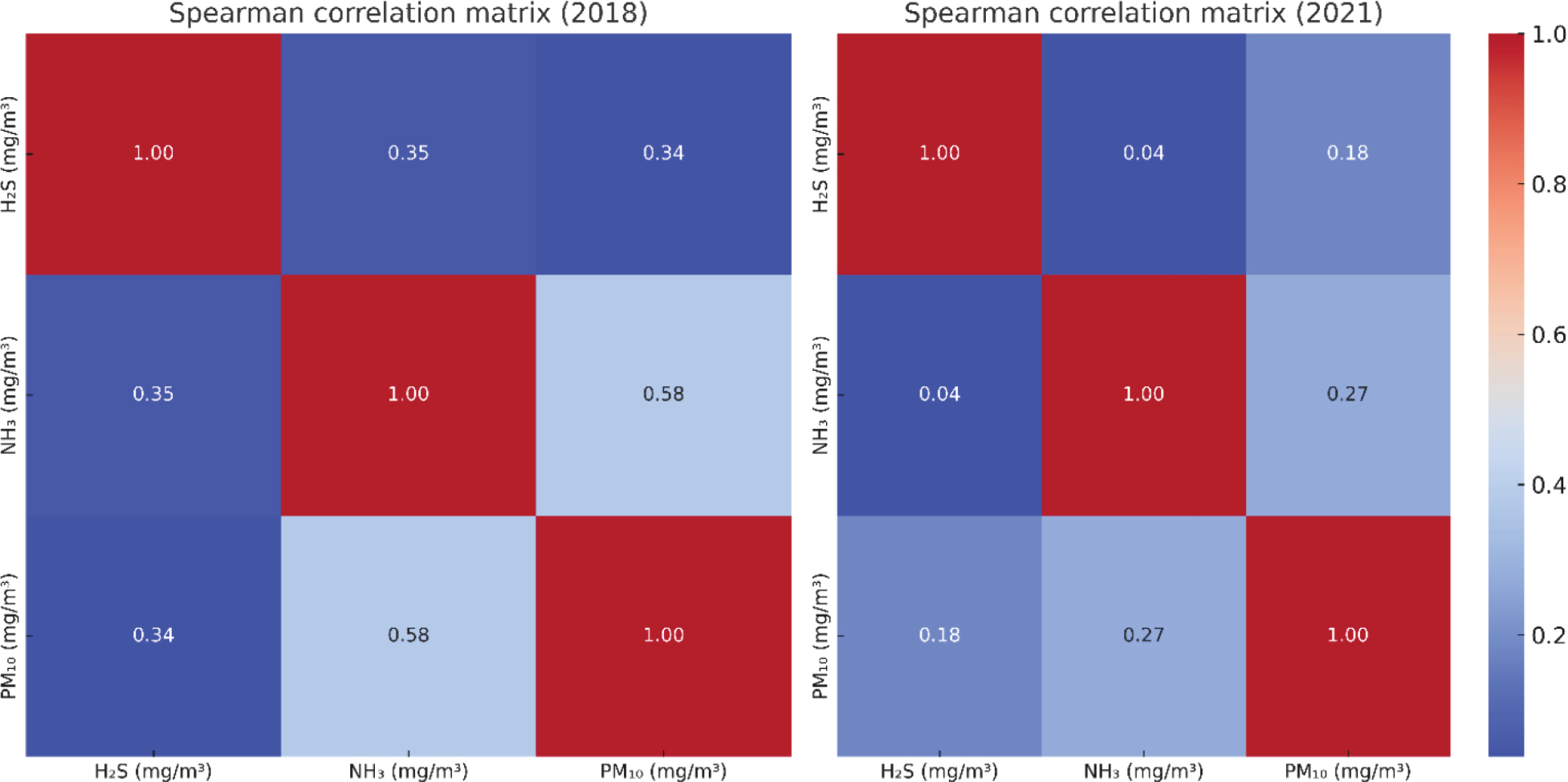
Figure 9
Spearman’s rank correlation matrix illustrating the relationships between H2S, NH3, and PM10 levels measured in ambient air near the WMC Marišćina for the years 2018 and 2021. The colour scale represents the strength and direction of the correlations, with values ranging from -1 (perfect negative correlation) to 1 (perfect positive correlation)