
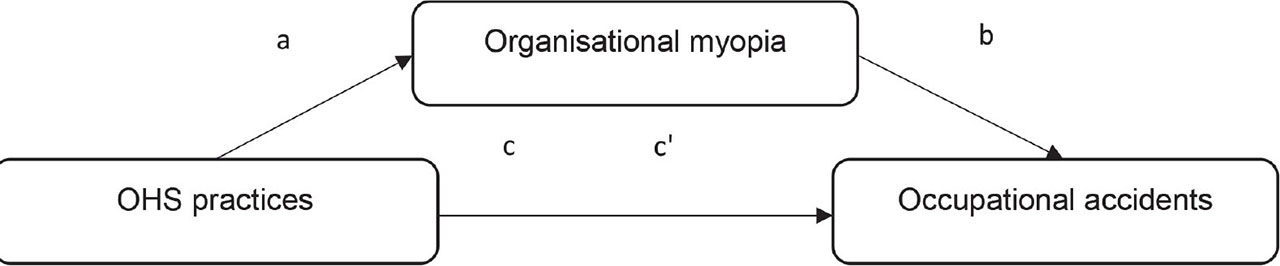
Figure 1
Conceptual model of mediation analysis. Path a represents the direct effect of the independent variable x (OHS practices) on the mediating variable m (organisational myopia). Path b represents the effect of m on the dependent variable y (occupational accidents). This effect is expressed as the coefficient obtained by testing x, y, and m in the same model. Path c indicates the total effect of x on y. Path c’ indicates the controlled effect of x on y, and is expressed as the coefficient obtained by testing x, y, and m in the same model
Table 1
Demographic characteristics of participating healthcare workers in Turkey
| Variables | Categories | N | % |
|---|---|---|---|
| Gender | Female | 295 | 70.2 |
| Male | 125 | 29.8 | |
| Age (years) | 18–25 | 123 | 29.3 |
| 26–33 | 141 | 33.6 | |
| 34–41 | 81 | 19.3 | |
| 42–49 | 58 | 13.8 | |
| 50 and above | 17 | 4 | |
| Education level | High school | 51 | 12.1 |
| Bachelor | 285 | 67.9 | |
| Postgraduate | 84 | 20 | |
| Marital status | Married | 183 | 43.6 |
| Single | 237 | 56.4 | |
| Work experience in the current workplace (years) | 1 and below | 119 | 28.3 |
| 2–5 | 160 | 38.1 | |
| 6–9 | 52 | 12.4 | |
| 10–13 | 43 | 10.2 | |
| 14 and above | 46 | 11 | |
| Total work experience (years) | 1 and below | 63 | 15 |
| 2–5 | 136 | 32.4 | |
| 6–9 | 59 | 14 | |
| 10–13 | 48 | 11.4 | |
| 14 and above | 114 | 27.1 | |
| Current position | Physician | 56 | 13.3 |
| Nurse / midwife | 115 | 27.4 | |
| Health technician | 83 | 19.8 | |
| Hospital administrative staff | 129 | 30.7 | |
| Manager | 19 | 4.5 | |
| Support services staff | 18 | 4.3 | |
| Have you had an occupational accident before? | Yes | 69 | 16.4 |
| No | 351 | 83.6 | |
| Have any of your colleagues had an occupational accident in the last year? | Yes | 139 | 33.1 |
| No | 281 | 66.9 | |
| Have you had a near-miss incident in your work environment before? | Yes | 156 | 37.1 |
| No | 264 | 62.9 | |
| Are the OHS measures at your workplace adequate? | Yes | 248 | 59 |
| No | 172 | 41 | |
| Are the occupational safety specialist and occupational physician services sufficient in your workplace? | Yes | 285 | 67.9 |
| No | 135 | 32.1 | |
| How often do you receive OHS training? | None | 8 | 1.9 |
| Once in six months | 120 | 28.6 | |
| Once a year | 231 | 55 | |
| Once in two years | 19 | 4.5 | |
| Once in three years | 27 | 6.4 | |
| Other | 15 | 3.6 |
Table 2
Factor and reliability analysis of the organisational myopia scale
| Rotated component matrix | ||||
|---|---|---|---|---|
| Items | Components | |||
| Organisation structure | Degree of routine | Individual indifference | Individual resistance | |
| O5: My managers are not flexible. | 0.744 | |||
| O3: Feedback about the organisation is not evaluated. | 0.732 | |||
| O2: Our workplace does not provide an environment where employees can share their ideas. | 0.723 | |||
| O6: The rules in our organisation are strict. | 0.717 | |||
| O4: In our workplace, work is always done the traditional way. | 0.713 | |||
| O7: There is very little innovation in our organisation. | 0.679 | |||
| R5: I have a standard job. | 0.786 | |||
| R4: My work lends itself to routinisation. | 0.783 | |||
| R2: My work is not open to innovation. | 0.671 | |||
| R1: I do not have the opportunity to improve myself at work. | 0.651 | |||
| R3: I always solve problems at work with the same methods. | 0.511 | |||
| R6: My job is not suitable for rotation. | 0.424 | |||
| I2: I am not curious about the developments around me. | 0.820 | |||
| I1: I do not follow innovations related to my work. | 0.750 | |||
| I3: I don’t recognise my own shortcomings easily. | 0.713 | |||
| I4: I don’t pay attention to the criticism of others. | 0.646 | |||
| IR2: I can’t give up my habits easily. | 0.813 | |||
| IR1: When I do something, I always use the methods I have used before. | 0.783 | |||
| IR3: Different environmental conditions scare me. | 0.576 | |||
| Variance explained | 18.738 % | 14.869 % | 13.342% | 9.933 % |
[i] Note: extraction method – principal component analysis; rotation method – varimax rotation; Kaiser-Meyer-Olkin (KMO) measure of sampling adequacy – 0.846; Bartlett’s test of sphericity – 0.000; approximately χ2 – 2888.375; degree of freedom – 171; total variance explained – 56.882 %; Cronbach’s alpha – 0.865; number of items – 19
Table 3
Factor and reliability analysis of OHS practices performance evaluation scale
| Rotated component matrix | |||||
|---|---|---|---|---|---|
| Items | Components | ||||
| Managerial measures | OHS awareness | Cooperation | OHS training | OHS criteria | |
| M3: Necessary health and safety measures are implemented in my workplace. | 0.753 | ||||
| M4: My workplace has the necessary protective health and safety equipment. | 0.749 | ||||
| M1: Employees at my workplace are provided with the necessary protective health and safety equipment. | 0.723 | ||||
| M2: We comply with health and safety measures at my workplace. | 0.702 | ||||
| M6: Risk assessments are carried out at regular intervals at my workplace. | 0.626 | ||||
| M5: Any work assignment at my workplace takes into account health and safety. | 0.566 | ||||
| A3: My colleagues are familiar with the measures of protection from occupational diseases. | 0.831 | ||||
| A1: My colleagues are familiar with occupational diseases and their causes. | 0.806 | ||||
| A2: My colleagues are familiar with the legal rights and responsibilities related to their work. | 0.775 | ||||
| A4: My colleagues are familiar with protection from health and safety risks at my workplace. | 0.767 | ||||
| A6: My colleagues know how to use protective equipment. | 0.585 | ||||
| C4: Information obtained by risk assessment is shared with the employees. | 0.761 | ||||
| C2: At my workplace, employees can easily express their concerns about health and safety issues. | 0.743 | ||||
| C3: Experts, management, and employees cooperate in regards to occupational health and safety at my workplace. | 0.731 | ||||
| C1: Management takes into account the health and safety concerns of employees. | 0.697 | ||||
| T3: Occupational health and safety trainings are implemented at my workplace. | 0.748 | ||||
| T2: Training in occupational health and safety is delivered in an understandable language. | 0.705 | ||||
| T1: Occupational health and safety training is announced to employees within a specific plan and programme. | 0.696 | ||||
| T5: If my workplace gets a new tool or equipment, training is provided on how to use it correctly. | 0.576 | ||||
| T4: Training in occupational health and safety includes practical demonstration. | 0.569 | ||||
| OH4: My colleagues do not jeopardise the health and safety of other staff while doing their work. | 0.791 | ||||
| OH3: My colleagues do not jeopardise their own health and safety while doing their work. | 0.720 | ||||
| OH5: My colleagues follow instructions to use machines, tools, and equipment at my workplace. | 0.684 | ||||
| OH1: When my colleagues encounter a threat to health and safety at work, they inform the management. | 0.593 | ||||
| OH2: At work, my colleagues apply the information they have learned from occupational health and safety training. | 0.579 | ||||
| Variance explained | 16.945 % | 15.636 % | 14.007 % | 13.952 % | 13.926 % |
[i] Note: extraction method – principal component analysis; rotation method – varimax rotation; Kaiser-Meyer-Olkin (KMO) measure of sampling adequacy – 0.960; Bartlett’s test of sphericity – 0.000; approximately χ2 – 8684.524; degree of freedom – 300; total variance explained – 74.466 %; Cronbach’s alpha – 0.965; number of items – 25
Table 4
Self-assessed risk of occupational accidents by study participants (N=420)
| Statements | N | % | |
|---|---|---|---|
| Have you had an occupational accident before? | Yes | 69 | 16.4 |
| No | 351 | 83.6 | |
| Total | 420 | 100.0 | |
| Have you had an occupational accident at your current workplace? | Yes | 46 | 11.0 |
| No | 374 | 89.0 | |
| Total | 420 | 100.0 | |
| Have any of your colleagues had an occupational accident in the last year? | Yes | 139 | 33.1 |
| No | 281 | 66.9 | |
| Total | 420 | 100.0 | |
| Have you had a near-miss incident in your work environment before? | Yes | 156 | 37.1 |
| No | 264 | 62.9 | |
| Total | 420 | 100.0 |
Table 5
Correlation analysis between participant scores on organisational myopia, OHS practices, and self-assessed risk of occupational accidents
Table 6
Results of mediation analysis
| Scales | R2 | p | B | p | LLCI | ULCI | Hypotheses |
|---|---|---|---|---|---|---|---|
| OHS practices (x) | 3.14 % | 0.0003 | −0.1387 | 0.0000 | −0.2128 | −0.0646 | H1 Confirmed |
| Organisational myopia (y) | 3.1729 | 0.0003 | 2.8987 | 3.4470 | |||
| OHS practices (x) | 6.92 % | 0.0000 | 0.0924 | 0.0000 | 0.0597 | 0.1251 | H2 Rejected |
| Organisational myopia (m) | 0.0130 | 0.5413 | −0.0288 | 0.0547 | |||
| Occupational accident risk (y) | 1.3882 | 0.0000 | 1.2102 | 1.5662 | |||
| OHS practices (x) | 6.84 % | 0.0000 | 0.0906 | 0.0000 | 0.0584 | 0.1227 | H3 Confirmed |
| Occupational accident risk (y) | 1.4294 | 0.0000 | 1.3105 | 1.5483 | |||
| Path | Indirect Effect | Boot SE | Boot LLCI | Boot ULCI | H4 Rejected | ||
| OHS Practices → Organisational Myopia → Occupational Accident Risk | −0.0018 | 0.0029 | −0.0091 | 0.0031 | |||
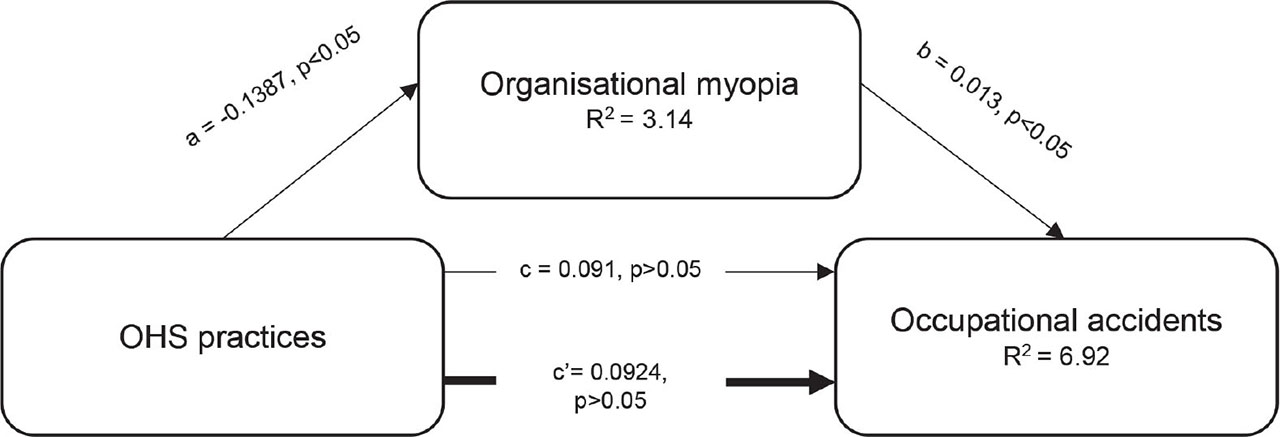
Figure 2
Mediating effect of organisational myopia between OHS practices and self-reported occupational accidents