
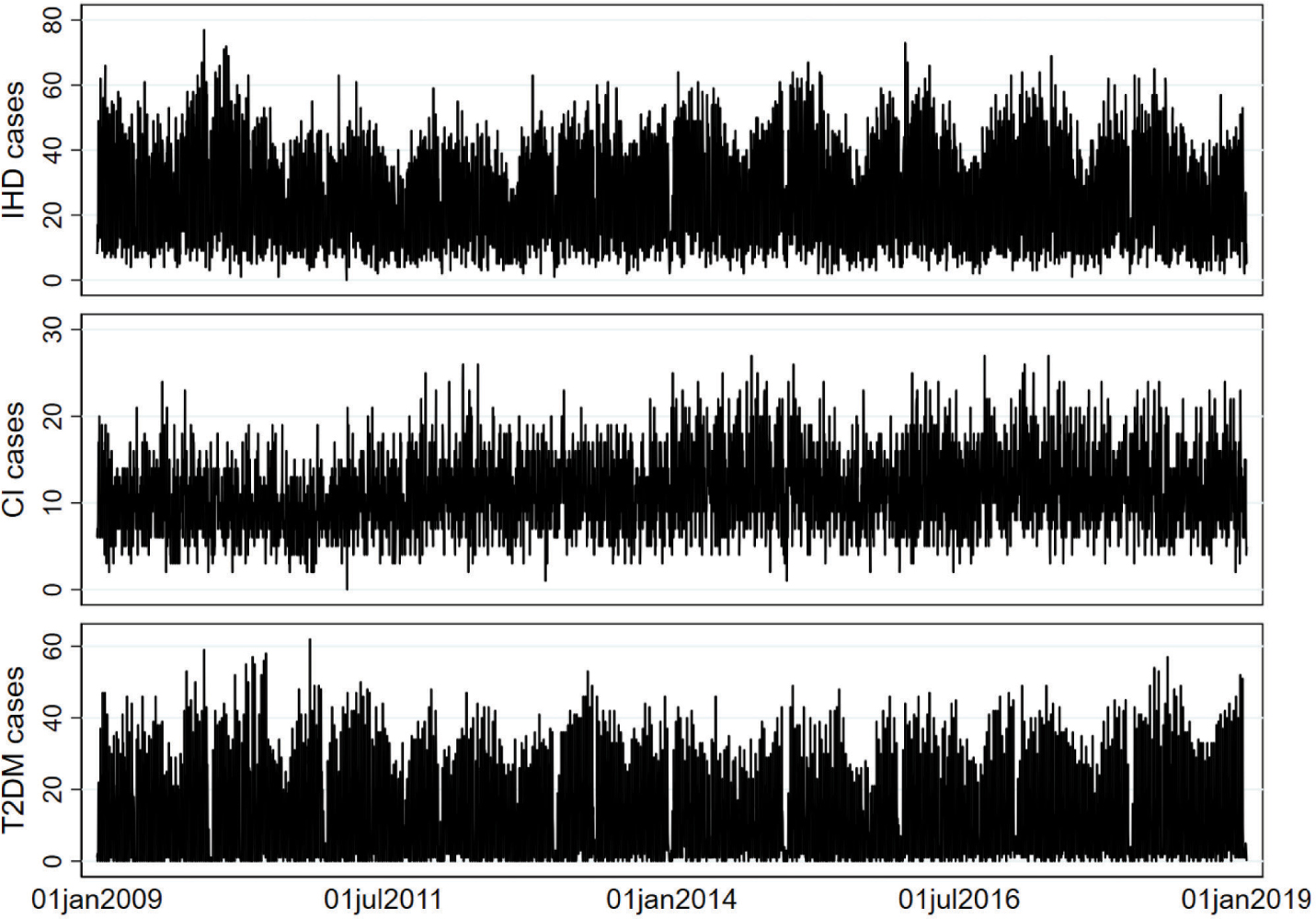
Figure 1
Daily hospital admission counts for ischaemic heart disease (IHD), cerebral infarction (CI), and type 2 diabetes mellitus (T2DM) in Sofia, Bulgaria from 2009 to 2018
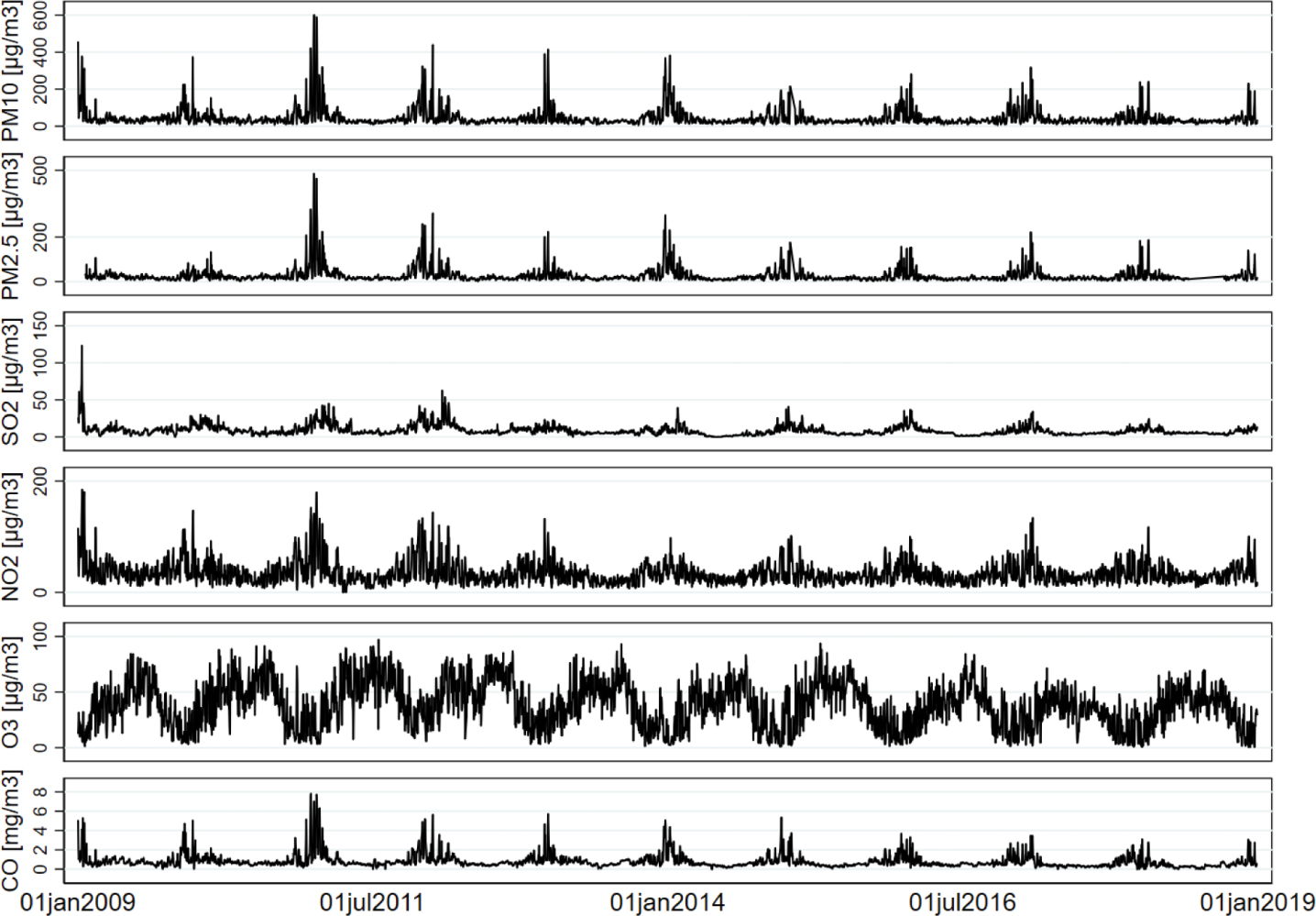
Figure 2
Daily concentrations of air pollutants in Sofia, Bulgaria from 2009 to 2018. CO – carbon monoxide; NO2 – nitrogen dioxide; O3 – ozone; PM10 – particulate matter ≤10 µm; PM2.5 – particulate matter ≤2.5 µm; SO2 – sulphur dioxide
Table 1
Descriptive statistics for the exposure variables in the study
| Variable | Missing data (N, %) | Percentiles | Min | Max | ||
|---|---|---|---|---|---|---|
| 25th | 50th | 75th | ||||
| PM10 | 45 (1.23) | 22.32 | 31.29 | 45.38 | 3.60 | 601.04 |
| PM2.5 | 204 (5.59) | 12.22 | 17.76 | 27.10 | 0.49 | 485.77 |
| NO2 | 23 (0.63) | 21.40 | 30.03 | 41.70 | 0.01 | 184.89 |
| SO2 | 25 (0.68) | 4.62 | 6.72 | 10.68 | 0.01 | 123.31 |
| O3 | 26 (0.71) | 22.82 | 38.47 | 52.28 | 0.39 | 97.27 |
| CO | 45 (1.23) | 0.42 | 0.61 | 0.90 | 0.00 | 7.83 |
| Temperature | 20 (0.55) | 4.70 | 12.44 | 19.19 | -14.39 | 31.375 |
| Relative humidity | 20 (0.55) | 56.29 | 65.80 | 76.21 | 30.50 | 98.26 |
Table 2
Spearman’s correlations between the key variables in the study
| Variables | 1. | 2. | 3. | 4. | 5. | 6. | 7. | 8. | 9. | 10. | 11. |
|---|---|---|---|---|---|---|---|---|---|---|---|
| 1. IHD | 1.00 | ||||||||||
| 2. CI | 0.52* | 1.00 | |||||||||
| 3. T2DM | 0.83* | 0.50* | 1.00 | ||||||||
| 4. PM10 | 0.05* | 0.02 | 0.02 | 1.00 | |||||||
| 5. PM25 | 0.03 | -0.01 | 0.01 | 0.88* | 1.00 | ||||||
| 6. SO2 | 0.07* | -0.01 | 0.04* | 0.50* | 0.55* | 1.00 | |||||
| 7. NO2 | 0.15* | 0.08* | 0.13* | 0.77* | 0.69* | 0.42* | 1.00 | ||||
| 8. O3 | -0.15* | -0.07* | -0.07* | -0.48* | -0.43* | -0.27* | -0.62* | 1.00 | |||
| 9. CO | 0.09* | -0.01 | 0.07* | 0.66* | 0.69* | 0.55* | 0.66* | -0.52* | 1.00 | ||
| 10. Temperature | -0.12* | -0.02 | -0.03 | -0.20* | -0.34* | -0.53* | -0.21* | 0.49* | -0.42* | 1.000 | |
| 11. Relative humidity | 0.09* | -0.02 | 0.03 | 0.08* | 0.15* | 0.12* | 0.07* | -0.50* | 0.30* | -0.53* | 1.00 |
Table 3
Risk of hospital admissions associated with air pollution levels on the same day (lag0)
| Pollutant | IHD (IRR) | CI (IRR) | T2DM (IRR) |
|---|---|---|---|
| PM10 | 0.996 (0.992, 1.000) | 0.998 (0.995, 1.001) | 0.995 (0.991, 0.999)* |
| PM2.5 | 0.995 (0.989, 1.001) | 0.998 (0.994, 1.003) | 0.993 (0.987, 1.000) |
| SO2 | 0.990 (0.967, 1.013) | 0.985 (0.960, 1.011) | 0.991 (0.957, 1.003) |
| NO2 | 1.003 (0.996, 1.010) | 0.999 (0.993, 1.005) | 1.002 (0.993, 1.011) |
| O3 | 0.991 (0.982, 1.001) | 0.995 (0.985, 1.004) | 0.992 (0.978, 1.006) |
| CO | 0.974 (0.948, 1.001) | 0.982 (0.962, 1.002) | 0.974 (0.947, 1.003) |
1 * Coefficient is statistically significant at p<0.05. All models are adjusted for time trend, day of the week, deciles of temperature, and relative humidity. Coefficients are incidence rate ratios (IRR) with their 95 % confidence intervals scaled per 10 μg/m3 for all other pollutants and per 1 mg/m3 for CO. CO – carbon monoxide; CI – cerebral infarction; IHD – ischemic heart disease; NO2 – nitrogen dioxide; O3 – ozone; PM10 – particulate matter ≤10 μm; PM2.5 – particulate matter ≤2.5 μm; SO2 – sulphur dioxide; T2DM – type 2 diabetes mellitus
Table 4
Risk of hospital admissions associated with above-threshold air pollution levels on the same day (lag0)
| Pollutant | IHD (IRR) | CI (IRR) | T2DM (IRR) |
|---|---|---|---|
| PM10 ≥45 μg/m3 | 1.007 (0.980, 1.034) | 1.000 (0.973, 1.028) | 0.991 (0.950, 1.034) |
| PM 5 ≥15 μg/m3 | 1.005 (0.982, 1.029) | 1.004 (0.979, 1.030) | 0.997 (0.959, 1.036) |
| SO ≥40 μg/m3 | 0.952 (0.858, 1.056) | 0.915 (0.796, 1.053) | 1.003 (0.827, 1.216) |
| NO ≥25 μg/m3 | 1.039 (1.013, 1.066)* | 1.019 (0.993, 1.045) | 1.029 (0.991, 1.069) |
| O ≥60 μg/m3 | 0.971 (0.935, 1.008) | 0.976 (0.941, 1.012) | 0.944 (0.893, 0.997)* |
| CO ≥4 mg/m3 | 0.929 (0.810, 1.064) | 0.995 (0.912, 1.085) | 0.875 (0.771, 0.994)* |
1 * Coefficient is statistically significant at p<0.05. All models are adjusted for time trend, day of the week, deciles of temperature, and relative humidity. Coefficients are incidence rate ratios (IRR) with their 95 % confidence intervals. CO – carbon monoxide; CI – cerebral infarction; IHD – ischemic heart disease; NO2 – nitrogen dioxide; O3 – ozone; PM10 – particulate matter ≤10 μm; PM2.5 – particulate matter ≤2.5 μm; SO2 – sulphur dioxide; T2DM – type 2 diabetes mellitus
Table 5
Risk of hospital admissions associated with deciles of air pollutant levels on the same day (lag0)
| Deciles | PM10 | PM2.5 | SO2 | NO2 | O3 | CO |
|---|---|---|---|---|---|---|
| Ischaemic heart disease (IRR) | ||||||
| D2 | 0.993 (0.948, 1.041) | 1.007 (0.959, 1.058) | 1.005 (0.959, 1.054) | 1.019 (0.970, 1.070) | 1.022 (0.975, 1.072) | 0.996 (0.953, 1.041) |
| D3 | 0.976 (0.934, 1.019) | 1.021 (0.977, 1.067) | 1.001 (0.952, 1.053) | 0.995 (0.945, 1.048) | 1.057 (1.004, 1.114)* | 0.997 (0.949, 1.047) |
| D4 | 0.976 (0.933, 1.022) | 0.989 (0.945, 1.036) | 1.014 (0.962, 1.068) | 1.031 (0.980, 1.086) | 1.022 (0.968, 1.078) | 0.981 (0.929, 1.035) |
| D5 | 0.953 (0.908, 1.000) | 1.004 (0.959, 1.050) | 1.012 (0.962, 1.065) | 1.027 (0.977, 1.080) | 1.02 (0.965, 1.078) | 0.998 (0.944, 1.054) |
| D6 | 1.004 (0.958, 1.053) | 1.015 (0.966, 1.067) | 0.990 (0.937, 1.045) | 1.046 (0.994, 1.100) | 1.033 (0.977, 1.092) | 1.009 (0.954, 1.067) |
| D7 | 0.983 (0.941, 1.027) | 1.000 (0.954, 1.048) | 1.011 (0.957, 1.069) | 1.078 (1.025,1.134)* | 0.978 (0.923, 1.037) | 1.012 (0.960, 1.067) |
| D8 | 1.008 (0.965, 1.053) | 0.998 (0.956, 1.042) | 0.997 (0.943, 1.053) | 1.055 (1.003,1.109)* | 0.982 (0.924, 1.043) | 1.007 (0.951, 1.067) |
| D9 | 1.022 (0.977, 1.070) | 1.011 (0.965, 1.060) | 0.999 (0.940, 1.061) | 1.067 (1.012,1.125)* | 0.981 (0.921, 1.045) | 1.048 (0.994, 1.106) |
| D10 | 0.944 (0.895, 0.997)* | 1.006 (0.953, 1.062) | 0.962 (0.895, 1.035) | 1.039 (0.983, 1.098) | 0.960 (0.897, 1.027) | 0.981 (0.922, 1.044) |
| Cerebral infarction (IRR) | ||||||
| D2 | 0.973 (0.929, 1.020) | 1.023 (0.977, 1.072) | 0.968 (0.915, 1.024) | 1.032 (0.981, 1.086) | 1.027 (0.980, 1.076) | 0.957 (0.913, 1.003) |
| D3 | 1.016 (0.967, 1.068) | 0.992 (0.945, 1.042) | 0.977 (0.924, 1.033) | 1.033 (0.984, 1.085) | 1.035 (0.984, 1.089) | 0.957 (0.908, 1.009) |
| D4 | 0.988 (0.939, 1.040) | 1.034 (0.984, 1.087) | 0.942 (0.889, 0.998)* | 1.042 (0.991, 1.097) | 1.058 (1.005,1.114)* | 0.965 (0.913, 1.020) |
| D5 | 1.004 (0.954, 1.057) | 1.038 (0.987, 1.092) | 0.971 (0.915, 1.030) | 1.060 (1.008,1.115)* | 1.023 (0.970, 1.079) | 0.957 (0.905, 1.011) |
| D6 | 0.975 (0.927, 1.027) | 1.018 (0.966, 1.073) | 0.960 (0.903, 1.020) | 1.038 (0.988, 1.090) | 0.986 (0.931, 1.045) | 0.976 (0.922, 1.034) |
| D7 | 0.994 (0.943, 1.046) | 1.022 (0.967, 1.080) | 0.973 (0.914, 1.036) | 1.053 (1.001,1.107)* | 1.010 (0.952, 1.073) | 0.995 (0.936, 1.057) |
| D8 | 1.004 (0.953, 1.058) | 1.023 (0.971, 1.079) | 0.982 (0.921, 1.047) | 1.050 (0.995, 1.108) | 1.011 (0.950, 1.075) | 0.963 (0.905, 1.024) |
| D9 | 0.983 (0.931, 1.038) | 0.981 (0.926, 1.039) | 0.975 (0.913, 1.040) | 1.072 (1.018,1.128)* | 0.987 (0.927, 1.052) | 0.961 (0.903, 1.023) |
| D10 | 0.965 (0.913, 1.020) | 1.000 (0.942, 1.060) | 0.936 (0.869, 1.009) | 0.997 (0.946, 1.052) | 0.995 (0.929, 1.067) | 0.929 (0.872, 0.989)* |
| Type 2 diabetes mellitus (IRR) | ||||||
| D2 | 0.986 (0.918, 1.058) | 1.019 (0.949, 1.095) | 0.968 (0.889, 1.055) | 1.050 (0.971, 1.135) | 0.992 (0.924, 1.065) | 0.986 (0.914, 1.063) |
| D3 | 0.933 (0.868, 1.002) | 0.984 (0.914, 1.059) | 0.958 (0.876, 1.048) | 1.009 (0.934, 1.090) | 1.010 (0.938, 1.087) | 0.999 (0.921, 1.083) |
| D4 | 0.930 (0.865, 1.000) | 0.951 (0.883, 1.025) | 0.991 (0.905, 1.086) | 1.003 (0.928, 1.085) | 0.985 (0.913, 1.063) | 0.947 (0.870, 1.031) |
| D5 | 0.925 (0.858, 0.997)* | 0.988 (0.916, 1.065) | 0.971 (0.887, 1.063) | 1.058 (0.979, 1.144) | 0.965 (0.890, 1.045) | 0.944 (0.865, 1.030) |
| D6 | 0.987 (0.916, 1.063) | 0.988 (0.916, 1.066) | 0.941 (0.858, 1.033) | 1.006 (0.930, 1.087) | 0.985 (0.907, 1.071) | 0.959 (0.877, 1.048) |
| D7 | 0.952 (0.884, 1.025) | 0.978 (0.905, 1.056) | 0.977 (0.888, 1.074) | 1.094 (1.012,1.182)* | 0.990 (0.907, 1.080) | 0.960 (0.877, 1.051) |
| D8 | 0.961 (0.891, 1.036) | 0.999 (0.924, 1.080) | 0.956 (0.867, 1.053) | 1.023 (0.944, 1.108) | 0.997 (0.910, 1.092) | 0.977 (0.890, 1.071) |
| D9 | 0.963 (0.891, 1.041) | 0.986 (0.909, 1.068) | 1.010 (0.914, 1.116) | 1.042 (0.961, 1.130) | 0.982 (0.893, 1.080) | 0.985 (0.898, 1.081) |
| D10 | 0.941 (0.868, 1.020) | 0.975 (0.895, 1.063) | 0.919 (0.823, 1.026) | 1.059 (0.974, 1.151) | 0.926 (0.837, 1.025) | 0.971 (0.882, 1.068) |
1 * Coefficient is statistically significant at p<0.05. D2–10 stand for deciles, where D1 is the reference category (not shown). All models are adjusted for time trend, day of the week, deciles of temperature, and relative humidity. Coefficients are incidence rate ratios (IRR) with their 95 % confidence intervals. CO – carbon monoxide; NO2 – nitrogen dioxide; O3 – ozone; PM10 – particulate matter ≤10 μm; PM2.5 – particulate matter ≥2.5 μm; SO2 – sulphur dioxide
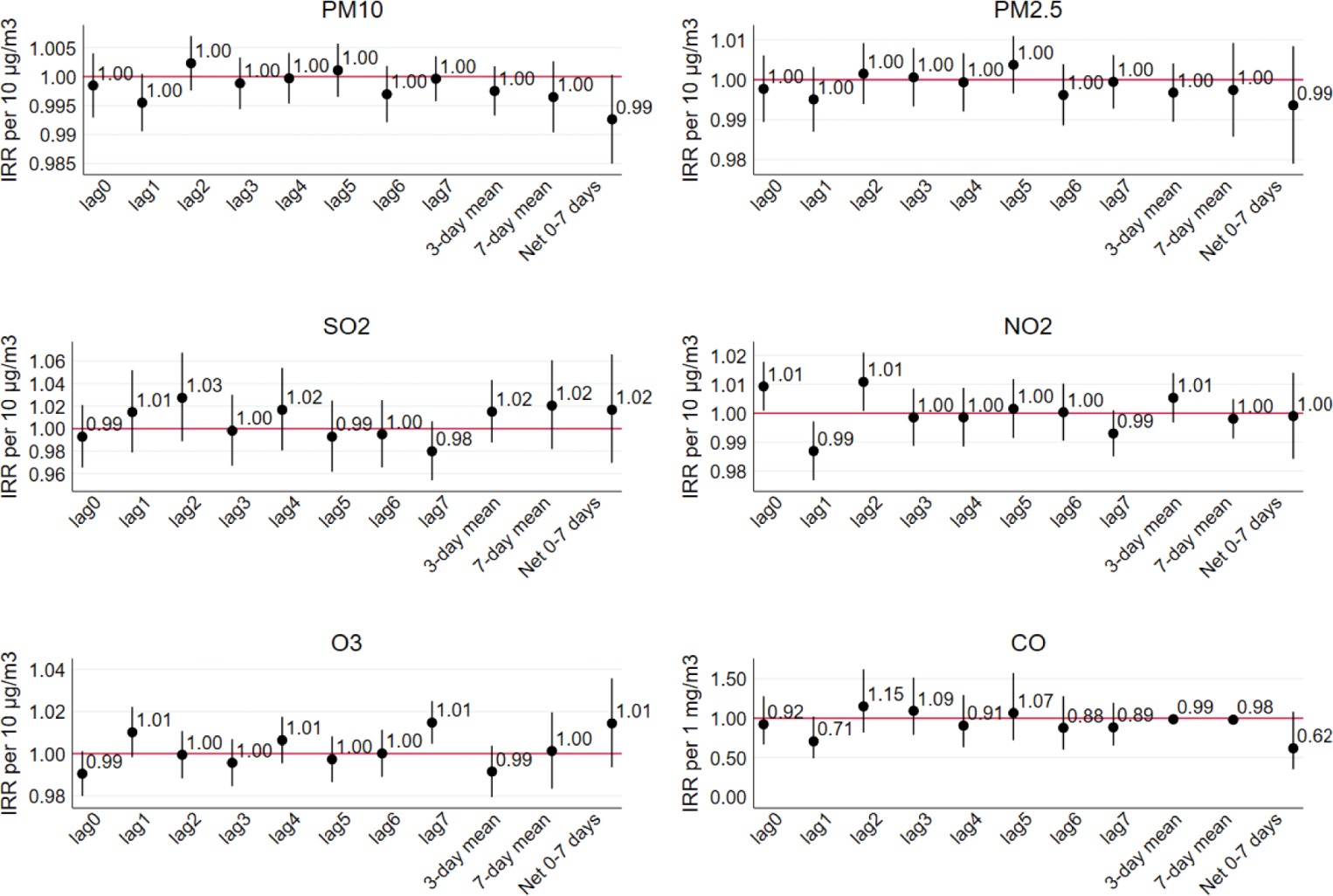
Figure 3
Risk of hospital admissions for ischaemic heart disease associated with air pollution levels over seven days. Lag models for the effects of pollutant concentrations include mutually adjusted 0–7 day lags, averaged over 3 and 7 days (lags 0–3 and 0–7), and the cumulative effect of lags 0–7 (net sum of lagged effects). All models are adjusted for time trend, day of the week, deciles of temperature, and relative humidity. Pollutants are tested one-at-a-time (single-pollutant models). Coefficients shown are incidence rate ratios (IRR) with 95 % confidence intervals, where intervals not crossing the horizontal reference line indicate statistically significant estimates. CO – carbon monoxide; NO2 – nitrogen dioxide; O3 – ozone; PM10 – particulate matter ≤10 µm; PM2.5 – particulate matter ≤2.5 µm; SO2 – sulphur dioxide
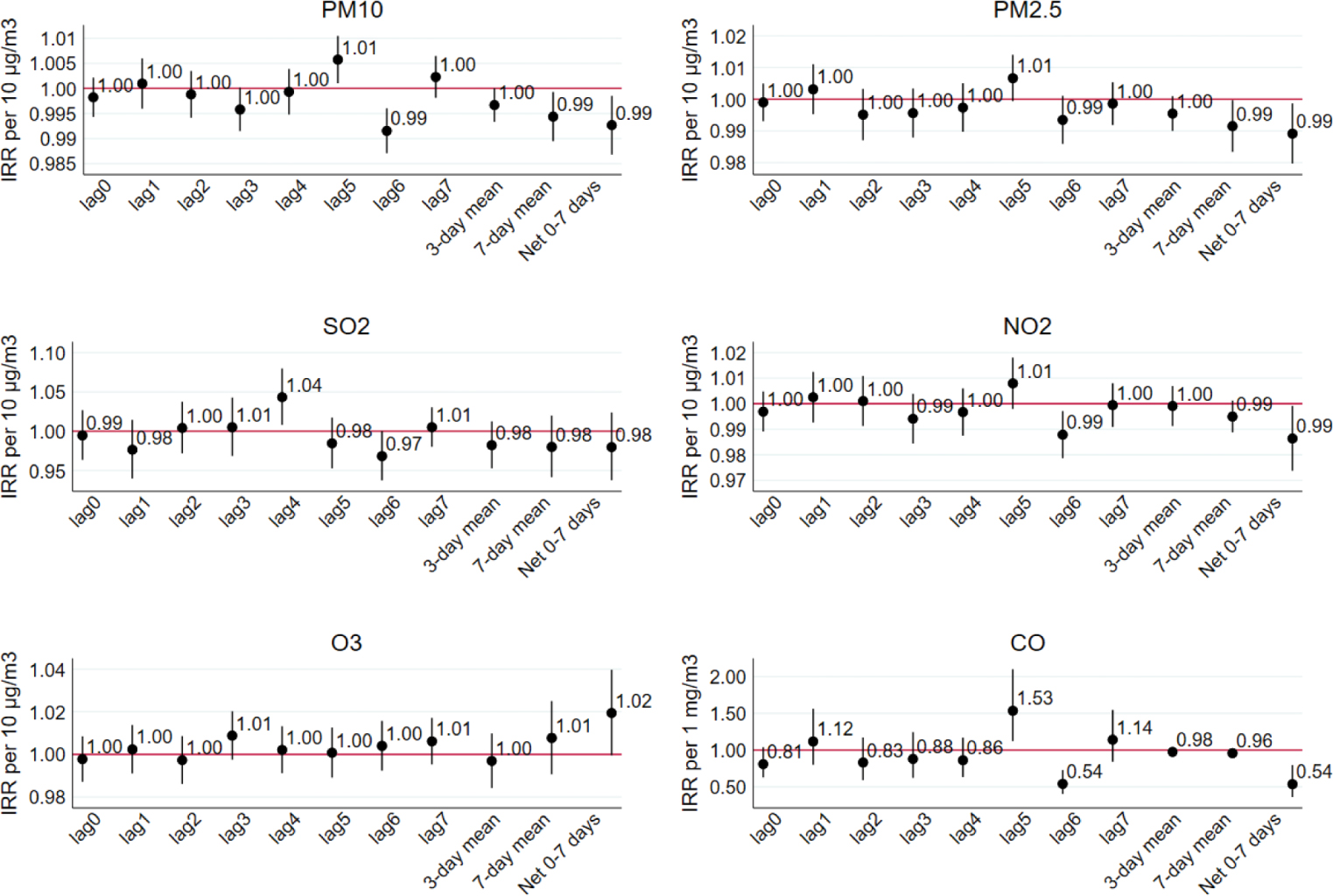
Figure 4
Risk of hospital admissions for cerebral infarction associated with air pollution levels over seven days. Lag models for the effects of pollutant concentrations include mutually adjusted 0–7 day lags, averaged over 3 and 7 days (lags 0–3 and 0–7), and the cumulative effect of lags 0–7 (net sum of lagged effects). All models are adjusted for time trend, day of the week, deciles of temperature, and relative humidity. Pollutants are tested one-at-a-time (single-pollutant models). Coefficients shown are incidence rate ratios (IRR) with 95 % confidence intervals, where intervals not crossing the horizontal reference line indicate statistically significant estimates. CO – carbon monoxide; NO2 – nitrogen dioxide; O3 – ozone; PM10 – particulate matter ≤10 µm; PM2.5 – particulate matter ≤2.5 µm; SO2 – sulphur dioxide
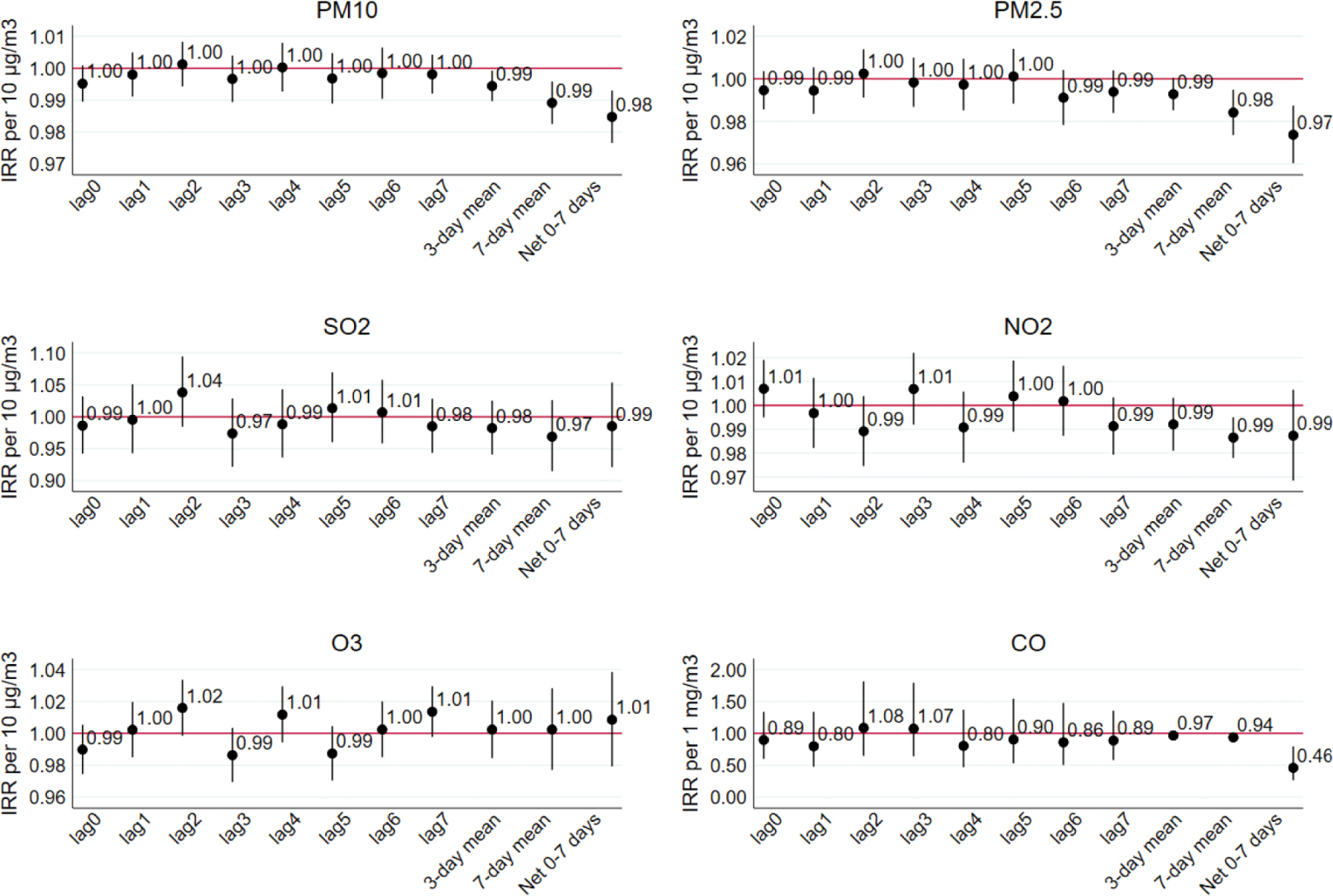
Figure 5
Risk of hospital admissions for type 2 diabetes mellitus associated with air pollution levels over seven days. Lag models for the effects of pollutant concentrations include mutually adjusted 0–7 day lags, averaged over 3 and 7 days (lags 0–3 and 0–7), and the cumulative effect of lags 0–7 (net sum of lagged effects). All models are adjusted for time trend, day of the week, deciles of temperature, and relative humidity. Pollutants are tested one-at-a-time (single-pollutant models). Coefficients shown are incidence rate ratios (IRR) with 95 % confidence inter vals, where intervals not crossing the horizontal reference line indicate statistically significant estimates. CO – carbon monoxide; NO2 – nitrogen dioxide; O3 – ozone; PM10 – particulate matter ≤10 µm; PM2.5 – particulate matter ≤2.5 µm; SO2 – sulphur dioxide
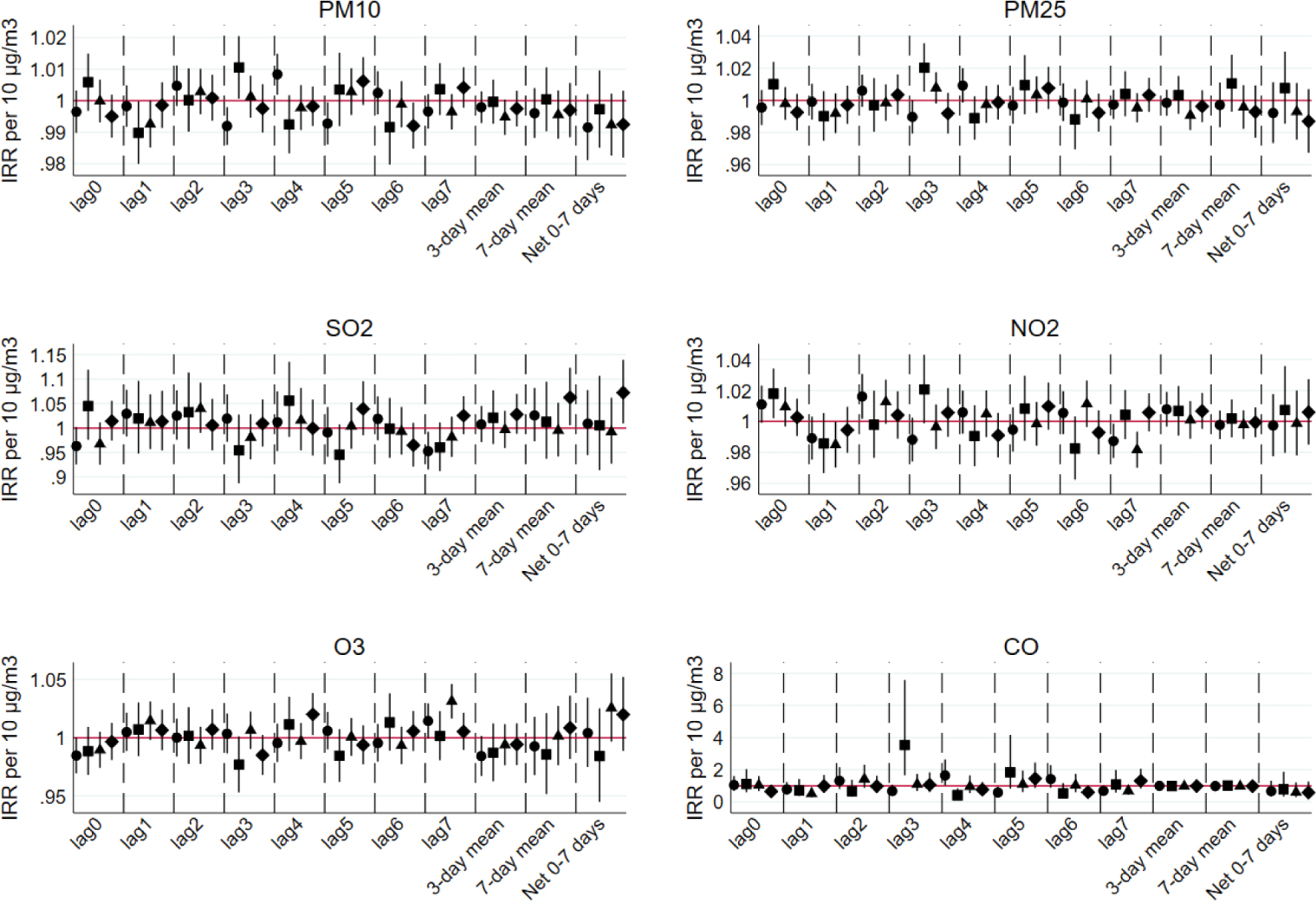
Figure 6
Risk of hospital admissions for ischemic heart disease associated with air pollution levels over seven days stratified by gender and age. Legend: circles – male <65 yrs.; squares – female <65 yrs.; triangles – male ≥65 yrs.; diamonds – female ≥65 yrs. Lag models for the effects of pollutant concentrations include mutually adjusted 0–7 day lags, averaged over 3 and 7 days (lags 0–3 and 0–7), and the cumulative effect of lags 0–7 (net sum of lagged effects). All models are adjusted for time trend, day of the week, deciles of temperature, and relative humidity. Pollutants are tested one-at-a-time (single-pollutant models). Coefficients shown are incidence rate ratios (IRR) with 95 % confidence inter vals, where intervals not crossing the horizontal reference line indicate statistically significant estimates. CO – carbon monoxide; NO2 – nitrogen dioxide; O3 – ozone; PM10 – particulate matter ≤10 µm; PM2.5 – particulate matter ≤2.5 µm; SO2 – sulphur dioxide
Table 6
Risk of hospital admissions associated with air pollution on the same day (lag0), stratified by time of year
| Pollutant | April — September | October — March | ||||
|---|---|---|---|---|---|---|
| IHD (IRR) | Cl (IRR) | T2DM (IRR) | IHD (IRR) | Cl (IRR) | T2DM (IRR) | |
| PM10 | 1.020 (1.000, 1.041)* | 1.004 (0.984, 1.024) | 0.999 (0.970, 1.029) | 0.995 (0.991, 0.999)* | 0.997 (0.995, 1.000) | 0.994 (0.990, 0.997)* |
| PM2.5 | 1.010 (0.983, 1.038) | 1.011 (0.981, 1.041) | 1.026 (0.980, 1.073) | 0.992 (0.986, 0.999)* | 0.997 (0.993, 1.001) | 0.993 (0.987, 0.999)* |
| SO2 | 0.979 (0.909, 1.055) | 1.056 (0.990, 1.126) | 1.001 (0.903, 1.111) | 0.988 (0.969, 1.008) | 0.982 (0.960, 1.004) | 0.964 (0.934, 0.996)* |
| NO2 | 1.038 (1.018,1.057)* | 1.022 (1.006,1.041)* | 1.026 (1.000,1.052)* | 0.996 (0.988, 1.003) | 0.996 (0.990, 1.003) | 0.997 (0.988, 1.006) |
| O3 | 0.984 (0.970, 0.997)* | 0.994 (0.982, 1.007) | 0.987 (0.968, 1.007) | 0.995 (0.983, 1.006) | 1.003 (0.991, 1.015) | 0.993 (0.976, 1.011) |
| CO | 1.071 (0.978, 1.175) | 0.978 (0.887, 1.078) | 1.010 (0.874, 1.169) | 0.964 (0.937, 0.992)* | 0.978 (0.961, 0.996)* | 0.969 (0.943, 0.996)* |
1 * Coefficient is statistically significant at p<0.05. All models are adjusted for time trend, day of the week, deciles of temperature, and relative humidity. Coefficients are incidence rate ratios (ERR) with their 95 % confidence intentais scaled per 10 μg/m3 for all other pollutants and per 1 mg/m3 for CO. CO – carbon monoxide; Cl – cerebral infarction; IHD – ischemic heart disease; NO2 – nitrogen dioxide; O3 – ozone; PM10 – particulate matter ≤10 μm; PM2.5 – particulate matter ≤2.5 μm; SO2 – sulphur dioxide; T2DM – type 2 diabetes mellitus
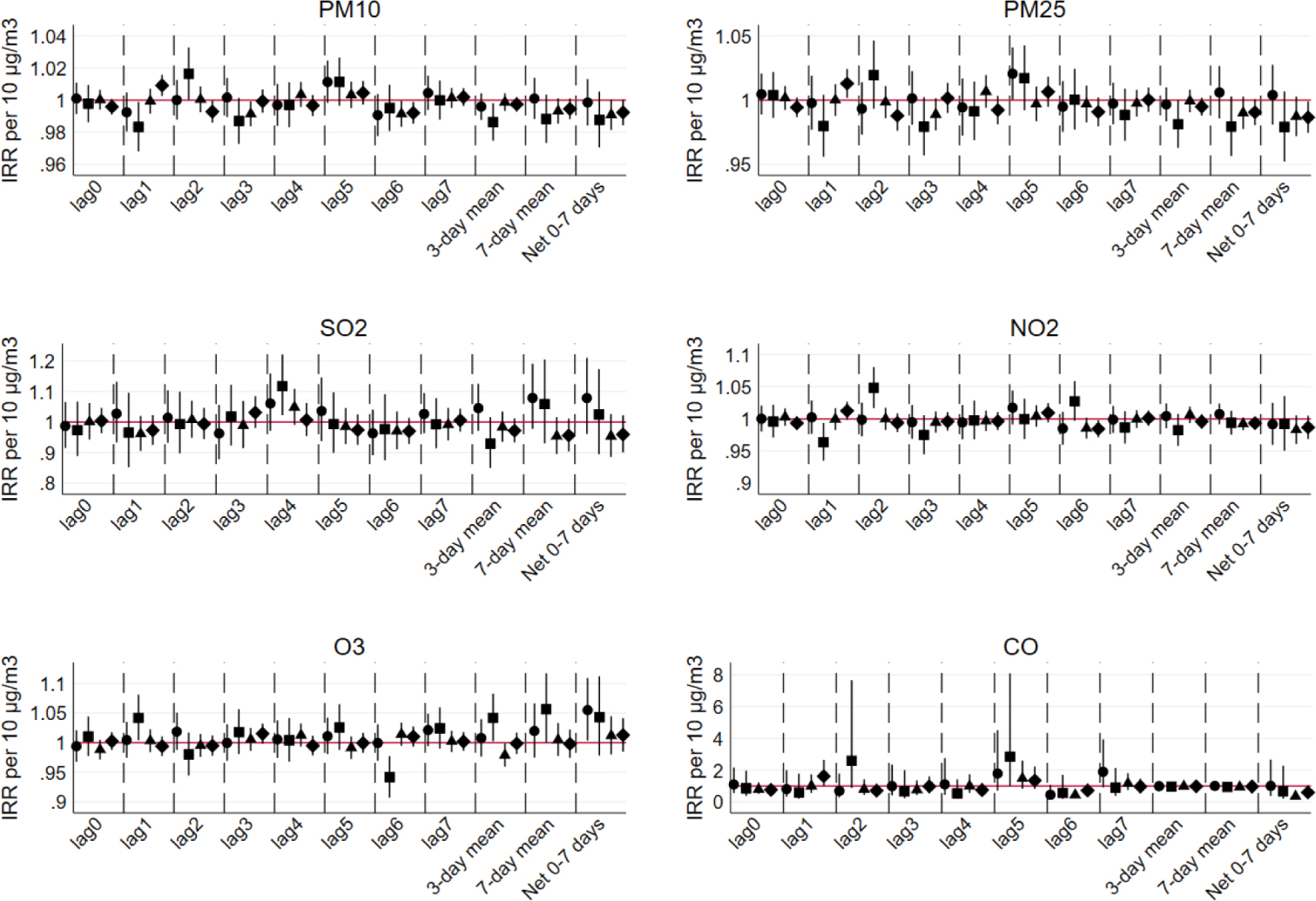
Figure 7
Risk of hospital admissions for cerebral infarction associated with air pollution levels over seven days stratified by gender and age. Legend: circles – male <65 yrs.; squares – female <65 yrs.; triangles – male ≥65 yrs.; diamonds – female ≥65 yrs.
Lag models for the effects of pollutant concentrations include mutually adjusted 0–7 day lags, averaged over 3 and 7 days (lags 0–3 and 0–7), and the cumulative effect of lags 0–7 (net sum of lagged effects). All models are adjusted for time trend, day of the week, deciles of temperature, and relative humidity. Pollutants are tested one-at-a-time (single-pollutant models). Coefficients shown are incidence rate ratios (IRR) with 95 % confidence inter vals, where intervals not crossing the horizontal reference line indicate statistically significant estimates. CO – carbon monoxide; NO2 – nitrogen dioxide; O3 – ozone; PM10 – particulate matter ≤10 µm; PM2.5 – particulate matter ≤2.5 µm; SO2 – sulphur dioxide
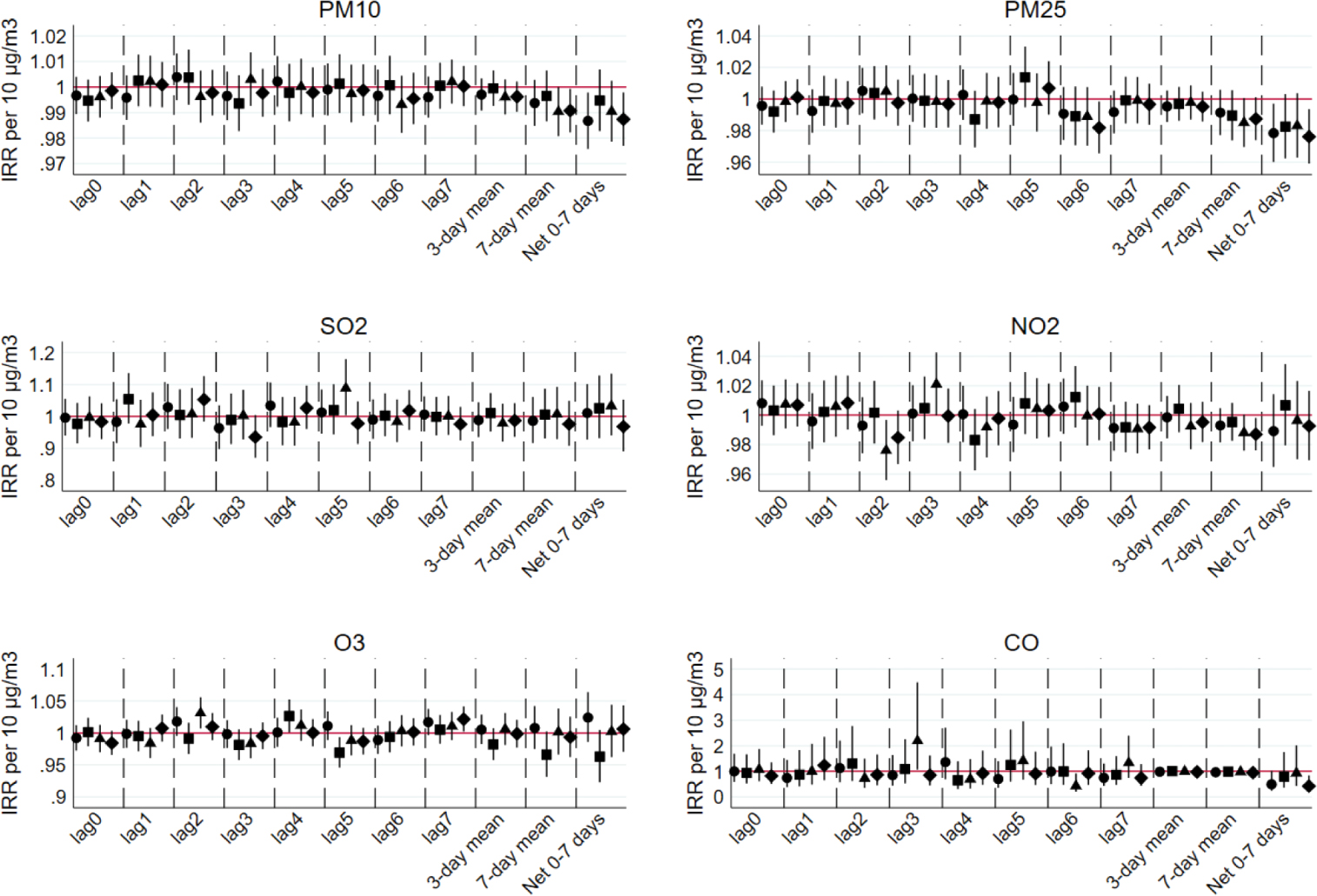
Figure 8
Risk of hospital admissions for type 2 diabetes mellitus associated with air pollution levels over seven days stratified by gender and age. Legend: circles – male <65 yrs.; squares – female <65 yrs.; triangles – male ≥65 yrs.; diamonds – female ≥65 yrs. Lag models for the effects of pollutant concentrations include mutually adjusted 0–7 day lags, averaged over 3 and 7 days (lags 0–3 and 0–7), and the cumulative effect of lags 0–7 (net sum of lagged effects). All models are adjusted for time trend, day of the week, deciles of temperature, and relative humidity. Pollutants are tested one-at-a-time (single-pollutant models). Coefficients shown are incidence rate ratios (IRR) with 95 % confidence inter vals, where intervals not crossing the horizontal reference line indicate statistically significant estimates. CO – carbon monoxide; NO2 – nitrogen dioxide; O3 – ozone; PM10 – particulate matter ≤10 µm; PM2.5 – particulate matter ≤2.5 µm; SO2 – sulphur dioxide