Have a personal or library account? Click to login
Different damaging effects of volatile anaesthetics alone or in combination with 1 and 2 Gy gamma-irradiation in vivo on mouse liver DNA: a preliminary study Cover

Different damaging effects of volatile anaesthetics alone or in combination with 1 and 2 Gy gamma-irradiation in vivo on mouse liver DNA: a preliminary study

Open Access
|Apr 2023

Figures & Tables

Figure 1

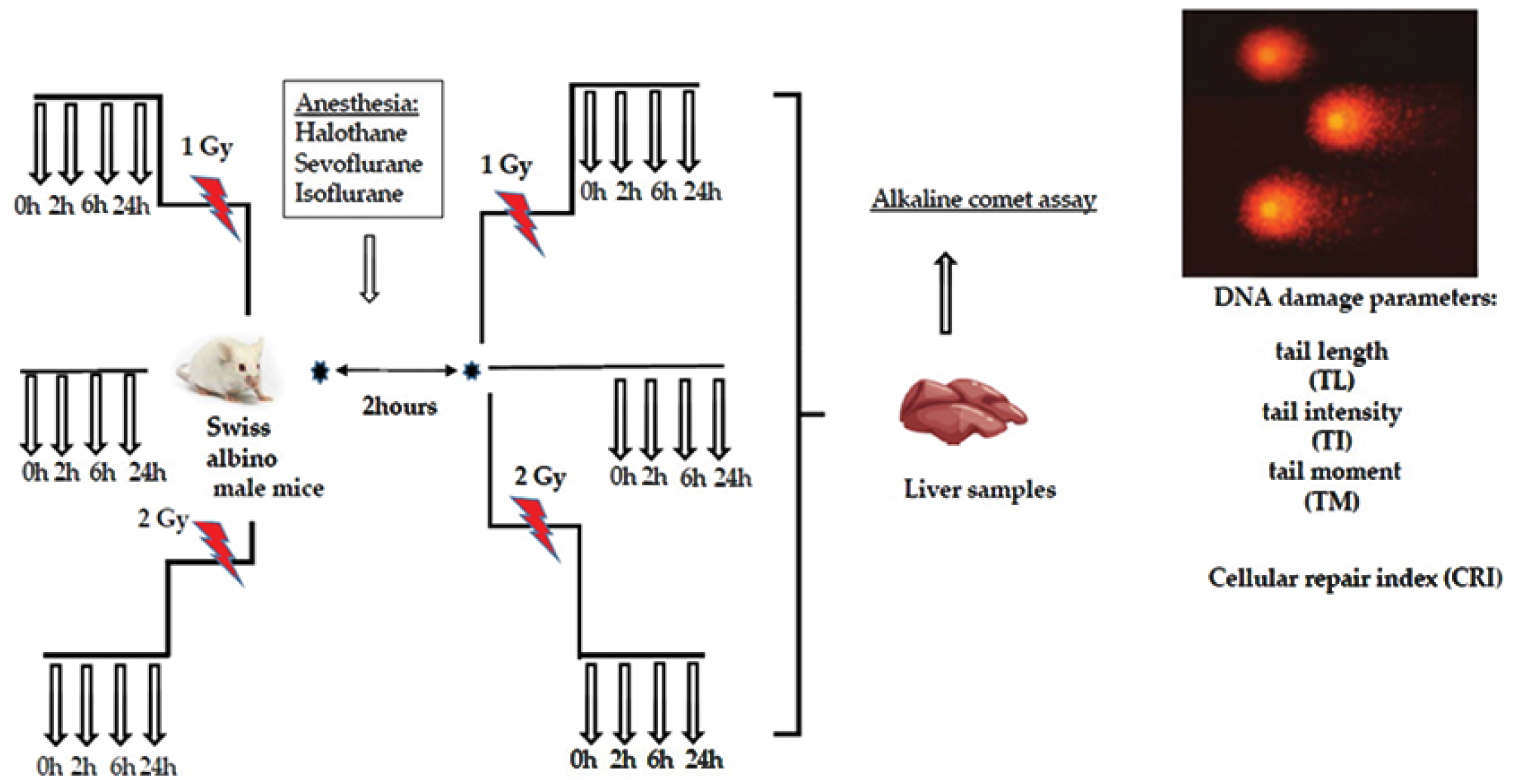
Scheme of the experiment. Male Swiss albino mice (n=240) were divided into 12 groups (control; 1 or 2 Gy irradiated; exposed to only halothane, sevoflurane or isoflurane; exposed to a combination of 1 or 2 Gy and either halothane, sevoflurane or isoflurane) and further each group was divided into 4 subgroups (according to the liver sampling time after the exposure- 0, 2, 6 and 24 hours) with 5 animals in each subgroup. Alkaline Comet assay was used for DNA damage and cellular repair index assessment
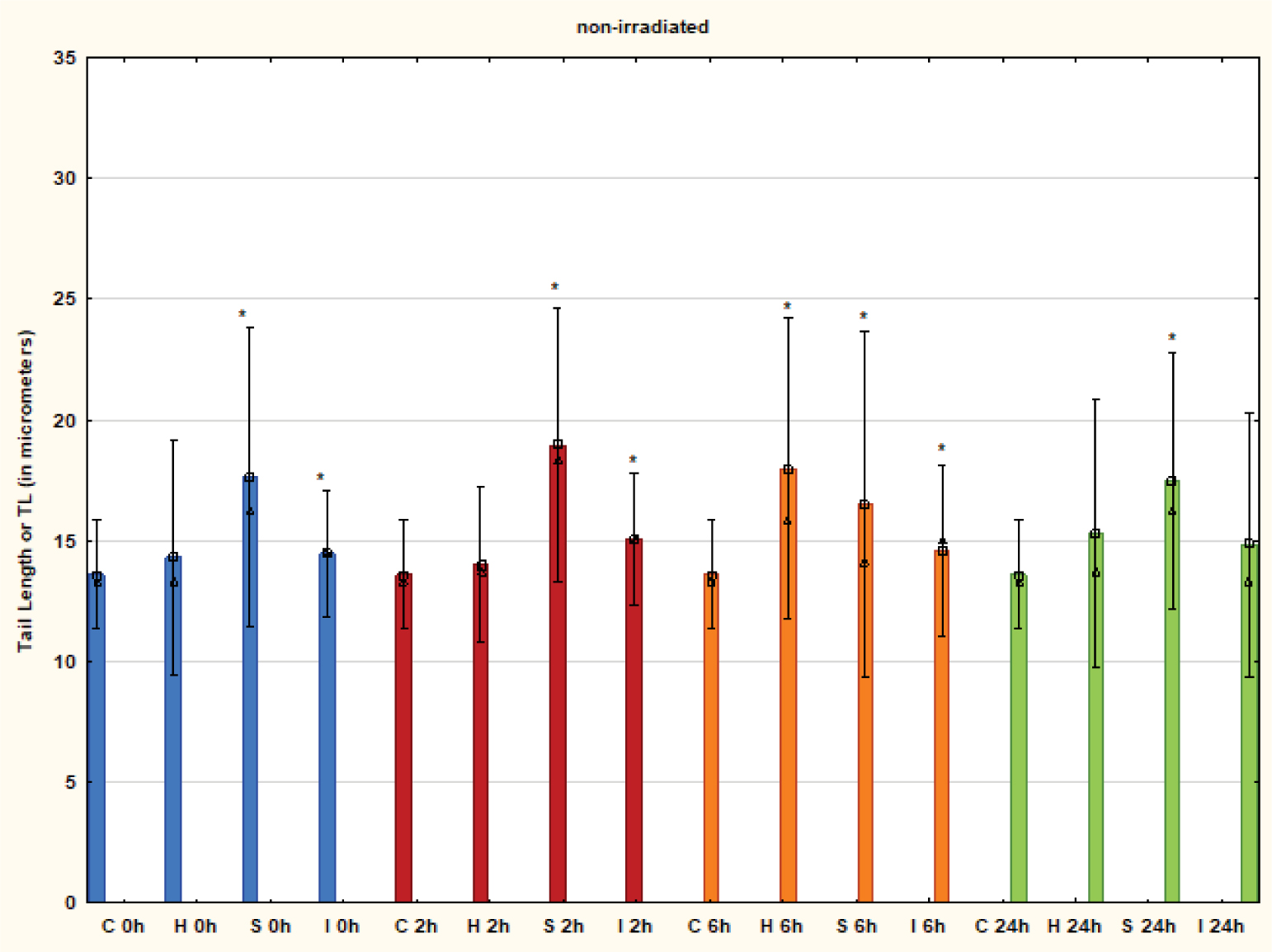

Figure 2a

Tail length values in liver cells of non-irradiated male Swiss albino mice anaesthetised solely with halothane (H), sevoflurane (S) or isoflurane (I). Samples taken immediately after (0 h), 2, 6 or 24 h after treatment were analysed from five animals per group for 200 comets. C-control. Samples were compared to control 0 h (C 0h), statistical differences (*) were analysed with the Mann-Whitney U test. The values represented here are mean (square), median (triangle), and standard deviation (SD, range)
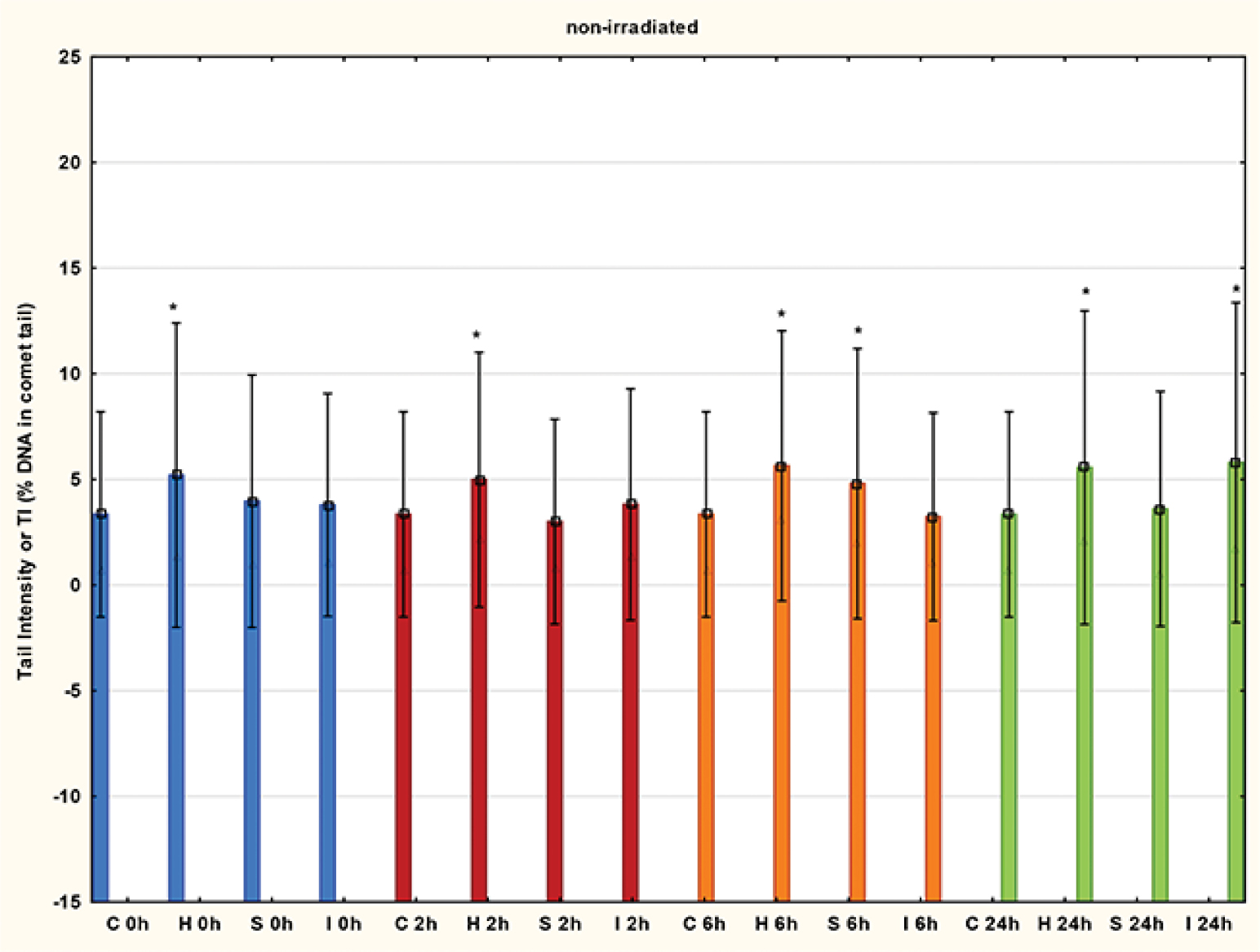
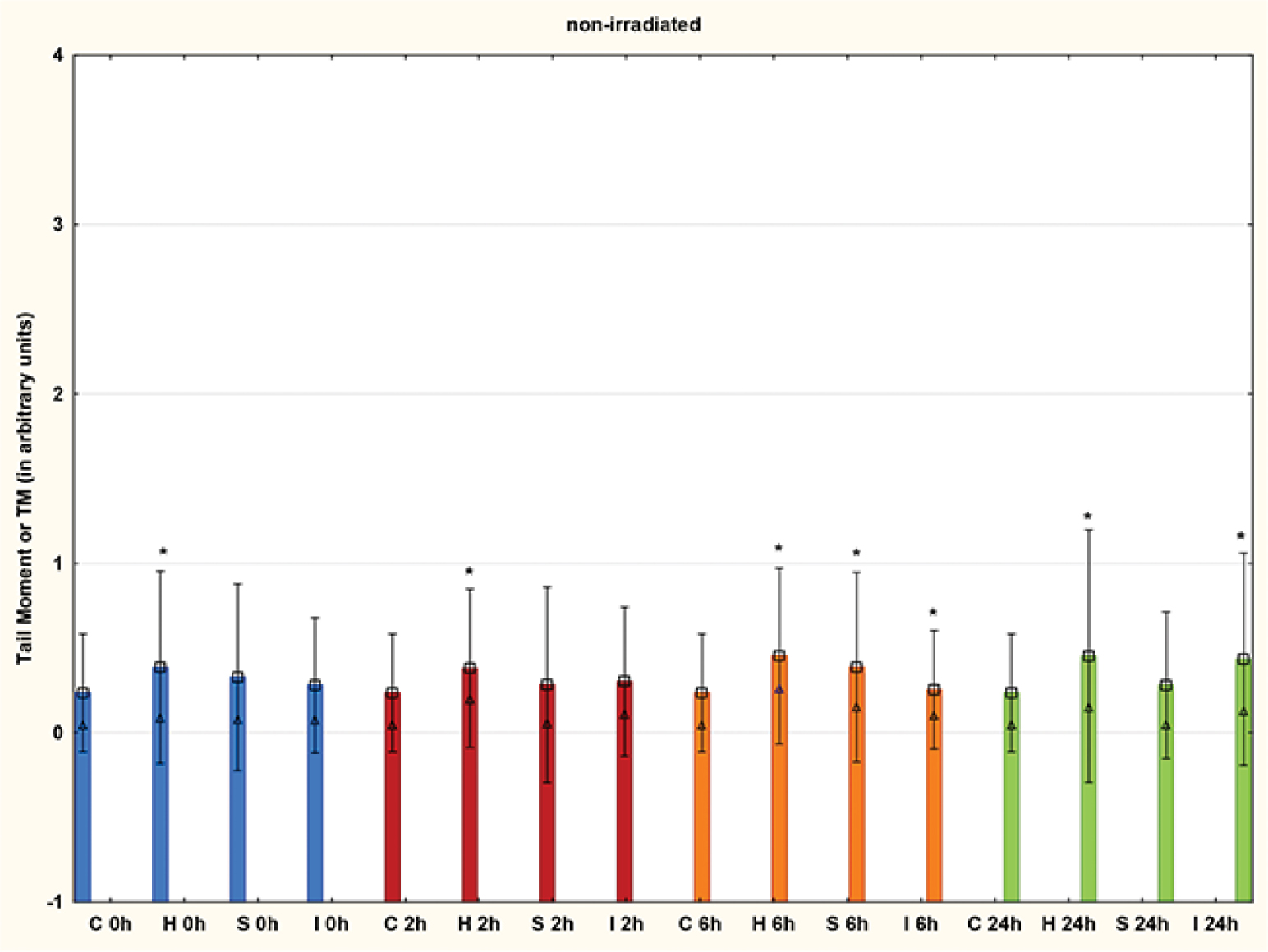
Figure 2b

Tail intensity values in liver cells of non-irradiated male Swiss albino mice anaesthetised solely with halothane (H), sevoflurane (S) or isoflurane (I). Samples taken immediately after (0 h), 2, 6 or 24h after treatment were analysed from five animals per group for 200 comets. C-control. Samples were compared to control 0 h (C 0h), statistical differences (*) were analysed with the Mann-Whitney U test. The values represented here are mean (square), median (triangle), and standard deviation (SD, range)
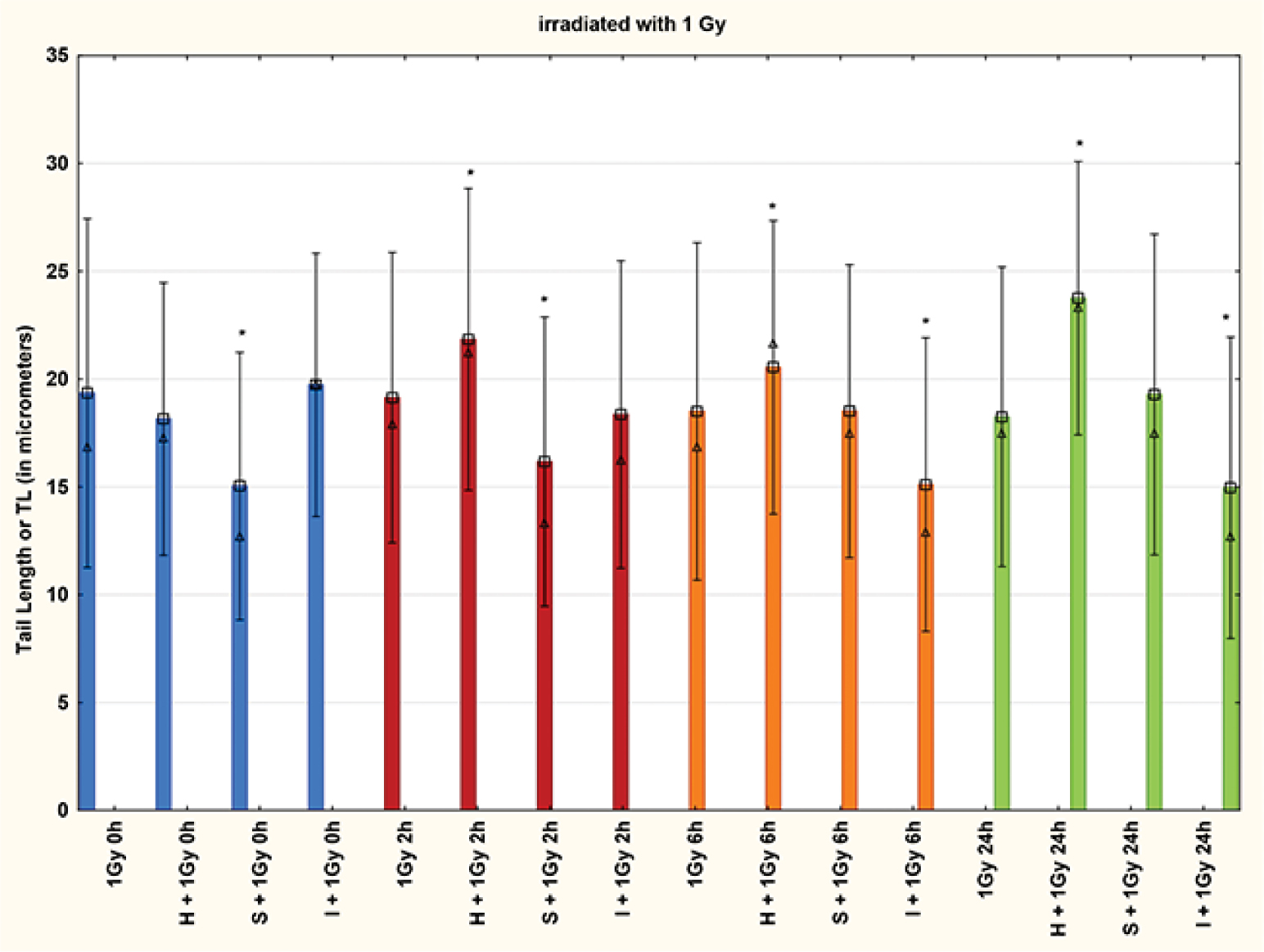
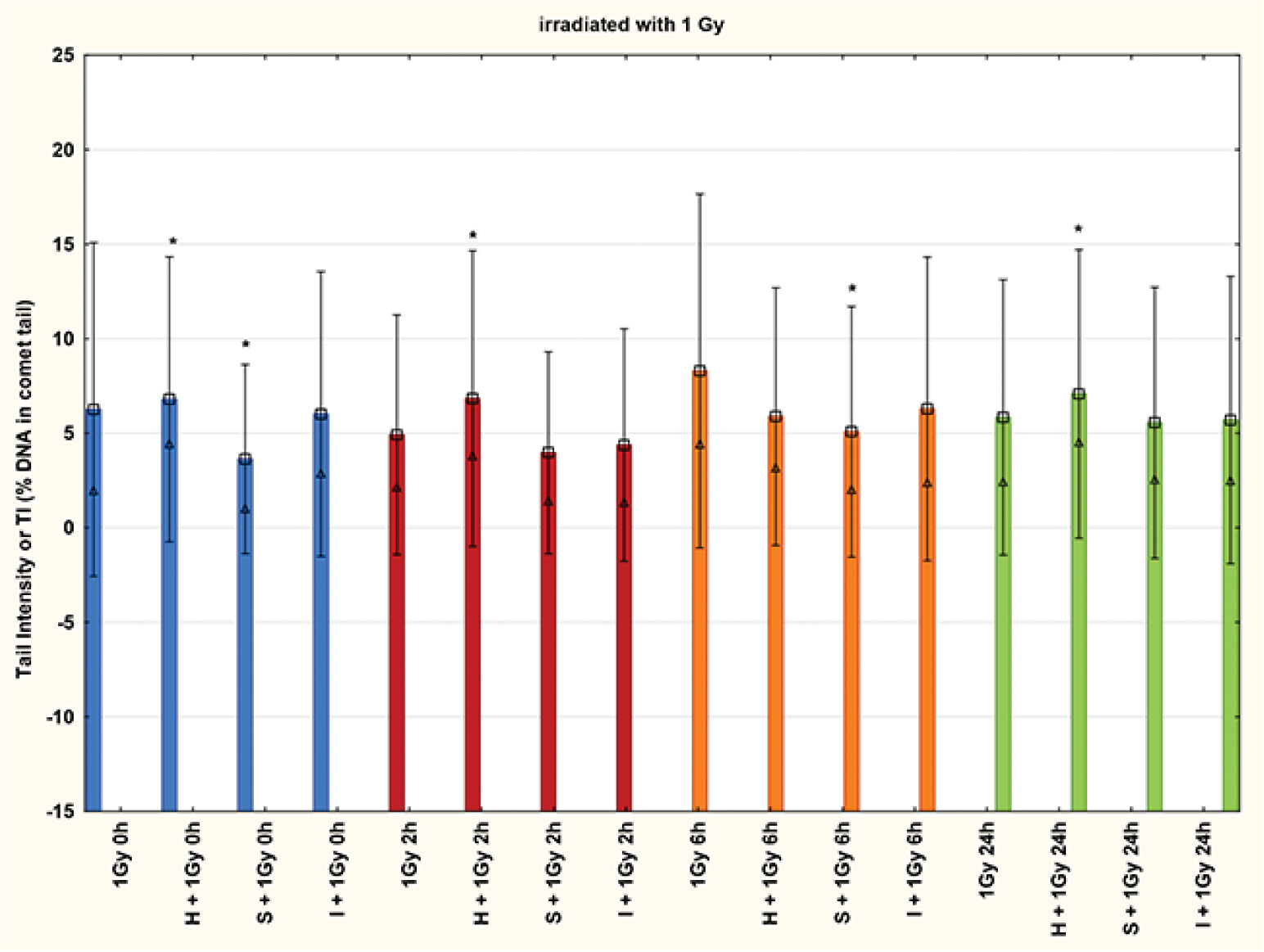
Figure 2c

Tail moment values in liver cells of non-irradiated male Swiss albino mice anaesthetised solely with halothane (H), sevoflurane (S) or isoflurane (I). Samples taken immediately after (0 h), 2, 6 or 24 h after treatment were analysed from five animals per group for 200 comets. C-control. Samples were compared to control 0 h (C 0h), statistical differences (*) were analysed with the Mann-Whitney U test. The values represented here are mean (square), median (triangle), and standard deviation (SD, range)
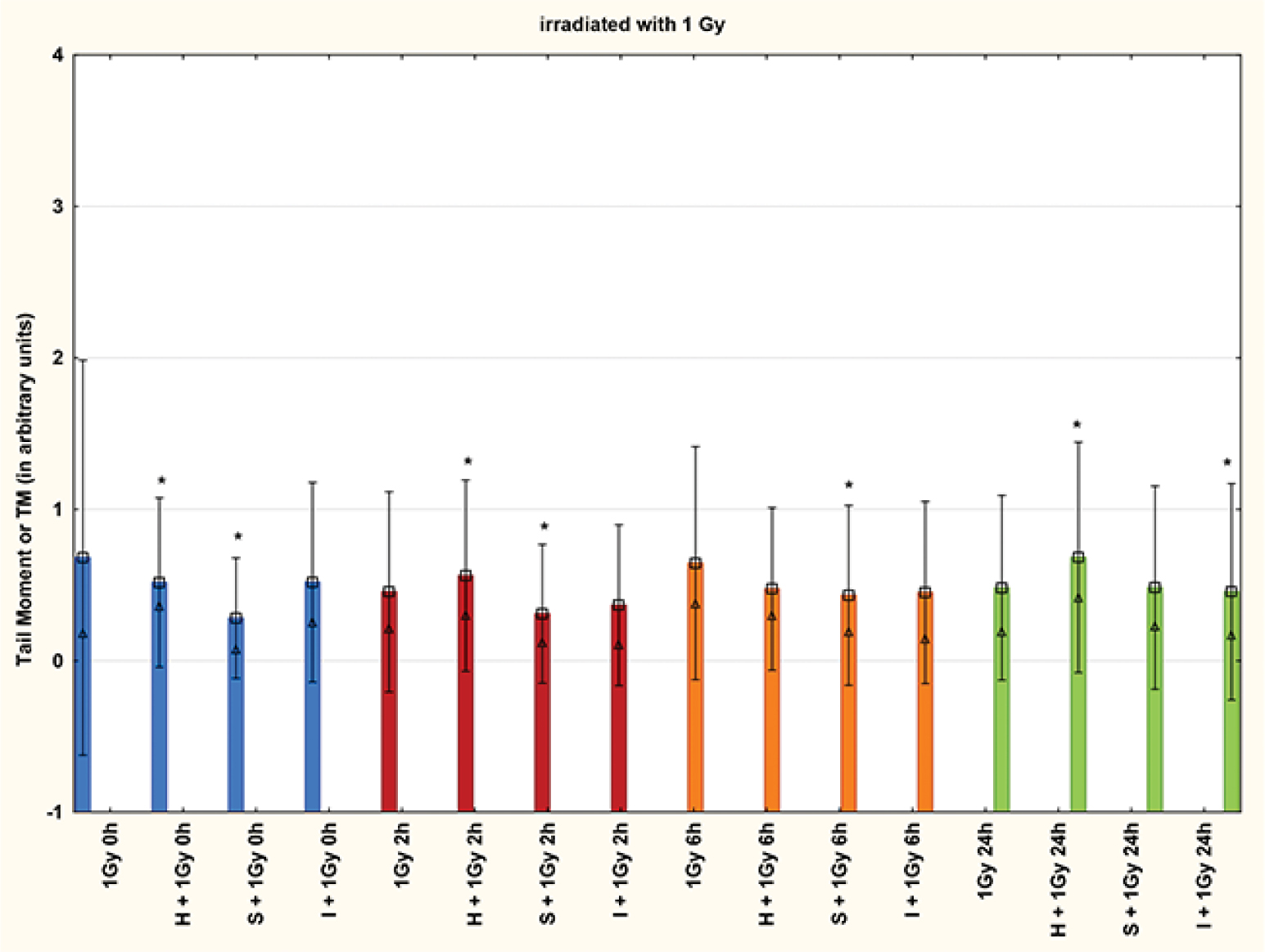
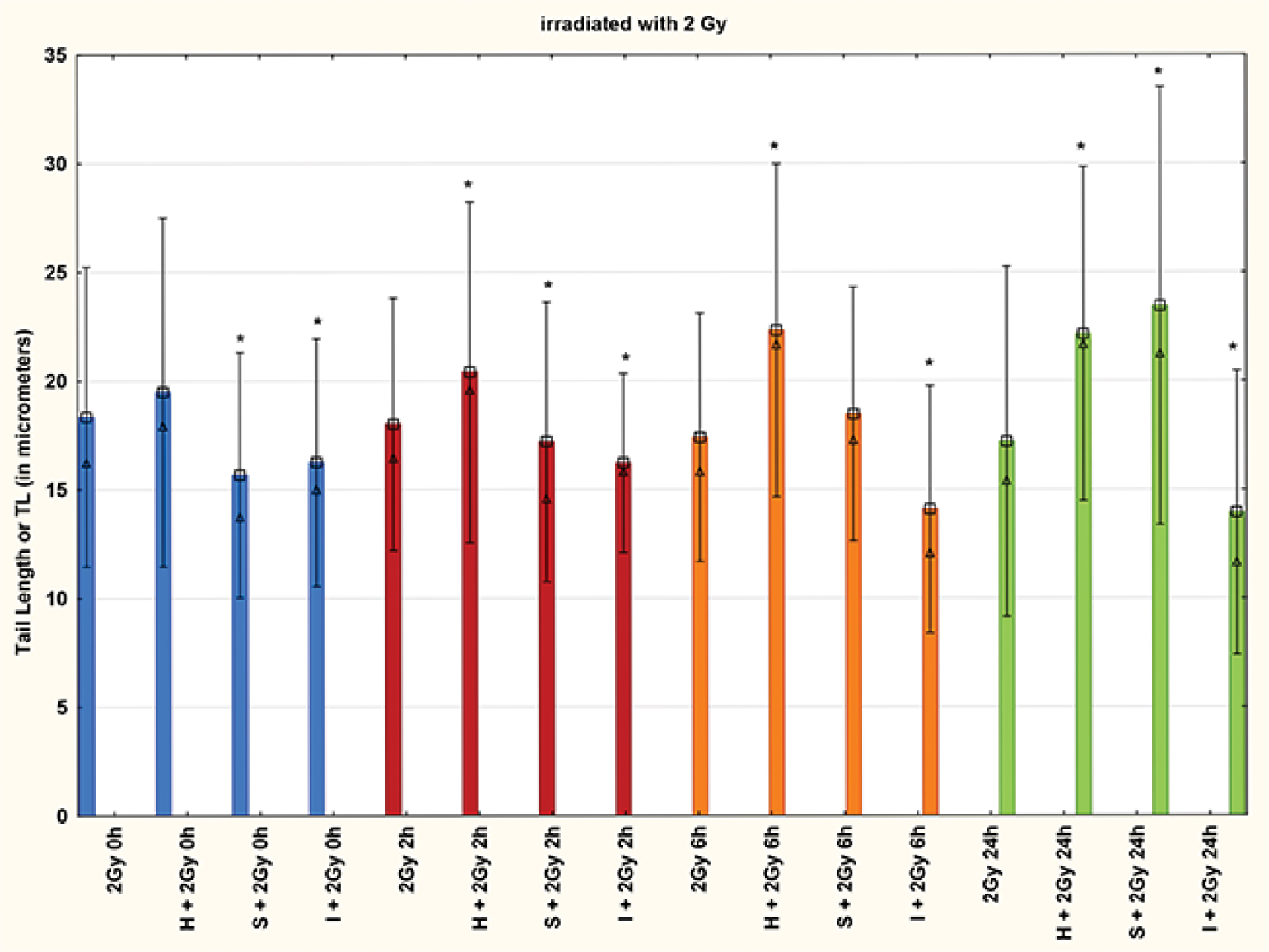
Figure 3a

Tail length values in liver cells of 1 Gy irradiated male Swiss albino mice previously anaesthetised with halothane (H), sevoflurane (S) or isoflurane (I). Samples taken immediately after (0 h), 2, 6 or 24 h after treatment were analysed from five animals per group for 200 comets. Samples were compared to 1 Gy 0 h, statistical differences (*) were analysed with the Mann-Whitney U test. The values represented here are mean (square), median (triangle), and standard deviation (SD, range)

Figure 3b

Tail intensity values in liver cells of 1 Gy irradiated male Swiss albino mice previously anaesthetised with halothane (H), sevoflurane (S) or isoflurane (I). Samples taken immediately after (0 h), 2, 6 or 24 h after treatment were analysed from five animals per group for 200 comets. Samples were compared to 1 Gy 0 h, statistical differences (*) were analysed with the Mann-Whitney U test. The values represented here are mean (square), median (triangle), and standard deviation (SD, range)

Figure 3c

Tail moment values in liver cells of 1 Gy irradiated male Swiss albino mice previously anaesthetised with halothane (H), sevoflurane (S) or isoflurane (I). Samples taken immediately after (0 h), 2, 6 or 24 h after treatment were analysed from five animals per group for 200 comets. Samples were compared to 1 Gy 0 h, statistical differences (*) were analysed with the Mann-Whitney U test. The values represented here are mean (square), median (triangle), and standard deviation (SD, range)

Figure 4a

Tail length values in liver cells of 2 Gy irradiated male Swiss albino mice previously anaesthetised with halothane (H), sevoflurane (S) or isoflurane (I). Samples taken immediately after (0 h), 2, 6 or 24 h after treatment were analysed from five animals per group for 200 comets. Samples were compared to 2 Gy 0 h, statistical differences (*) were analysed with the Mann-Whitney U test. The values represented here are mean (square), median (triangle), and standard deviation (SD, range).
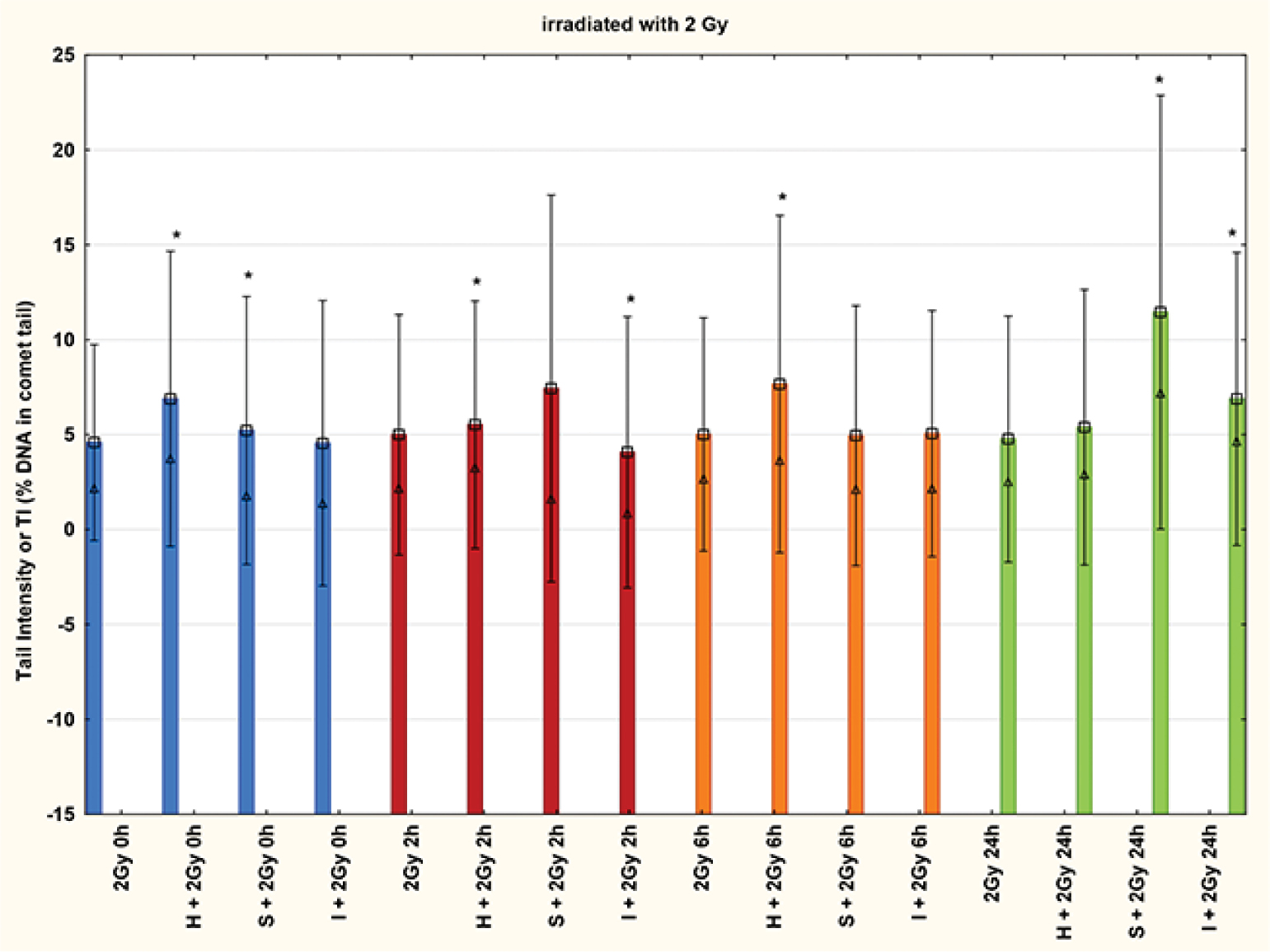

Figure 4b

Tail intensity values in liver cells of 2 Gy irradiated male Swiss albino mice previously anaesthetised with halothane (H), sevoflurane (S) or isoflurane (I). Samples taken immediately after (0 h), 2, 6 or 24 h after treatment were analysed from five animals per group for 200 comets. Samples were compared to 2 Gy 0 h, statistical differences (*) were analysed with the Mann-Whitney U test. The values represented here are mean (square), median (triangle), and standard deviation (SD, range)
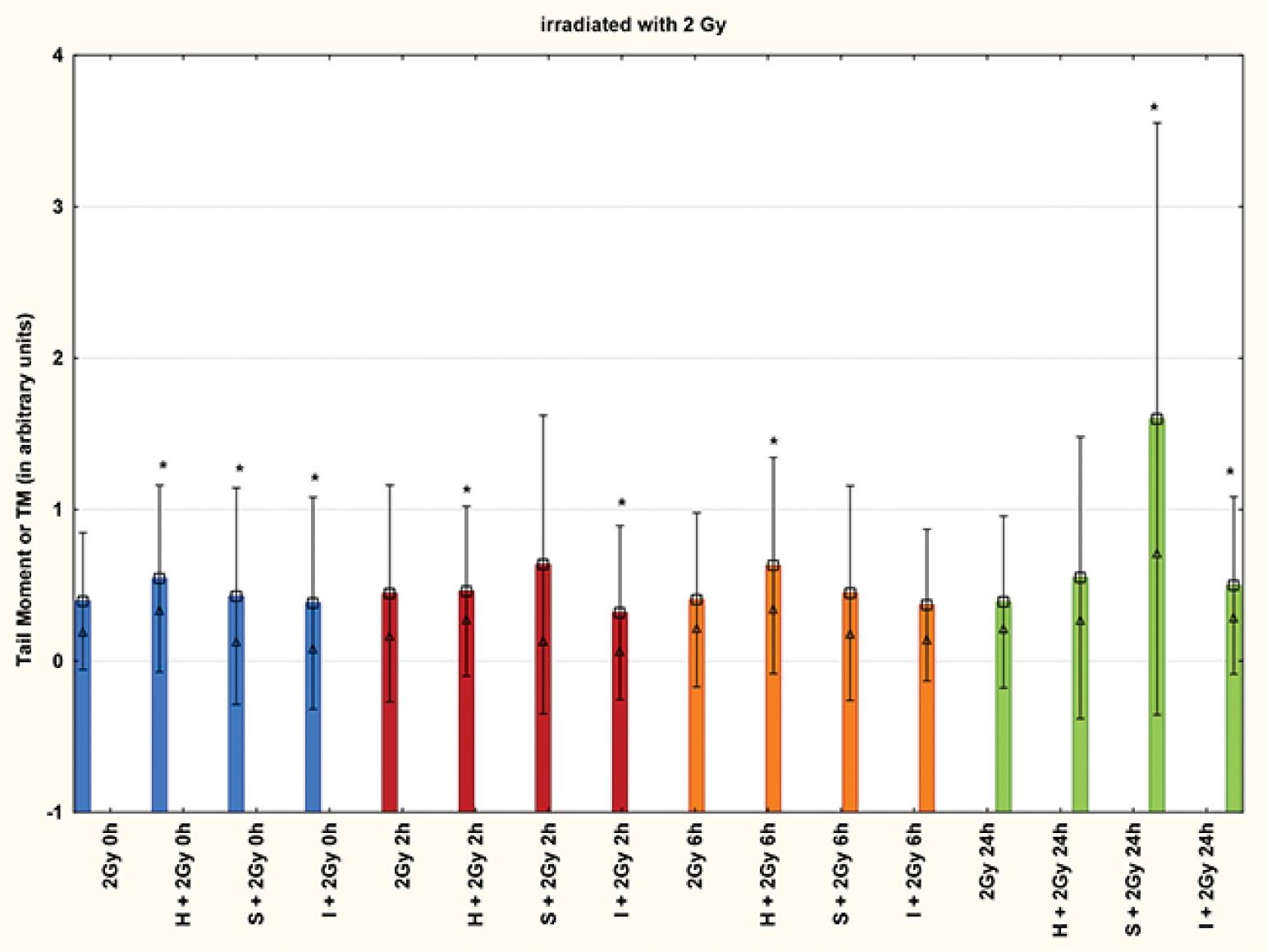

Figure 4c

Tail moment values in liver cells of 2 Gy irradiated male Swiss albino mice previously anaesthetised with halothane (H), sevoflurane (S) or isoflurane (I). Samples taken immediately after (0 h), 2, 6 or 24 h after treatment were analysed from five animals per group for 200 comets. Samples were compared to 2 Gy 0 h, statistical differences (*) were analysed with the Mann-Whitney U test. The values represented here are mean (square), median (triangle) and standard deviation (SD, range)
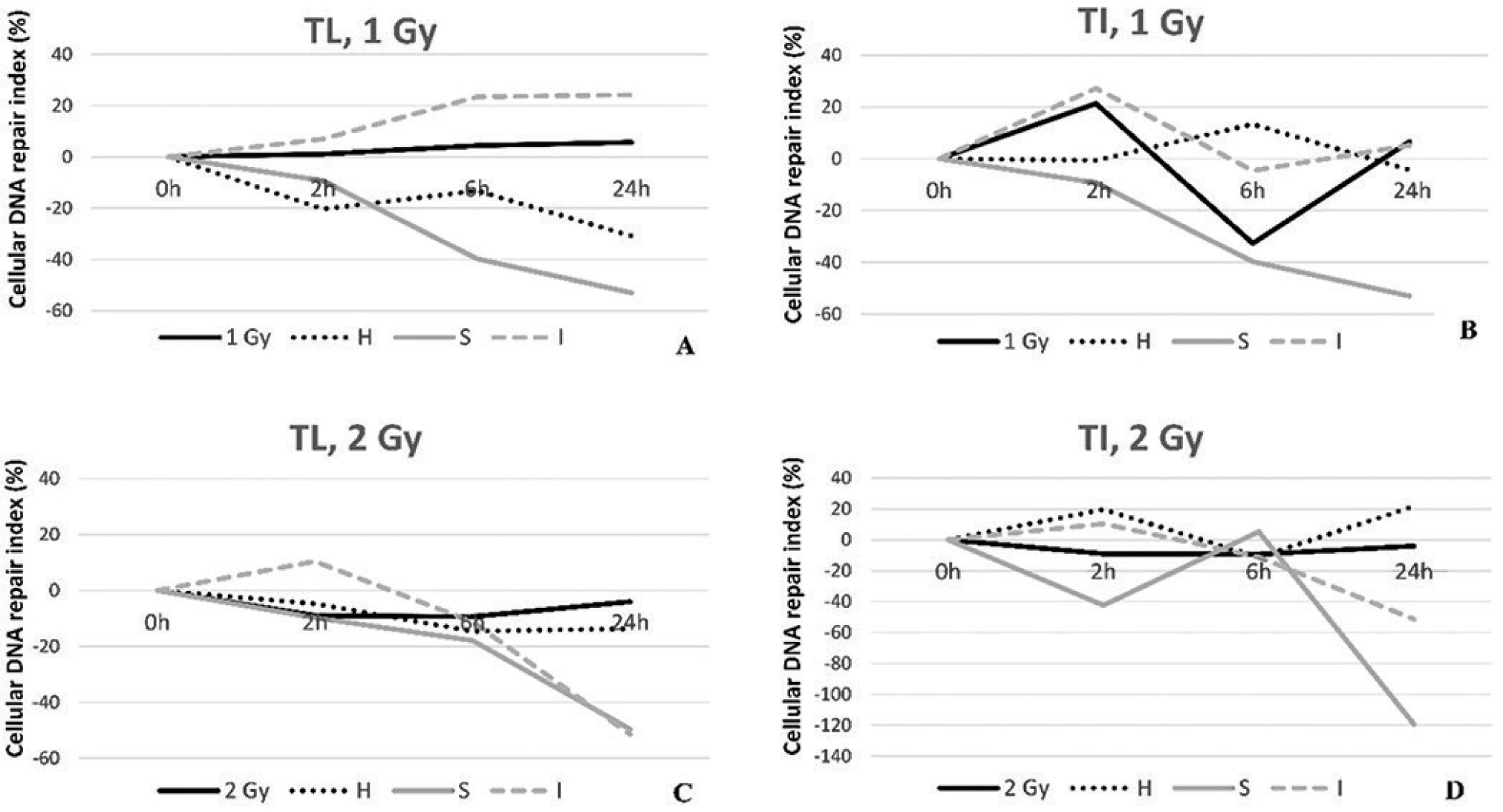

Figure 5

CRI index (percentage of repair) for tail length (TL) and tail intensity (TI) parameter measured in liver cells of mice for 24 hours. 0 h-immediately after, 2 h, 6 h and 24 h after combined exposure to anaesthetics and: 1 Gy (A, B) or 2 Gy (C, D) γ-irradiation (60Co). H-halothane, S-sevoflurane, I-isoflurane
DOI: https://doi.org/10.2478/aiht-2023-74-3692 | Journal eISSN: 1848-6312 | Journal ISSN: 0004-1254
Language: English, Croatian, Slovenian
Page range: 22 - 33
Submitted on: Nov 1, 2022
|
Accepted on: Mar 1, 2023
|
Published on: Apr 4, 2023
In partnership with: Paradigm Publishing Services
Publication frequency: 4 issues per year

© 2023 Vesna Benković, Mirta Milić, Nada Oršolić, Anica Horvat Knežević, Gordana Brozović, Nikola Borojević, published by Institute for Medical Research and Occupational Health
This work is licensed under the Creative Commons Attribution-NonCommercial-NoDerivatives 3.0 License.