
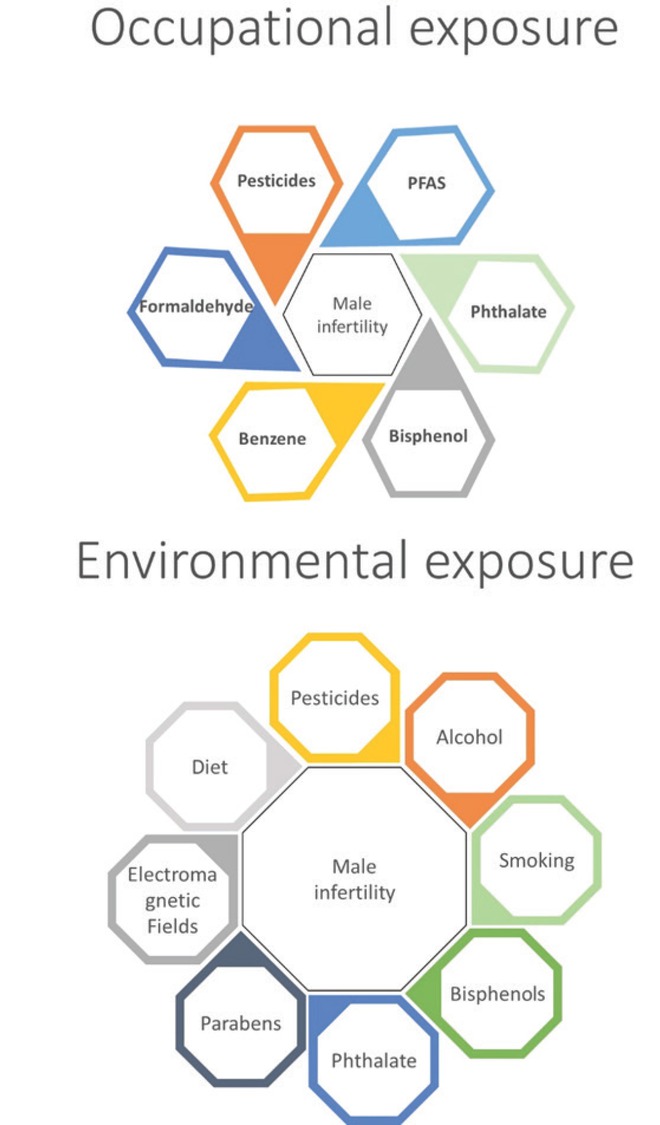
Figure 1
Overview of occupational and environmental stressors associated with male infertility
Table 1
Types of biochemical, cytological, genetic, and epigenetic disorders in male infertility after occupational and environmental exposure to stressors
| Disorder | Occupational exposure | References | Environmental exposure | References |
|---|---|---|---|---|
| Hormonal | Testosterone ↓ | (24, 33, 35) | Testosterone ↓ Oestradiol↓ Aromatase ↓ Gonadotropins↑ Aromatase↑ Leptin↑ | (38, 39, 42, 43, 46, 47, 58, 115, 116, 119, 120) |
| Sperm | Sperm motility ↓ Apoptosis ↑ ROS generation Sperm count ↓ Asthenozoospermia Necrozoospermia Oligozoospermia Sperm immaturity↑ | (14, 17, 18, 19, 20, 21, 22, 23, 24, 25, 34, 35) | Sperm count ↓ Sperm motility ↓ Abnormal morphology ↑ Oligozoospermia Asthenozoospermia Azoospermia Apoptosis↑ | (6, 7, 25, 26, 27, 28, 36, 46, 47, 55, 56, 58, 59, 63, 64, 107, 108, 117, 118, 119, 120, 122, 124) |
| Mitochondrial | – | – | mitochondria Disturbances functionality in | (121, 125, 126) |
| DNA | DNA fragmentation Genome damage Disomy X ↑ Disomy Y ↑ Hyperhaploidy | (14, 15, 23, 35) | XY18 disomy Disomy of chromosome 13 Disrupted DNA integrity Sex chromosome aneuploidy Deletions in AZF region Sex chromosome disomy DNA damage DNA fragmentation | (11, 24, 48, 49, 50, 55, 56, 58, 59, 119, 120, 121) |
| DNA methylation | Sperm LINE-1 hydroxymethylation DNA hydroxymethylation partially dependent on trimethylation of H3 in human spermatogenesis | (36, 37, 38) | Hypermethylation of LINE-1 and hypomethylation of P16 gene | (10) |