
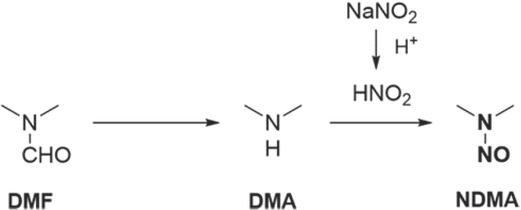
Figure 1
Production changes that caused formation of NDMA in the Zhejiang Huahai Pharmaceutical plant (6)
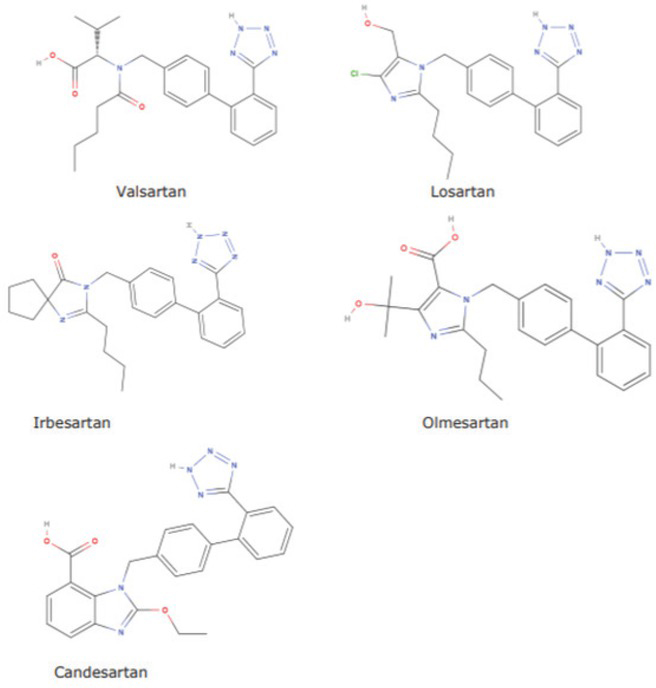
Figure 2
Sartans with a tetrazole ring contaminated with impurities (4)
Table 1
| Sources of nitrosamine contamination/formation in the API | |||||
|---|---|---|---|---|---|
| Critical combinations of compounds | Nitrosamine | NOx source | Amine source | Amine nitrosated by NOx | Critical combination |
| NDMA | NaNO2 | Dimethylformamide (DMF) | Dimethylamine (DMA) | reagent / solvent | |
| NDEA | NaNO2 | Triethylamine (TEA) | Diethylamine (DEA) | reagent / reagent | |
| Triethylamine hydrochloride (TEA HCl) | Triethylamine (TEA) | reagent / catalyst | |||
| Reagents, solvents, and catalysts | The use of azide reagents in the synthesis of tetrazole, under the acidic conditions required for the isolation and extraction of tetrazole, releases the dangerous hydrazoic acid which can give e.g. amines. The remaining amounts of azide can be decomposed into gaseous by-products such as nitrogen and nitrous oxide (N2O) by the addition of sodium nitrite (NaNO2). | ||||
| Faults in the production process | Inappropriate or poorly controlled reaction conditions concerning temperature, pH, or the order of addition of reagents, intermediates, or solvents. | ||||
| Recovered and recycled materials | If the solvents used in the reaction step involving azide are collected and reused, there is a possibility that nitrosamines may be inadvertently introduced into the production process if the waste stream is quenched with nitrite in the presence of secondary or tertiary amines and subsequently treated with nitric acid, e.g. to destroy residual azides without adequate process control. There is also a possibility that the process water used in the production of the API may contain low levels of nitrosamines due to environmental pollution. | ||||
| Third-party | External recovery companies do not receive sufficiently specific information on the composition of the materials they process and they use routine processing procedures and generally accepted equipment. This can lead to cross-contamination of solvents, reagents, and catalysts (originating from different sources and processes) if the equipment is not properly cleaned between customer orders or if precautions are not taken to prevent the formation of nitrosamines. | ||||
| Contaminated raw materials and intermediates | Distributors using recovered materials or raw materials that contain nitrites or amines and whose processing can lead to the formation of nitrosamines. Problematic if an API manufacturer who exclusively uses nitrosamine-free processes is not aware that there is a risk of nitrosamine formation. | ||||
| Sources of nitrosamine contamination of finished products | |||||
|---|---|---|---|---|---|
| Use of certain packaging materials | Nitrosamine | NOsource x | Amine source | Amine nitrosated by NOx | Critical combination |
| NDMA | Nitrocellulose (on lidding foil) | Printing ink | Dimethylamine (DMA) | Lidding foil / printing ink | |
| NDEA | Nitrocellulose (on lidding foil) | Printing ink | Diethylamine (DEA) | Lidding foil / printing ink | |
| Storage conditions | Some stored medicinal products may undergo degradation pathways that form nitrosamine impurities. The chemical structure of metformin also indicates the possibility of subsequent nitrosamine formation during storage. The formation of metformin hydroperoxide can lead to the oxidation of other metformin molecules or the formation of nitrosamines by intramolecular oxidation, which leads to rearrangements and fragmentation reactions. Due to the high nitrogen content in metformin, numerous positions for N-oxidations are possible. Besides, numerous fragmentation reactions enable decomposition of the molecular structure, which can lead to the formation of thermodynamically stable nitrosamine derivatives. | ||||
| Endogenous production from drugs | In vitro studies of different pH solutions of ranitidine with and without nitrite have shown the possibility of NDMA formation from ranitidine in acidic gastric pH in the presence of high levels of nitrites, which nitrosate the diamine part of the ranitidine molecule. | ||||