
Table 1
Frequency of hand washing, skin symptoms, and transepidermal water loss among hairdressing and beautician apprentices
| Hairdressing apprentices (N=101) | Beautician apprentices (N=76) | Difference between hairdressing and beautician apprentices | |
|---|---|---|---|
| Washing N (%) hands >20 times/day | 28 (28) | 20 (26) | P=0.835 |
| Self-reported history of hand/wrist eczema or urticaria N (%) | 35 (35) | 19 (25) | P=0.041 |
| Self-reported history of dry hands (without eczema or urticaria) N (%) | 37 (37) | 23 (30) | P=0.082 |
| Without history of self-reported symptoms hands) (eczema, urticaria, dry N (%) | 29 (29) | 34 (45) | – |
| One or more skin changes on clinical examination N (%) | 40 (40) | 27 (36) | P=0.579 |
| OHSI Median (IQR) | 3 (2–4) | 3 (2–4) | P=0.774 |
| TEWL Median hand (IQR) [g/m2/h] | 19.6 (16.7–24.8) | 18.6 (13.7–23.0) | P=0.085 |
| TEWL Median, forearm (IQR) [g/m2/h] | 12.2 (9.9–15.1) | 12.2 (10.3–15.0) | P=0.858 |
[i] IQR – interquartile range; N– number of apprentices; TEWL – transepidermal water loss; OHSI – Osnabrück Hand Eczema Severity Index. P<0.05 – statistically significant difference between groups (Pearson’s chi square or Fisher test for categorical variables; Mann Whitney or t-test for continuous variables). Significance of difference in the frequency of self-reported symptoms was tested in comparison to the control group without any self-reported symptoms or dry skin
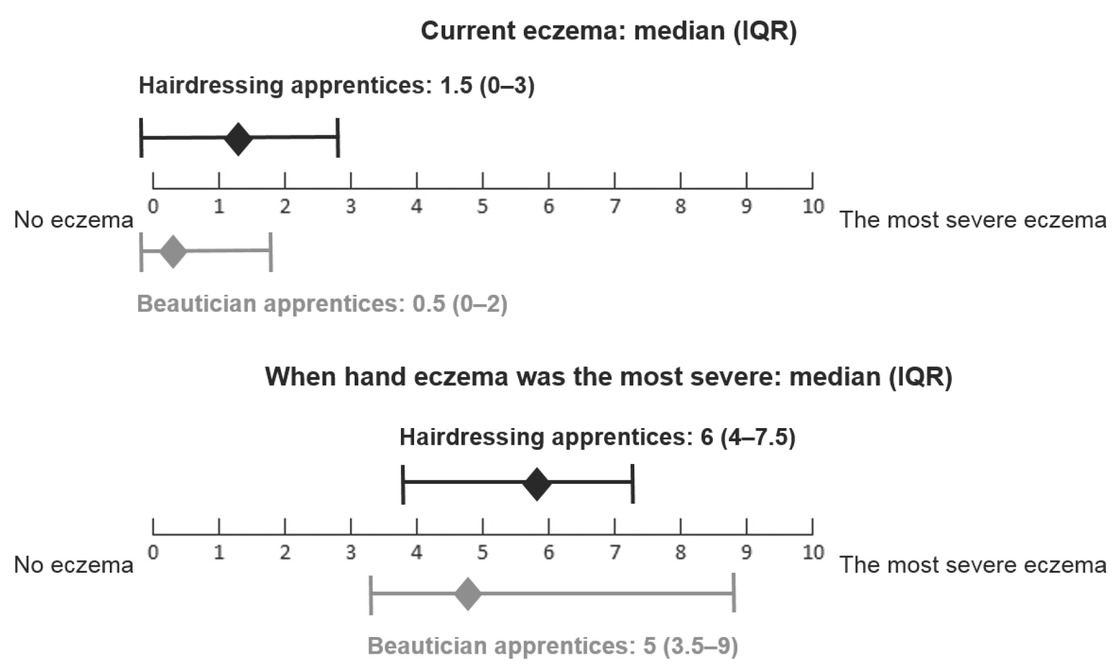
Figure 1
Self-reported ratings of hand eczema severity. The differences between the two trades in self-rated severity scores were significant (P<0.001 Mann-Whitney test) for both scales
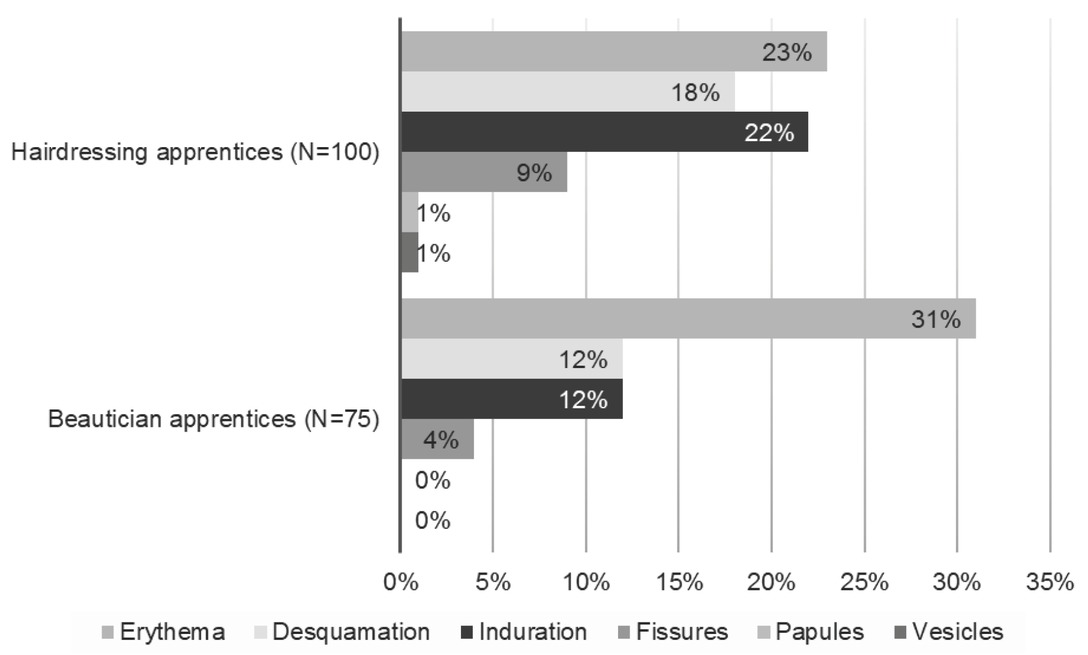
Figure 2
Skin symptoms found during clinical examination of hands/wrists. One apprentice from each group did not complete skin examination. There was no significant statistical difference in proportions of each symptom between the hairdressing and beautician apprentices
Table 2
Predictor association with hand and forearm transepidermal water loss as outcomes
| Log hand TEWL P model=0.119, adjusted | R | 2=0.024 | Log forearm TEWL P model=0.303, adjusted | R | 2=0.007 | |
|---|---|---|---|---|---|---|
| Predictors | Coefficient (95 % CI) | P | Coefficient (95 % CI) | P | ||
| Beautician vs hairdressing apprentices | -0.04 (-0.09–0.02) | 0.218 | 0.04 (-0.01–0.09) | 0.140 | ||
| Washing hands >20 times/day | 0.08 (0.02–0.14) | 0.013 | 0.03 (-0.02–0.08) | 0.257 | ||
| Self-eczema reported or urticaria history of hand/wrist | 0.03 (-0.04–0.10) | 0.414 | 0.04 (-0.02–0.10) | 0.161 | ||
| Self-(without reported eczema history or urticaria) of dry hands | 0.002 (-0.06–0.07) | 0.930 | 0.001 (-0.05–0.06) | 0.953 | ||
| One examination or more skin changes on clinical | 0.01 (-0.05–0.06) | 0.855 | 0.001 (0.05–0.05) | 0.974 | ||
| Washing measurement hands within 2 h before | 0.01 (-0.02–0.14) | 0.821 | 0.01 (-0.04–0.06) | 0.660 |