
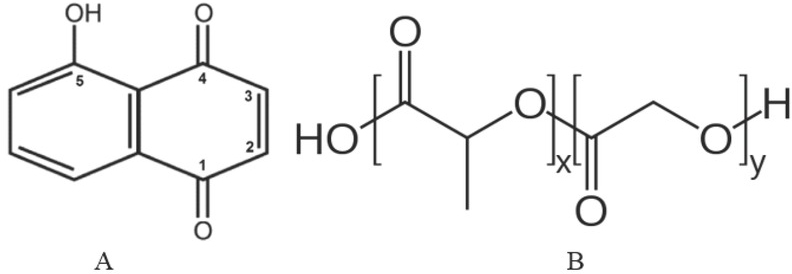
Figure 1
Chemical structure of juglone (A) and poly (lactic-co-glycolic acid) (B)
Table 1
Physicochemical properties of juglone loaded PLGA nanoparticles
| Encapsulating efficiency (%) | Drug loading (%) | Particle size (nm) | Zeta potential (mV) | Polydispersity index |
|---|---|---|---|---|
| 29.95±2.8 | 15.42±2.1 | 213.33±5.2 | -14.58±2.8 | 0.115±0.03 |
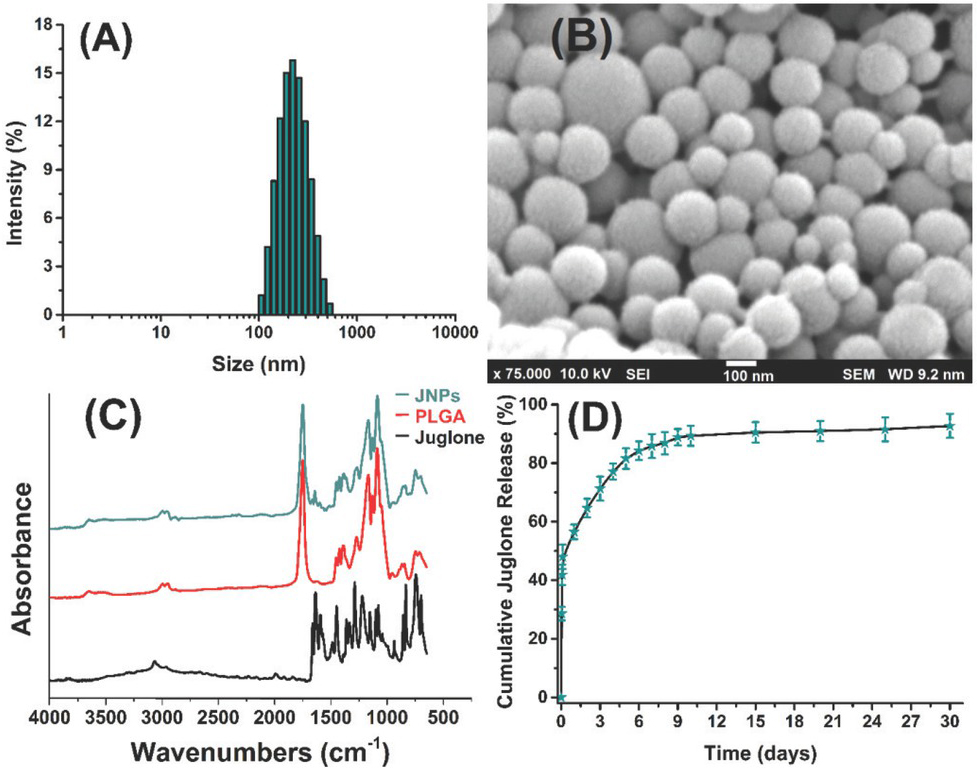
Figure 2
Particle size distribution (A), scanning electron microscopy image (B), FT-IR spectra (C), and release pattern (D) of nanoparticles
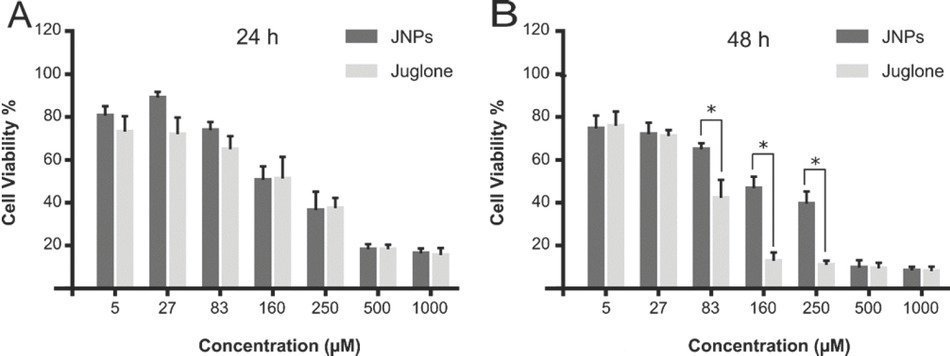
Figure 3
Viability of L929 fibroblasts treated with free and PLGA nanoparticle-coated juglone (JNP) after 24 h (A) and 48 h (B); Cell viability was measured with the MTT assay. Values are expressed as means of quadruple samples with standard error. *statistically significant differences between juglone and JNP (p<0.05)
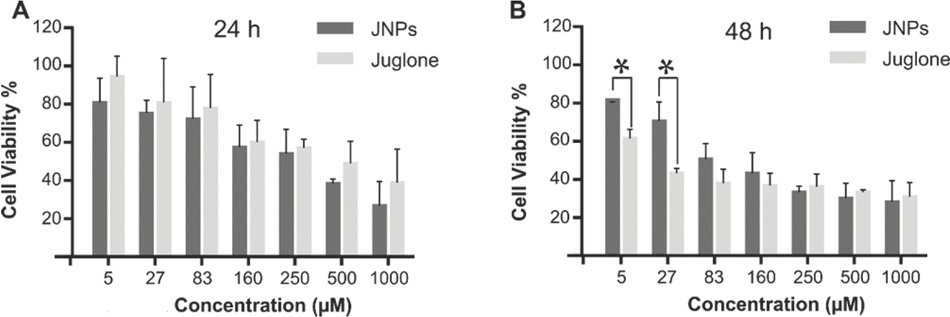
Figure 4
Viability of alfalfa cells treated with free and PLGA nanoparticle-coated juglone (JNP) after 24 h (A) and 48 h (B); Cell viability was measured with the MTT assay. Values are expressed as means of triple samples with standard error. *statistically significant differences between juglone and JNP (p<0.05)
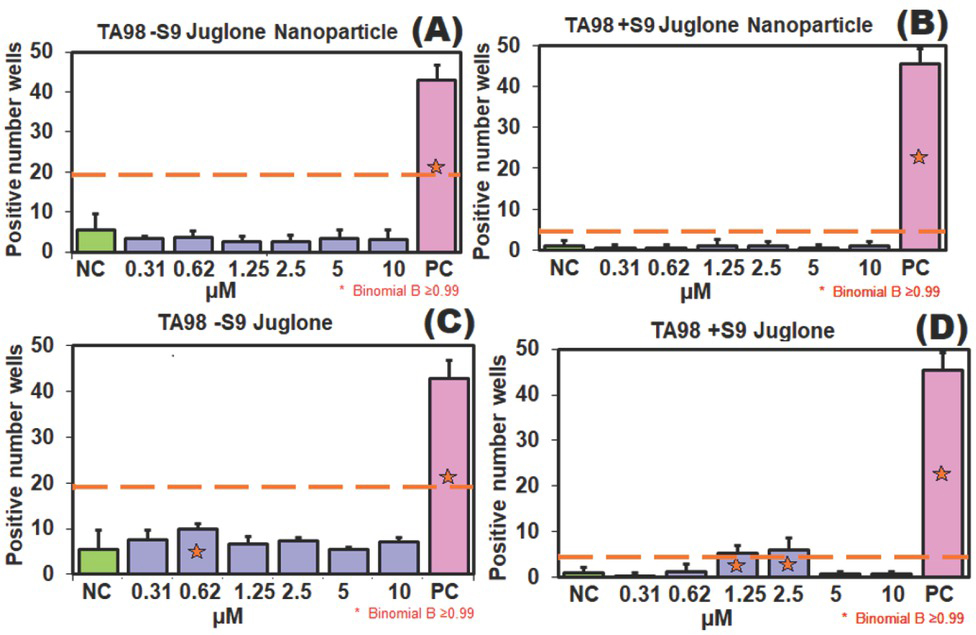
Figure 5
Potential mutagenicity in S. typhimurium TA98 treated with 0.31−10 μmol/L juglone: (A) TA98-S9 treated with JNPs; (B) TA98+S9 treated with JNPs; (C) TA98-S9 treated with free juglone; (D) TA98+S9 treated with free juglone; PC – positive control: 2-NF (2 μg/mL) and 4-NQO (0.1 μg/mL) without S9 and 2-AA (1 μg/mL) with S9; NC – negative control: water; *B value ≥0.99
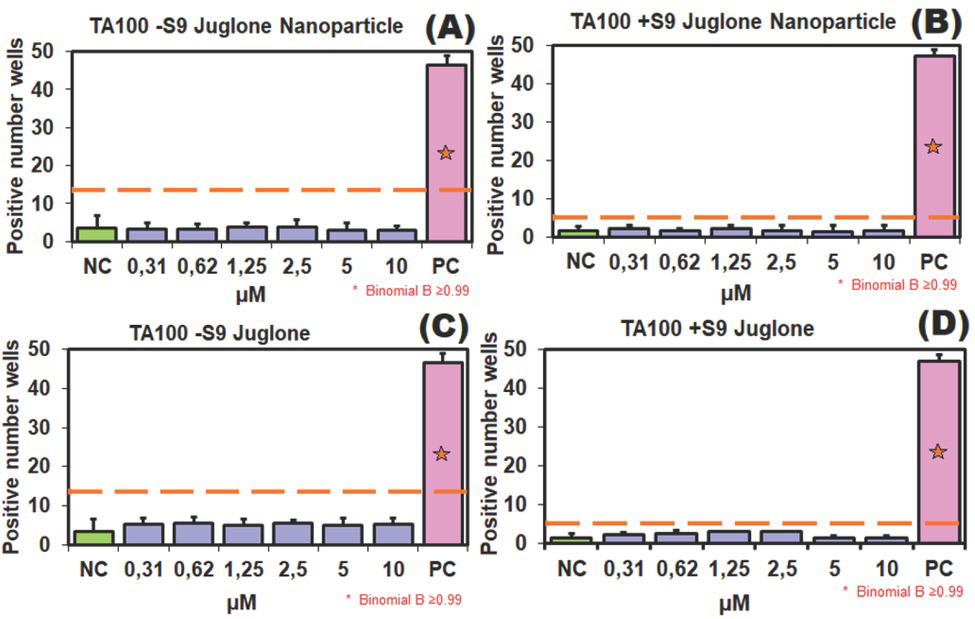
Figure 6
Potential mutagenicity in S. typhimurium TA100 treated with 0.31−10 μmol/L juglone: (A) TA100-S9 treated with JNPs; (B) TA100+S9 treated with JNPs; (C) TA100-S9 treated with free juglone; (D) TA100+S9 treated with free juglone; PC – positive control: 2-NF (2 μg/mL) and 4-NQO (0.1 μg/mL) without S9 and 2-AA (2.5 μg/mL) with S9; NC – negative control: water; *B value ≥0.99