Have a personal or library account? Click to login
Physiological and pathophysiological role of endocrine fibroblast growth factors Cover

Physiological and pathophysiological role of endocrine fibroblast growth factors

By: Agata Łukawska and  Agata Mulak  
Open Access
|May 2022

Figures & Tables

Fig. 1

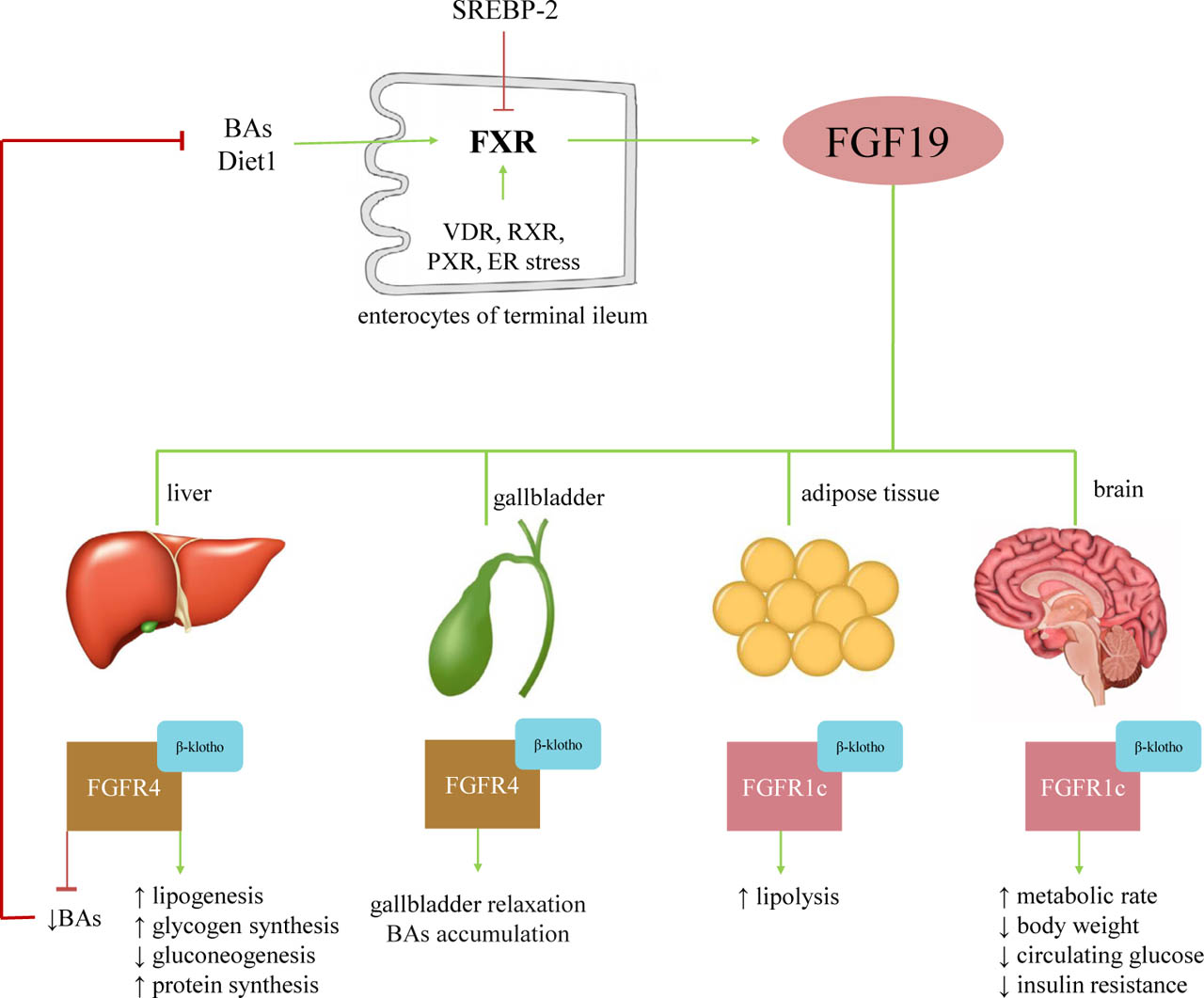
Regulation of Fibroblast Growth Factor 19 (FGF19) expression and the main functions of FGF19; FGF19 is produced in the enterocytes of the terminal ileum in response to the farnesoid X receptor (FXR) activation. Bile acids (BAs), Diet1, the vitamin D receptor (VDR), retinoid X receptor (RXR), pregnane X receptor (PXR), and endoplasmic reticulum (ER) stress induce expression of FGF19. Sterol regulatory element-binding protein 2 (SREBP-2) inhibits transcription of FGF19. FGF19 interacts with various organs including the liver, gallbladder, adipose tissue and the brain through fibroblast growth factor receptors (FGFR) and β-Klotho protein. The effects of action in particular organs are presented in the figure. Based on [5, 10]
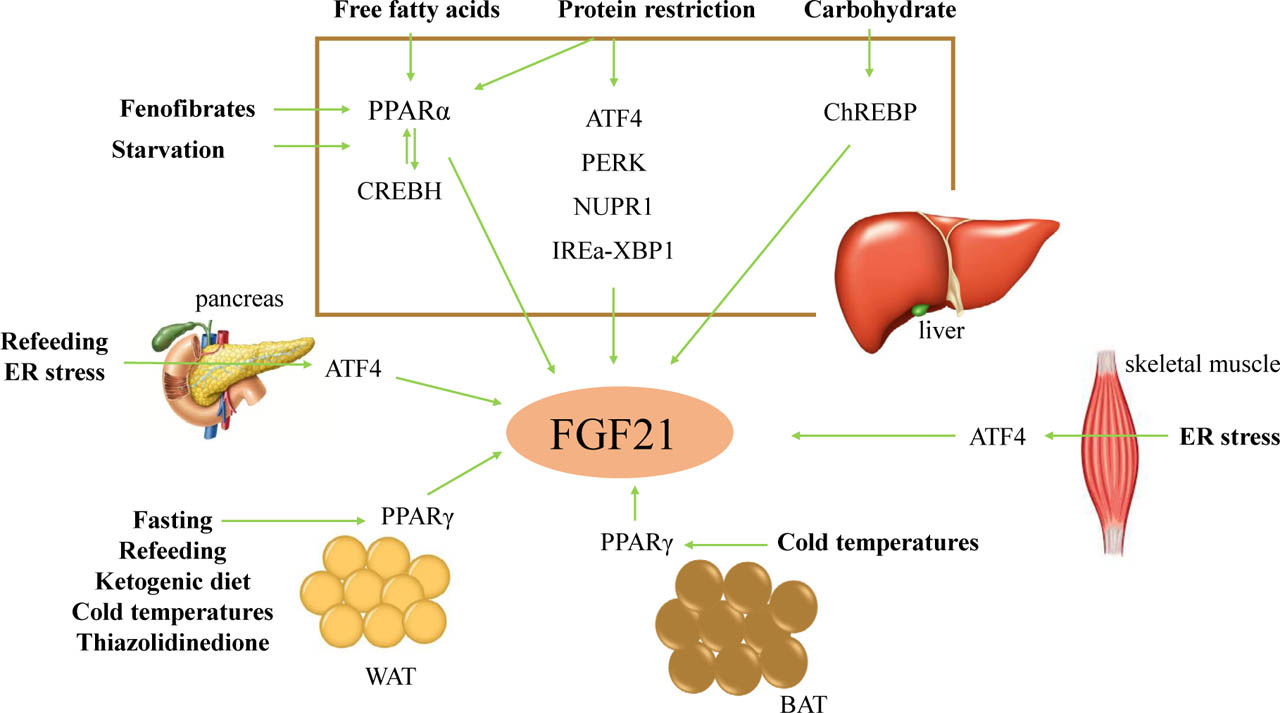

Fig. 2

Regulation of Fibroblast Growth Factor 21 (FGF21) expression; FGF21 is mainly produced in the liver, white adipose tissue (WAT), brown adipose tissue (BAT), and the pancreas, but is also synthesized in lower level in the skeletal muscles. In the figure, inducers of FGF21 synthesis (marked in bold font) act on the particular organs and stimulate signaling cascades including peroxisome proliferator receptor α (PPARα), cyclic adenosine monophosphate responsive element-binding protein H (CREBH), carbohydrate-responsive binding protein (ChREBP). The activation of transcription factor 4 (ATF4), protein kinase R-like endoplasmic reticulum kinase (PERK), the liver-integrated stress response-driven nuclear protein 1 (NUPR1), inositol-requiring enzyme 1 - transcription factor X-box-binding protein 1 (IREa-XBP1), and PPARγ, consequently leads to FGF21 expression. Based on [10, 55]
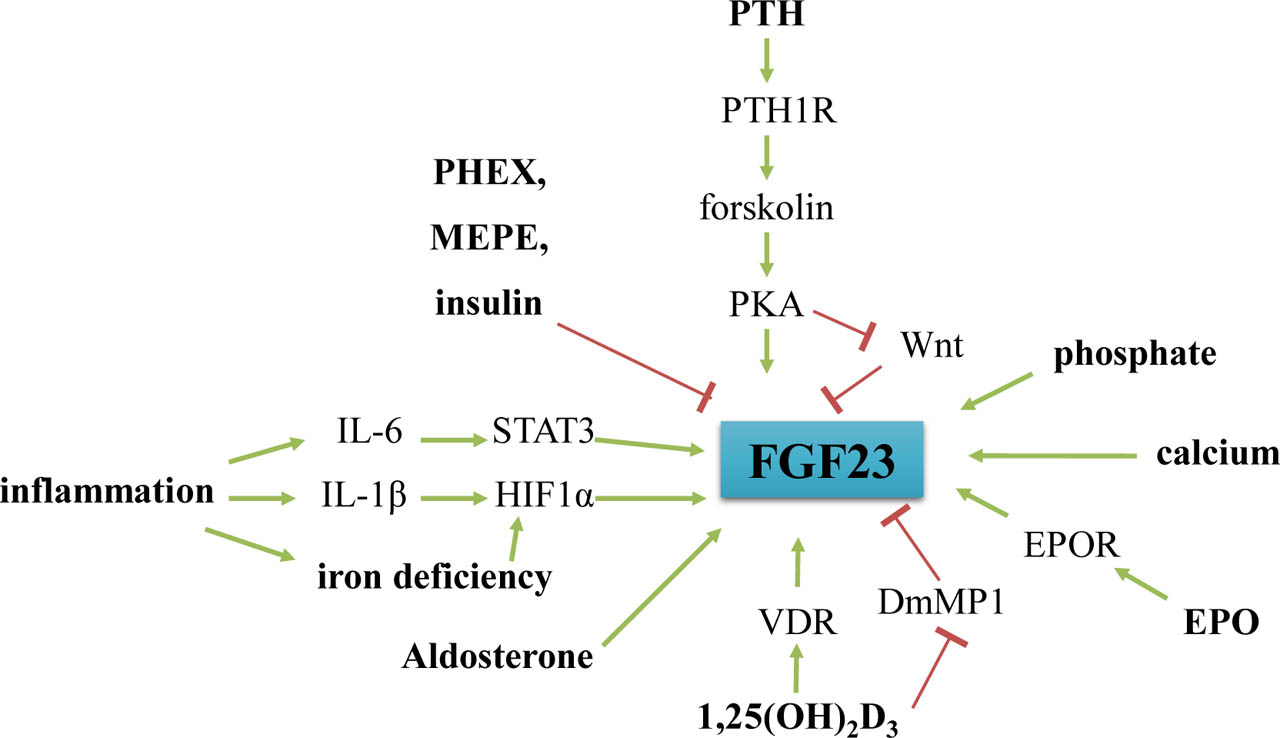

Fig. 3

Regulation of Fibroblast Growth Factor 23 (FGF23) expression; FGF23 is predominantly synthesized by osteoblasts and osteocytes. Parathyroid hormone (PTH), phosphate, calcium, erythropoietin (EPO), 1,25-dihydroxyvitamin D (1,25(OH)2D3), aldosterone, iron deficiency, and inflammation are stimulators of FGF23 production (marked in bold font). Mode of their action is presented in the figure. Phosphate-regulating gene with homologies to endopeptidase on the X chromosome (PHEX), matrix extracellular phosphoglycoprotein (MEPE), insulin, Wnt pathway, and dentin matrix acidic phosphoprotein 1 (DMP1) are inhibitors of the FGF23 expression.PTH1R – Parathyroid hormone receptor, PKA – protein kinase A, EPOR – erythropoietin receptor, VDR – vitamin D receptor, IL-1β – interleukin-1β, IL-6 – interleukin 6, STAT 3–signal transducer and activator of transcription 3, HIF1α – hypoxia inducible factor 1α. Based on [5, 89]
Language: English
Page range: 39 - 53
Submitted on: Jan 29, 2021
Accepted on: Sep 7, 2021
Published on: May 10, 2022
Published by: Hirszfeld Institute of Immunology and Experimental Therapy
In partnership with: Paradigm Publishing Services
Publication frequency: 1 issue per year

© 2022 Agata Łukawska, Agata Mulak, published by Hirszfeld Institute of Immunology and Experimental Therapy
This work is licensed under the Creative Commons Attribution-NonCommercial-NoDerivatives 4.0 License.