
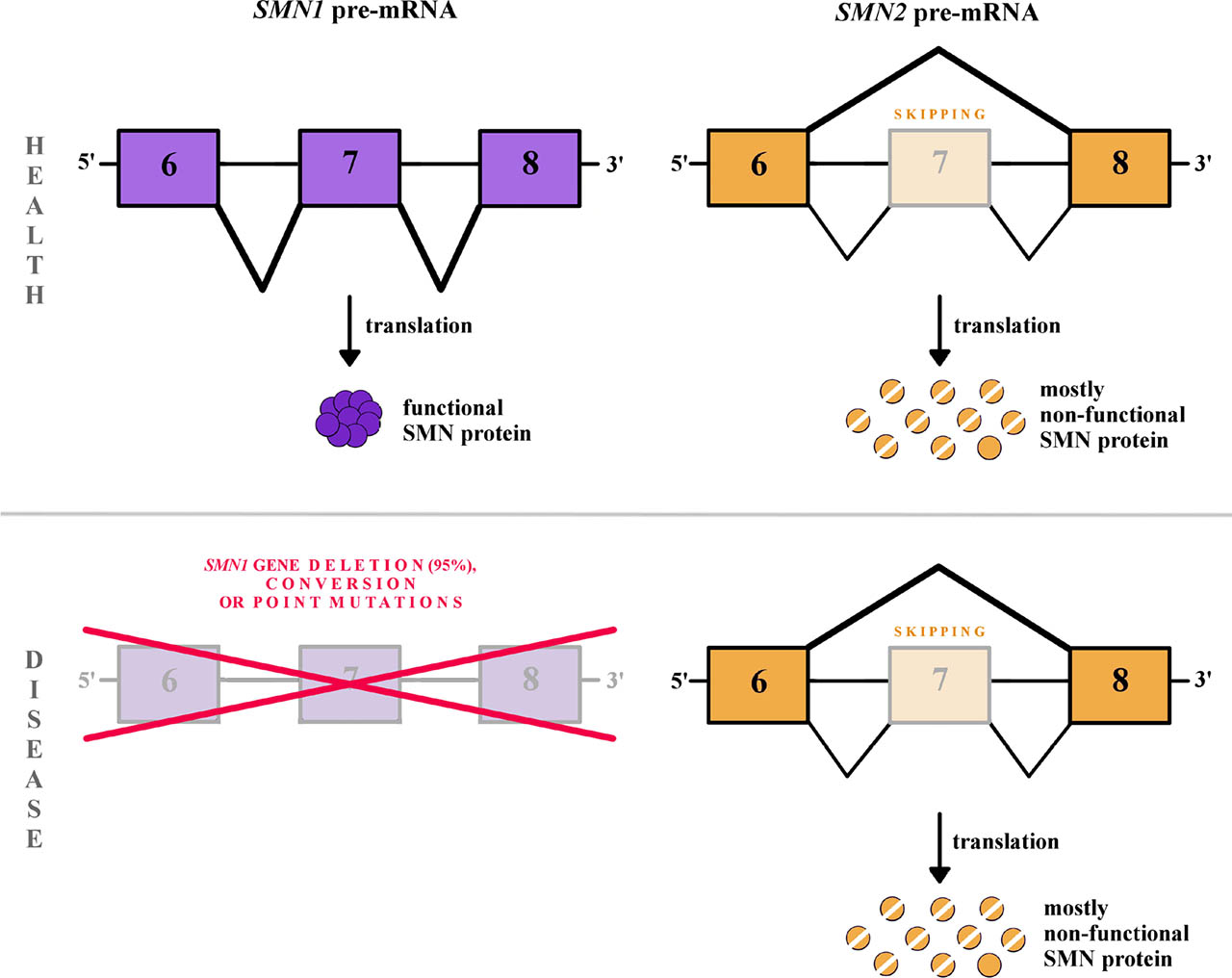
Fig. 1
SMN1 produces all the functional protein and is the gene affected in spinal muscular atrophy (SMA). SMN2 produces non-functional and unstable protein nevertheless it makes only 10% functional protein. Mutation or deletion causes that SMN1 is not produced.
SMN1- survival of motor neuron; SMN2- survival of motor neuron 2
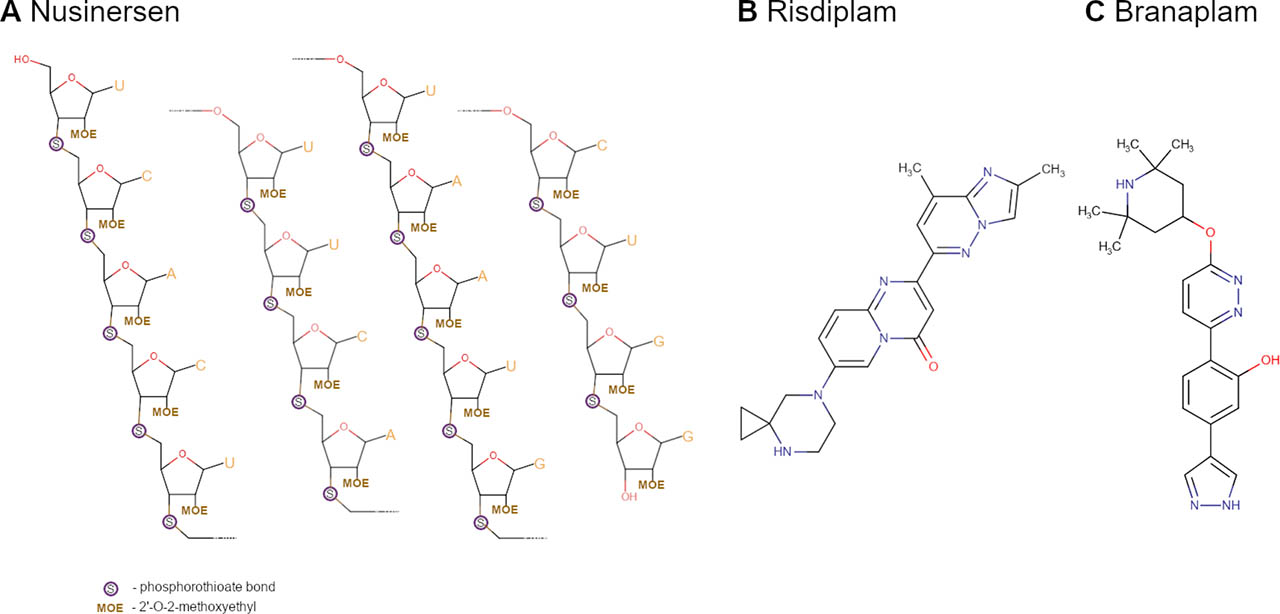
Fig. 2
Chemical structural formulas of (A) Nusinersen (Spinraza) as sodium salt; C234H340N61O128P17S17, (B) Risdiplam (Evrysdi); C22H23N7O. (C) Branaplam; C22H27N5O2.
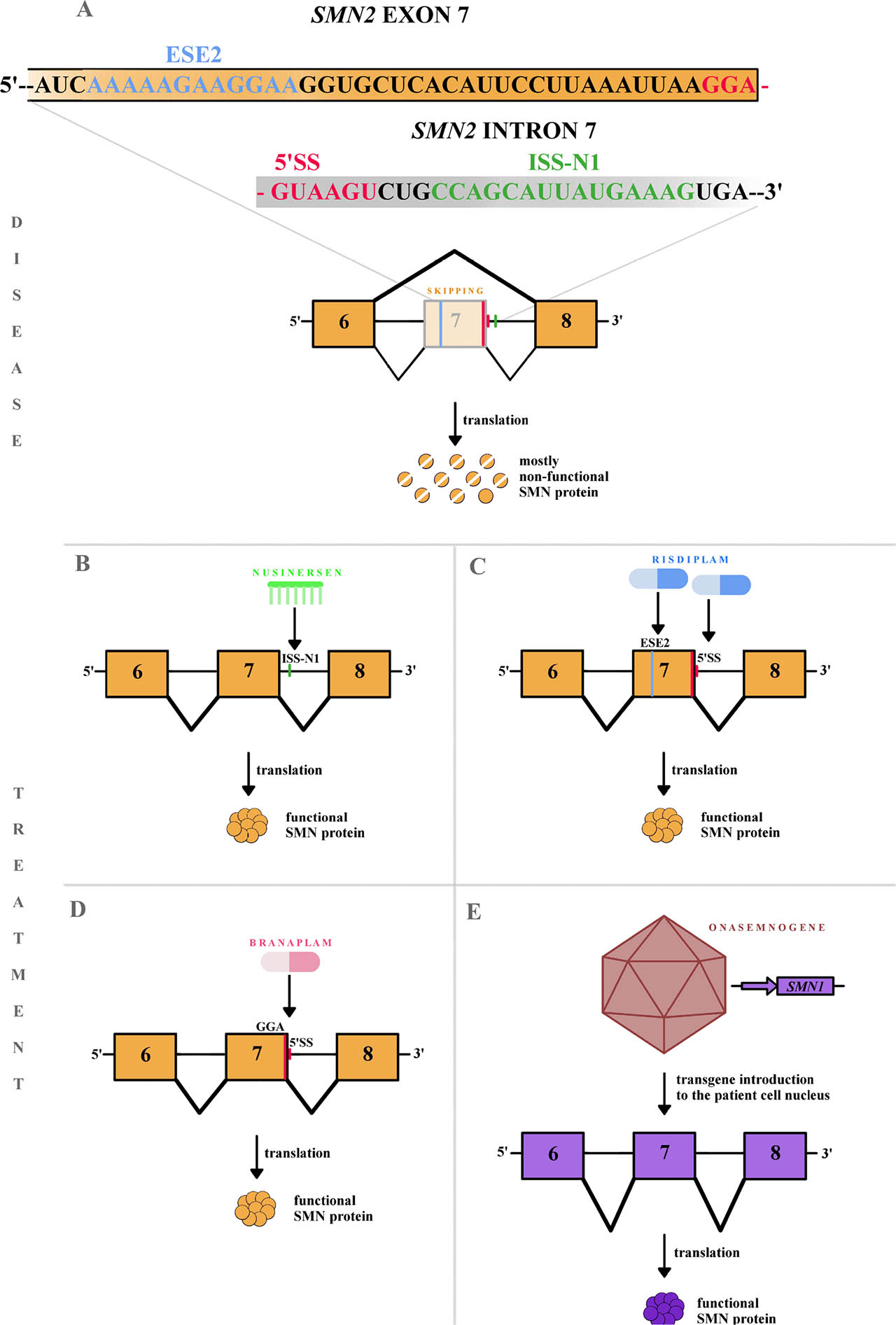
Fig. 3
Mechanisms of SMA treatment using different types of therapy. (A) Mutations in SMN1 gene result in SMN protein deficiency. (B) Nusinersen (Spinraza) targets the ISS-N1 region in the SMN2 gene allowing the inclusion of exon 7 in the mRNA, which leads to high full-length SMN protein production. This treatment can bypass the loss of function in the SMN1 gene. (C) Risdiplam (Evrysdi) is an SMN2 splicing modifier designed to increase the level of SMN protein by affecting SMN2 gene. (D) Branaplam stabilizes duplex U1:5′ss at the 5′ss SMN2 exon 7 consequently contributing to enhancing exon 7 inclusion. (E) Onasemnogene abeparvovec (Zolgensma) is a gene therapy based on using adeno-associated virus subtype 9 (AAV9). AAV9 delivers a functional copy of the SMN1 gene which results in increasing the level of SMN protein. N1- survival of motor neuron; SMN2- survival of motor neuron 2; ISS-N1- intronic splicing silencer N1
Table 1
Summary of risdiplam clinical trials Roche. Roche announces 2-year risdiplam data from SUNFISH and new data from JEWELFISH in infants, children and adults with spinal muscular atrophy (SMA) [29, 30, 31, 32, 33] SMN1- survival of motor neuron; SMN2- survival of motor neuron 2; MFM- Motor Function Measure
| Clinical trial | Identification number | Characteristics | Patients profile | Main purpose of study | Current status of study |
|---|---|---|---|---|---|
| FIREFISH | NCT02913482 | Two-part, open label study. | Infants aged 1–7 months of age with SMA type I and two SMN2 gene copies. | Part one: dose-escalation study Part two: investigation of efficiency at the dose selected in the first part. | The study met its primary endpoint. |
| SUNFISH | NCT02908685 | Two-part, double blind, placebo-controlled study. | People between 2–25 years old with SMA type II or III. | Part one: dose-escalation study Part two: motor function evaluation using total score of MFM. | The study met its primary endpoint. |
| JEWELFISH | NCT03032172 | Open-label exploratory trial. | People between 6 months – 60 years, previously treated with SMA-directed therapies | Safety and tolerability of daily risdiplam dose in non-naïve patients who have taken nusinersen, olesoxime or onasemnogene abeparvovec-xioi. | The study has completed recruitment. |
| RAINBOWFISH | NCT03779334 | Single-arm, multicentre study. | Babies from birth to six weeks of age (at first dose) with genetically diagnosed SMA, without symptoms. | Efficacy, safety, pharmacokinetics and pharmacodynamics. | The study is currently in phase 2. No results were published yet. |
Table 2
Summary of approved therapeutics and substances under clinical trials for SMA [20, 23, 24, 28, 35, 36, 38]
| Therapeutic | Management company | Characteristics | Patient's profile | Dosage and administration |
|---|---|---|---|---|
| Spinraza** | Biogen | Survival motor neuron 2 (SMN2) splicing modifier | All ages and types | Administered by intrathecal injection at an equivalent dose of 12 mg (4–5 ml based on age) |
| Zolgensma** | Novartis Gene Therapies* | Gene therapy based on using recombinant adeno-associated virus subtype 9 (AAV9) to overexpression SMN1 gene | Less than two years old paediatric patients with spinal muscular atrophy and bi-allelic mutations in the SMN1 gene | One intravenous infusion; dosage based on patient's body weight |
| Evrysdi** | Roche, Genetech Inc. | Survival motor neuron 2 (SMN2) splicing modifier | Patients 2 months of age and older suffering from SMA | Administrated orally once a day; dosage is determined by patient age and body weight |
| Reldesemtiv | Cytokinetics/Astellas | Muscle drug (non-SMN) | Patients with SMA types 2, 3 and 4 who are age 12 or older | Administrated orally; phase 2 trial completed |
| Apitegromab | Scholar Rock | Muscle drug (non-SMN) | Patient between 2 and 21 who have SMA type 2 or 3. | Administrated by intravenous infusion; phase 2 trial ongoing |