
Table 1
Overview of available tracers for SLN mapping in OSCC
| Peritumoral administered tracer | Time of application | Localization of SLNs | Advantages | Disadvantages |
|---|---|---|---|---|
| Methylene blue dye | Intraoperatively | INTRAOPERATIVELY identification of the SLNs stained with blue dye | - Availability - Low cost - Very low rate of allergic reactions - No nuclear facilities required | - Rapid loss of visibility of the marker in the presence of large amount of adipose tissue or significant intraoperative bleeding - Rapid lymphatic transportation tracker - Staining of primary tumor - Alteration of absorption of the laser energy - Possible extravasation of the dye in the surgical field |
| 99mTc-labelled radiotracer | Preoperatively | PREOPERATIVELY conventional lymphoscintigraphy INTRAOPERATIVELY by gamma-probe | - Most investigated technique - Possibility of small surgical incision - Lack of primary tumor staining | - Subject to shine through phenomenon - Requires nuclear facilities - High cost - Low sensitivity in case of SCC of the floor of the mouth |
| Indocyanine green | Preoperatively | INTRAOPERATIVELY NIR fluorescence imagining system | - Possibility of small surgical incision (percutaneous visualization) - Lack of primary tumor staining | - Limited clinical experience in OSCC - Rapid lymphatic transportation tracker - High cost |
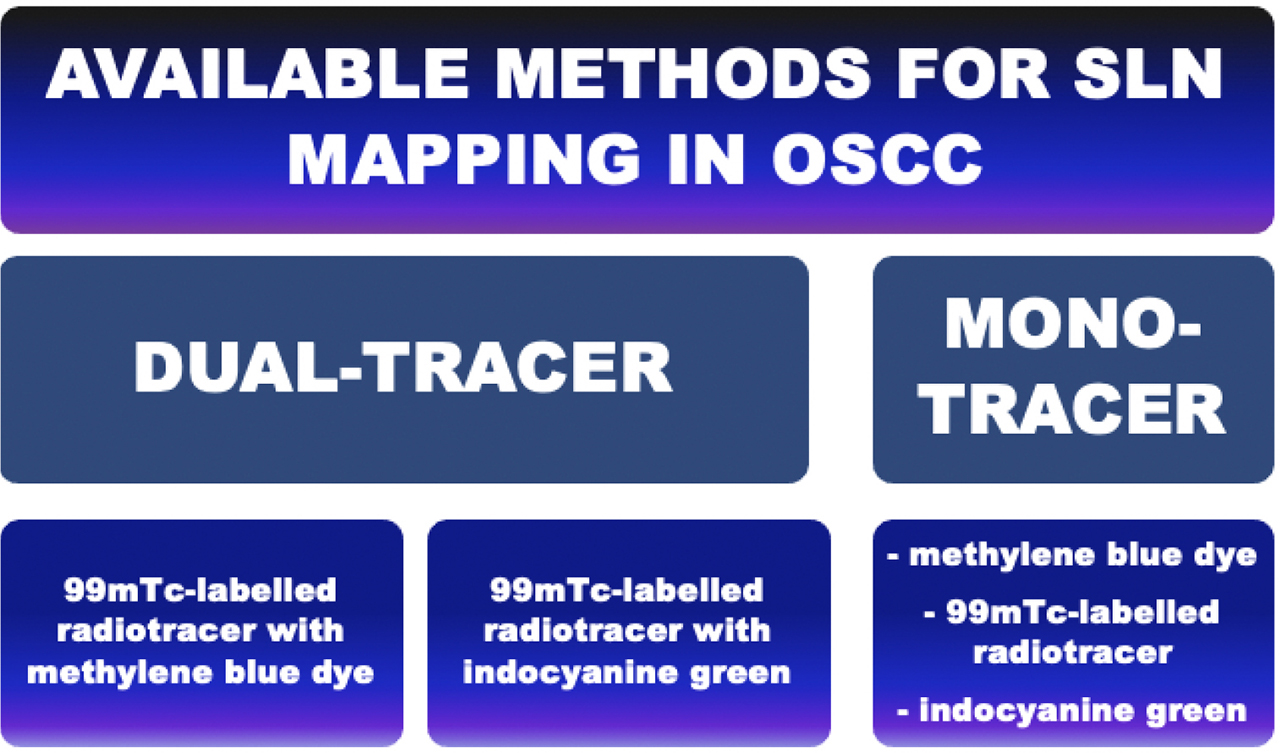
Fig. 1
Available methods for SLN mapping in OSCC
Table 2
Overview of new tracers which can be administered around the primary tumor in order to map SLNs and possibilities of their preoperative and intraoperative detection
| Tracer | Preoperative SLNs detection | Intraoperative SLNs detection |
|---|---|---|
| Gadolinium-based paramagnetic contrast agent [Gd3+] | MR lymphography | - |
| Superparamagnetic iron oxide nanoparticle (SPIO) | MR lymphography | magnetomer |
| Iodine-based contrast agent | CT lymphography | - |
| [89 Zr] – nanocolloid positron emitting radiotracer | PET lymphoscintigraphy | PET-probe |