
INTRODUCTION
Plant-derived phytocompounds exhibit broad-spectrum pharmacological activities against a wide range of pathological conditions; however, their clinical application is frequently limited by poor aqueous solubility, low membrane permeability, and transporter-mediated efflux, resulting in reduced oral bioavailability and therapeutic efficacy (Singh & Gauri, 2023). Among the strategies developed to overcome these limitations, thiolated polymers (thiomers) have attracted considerable attention due to their multifunctional properties and ability to improve mucosal drug delivery. Thiomers are hydrophilic and biocompatible polymers functionalized with covalently attached thiol groups that enhance mucoadhesion, cellular permeation, and drug residence time at biological membranes (Jain et al., 2018; Veider et al., 2024). In addition, thiomers have been reported to modulate efflux transporter activity, including P-glycoprotein (P-gp), thereby increasing the intestinal absorption of poorly permeable compounds (Leichner et al., 2019). Consequently, thiolated polymers have emerged as promising excipients for improving the bioavailability of bioactive molecules affected by transporter-mediated efflux.
Chitosan is one of the most extensively investigated polymers for pharmaceutical and biomedical applications because of its biodegradability, biocompatibility, low toxicity, and intrinsic permeation-enhancing properties (Xing et al., 2018). Owing to the presence of reactive amino groups, chitosan can be readily chemically modified to obtain derivatives with improved functional performance. Thiolated chitosan derivatives containing free thiol (-SH) groups exhibit enhanced mucoadhesion, prolonged mucosal residence time, reversible inhibition of efflux pumps, and increased epithelial permeation (Federer et al., 2021; Kafedjiiski et al., 2005). Among these derivatives, chitosan-glutathione (ch. GSH) conjugates have shown particular promise. Glutathione (GSH), a naturally occurring biocompatible tripeptide with a favorable toxicological profile, contributes to enhanced permeation-promoting and bioadhesive properties when covalently linked to chitosan (Hoyer et al., 2008; Li et al., 2011). Similarly, thiolated poly(acrylic acid) (PAA-GSH) conjugates have demonstrated improved mucoadhesive characteristics and the ability to enhance drug transport across epithelial barriers (Hoyer et al., 2008; Laffleur et al., 2017). These properties suggest that thiolated polymers may represent an effective approach for improving the intestinal delivery of compounds subjected to P-gp-mediated efflux.
Vinca alkaloids are an important class of naturally occurring indole alkaloids widely used in the treatment of cardiovascular and oncological disorders (Mendonce et al., 2025). However, their therapeutic efficacy is often limited by poor intestinal permeability and multidrug resistance mechanisms associated with the overexpression of ATP-dependent efflux transporters, particularly P-glycoprotein (P-gp) (Gherbovet et al., 2016; Iqbal et al., 2022; Mora Lagares et al., 2019; Pham et al., 2020; Zhang et al., 2017). P-gp expressed on intestinal epithelial cells actively transports various alkaloids back into the intestinal lumen, thereby reducing intracellular accumulation and oral bioavailability. Accordingly, modulation of P-gp activity represents a promising strategy to improve the absorption and pharmacological efficacy of vinca alkaloids.
“Vingerbine” is a naturally occurring anti-arrhythmic and cardiotonic alkaloid fraction isolated from the aerial parts of Vinca herbacea Waldst. et Kit., a plant widely distributed in Georgia. The plant is characterized by pronounced polymorphism, substantial variability in alkaloid composition, and diverse pharmacological activities. Isolation and characterization of vingerbine were performed at the Direction of Alkaloids, Iovel Kutateladze Institute of Pharmacochemistry, TSMU (Chkhikvadze, 1985; Chkhikvadze et al., 1981; Novikova et al., 1984; Vachnadze et al., 1971; Vachnadze et al., 1972). Vingerbine comprises four indoline alkaloids of the ajmaline series—vincarine, herbadine, herbamine, and vincamajine—each exhibiting distinct cardio- and vasotrophic activities. Pharmacological studies indicate that the therapeutic effect of vingerbine results from the complementary and synergistic activities of these alkaloids (Chkhikvadze et al., 1981; Novikova et al., 1984; Vachnadze et al., 1972). Our previous studies demonstrated that P-gp significantly contributes to the active efflux and limited intestinal permeability of vingerbine alkaloids in Caco-2 cells, suggesting that transporter-mediated efflux is one of the major factors restricting their absorption (Tsiklauri et al., 2008; Tsiklauri et al., 2023).
To the best of our knowledge, the effect of thiolated polymers on the intestinal transport of vingerbine alkaloids has not previously been investigated. Accordingly, the present study aimed to evaluate the influence of thiolated chitosan (ch. GSH) and thiolated poly(acrylic acid) (PAA-GSH) conjugates on the permeability of vingerbine alkaloids across Caco-2 cell monolayers as an in vitro intestinal barrier model (Moyer et al., 2025).
MATERIALS AND METHODS
Materials
Chitosan (medium molecular weight, ∼400 kDa; degree of deacetylation 83%–85%) was purchased from Fluka Chemical (Buchs, Switzerland). L-glutathione (reduced form, GSH), polyacrylic acid (linear, molecular weight ∼450 kDa; PAA450), phosphate buffered saline (PBS), N-(2-hydroxyethyl) piperazine-N-(2-ethanesulfonic acid) (HEPES), and minimum essential medium (MEM) were all purchased from Sigma (St. Louis, MO, USA). Dimethyl sulfoxide was obtained from Acros Organics (USA) and fetal calf serum (FCS; Cat. No. 26140-079) from Gibco (USA). All chemicals used were of analytical grade. The thiolated polymers, ch.GSH and PAA-GSH, used in this study were previously prepared and characterized as described in the literature (Kafedjiiski et al., 2005; Hoyer et al., 2008). Briefly, glutathione was covalently attached to chitosan and poly(acrylic acid) via carbodiimide-mediated coupling at polymer/GSH ratios of 1:5 and 1:2 (w/w), respectively, yielding thiolated polymer conjugates. Successful conjugation was confirmed by quantification of immobilized thiol groups and disulfide bonds using Ellman’s reagent, demonstrating the presence of reactive thiol functionalities relevant to their permeation-enhancing properties. Vingerbine (Fig. 1), a crude mixture of indoline alkaloids, was isolated from Vinca herbacea W. et Kit. according to previously described procedures (Tsiklauri et al., 2008; Vachnadze et al., 1971). The extract consists of four indoline alkaloids of the ajmaline series: vincarine (C21H24N2O3; 353.3; m.p. 264–265 °C; [α] D +13.75 ± 0.80, ethanol), vincamajine (C22H26N2O3; 366; m.p. 226–227 °C; [α]D −21 ± 0.10, chloroform), herbadine (C21H24N2O4; 368; m.p. 203–206 °C, acetone), and herbamine (C22H26N2O4; 382; m.p. 174–176 °C, acetone) (Tsiklauri et al., 2023; Vachnadze et al., 1971).
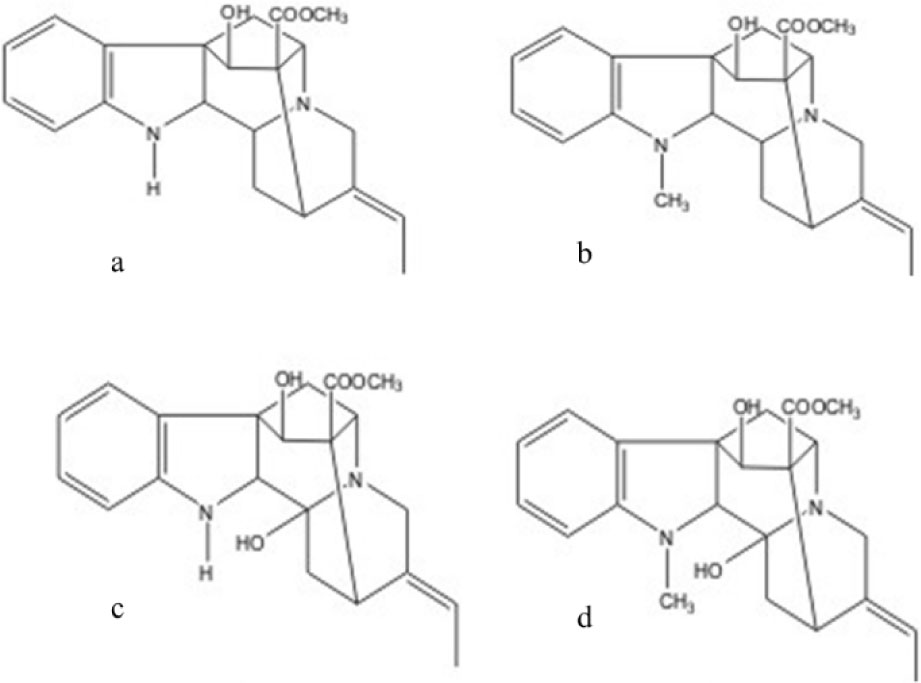
Figure 1.
Molecular structures of vingerbine alkaloids: (a) vincarine, (b) vincamajine, (c) herbadine, and (d) herbamine
Caco-2 Cells
Caco-2 cells (passage 87) were used in all experiments. Cells were seeded onto 12-well Transwell® polyester membrane inserts (0.4 μm pore size, 12 mm diameter; Costar) and cultured according to the method described by Sattler et al. (1977). The cells were maintained in MEM supplemented with 20% FCS. The culture medium was replaced 24 h after seeding and every other day thereafter, adding 0.5 mL and 1.5 mL to the apical and basolateral compartments, respectively. Cells were incubated at 37 °C in a humidified atmosphere of 95% air and 5% CO2.
Measurement of Transepithelial Electrical Resistance (TEER)
TEER was assessed to monitor the integrity and tight junction formation of Caco-2 cell monolayers during differentiation and throughout transport experiments. Before permeability testing, inserts were rinsed three times with pre-warmed Hank’s Balanced Salt Solution (HBSS) supplemented with 25 mM HEPES, adjusted to pH 7.4, and equilibrated in the same transport buffer for 60 min under standard incubation conditions (37°C, 5% CO2). TEER values were monitored hourly throughout the study using an EVOM® epithelial voltohmmeter (World Precision Instruments Inc., Sarasota, FL, USA) with paired electrodes.
Western blotting of P-gp
P-gp expression in Caco-2 cells was verified by Western blotting. Total cellular proteins were separated by SDS–PAGE and electrotransferred onto membranes. The membranes were incubated with monoclonal C219 primary antibody (1:150; Abcam), followed by horseradish peroxidase-conjugated anti-mouse IgG secondary antibody (1:1500; Amersham). Immunodetection was performed using an enhanced chemiluminescence system (Amersham Biosciences). A specific immunoreactive band at ∼170 kDa, consistent with P-gp, was observed. Densitometric analysis was carried out using 1D Image Analysis Software (Eastman Kodak).
Permeation studies
Permeation experiments were conducted using Caco-2 cell monolayers cultured for 24 days. Prior to the study, monolayers were equilibrated with PBS (pH 6.8) and subsequently incubated with HEPES buffer (pH 6.8) for 30 min at 37 °C under 5% CO2. Monolayer integrity was confirmed by TEER measurements.
Permeation was initiated by replacing the HEPES solution (1.45 g NaCl, 0.42 g NaHCO3, 0.72 g glucose, 74.5 mg KCl, 59.4 mg MgSO4, and 953.2 mg HEPES in 100 mL demineralized H2O; pH 6.8) with the same buffer containing 0.02% (w/v) vingerbine, either alone or in combination with 0.5% (w/v) GSH, 0.5% (w/v) ch.GSH, or 0.5% (w/v) PAA-GSH conjugates. Samples (200 μL) were collected from the receiver compartment at 60-min intervals over 3 h and replaced with fresh buffer. Following centrifugation (13,000 rpm, 5 min), 50 μL of the supernatant was analyzed by HPLC.
Analytical Method
Permeated vinca alkaloids were quantified according to the previously described procedures (Tsiklauri et al., 2008). Briefly, analyses were performed using an HPLC system (Merck Hitachi ELITE LaChrom) equipped with an L-2200 autosampler, L-2130 pump, L-2450 diode array detector, and L-2480 fluorescence detector. Separation was performed on an Agilent Zorbax Eclipse XDB-C8 reversed-phase column (150 × 4.6 mm i.d., 5 μm) maintained at 25 °C.
The mobile phase consisted of 0.1% triethylamine (solvent A) and methanol (solvent B) under gradient elution conditions as follows: 0–40 min, linear gradient from 50:50 to 30:70 (A:B); 40–50 min, isocratic elution at 10:90 (A:B); and 50–60 min, isocratic elution at 50:50 (A:B) for column re-equilibration. The flow rate was 0.8 mL/min, and the injection volume was 50 μL. Alkaloids were detected at 280 nm. No interference from Caco-2 cellular components was observed. Compound identification was performed using a combined HPLC–MS approach. Alkaloids were identified based on chromatographic retention behavior and characteristic MS fragmentation patterns, enabling reliable differentiation of the structurally related indoline alkaloids present in vingerbine (Tsiklauri et al., 2023; Zhou et al., 2005).
Calculations
TEER was determined according to the following equation (Amidon et al., 1995):
where the TEERtotal represents the resistance of the insert with the cell monolayer, TEERblank corresponds to the resistance of the medium-filled blank insert, and A is membrane surface area (1.13 cm2).The apparent permeability coefficient (Papp, cm/s), expressed in cm/s, was calculated using the following formula (Artursson et al., 1990):
where ΔQ/Δt is the permeability rate of the investigational compound (μg/s), A is the surface area of the cell monolayer (cm2), and C0 is the initial concentration in the donor chamber (μg /mL).The percentage transport was calculated by relating the amount of alkaloid appearing in the receiver compartment to the initial concentration in the donor compartment ×100. Permeation was monitored for 3 h.
Statistical Data Analysis
Experiments were performed in triplicate using independent biological replicates. Data are presented as mean ± standard error of the mean (SEM). Statistical analysis was performed using one-way ANOVA followed by Dunnett’s post hoc test versus control. P < 0.05 was considered statistically significant.
RESULTS AND DISCUSSION
Only Caco-2 monolayers exhibiting TEER values between 500 and 600 Ω·cm2 were selected for the experiments, ensuring the formation of tight and differentiated epithelial barriers. TEER measurements obtained following completion of the transport experiments remained comparable to baseline values, confirming the maintenance of monolayer integrity throughout the assay period. Importantly, none of the tested formulations induced statistically significant changes in TEER, indicating that the experimental conditions and polymeric systems did not adversely affect epithelial barrier function.
Western blot analysis confirmed the expression of P-gp in Caco-2 cells, as evidenced by the presence of a distinct immunoreactive band at the expected molecular weight (Fig. 2), validating the model for transporter-related permeability studies.
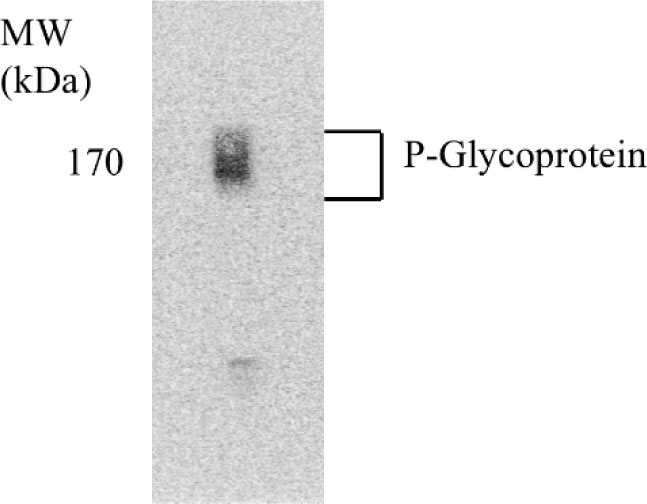
Figure 2.
Western blot analysis of P-gp (170 kDa) expression in cultured Caco-2 cells
Vingerbine, a hydrophilic, weakly cationic crude alkaloid extract isolated from Vinca herbacea W. et Kit., consists of four indoline alkaloids of the ajmaline series: vincarine, herbadine, vincamajine, and herbamine. Previous permeability studies have demonstrated that structurally related indoline alkaloids with comparable physicochemical properties exhibit distinct interactions with intestinal efflux mechanisms in Caco-2 cell monolayers. In particular, vincarine and herbadine (N–H) show transport behavior consistent with P-gp-mediated efflux, whereas herbamine and vincamajine (N–CH3) are less affected by P-gp/MDR1 activity. Lipophilicity has further been identified as a contributing determinant of transporter affinity, with the more hydrophobic vincarine exhibiting the strongest interaction with P-gp (Tsiklauri et al., 2008; Tsiklauri et al., 2023).
Based on these established structure–transport relationships, the present study quantified the transepithelial transport of vincarine, herbadine, and herbamine as representatives of distinct P-gp-associated permeability phenotypes. Vincamajine was excluded due to its previously demonstrated permeability profile, which closely parallels that of herbamine; accordingly, herbamine was selected as a representative N-methylated analogue.
Within this framework, the present work investigated the modulatory effects of thiolated polymer systems on alkaloid transepithelial transport using an in vitro Caco-2 cell monolayer model. The influence of free GSH, Ch–GSH, and PAA–GSH on apical-to-basolateral permeability was evaluated at 37 °C under controlled conditions (Table 1, Fig. 3).
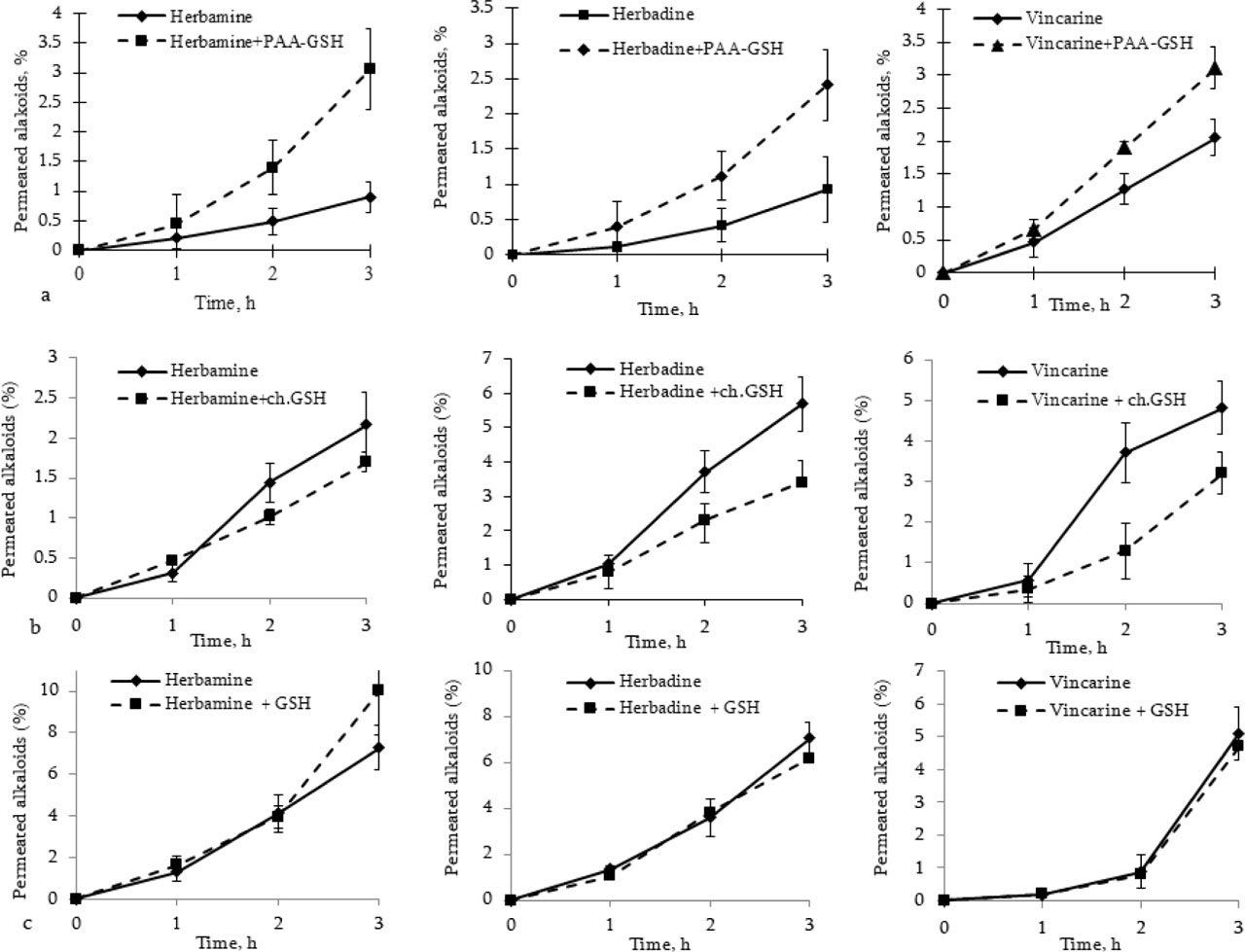
Figure 3.
Effect of PAA-GSH (a), ch.GSH (b), and GSH (c) on the transepithelial transport of vingerbine alkaloids across Caco-2 cell monolayers. Values are expressed as mean ± SD of at least three independent experiments
Table 1.
Apparent permeability (Papp ± SD, n = 3) of vingerbine alkaloids across Caco-2 cell monolayers during apical-to-basolateral (A→B) transport, with and without the indicated polymers
| Apical-to-basolateral compartment | No polymer | GSH | ch.GSH | PAA-GSH |
|---|---|---|---|---|
| Papp × 10−6 (cm/s) | ||||
| Herbamine | 4.70±0.03 | 6.44 ± 0.01 | 3.68 ± 0.12 | 15.98 ± 0.46 |
| Herbadine | 6.20±0.02 | 5.64 ± 0.07 | 3.71±0.04 | 16.05 ± 0.35 |
| Vincarine | 4.20±0.02 | 3.86±0.09 | 2.78 ± 0.14 | 6.38 ± 0.03 |
Among the investigated formulations, PAA-GSH conjugates significantly enhanced the apical-to-basolateral transport of all tested alkaloids (p < 0.05; Table 1, Fig. 3A). This permeation-enhancing effect is likely mediated by thiol-induced modulation of epithelial barrier integrity and potential inhibition of efflux transporters. Thiolated poly(acrylic acid) derivatives are known to interact with cysteine-rich domains of membrane-associated proteins, resulting in reversible loosening of tight junctions and subsequent enhancement of paracellular transport (Laffleur et al., 2017; Zhang et al., 2018). This mechanism is consistent with the increased absorptive flux observed in the present study. Importantly, the magnitude of permeability enhancement was compound-dependent. Herbamine exhibited the most pronounced increase in permeability (3.4-fold), suggesting limited susceptibility to P-gp-mediated efflux and efficient utilization of the transient increase in paracellular permeability induced by PAA-GSH.
In contrast, vincarine demonstrated a comparatively lower enhancement (1.52-fold), likely attributable to its higher lipophilicity and stronger affinity for P-gp, which may partially offset the contribution of enhanced paracellular transport. Herbadine displayed an intermediate response (2.59-fold), indicating moderate sensitivity to tight junction modulation combined with partial involvement of active efflux mechanisms. Collectively, these findings suggest that the permeation-enhancing efficiency of PAA-GSH is governed by the combined influence of transient paracellular pathway modulation and compound-specific susceptibility to efflux transporter-mediated transport.
Conversely, ch.GSH reduced the absorptive transport of vingerbine alkaloids, decreasing the permeability of herbamine, herbadine, and vincarine by 1.28-, 1.67-, and 1.51-fold, respectively (Table 1, Fig. 3B). This effect is likely related to the polycationic nature of chitosan, whose protonated amino groups can form electrostatic interactions with the cationic nitrogen-containing alkaloids. In addition, hydrogen bonding and hydrophobic interactions may promote partial complexation of the alkaloids within the ch.GSH matrix, thereby reducing the fraction of freely diffusible compounds available for transepithelial transport. The mucoadhesive and membrane-interactive properties of chitosan derivatives may further contribute to enhanced retention of the alkaloids at the epithelial surface, ultimately limiting their effective diffusion across the Caco-2 monolayer. Notably, the magnitude of permeability reduction differed among the investigated alkaloids, indicating structure-dependent polymer–drug interactions. The more pronounced decrease observed for herbadine and vincarine suggests stronger affinity toward the chitosan-based carrier system, potentially associated with increased hydrophobicity and greater involvement of transporter-mediated processes, whereas the comparatively smaller reduction observed for herbamine may reflect weaker polymer interactions and higher diffusional mobility (Tsiklauri et al., 2008; Tsiklauri et al., 2023).
Free GSH did not induce statistically significant changes in the permeability of herbadine or vincarine compared with the corresponding control compounds. The respective Papp values remained comparable to controls (Table 1, Fig. 3C), indicating that low-molecular-weight GSH alone is insufficient to substantially modulate epithelial barrier integrity or transporter activity under the applied experimental conditions. Unlike thiolated polymer conjugates, free GSH lacks the macromolecular architecture and multivalent thiol presentation necessary for sustained interaction with tight junction-associated proteins and membrane transport processes.
In contrast, herbamine exhibited a modest yet statistically significant increase in apical-to-basolateral flux (1.38-fold) and overall permeability (1.25-fold), indicating a compound-specific response. This effect may be attributed to subtle redox-mediated actions of GSH at the epithelial interface, potentially influencing the thiol-disulfide equilibrium of tight junction-associated proteins or weakly modulating efflux transporter activity. Given the comparatively lower contribution of P-glycoprotein-mediated transport to herbamine permeability relative to vincarine, even minor alterations in paracellular permeability or efflux function may result in measurable enhancement of absorptive transport.
Neither free GSH nor PAA–GSH produced statistically significant alterations in the basolateral transport of the investigated alkaloids compared with the corresponding control compounds (Table 2). Consistently, the calculated efflux modulation ratio (EMR) values remained close to unity, indicating only minimal effects on efflux-associated transport mechanisms.
Table 2.
Influence of indicated thiolated polymers on vingerbine alkaloid efflux across Caco-2 cell
| Vingerbine alkaloids | GSH | PAA-GSH |
|---|---|---|
| EMR* | ||
| Herbamine | 1.01 ± 0.28 | 0.99 ± 0.26 |
| Herbadine | 0.96 ± 0.18 | 0.94 ± 0.02 |
| Vincarine | 0.92 ± 0.09 | 0.97 ± 0.09 |
In contrast, ch.GSH exhibited a pronounced efflux-modulating effect. Basolateral-to-apical transport was reduced by 1.25-, 2.79-, and 2.80-fold for herbamine, herbadine, and vincarine, respectively (Fig. 4), indicating reduced drug availability for efflux-mediated transport. This effect is most likely associated with polymer–drug complex formation rather than direct P-gp inhibition. The stronger modulation observed for herbadine and vincarine is consistent with their reported P-gp-associated transport behavior related to the presence of an unsubstituted nitrogen atom (N–H), which favors basolateral-to-apical efflux (Tsiklauri et al., 2008; Tsiklauri et al., 2023). In contrast, herbamine, containing an N–CH3 group, appears less dependent on P-gp/MDR1-mediated transport, explaining its comparatively weaker response. The greater reduction observed for herbadine and vincarine may additionally reflect stronger polymer affinity and/or greater involvement in transporter-mediated transport pathways compared with herbamine.
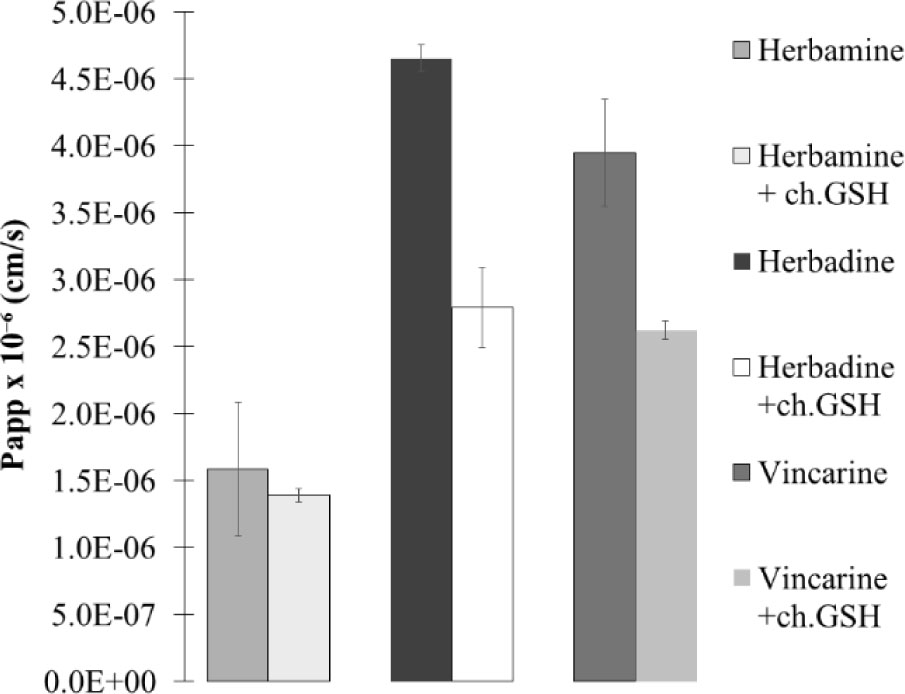
Figure 4.
Effect of ch.GSH conjugates on the apparent permeability (Papp) of vingerbine alkaloids across Caco-2 cell monolayers in the basolateral-to-apical (B→A) direction. Values represent the mean ± SD of at least three independent experiments
CONCLUSION
Thiolated polymers differentially modulated the intestinal permeability of vingerbine alkaloids. PAA-GSH conjugates significantly enhanced absorptive transport, most likely through reversible thiol-mediated tight junction modulation. In contrast, ch.GSH reduced both absorptive and basolateral transport probably due to polymer–drug interactions and increased drug retention. Free GSH showed minimal effects. These findings highlight PAA-GSH as a promising carrier for improving intestinal delivery of vingerbine alkaloids. Future studies will focus on the development of optimized polymer-based delivery systems to further improve the bioavailability and therapeutic efficacy of this anti-arrhythmic agent.
ACKNOWLEDGMENTS
L. Tsiklauri thanks the Austrian Development Cooperation (OeAD) for financial support.
Notes
[2] Contributed by AUTHOR CONTRIBUTIONS
Experimental work and original draft preparation were performed by L. Tsiklauri. Vingerbine was provided by V. Vachnadze. Project administration and manuscript proofreading were conducted by A. Bernkop-Schnürch. All authors reviewed and approved the final manuscript.