
Table 1
The influence of tinctures prepared from Ocimum americanum herb on the spontaneous behavior of rats in the open field test (n = 6).
| Group | Number of squares crossed | Tentative research activity | Indicators of anxiety (emotional reactions) | |||
|---|---|---|---|---|---|---|
| Vertical racks | Examined holes | Defecations | Urinations | Grooming | ||
| Control | 32.61 ± 2.29 | 9.52 ± 0.89 | 5.21 ± 0.47 | 1.03 ± 0.1 | 0.51 ± 0.05 | 2.32 ± 0.21 |
| OAT | 29.17 ± 1.09 | 8.83 ± 0.28 | 4.83 ± 0.35 | 0.67 ± 0.091 | 0.5 ± 0.05 | 2.33 ± 0.24 |
| OATEs | 26.0 ± 1.021 | 8.0 ± 0.421 | 4.5 ± 0.21 | 0.5 ± 0.051 | 0.33 ± 0.021,2 | 2.17 ± 0.19 |
| Diazepam | 18.5 ± 0.541 | 6.5 ± 0.181 | 3.17 ± 0.091 | 0.5 ± 0.021 | 01 | 1.17 ± 0.041 |
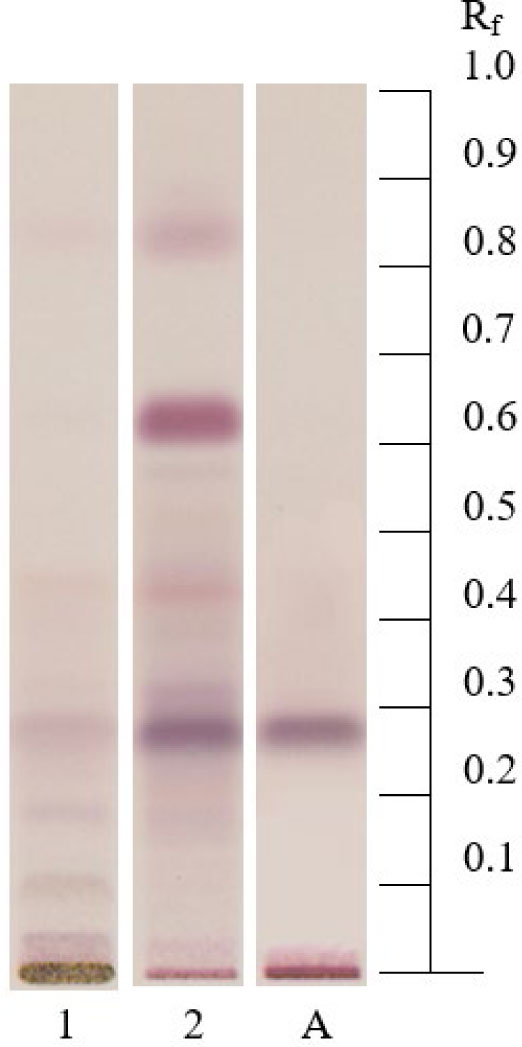
Figure 1
HPTLC chromatograms of the OATEs (1), Ocimum americanum essential oil (2), and linalool standard (A) after the derivatization with anisaldehyde solution at day light. Mobile phase: ethyl acetate – toluene (5:95).
Table 2
The results of HPTLC analyses of biologically active compounds in OATEs.
| Compound | Rf value | Colour | Presence in OATEs | Presence in essential oil of O. americanum |
|---|---|---|---|---|
| Method A | ||||
| Unknown compound | 0.03 | Violet | + | − |
| Unknown compound | 0.11 | Violet | + | − |
| Unknown compound | 0.19 | Violet | + | − |
| Linalool | 0.29 | Violet | + | + |
| Unknown compound | 0.85 | Violet | + | + |
| Method B | ||||
| Rutin | 0.09 | Yellow | + | * |
| Unknown compound | 0.14 | Blue | + | * |
| Unknown compound | 0.27 | Yellow | + | * |
| Unknown compound | 0.29 | Blue | + | * |
| Unknown compound | 0.43 | Dark blue | + | * |
| Unknown compound | 0.64 | Blue | + | * |
| Rosmarinic acid | 0.75 | Blue | + | * |
| Caffeic acid | 0.79 | Blue | + | * |
[i] Notation. ‘+’ compound is presented; * – parameter was not studied
Table 3
The robustness testing for the identification of linalool in OATEs by HPTLC.
| Indicator | Level of changes | Rf variability (RSD, %) |
|---|---|---|
| Mobile phase composition (ethyl acetate – toluene, V/V) | 5:95 | 0.6 |
| 5.2:95 | 1.3 | |
| 4.8:95 | 0.8 | |
| Development distance, cm | 8 | 1.3 |
| 18 | 1.8 | |
| Chamber | 3 different containers | 1.3 |
| Analysts | 2 different analysts | 0.8 |
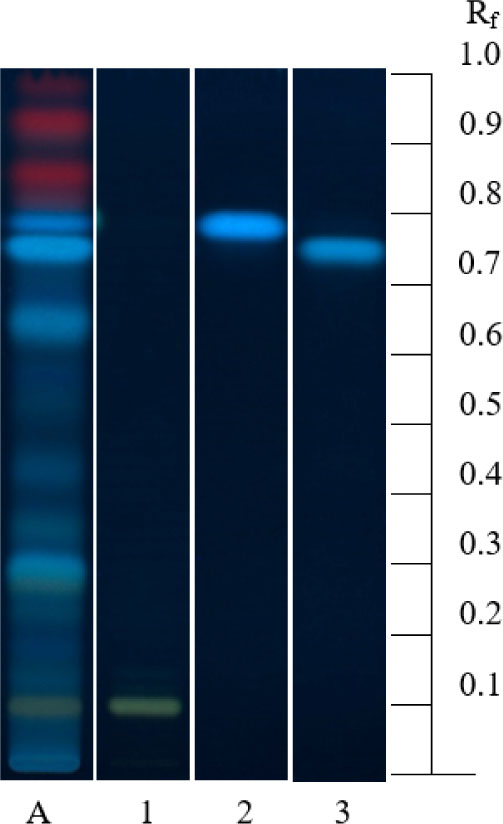
Figure 2
HPTLC chromatograms of the OATEs (A) and polyphenols standards (1 – rutin; 2 – caffeic acid; 3 – RA) after the derivatization with 1% methanolic AlCl3 at λ=366 nm. Mobile phase: ethyl acetate – formic acid – water (15:1:1).
Table 4
The robustness testing of RA identification in OATEs by HPTLC.
| Indicator | Level of changes | Rf variability (RSD, %) |
|---|---|---|
| Mobile phase composition (ethyl acetate – formic acid – water, V/V) | 15:1:1 | 0.8 |
| 15:1.05:1 | 1.3 | |
| 15:0.95:1 | 1.7 | |
| 15:1:1.05 | 1.3 | |
| 15:1:0.95 | 1.3 | |
| Development distance, cm | 8 | 0.8 |
| 18 | 1.3 | |
| Chamber | 3 different containers | 1.7 |
| Analysts | 2 different analysts | 0.6 |
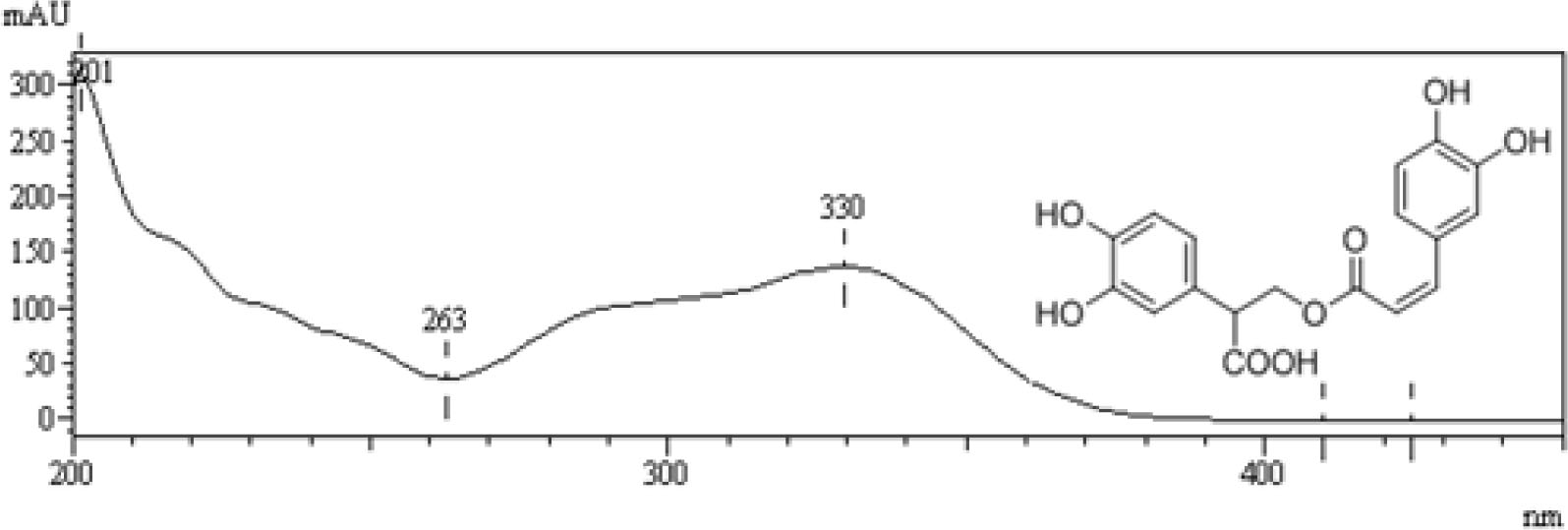
Figure 3
UV absorption spectrum of RA in the HPLC method
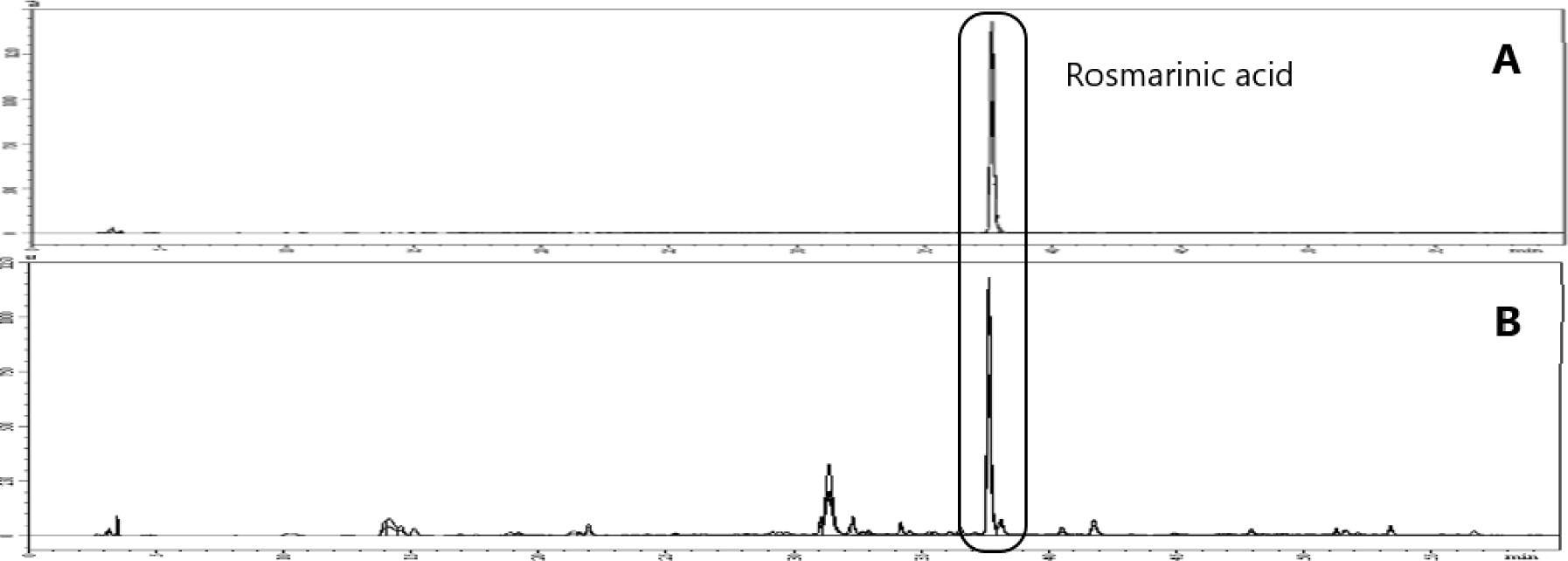
Figure 4
HPLC chromatogram of the RA standard solution (A) and OATEs (B) (λ=330 nm)
Table 5
The system suitability parameters for the determination of RA by HPLC.
| Standard | Retention time (Rt) | Tailing factor (T) | Theoretical plates (N) |
|---|---|---|---|
| Rosmarinic acid | 38.0 | 1.2 | 2399586 |
Table 6
The linearity, regression equation, limit of detection, limit of quantitation, precision parameters of RA standard in the HPLC analysis.
| Standard | Linearity range [μg/ml] | Regression equation | R2 | LOD [μg/ml] | LOQ [μg/ml] | RSD [%] | |
|---|---|---|---|---|---|---|---|
| Inter-day | Intra-day | ||||||
| Rosmarinic acid | 5–50 | Y = 0.235x + 0.164 | 0.9998 | 0.005 | 0.015 | 0.16 | 0.04 |